
100,000 Whys for Kids: A Full-Color Visual Encyclopedia of Big Questions, Clear Answers
Paperback
• 120 Pages
• USD 19.97
• English
• 9798197547286
No ratings yet
| Publisher | Independently Published |
|---|---|
| ISBN13 | 9798197547286 |
| ASIN/SKU | B0H2B1DH6L |
| Book Format | Paperback |
| Language | English |
| Pages | 120 |
| List Price | USD 19.97 |
| Publishing Date | 08/05/2026 |
| Dimensions | 8.5 x 0.28 x 11 inches |
| Weight | 11.3 ounces |
| Book Code | BD00054652 |
Buy this Book
Amazon Stores
Ebook Stores
Other Stores
Discover 100,000 Whys for Kids: A Full-Color Visual Encyclopedia of Big Questions, Clear Answers by Elliott Wonder. This book is published by Independently Published in Paperback format, ISBN 9798197547286, ASIN B0H2B1DH6L, under Children's Books, Encyclopedias, Childrens.
Book Description
A Full-color visual encyclopedia for kids who ask big questions about everything.
Most kids’ fact books give short answers, tiny pictures, or long blocks of text. This book is different. Every page is built around one clear WHY question, one simple explanation, full-color infographic artwork, quick facts, at-a-glance notes, and common myths.
Why are flamingos pink? Why does the Moon change shape? Why do volcanoes erupt? Why does popcorn pop? Why do computers use only 1s and 0s?
It is designed for curious readers ages 6 to 13 who want to understand how the world works, not just memorize facts.
Inside, kids will explore 10 big worlds:
Animals: flamingos, zebras, owls, elephants, bees, butterflies, bats, and more
Space: Moon phases, planets, craters, astronauts, Mars, rings, and spacesuits
Planet Earth: volcanoes, earthquakes, oceans, tides, rivers, mountains, deserts, and the atmosphere
Nature: snowflakes, thunder, leaves, flowers, fog, rainbows, trees, cactuses, and sunlight
The Human Body: sneezes, hiccups, blood, teeth, sweat, goose bumps, blinking, and more
Science and How Things Work: magnets, mirrors, prisms, fire, rust, static electricity, bubbles, and sound
Food and Everyday Life: popcorn, bread, onions, cheese, apples, soda, ice cream, honey, and cooking smells
History: pyramids, early tools, writing, cities, lighthouses, ocean exploration, and ancient civilizations
Senses and Mind: sleep, dreams, yawning, taste, tickling, itching, voice recordings, and glowing animal eyes
Inventions and Everyday Tools: computers, vacuum cleaners, headphones, clocks, bike tires, shoes, paper, and squeaky doors
What makes this book different?
• Full-color visual explanations on every main page
• 100 kid-friendly WHY questions across 10 subject areas
• One-page answers that are clear, visual, and easy to browse
• Quick facts, at-a-glance summaries, and common myths
• A premium large-format design made for curious kids
• Great for read-alouds, classroom prompts, homeschooling, quiet reading, and family conversations
Each answer is written in simple, age-appropriate language. The explanations are clear enough for younger readers, but rich enough to keep older kids interested.
This is not a dense textbook. It is not a plain fact list. It is a colorful visual journey through the questions kids naturally ask.
Most kids’ fact books give short answers, tiny pictures, or long blocks of text. This book is different. Every page is built around one clear WHY question, one simple explanation, full-color infographic artwork, quick facts, at-a-glance notes, and common myths.
Why are flamingos pink? Why does the Moon change shape? Why do volcanoes erupt? Why does popcorn pop? Why do computers use only 1s and 0s?
It is designed for curious readers ages 6 to 13 who want to understand how the world works, not just memorize facts.
Inside, kids will explore 10 big worlds:
Animals: flamingos, zebras, owls, elephants, bees, butterflies, bats, and more
Space: Moon phases, planets, craters, astronauts, Mars, rings, and spacesuits
Planet Earth: volcanoes, earthquakes, oceans, tides, rivers, mountains, deserts, and the atmosphere
Nature: snowflakes, thunder, leaves, flowers, fog, rainbows, trees, cactuses, and sunlight
The Human Body: sneezes, hiccups, blood, teeth, sweat, goose bumps, blinking, and more
Science and How Things Work: magnets, mirrors, prisms, fire, rust, static electricity, bubbles, and sound
Food and Everyday Life: popcorn, bread, onions, cheese, apples, soda, ice cream, honey, and cooking smells
History: pyramids, early tools, writing, cities, lighthouses, ocean exploration, and ancient civilizations
Senses and Mind: sleep, dreams, yawning, taste, tickling, itching, voice recordings, and glowing animal eyes
Inventions and Everyday Tools: computers, vacuum cleaners, headphones, clocks, bike tires, shoes, paper, and squeaky doors
What makes this book different?
• Full-color visual explanations on every main page
• 100 kid-friendly WHY questions across 10 subject areas
• One-page answers that are clear, visual, and easy to browse
• Quick facts, at-a-glance summaries, and common myths
• A premium large-format design made for curious kids
• Great for read-alouds, classroom prompts, homeschooling, quiet reading, and family conversations
Each answer is written in simple, age-appropriate language. The explanations are clear enough for younger readers, but rich enough to keep older kids interested.
This is not a dense textbook. It is not a plain fact list. It is a colorful visual journey through the questions kids naturally ask.
Author Biography
Elliott Wonder creates visual nonfiction books for curious kids who love big questions, surprising facts, and clear answers about how the world works.
His books turn science, space, animals, nature, history, food, inventions, and everyday mysteries into colorful visual journeys that children can explore one page at a time.
Elliott believes curiosity is one of the best ways for young readers to build confidence, ask better questions, and discover the joy of learning.
His books turn science, space, animals, nature, history, food, inventions, and everyday mysteries into colorful visual journeys that children can explore one page at a time.
Elliott believes curiosity is one of the best ways for young readers to build confidence, ask better questions, and discover the joy of learning.
Editorial Reviews
Editorial Reviews will be added soon…
Book Summary
“100,000 Whys for Kids: A Full-Color Visual Encyclopedia of Big Questions, Clear Answers” by Elliott Wonder is a bright, lively, and curiosity-filled book made for children who are always asking questions about the world around them. The book works like a friendly encyclopedia, but it does not feel heavy, boring, or difficult. Instead of long textbook-style chapters, it is built around the simple questions children naturally ask every day: Why is the sky blue? Why do animals behave in certain ways? How does the human body work? Why do stars shine? How do machines help us? Through these kinds of questions, the book invites young readers to explore science, nature, space, animals, technology, history, and everyday life in a fun and easy way.
The main idea of the book is that every question matters. Children often look at the world with wonder, and this book treats that wonder as something valuable. Rather than giving short answers that stop curiosity, it gives clear explanations that encourage children to think more deeply. The answers are written in simple language, so young readers can understand them without needing an adult to explain every sentence. At the same time, the book does not talk down to children. It respects their intelligence and gives them real information in a way that feels warm, friendly, and exciting.
One of the strongest features of the book is its question-and-answer style. Each section begins with a question that sounds like something a child might actually ask. The answer then explains the idea step by step, often starting with something familiar before moving into a bigger concept. For example, a question about rain might lead into a simple explanation of clouds, water vapor, and the weather cycle. A question about the Moon might introduce gravity, orbits, and space travel. A question about the body might explain the heart, lungs, brain, bones, or senses. This structure makes the book easy to read in small pieces. A child can open it anywhere, read one or two pages, and still learn something interesting.
The book’s full-color visual style is also very important. It uses pictures, illustrations, diagrams, and colorful layouts to help explain ideas that might otherwise seem complicated. For children, images often make learning easier because they can see what the words are describing. A picture of the solar system helps explain planets better than words alone. A drawing of an animal’s body can show how it survives in its environment. A diagram of the human body can make organs and bones easier to understand. These visuals make the book feel active and engaging, almost like a guided tour through a museum of fascinating facts.
The topics in the book are wide-ranging, which gives it the feeling of a large adventure through knowledge. In the science sections, children learn about weather, light, sound, energy, plants, the Earth, and natural forces. In the nature and animal sections, they discover how living things grow, adapt, protect themselves, find food, and communicate. The space pages introduce planets, stars, the Sun, the Moon, astronauts, rockets, and the mystery of the universe. The human body sections explain how people breathe, move, think, feel, grow, and stay healthy. Technology and history topics help children understand inventions, machines, transportation, communication, discoveries, and the way human life has changed over time.
Although the book contains many facts, its purpose is not only to fill a child’s mind with information. It also teaches a way of thinking. It shows children that the world is full of patterns, causes, and connections. Things do not simply happen for no reason. Rain falls because of changes in the atmosphere. Birds migrate because of seasons and survival needs. Machines work because people have learned to use energy, design, and tools. The body heals itself through amazing natural processes. By explaining these connections, the book helps children develop curiosity, observation, and early critical thinking skills.
Another important part of the book is that it makes learning feel safe and enjoyable. Many big questions can feel confusing or even frightening to children, especially questions about storms, sickness, space, wild animals, or how the world works. This book gives calm, clear answers that can make the unknown feel less scary. When children understand something, they often feel more confident. The book turns mystery into discovery. It shows that asking “why” is not annoying or silly, but one of the best ways to learn.
The tone of the book is playful and encouraging. It feels as if a patient and knowledgeable guide is speaking directly to the reader. Instead of presenting facts in a dry way, it often adds interesting details, surprising examples, or fun facts that help children remember what they have learned. This makes it especially useful for reluctant readers or children who prefer visual learning. Because the entries are short and colorful, the book can hold a child’s attention without overwhelming them.
The book can also be enjoyed in different ways. A child can read it alone, flipping through pages based on whatever catches their eye. Parents can read it with children at bedtime or during quiet time. Teachers can use it to introduce classroom discussions or support science and general knowledge lessons. It is also useful when a child suddenly asks a question at home, in the car, at school, or while watching something outside. Instead of giving a quick answer, an adult can turn to the book and explore the topic together.
100,000 Whys for Kids is more than a collection of answers. It is a celebration of curiosity. It teaches children that the world is interesting, understandable, and worth exploring. By combining simple explanations with colorful visuals and a wide range of topics, Elliott Wonder creates a book that can spark imagination and build knowledge at the same time. It encourages children to keep asking questions, to notice the details of everyday life, and to believe that learning can be joyful. The book’s greatest value is not just in the facts it provides, but in the habit of wonder it helps children develop.
The main idea of the book is that every question matters. Children often look at the world with wonder, and this book treats that wonder as something valuable. Rather than giving short answers that stop curiosity, it gives clear explanations that encourage children to think more deeply. The answers are written in simple language, so young readers can understand them without needing an adult to explain every sentence. At the same time, the book does not talk down to children. It respects their intelligence and gives them real information in a way that feels warm, friendly, and exciting.
One of the strongest features of the book is its question-and-answer style. Each section begins with a question that sounds like something a child might actually ask. The answer then explains the idea step by step, often starting with something familiar before moving into a bigger concept. For example, a question about rain might lead into a simple explanation of clouds, water vapor, and the weather cycle. A question about the Moon might introduce gravity, orbits, and space travel. A question about the body might explain the heart, lungs, brain, bones, or senses. This structure makes the book easy to read in small pieces. A child can open it anywhere, read one or two pages, and still learn something interesting.
The book’s full-color visual style is also very important. It uses pictures, illustrations, diagrams, and colorful layouts to help explain ideas that might otherwise seem complicated. For children, images often make learning easier because they can see what the words are describing. A picture of the solar system helps explain planets better than words alone. A drawing of an animal’s body can show how it survives in its environment. A diagram of the human body can make organs and bones easier to understand. These visuals make the book feel active and engaging, almost like a guided tour through a museum of fascinating facts.
The topics in the book are wide-ranging, which gives it the feeling of a large adventure through knowledge. In the science sections, children learn about weather, light, sound, energy, plants, the Earth, and natural forces. In the nature and animal sections, they discover how living things grow, adapt, protect themselves, find food, and communicate. The space pages introduce planets, stars, the Sun, the Moon, astronauts, rockets, and the mystery of the universe. The human body sections explain how people breathe, move, think, feel, grow, and stay healthy. Technology and history topics help children understand inventions, machines, transportation, communication, discoveries, and the way human life has changed over time.
Although the book contains many facts, its purpose is not only to fill a child’s mind with information. It also teaches a way of thinking. It shows children that the world is full of patterns, causes, and connections. Things do not simply happen for no reason. Rain falls because of changes in the atmosphere. Birds migrate because of seasons and survival needs. Machines work because people have learned to use energy, design, and tools. The body heals itself through amazing natural processes. By explaining these connections, the book helps children develop curiosity, observation, and early critical thinking skills.
Another important part of the book is that it makes learning feel safe and enjoyable. Many big questions can feel confusing or even frightening to children, especially questions about storms, sickness, space, wild animals, or how the world works. This book gives calm, clear answers that can make the unknown feel less scary. When children understand something, they often feel more confident. The book turns mystery into discovery. It shows that asking “why” is not annoying or silly, but one of the best ways to learn.
The tone of the book is playful and encouraging. It feels as if a patient and knowledgeable guide is speaking directly to the reader. Instead of presenting facts in a dry way, it often adds interesting details, surprising examples, or fun facts that help children remember what they have learned. This makes it especially useful for reluctant readers or children who prefer visual learning. Because the entries are short and colorful, the book can hold a child’s attention without overwhelming them.
The book can also be enjoyed in different ways. A child can read it alone, flipping through pages based on whatever catches their eye. Parents can read it with children at bedtime or during quiet time. Teachers can use it to introduce classroom discussions or support science and general knowledge lessons. It is also useful when a child suddenly asks a question at home, in the car, at school, or while watching something outside. Instead of giving a quick answer, an adult can turn to the book and explore the topic together.
100,000 Whys for Kids is more than a collection of answers. It is a celebration of curiosity. It teaches children that the world is interesting, understandable, and worth exploring. By combining simple explanations with colorful visuals and a wide range of topics, Elliott Wonder creates a book that can spark imagination and build knowledge at the same time. It encourages children to keep asking questions, to notice the details of everyday life, and to believe that learning can be joyful. The book’s greatest value is not just in the facts it provides, but in the habit of wonder it helps children develop.
Sample Chapters
Sample Chapters will be added soon…
Reader Reviews
No reviews yet.
100,000 Whys for Kids: A Full-Color Visual Encyclopedia of Big Questions, Clear Answers
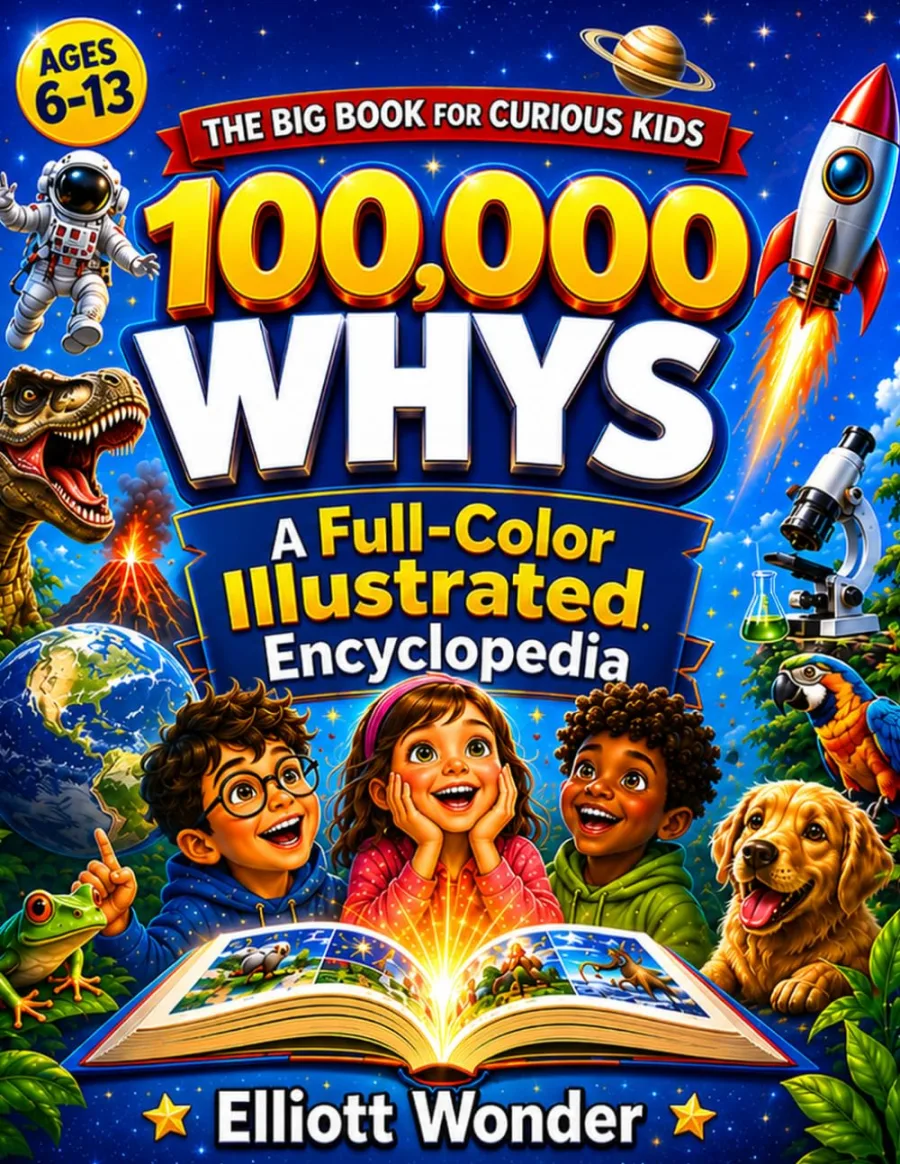
Download Cover Image
Do you want to download the full cover image for 100,000 Whys for Kids: A Full-Color Visual Encyclopedia of Big Questions, Clear Answers?