
Suicidal Empathy: Dying to Be Kind
Hardcover
• 256 Pages
• USD 32.99
• English
• 9780063446533
No ratings yet
| Publisher | Broadside Books |
|---|---|
| ISBN13 | 9780063446533 |
| ASIN/SKU | 0063446537 |
| Book Format | Hardcover |
| Language | English |
| Pages | 256 |
| List Price | USD 32.99 |
| Publishing Date | 12/05/2026 |
| Dimensions | 6 x 0.83 x 9 inches |
| Weight | 15.3 ounces |
| Book Code | BD00054680 |
Buy this Book
Amazon Stores
Ebook Stores
Other Stores
Discover Suicidal Empathy: Dying to Be Kind by Gad Saad. This book is published by Broadside Books in Hardcover format, ISBN 9780063446533, ASIN 0063446537, under History, Politics, Non Fiction.
Book Description
AN INSTANT #1 NEW YORK TIMES BESTSELLER
The bestselling author of The Parasitic Mind shows why empathy in politics leads to civilizational collapse.
What happens when a society elevates victimhood to a virtue and decides that punishment is cruel? You get the disease Dr. Gad Saad calls suicidal empathy. And the West may be terminally infected.
In his new book, Suicidal Empathy, Saad unleashes a blistering critique of maladaptively irrational altruism that has gripped our culture. This mind parasite hijacked the empathy module of our progressive elite, leading to a catastrophic miscalibration of moral priorities. The results are everywhere: from coddling violent criminals to protecting rapists to branding self-defense as toxic behavior. We are witnessing a civilization in rapid decline. Lunatic policies are instituted because we prioritize the feelings of ostensibly marginalized groups over The Truth, criminals over victims, and squatters over homeowners. This is not humane; it’s an active dismantling of the pillars that keep us safe and free.
This crisis of empathy creates a horrifying system of inverse morality where the strong and successful are demonized, and the destructive are celebrated. Just look at the insane inversions we tolerate daily: we prefer illegal migrants over our own legal citizens and veterans, permit drug addicts to threaten children’s safety in parks, and elevate transgender 'women' above biological women in sports and safe spaces. Common sense is dying in a deluge of misguided compassion.
Suicidal Empathy is your wake-up call. Stop ignoring your survival instincts in the name of political correctness. This isn't just misguided policy; it is the ultimate expression of a culture actively choosing its own demise.
The bestselling author of The Parasitic Mind shows why empathy in politics leads to civilizational collapse.
What happens when a society elevates victimhood to a virtue and decides that punishment is cruel? You get the disease Dr. Gad Saad calls suicidal empathy. And the West may be terminally infected.
In his new book, Suicidal Empathy, Saad unleashes a blistering critique of maladaptively irrational altruism that has gripped our culture. This mind parasite hijacked the empathy module of our progressive elite, leading to a catastrophic miscalibration of moral priorities. The results are everywhere: from coddling violent criminals to protecting rapists to branding self-defense as toxic behavior. We are witnessing a civilization in rapid decline. Lunatic policies are instituted because we prioritize the feelings of ostensibly marginalized groups over The Truth, criminals over victims, and squatters over homeowners. This is not humane; it’s an active dismantling of the pillars that keep us safe and free.
This crisis of empathy creates a horrifying system of inverse morality where the strong and successful are demonized, and the destructive are celebrated. Just look at the insane inversions we tolerate daily: we prefer illegal migrants over our own legal citizens and veterans, permit drug addicts to threaten children’s safety in parks, and elevate transgender 'women' above biological women in sports and safe spaces. Common sense is dying in a deluge of misguided compassion.
Suicidal Empathy is your wake-up call. Stop ignoring your survival instincts in the name of political correctness. This isn't just misguided policy; it is the ultimate expression of a culture actively choosing its own demise.
Author Biography
Dr. Gad Saad is a scholar at the Declaration of Independence Center for the Study of American Freedom at the University of Mississippi. He is also Professor of Marketing at Concordia University (Montreal, Canada), and former holder of the Concordia University Research Chair in Evolutionary Behavioral Sciences and Darwinian Consumption (2008-2018). In 2024-2025, he was a Visiting Professor and Global Ambassador at Northwood University and has previously held Visiting Associate Professorships at Cornell University, Dartmouth College, and the University of California–Irvine. Dr. Saad has been the recipient of teaching, research, and media awards.
Professor Saad pioneered the use of evolutionary psychology in marketing and consumer behavior. He has authored 75+ scientific papers, many at the intersection of evolutionary psychology and a broad range of disciplines including consumer behavior, marketing, advertising, psychology, medicine, and economics. He has authored five books and edited a sixth: The Evolutionary Bases of Consumption; The Consuming Instinct: What Juicy Burgers, Ferraris, Pornography, and Gift Giving Reveal About Human Nature; Evolutionary Psychology in the Business Sciences (edited); The Parasitic Mind: How Infectious Ideas Are Killing Common Sense; The Saad Truth about Happiness: 8 Secrets for Leading the Good Life; and Suicidal Empathy: Dying to Be Kind. His Psychology Today blog (Homo Consumericus), YouTube channel (THE SAAD TRUTH), and podcast (The Saad Truth with Dr. Saad) have garnered 7+ million, 43+ million total views, and 12+ million downloads, respectively.
He received a BSc (1988) and an MBA (1990) both from McGill University, and his MS (1993) and PhD (1994) from Cornell University.
Professor Saad pioneered the use of evolutionary psychology in marketing and consumer behavior. He has authored 75+ scientific papers, many at the intersection of evolutionary psychology and a broad range of disciplines including consumer behavior, marketing, advertising, psychology, medicine, and economics. He has authored five books and edited a sixth: The Evolutionary Bases of Consumption; The Consuming Instinct: What Juicy Burgers, Ferraris, Pornography, and Gift Giving Reveal About Human Nature; Evolutionary Psychology in the Business Sciences (edited); The Parasitic Mind: How Infectious Ideas Are Killing Common Sense; The Saad Truth about Happiness: 8 Secrets for Leading the Good Life; and Suicidal Empathy: Dying to Be Kind. His Psychology Today blog (Homo Consumericus), YouTube channel (THE SAAD TRUTH), and podcast (The Saad Truth with Dr. Saad) have garnered 7+ million, 43+ million total views, and 12+ million downloads, respectively.
He received a BSc (1988) and an MBA (1990) both from McGill University, and his MS (1993) and PhD (1994) from Cornell University.
Editorial Reviews
Editorial Reviews will be added soon…
Book Summary
Gad Saad's "Suicidal Empathy: Dying to Be Kind" tackles a counterintuitive and highly provocative idea: that our most celebrated virtue—empathy—can become a fatal flaw when detached from reason, logic, and self-preservation. As an evolutionary behavioral scientist, Saad builds on the themes of his previous work to explore how pathological altruism is eroding Western societies. He argues that while empathy is a beautiful and necessary evolutionary adaptation meant to foster cooperation and care within families and tight-knit communities, its modern, unchecked application threatens the very survival of the cultures that champion it most. The book serves as a diagnostic tool, examining how a desperate desire to be perceived as kind, compassionate, and tolerant has blinded policymakers, institutions, and ordinary citizens to the catastrophic consequences of their well-intentioned actions.
To understand the phenomenon of suicidal empathy, Saad first grounds the reader in the fundamentals of evolutionary psychology. He explains that human empathy evolved in our ancestral past to ensure the survival of kin and reciprocal allies. There was a clear, biological imperative to care for one's children, extended family, and trusted neighbors, because this mutual support ensured the continuation of shared genes and group cohesion. However, Saad points out a massive evolutionary mismatch in the modern era. Today, people are culturally pressured to extend unconditional, boundless empathy to the entire global population, including strangers who do not share their fundamental values or, in some cases, hold actively hostile intentions toward them. By stripping empathy of its natural, protective boundaries, society has created an environment where parasitic ideas and malicious actors can thrive, relentlessly exploiting the host's pathological kindness.
One of the most prominent arenas where Saad observes suicidal empathy in action is in contemporary immigration and border policies. He argues that Western nations, driven by a profound but misguided sense of collective guilt and boundless compassion, frequently adopt open-door policies without considering the long-term cultural, economic, and security impacts. Saad points out that while the impulse to help refugees and migrants is often rooted in a genuine desire to alleviate suffering, prioritizing the feelings and needs of outsiders over the safety, stability, and cultural cohesion of one’s own citizens is a form of societal self-immolation. He contends that a healthy society, much like a healthy biological organism, must have a functioning immune system—a mechanism to distinguish between what belongs and what is potentially harmful. Suicidal empathy dismantles this immune system, framing any attempt at self-preservation or border enforcement as an act of cruel bigotry.
Saad also applies his thesis to domestic issues, particularly the criminal justice system and the cultural shift away from meritocracy. He critiques the growing trend of restorative justice that prioritizes the rehabilitation and emotional well-being of violent criminals over the rights and safety of victims and the general public. By extending boundless empathy to the perpetrator while downplaying the suffering of the victim, society sends a dangerous message that diminishes the value of law, order, and personal responsibility. Furthermore, Saad explores how suicidal empathy infects academia and the corporate world through initiatives that prioritize equal outcomes over individual merit. He argues that lowering rigorous standards in fields like medicine, aviation, or engineering out of a misplaced sense of compassion for underperforming groups ultimately harms society by compromising competence, excellence, and safety.
Beyond institutional policy, Saad delves into the psychology of the individuals who champion these self-destructive ideologies. He suggests that for many, the performance of empathy has become a status symbol—a way to signal moral superiority and virtue to their peers. This performative kindness often requires no real sacrifice from the individual signaling it, yet the negative externalities are passed on to the rest of society. Saad refers to this as a luxury belief held by the elite, who can advocate for defunding the police or opening borders from the safety of affluent, gated communities. They are insulated from the immediate consequences of the policies they support, allowing their unchecked empathy to flourish at the direct expense of working-class citizens who must live with the chaotic fallout.
In concluding the book, Saad does not argue for the eradication of empathy; rather, he passionately calls for its calibration. He posits that true compassion cannot exist without truth, reason, and an unwavering commitment to reality. Empathy must be balanced with the necessary virtues of courage, logic, and a willingness to say "no." The antidote to suicidal empathy, according to Saad, is the courage to tolerate the discomfort of being called unkind by those who weaponize guilt and victimhood. He urges readers to reclaim their evolutionary right to self-preservation and to recognize that drawing boundaries is not an act of hatred, but an act of essential self-love and societal maintenance. Ultimately, the book is a forceful wake-up call, challenging readers to stop sacrificing their safety, culture, and common sense on the altar of pathological kindness.
To understand the phenomenon of suicidal empathy, Saad first grounds the reader in the fundamentals of evolutionary psychology. He explains that human empathy evolved in our ancestral past to ensure the survival of kin and reciprocal allies. There was a clear, biological imperative to care for one's children, extended family, and trusted neighbors, because this mutual support ensured the continuation of shared genes and group cohesion. However, Saad points out a massive evolutionary mismatch in the modern era. Today, people are culturally pressured to extend unconditional, boundless empathy to the entire global population, including strangers who do not share their fundamental values or, in some cases, hold actively hostile intentions toward them. By stripping empathy of its natural, protective boundaries, society has created an environment where parasitic ideas and malicious actors can thrive, relentlessly exploiting the host's pathological kindness.
One of the most prominent arenas where Saad observes suicidal empathy in action is in contemporary immigration and border policies. He argues that Western nations, driven by a profound but misguided sense of collective guilt and boundless compassion, frequently adopt open-door policies without considering the long-term cultural, economic, and security impacts. Saad points out that while the impulse to help refugees and migrants is often rooted in a genuine desire to alleviate suffering, prioritizing the feelings and needs of outsiders over the safety, stability, and cultural cohesion of one’s own citizens is a form of societal self-immolation. He contends that a healthy society, much like a healthy biological organism, must have a functioning immune system—a mechanism to distinguish between what belongs and what is potentially harmful. Suicidal empathy dismantles this immune system, framing any attempt at self-preservation or border enforcement as an act of cruel bigotry.
Saad also applies his thesis to domestic issues, particularly the criminal justice system and the cultural shift away from meritocracy. He critiques the growing trend of restorative justice that prioritizes the rehabilitation and emotional well-being of violent criminals over the rights and safety of victims and the general public. By extending boundless empathy to the perpetrator while downplaying the suffering of the victim, society sends a dangerous message that diminishes the value of law, order, and personal responsibility. Furthermore, Saad explores how suicidal empathy infects academia and the corporate world through initiatives that prioritize equal outcomes over individual merit. He argues that lowering rigorous standards in fields like medicine, aviation, or engineering out of a misplaced sense of compassion for underperforming groups ultimately harms society by compromising competence, excellence, and safety.
Beyond institutional policy, Saad delves into the psychology of the individuals who champion these self-destructive ideologies. He suggests that for many, the performance of empathy has become a status symbol—a way to signal moral superiority and virtue to their peers. This performative kindness often requires no real sacrifice from the individual signaling it, yet the negative externalities are passed on to the rest of society. Saad refers to this as a luxury belief held by the elite, who can advocate for defunding the police or opening borders from the safety of affluent, gated communities. They are insulated from the immediate consequences of the policies they support, allowing their unchecked empathy to flourish at the direct expense of working-class citizens who must live with the chaotic fallout.
In concluding the book, Saad does not argue for the eradication of empathy; rather, he passionately calls for its calibration. He posits that true compassion cannot exist without truth, reason, and an unwavering commitment to reality. Empathy must be balanced with the necessary virtues of courage, logic, and a willingness to say "no." The antidote to suicidal empathy, according to Saad, is the courage to tolerate the discomfort of being called unkind by those who weaponize guilt and victimhood. He urges readers to reclaim their evolutionary right to self-preservation and to recognize that drawing boundaries is not an act of hatred, but an act of essential self-love and societal maintenance. Ultimately, the book is a forceful wake-up call, challenging readers to stop sacrificing their safety, culture, and common sense on the altar of pathological kindness.
Sample Chapters
Sample Chapters will be added soon…
Reader Reviews
No reviews yet.
Suicidal Empathy: Dying to Be Kind
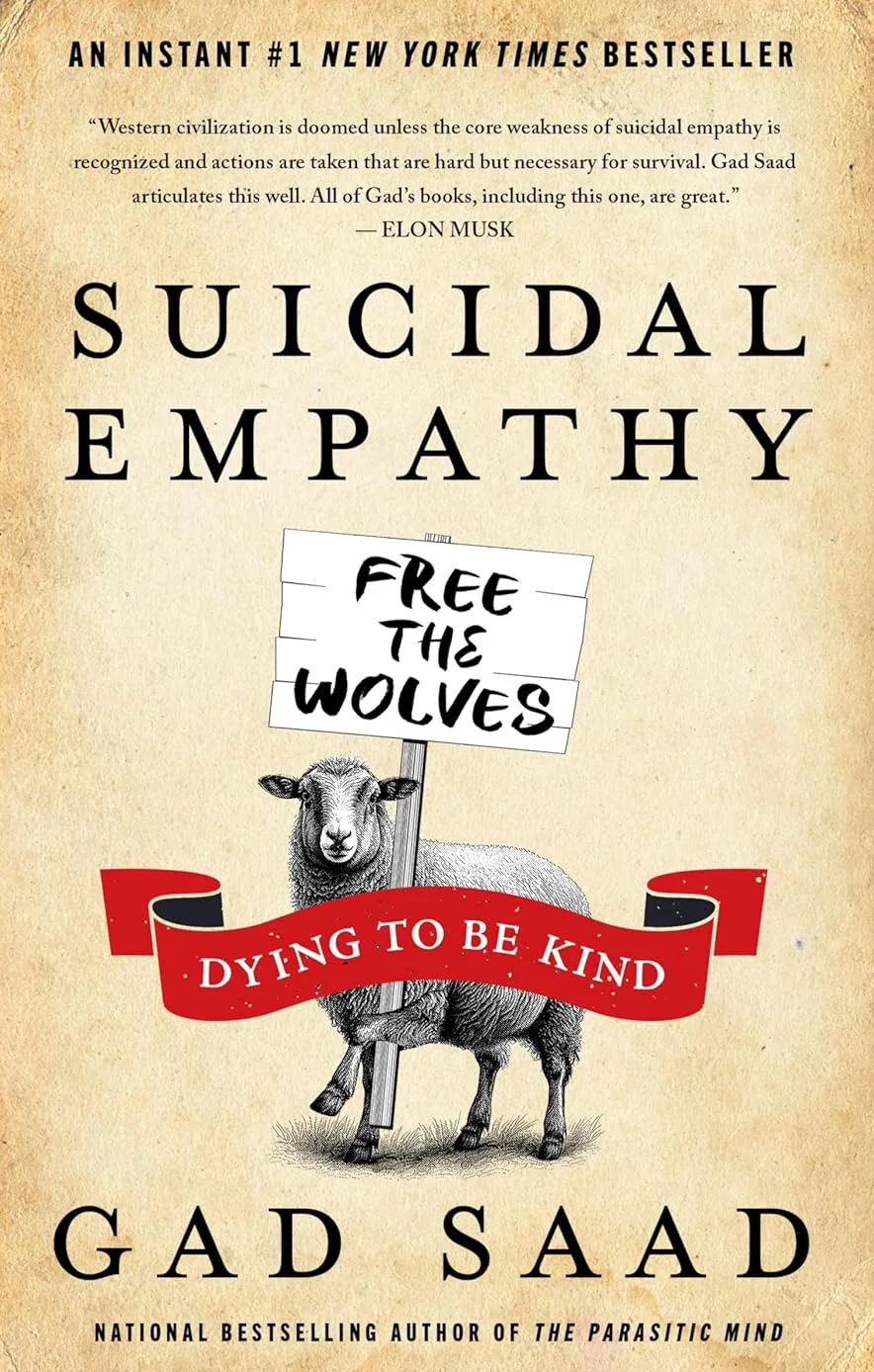
Download Cover Image
Do you want to download the full cover image for Suicidal Empathy: Dying to Be Kind?