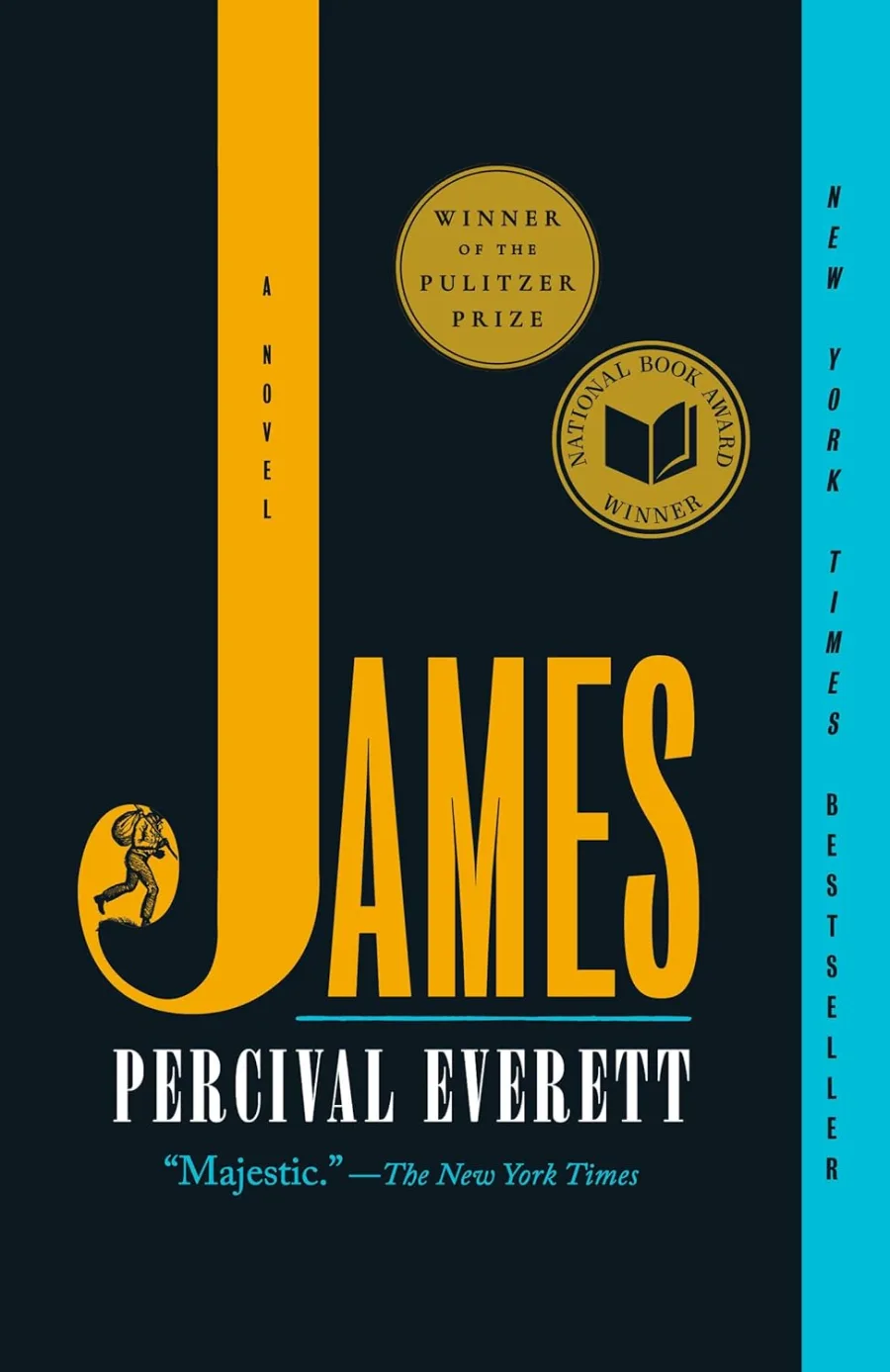
James: A Novel
Paperback
• 320 Pages
• USD 20.00
• English
• 9780593686867
No ratings yet
| Publisher | Vintage |
|---|---|
| ISBN13 | 9780593686867 |
| ASIN/SKU | 0593686861 |
| Book Format | Paperback |
| Language | English |
| Pages | 320 |
| List Price | USD 20.00 |
| Publishing Date | 21/04/2026 |
| Dimensions | 5.12 x 0.68 x 7.95 inches |
| Weight | 8 ounces |
| Book Code | BD00054702 |
Buy this Book
Amazon Stores
Ebook Stores
Other Stores
Discover James: A Novel by Percival Everett. This book is published by Vintage in Paperback format, ISBN 9780593686867, ASIN 0593686861, under Literature and Fiction, Historical Fiction, Literary.
Book Description
PULITZER PRIZE WINNER • #1 NEW YORK TIMES BESTSELLER • NATIONAL BOOK AWARD WINNER • A brilliant, action-packed reimagining of Adventures of Huckleberry Finn, both harrowing and darkly humorous, told from the enslaved Jim's point of view • In development as a feature film to be produced by Steven Spielberg
KIRKUS PRIZE WINNER • NATIONAL BOOK CRITICS CIRCLE AWARD FINALIST • SHORTLISTED FOR THE BOOKER PRIZE • A Best Book of the Year: The New York Times Book Review, LA Times, The New Yorker, The Atlantic, The Economist, TIME, and more.
"Genius"—The Atlantic • "A masterpiece that will help redefine one of the classics of American literature, while also being a major achievement on its own."—Chicago Tribune • "A provocative, enlightening literary work of art."—The Boston Globe • "Everett’s most thrilling novel, but also his most soulful."—The New York Times
When Jim overhears that he is about to be sold to a man in New Orleans, separated from his wife and daughter forever, he runs away until he can formulate a plan. Meanwhile, Huck has faked his own death to escape his violent father. As all readers of American literature know, thus begins the dangerous and transcendent journey by raft down the Mississippi River toward the elusive and unreliable promise of the Free States and beyond.
Brimming with the electrifying humor and lacerating observations that have made Everett a literary icon, this brilliant and tender novel radically illuminates Jim’s agency, intelligence, and compassion as never before. James is destined to be a major publishing event and a cornerstone of twenty-first century American literature.
KIRKUS PRIZE WINNER • NATIONAL BOOK CRITICS CIRCLE AWARD FINALIST • SHORTLISTED FOR THE BOOKER PRIZE • A Best Book of the Year: The New York Times Book Review, LA Times, The New Yorker, The Atlantic, The Economist, TIME, and more.
"Genius"—The Atlantic • "A masterpiece that will help redefine one of the classics of American literature, while also being a major achievement on its own."—Chicago Tribune • "A provocative, enlightening literary work of art."—The Boston Globe • "Everett’s most thrilling novel, but also his most soulful."—The New York Times
When Jim overhears that he is about to be sold to a man in New Orleans, separated from his wife and daughter forever, he runs away until he can formulate a plan. Meanwhile, Huck has faked his own death to escape his violent father. As all readers of American literature know, thus begins the dangerous and transcendent journey by raft down the Mississippi River toward the elusive and unreliable promise of the Free States and beyond.
Brimming with the electrifying humor and lacerating observations that have made Everett a literary icon, this brilliant and tender novel radically illuminates Jim’s agency, intelligence, and compassion as never before. James is destined to be a major publishing event and a cornerstone of twenty-first century American literature.
Author Biography
PERCIVAL EVERETT is a Distinguished Professor of English at USC and the author of Pulitzer Prize and National Book Award winner James. His other most recent books include Dr. No (finalist for the NBCC Award for Fiction and winner of the PEN/Jean Stein Book Award), The Trees (finalist for the Booker Prize and the PEN/Faulkner Award for Fiction), Telephone (finalist for the Pulitzer Prize), So Much Blue, Erasure, and I Am Not Sidney Poitier. He has received the NBCC Ivan Sandrof Life Achievement Award, The Windham Campbell Prize from Yale University, and the Stowe Prize for Literary Activism. American Fiction, the feature film based on his novel Erasure, was released in 2023 and was awarded the Academy Award for Best Adapted Screenplay. He lives in Los Angeles with his wife, the writer Danzy Senna, and their children.
Editorial Reviews
A NEW YORK TIMES BESTSELLER | WINNER OF THE NATIONAL BOOK AWARD AND THE KIRKUS PRIZE FOR FICTION
NAMED A BEST BOOK OF THE YEAR BY THE WASHINGTON POST, THE NEW YORKER, NPR, THE NEW YORK TIMES BOOK REVIEW, THE ECONOMIST, THE CHICAGO TRIBUNE, AND VANITY FAIR, AMONG OTHERS...
“The cult favorite author’s electric new work. . . James completely reimagines one-half of Finn’s famous duo, elevating him from unwitting sidekick to reluctant hero. . . Everett brings that laser-sharp wit to James, creating a radical new American adventure.”
—W Magazine
“James offers page-turning excitement but also off-kilter philosophical picaresque. . . Gripping, painful, funny, horrifying, this is multi-level entertainment, a consummate performance to the last."
—The Guardian
“Blasted clean of Twain’s characterization, Jim emerges here as a man of great dignity, altruism, and intelligence. . . Clever, soulful, and full of righteous rage, [Jim’s] long-silenced voice resounds through this remarkable novel. Subversive and thrilling, James is destined to become a modern classic.”
—Esquire
“[A] careful and thought-provoking auditing of Huckleberry Finn. . . [James is] a kind of commentary or midrash, broadening our understanding of an endangered classic by bringing out the tragedy behind the comic facade. And that is no small thing. I expect that James will be spoken of as a repudiation of Huckleberry Finn, but a book like this can only be written in a spirit of engaged devotion. More than a correction, it’s a rescue mission. And maybe this time it will work.”
—The Wall Street Journal
“Heir to Mark Twain’s satirical vision, Everett turns a boyhood memoir into a neo-fugitive slave narrative thriller. . . Using erasure, Everett has produced a daring emendation. Redacting swaths of Huck Finn, he’s revealed another code: the untranslated story of James’s self-emancipation. . . James is a provocative, enlightening work of literary art.”
—The Boston Globe
“[Everett is a] prolific genius. . . A literary jukebox. . . If anyone is poised to casually (after all, he has bills) write a masterpiece that not only becomes instant canon but also sets a brush fire to the current ones it stands upon, it’s Everett. And that’s exactly what he’s done with James.”
—Elle
"Huck Finn’ Is a Masterpiece. This Retelling Just Might Be, Too."
—The New York Times
“[A] sly response to The Adventures of Huckleberry Finn. . . While The Adventures of Huckleberry Finn lampooned American society through the naiveté of its young narrator, James critiques White racism with the sharp insight of a character who’s felt the lash...What’s most striking, ultimately, is the way James both honors and interrogates Huck Finn, along with the nation that reveres it.”
—The Washington Post
NAMED A BEST BOOK OF THE YEAR BY THE WASHINGTON POST, THE NEW YORKER, NPR, THE NEW YORK TIMES BOOK REVIEW, THE ECONOMIST, THE CHICAGO TRIBUNE, AND VANITY FAIR, AMONG OTHERS...
“The cult favorite author’s electric new work. . . James completely reimagines one-half of Finn’s famous duo, elevating him from unwitting sidekick to reluctant hero. . . Everett brings that laser-sharp wit to James, creating a radical new American adventure.”
—W Magazine
“James offers page-turning excitement but also off-kilter philosophical picaresque. . . Gripping, painful, funny, horrifying, this is multi-level entertainment, a consummate performance to the last."
—The Guardian
“Blasted clean of Twain’s characterization, Jim emerges here as a man of great dignity, altruism, and intelligence. . . Clever, soulful, and full of righteous rage, [Jim’s] long-silenced voice resounds through this remarkable novel. Subversive and thrilling, James is destined to become a modern classic.”
—Esquire
“[A] careful and thought-provoking auditing of Huckleberry Finn. . . [James is] a kind of commentary or midrash, broadening our understanding of an endangered classic by bringing out the tragedy behind the comic facade. And that is no small thing. I expect that James will be spoken of as a repudiation of Huckleberry Finn, but a book like this can only be written in a spirit of engaged devotion. More than a correction, it’s a rescue mission. And maybe this time it will work.”
—The Wall Street Journal
“Heir to Mark Twain’s satirical vision, Everett turns a boyhood memoir into a neo-fugitive slave narrative thriller. . . Using erasure, Everett has produced a daring emendation. Redacting swaths of Huck Finn, he’s revealed another code: the untranslated story of James’s self-emancipation. . . James is a provocative, enlightening work of literary art.”
—The Boston Globe
“[Everett is a] prolific genius. . . A literary jukebox. . . If anyone is poised to casually (after all, he has bills) write a masterpiece that not only becomes instant canon but also sets a brush fire to the current ones it stands upon, it’s Everett. And that’s exactly what he’s done with James.”
—Elle
"Huck Finn’ Is a Masterpiece. This Retelling Just Might Be, Too."
—The New York Times
“[A] sly response to The Adventures of Huckleberry Finn. . . While The Adventures of Huckleberry Finn lampooned American society through the naiveté of its young narrator, James critiques White racism with the sharp insight of a character who’s felt the lash...What’s most striking, ultimately, is the way James both honors and interrogates Huck Finn, along with the nation that reveres it.”
—The Washington Post
Book Summary
James A Novel by Percival Everett is a bold, inventive retelling of Adventures of Huckleberry Finn from the perspective of Jim, the enslaved man who, in Twain’s original, is mostly seen through Huck’s eyes. Here, Jim becomes James—a fully realized, brilliant, emotionally complex man whose inner life has long been hidden beneath the mask he is forced to wear in a racist society. Everett keeps the broad outline of the original journey along the Mississippi River but transforms it into a sharper, more modern-feeling exploration of race, language, power, and survival in antebellum America. The result is both familiar and entirely new: a story you think you know, told from the one person who was never allowed to speak for himself.
At the start of the novel, James is living as an enslaved man on the plantation where Huck Finn grows up. To white people, he performs the role they expect: speaking in broken, stereotyped dialect, acting slow, simple, and harmless. But the first major twist Everett gives us is that this is a conscious performance. When no white person is present, James and the other enslaved Black people speak in educated, articulate English, discuss philosophy, strategy, and literature, and reveal the rich inner world that has always existed behind the façade. They understand that sounding “smart” or too capable would be dangerous; survival depends on convincing white people that they are less than they truly are. This gap between how James truly is and how he must appear to survive becomes a central tension of the book.
News reaches James that he is about to be sold “downriver,” likely to an even harsher fate. Already separated from his wife and child, the threat of being sent farther south and permanently cut off from any chance of family or freedom pushes him toward a desperate choice. Around the same time, Huck fakes his own death to escape his abusive father, and James seizes the opportunity to run as well. He and Huck end up together on a raft on the Mississippi, heading south, just as in Twain’s story. But in James, we see this journey from James’s point of view. Huck is still a boy—often kind and loyal in his way, but deeply shaped by the racist ideas of his time. James must navigate their relationship carefully, valuing Huck’s companionship and practical help while constantly aware that Huck has been raised to see him as property.
The river journey becomes a series of encounters with the violent absurdity of the slave-holding world. James passes through towns and plantations where brutality is ordinary and hypocrisy is thick in the air. Slavery is often justified with religion, profit, and “civilized” values, and Everett shows how hollow those justifications are. James witnesses auctions, whippings, and the casual separation of families, and he must often hide his intelligence and grief, because showing anger or resistance could cost him his life. The tone swings between dark comedy and deep tragedy; sometimes the cruelty is shown through absurd, almost surreal scenes that highlight how mad the system truly is.
As James moves downriver, he is not only running away; he is learning, observing, and sharpening his understanding of white society. He encounters con men, preachers, landowners, and everyday citizens, all participating in or benefiting from slavery in different ways. Some are openly vicious; others are “kind” in the way that still rests on ownership and paternalism. Everett gives James a clear, sharp moral and intellectual lens. James sees through their excuses and manipulations, but he must constantly decide whether to speak or stay silent. His survival depends on knowing when to play the fool and when to reveal his true self.
The novel also deepens James’s personal emotional journey. He is not just fighting for abstract freedom; he is haunted by the loss of his wife and child and driven by the hope of reunion. Memories of them appear through the book, sometimes tender, sometimes agonizing. We feel his loneliness on the raft, his sense of being unmoored from any stable place, and his yearning to be more than someone who is always running and hiding. His bond with the other enslaved people he meets—those who help him, who share information, or who show quiet acts of resistance—underscores the idea of a shared struggle and shared courage.
Huck’s role is fascinating in this retelling. To James, Huck is both companion and potential threat. He is a child taught to believe that Black people are naturally inferior and that slavery is normal, but he also has an instinctive fairness and affection that sometimes pushes against those beliefs. Everett doesn’t turn Huck into a perfect hero; instead, he remains a boy who is gradually, haltingly forced to reconsider what he has always been told. James can see Huck changing, but he also understands that one boy’s sympathy cannot erase the vast system of oppression they’re traveling through. The novel uses this relationship to explore how racism is taught, how it can be questioned, and how incomplete any “awakening” can be when the entire world is built on inequality.
Language is one of the book’s most powerful tools. By showing James and other Black characters slipping between “mask” speech and real speech, Everett exposes how the original literary tradition flattened Black voices. The caricatured dialect we know from classic literature is revealed as a survival tactic, not a natural way of speaking. Underneath it lies wit, education, and complexity. This shifts the reader’s entire sense of who Jim/James is and what was stolen from him, not just in his life, but in how his story has been told for generations. It becomes a comment on how Black characters have historically been portrayed in white-authored literature—and an act of reclamation.
As the story progresses, danger intensifies. James finds himself in situations where his freedom hangs by a thread, and where betrayal or simple bad luck could undo everything. There are moments of brutal violence and moments of quiet, devastating loss. Everett does not indulge in sensationalism; he shows the reality of slavery without softening it, but also gives James moments of humor, warmth, and dignity. The pacing builds toward critical decisions: whether James can truly escape the system that hunts him, whether he can reunite with his family, and what kind of future is even possible for someone marked as property.
By the end of James, the novel has not only retold a classic story but reshaped its meaning. James is no longer a side character in Huck’s adventure; he is the heart of the narrative—a man who thinks, feels, strategizes, and suffers within a vast, cruel system. The book makes clear that his story always mattered, even when it was pushed to the margins. Everett’s retelling highlights the intelligence, humanity, and resistance of an enslaved man who refuses to let the world define his worth, even when he must hide his true self to survive. The novel closes with a mixture of pain and hard-won clarity, asking the reader to reconsider not only Huckleberry Finn, but the entire tradition of stories about slavery and who gets to speak within them.
At the start of the novel, James is living as an enslaved man on the plantation where Huck Finn grows up. To white people, he performs the role they expect: speaking in broken, stereotyped dialect, acting slow, simple, and harmless. But the first major twist Everett gives us is that this is a conscious performance. When no white person is present, James and the other enslaved Black people speak in educated, articulate English, discuss philosophy, strategy, and literature, and reveal the rich inner world that has always existed behind the façade. They understand that sounding “smart” or too capable would be dangerous; survival depends on convincing white people that they are less than they truly are. This gap between how James truly is and how he must appear to survive becomes a central tension of the book.
News reaches James that he is about to be sold “downriver,” likely to an even harsher fate. Already separated from his wife and child, the threat of being sent farther south and permanently cut off from any chance of family or freedom pushes him toward a desperate choice. Around the same time, Huck fakes his own death to escape his abusive father, and James seizes the opportunity to run as well. He and Huck end up together on a raft on the Mississippi, heading south, just as in Twain’s story. But in James, we see this journey from James’s point of view. Huck is still a boy—often kind and loyal in his way, but deeply shaped by the racist ideas of his time. James must navigate their relationship carefully, valuing Huck’s companionship and practical help while constantly aware that Huck has been raised to see him as property.
The river journey becomes a series of encounters with the violent absurdity of the slave-holding world. James passes through towns and plantations where brutality is ordinary and hypocrisy is thick in the air. Slavery is often justified with religion, profit, and “civilized” values, and Everett shows how hollow those justifications are. James witnesses auctions, whippings, and the casual separation of families, and he must often hide his intelligence and grief, because showing anger or resistance could cost him his life. The tone swings between dark comedy and deep tragedy; sometimes the cruelty is shown through absurd, almost surreal scenes that highlight how mad the system truly is.
As James moves downriver, he is not only running away; he is learning, observing, and sharpening his understanding of white society. He encounters con men, preachers, landowners, and everyday citizens, all participating in or benefiting from slavery in different ways. Some are openly vicious; others are “kind” in the way that still rests on ownership and paternalism. Everett gives James a clear, sharp moral and intellectual lens. James sees through their excuses and manipulations, but he must constantly decide whether to speak or stay silent. His survival depends on knowing when to play the fool and when to reveal his true self.
The novel also deepens James’s personal emotional journey. He is not just fighting for abstract freedom; he is haunted by the loss of his wife and child and driven by the hope of reunion. Memories of them appear through the book, sometimes tender, sometimes agonizing. We feel his loneliness on the raft, his sense of being unmoored from any stable place, and his yearning to be more than someone who is always running and hiding. His bond with the other enslaved people he meets—those who help him, who share information, or who show quiet acts of resistance—underscores the idea of a shared struggle and shared courage.
Huck’s role is fascinating in this retelling. To James, Huck is both companion and potential threat. He is a child taught to believe that Black people are naturally inferior and that slavery is normal, but he also has an instinctive fairness and affection that sometimes pushes against those beliefs. Everett doesn’t turn Huck into a perfect hero; instead, he remains a boy who is gradually, haltingly forced to reconsider what he has always been told. James can see Huck changing, but he also understands that one boy’s sympathy cannot erase the vast system of oppression they’re traveling through. The novel uses this relationship to explore how racism is taught, how it can be questioned, and how incomplete any “awakening” can be when the entire world is built on inequality.
Language is one of the book’s most powerful tools. By showing James and other Black characters slipping between “mask” speech and real speech, Everett exposes how the original literary tradition flattened Black voices. The caricatured dialect we know from classic literature is revealed as a survival tactic, not a natural way of speaking. Underneath it lies wit, education, and complexity. This shifts the reader’s entire sense of who Jim/James is and what was stolen from him, not just in his life, but in how his story has been told for generations. It becomes a comment on how Black characters have historically been portrayed in white-authored literature—and an act of reclamation.
As the story progresses, danger intensifies. James finds himself in situations where his freedom hangs by a thread, and where betrayal or simple bad luck could undo everything. There are moments of brutal violence and moments of quiet, devastating loss. Everett does not indulge in sensationalism; he shows the reality of slavery without softening it, but also gives James moments of humor, warmth, and dignity. The pacing builds toward critical decisions: whether James can truly escape the system that hunts him, whether he can reunite with his family, and what kind of future is even possible for someone marked as property.
By the end of James, the novel has not only retold a classic story but reshaped its meaning. James is no longer a side character in Huck’s adventure; he is the heart of the narrative—a man who thinks, feels, strategizes, and suffers within a vast, cruel system. The book makes clear that his story always mattered, even when it was pushed to the margins. Everett’s retelling highlights the intelligence, humanity, and resistance of an enslaved man who refuses to let the world define his worth, even when he must hide his true self to survive. The novel closes with a mixture of pain and hard-won clarity, asking the reader to reconsider not only Huckleberry Finn, but the entire tradition of stories about slavery and who gets to speak within them.
Sample Chapters
Sample Chapters will be added soon…
Reader Reviews
No reviews yet.
James: A Novel