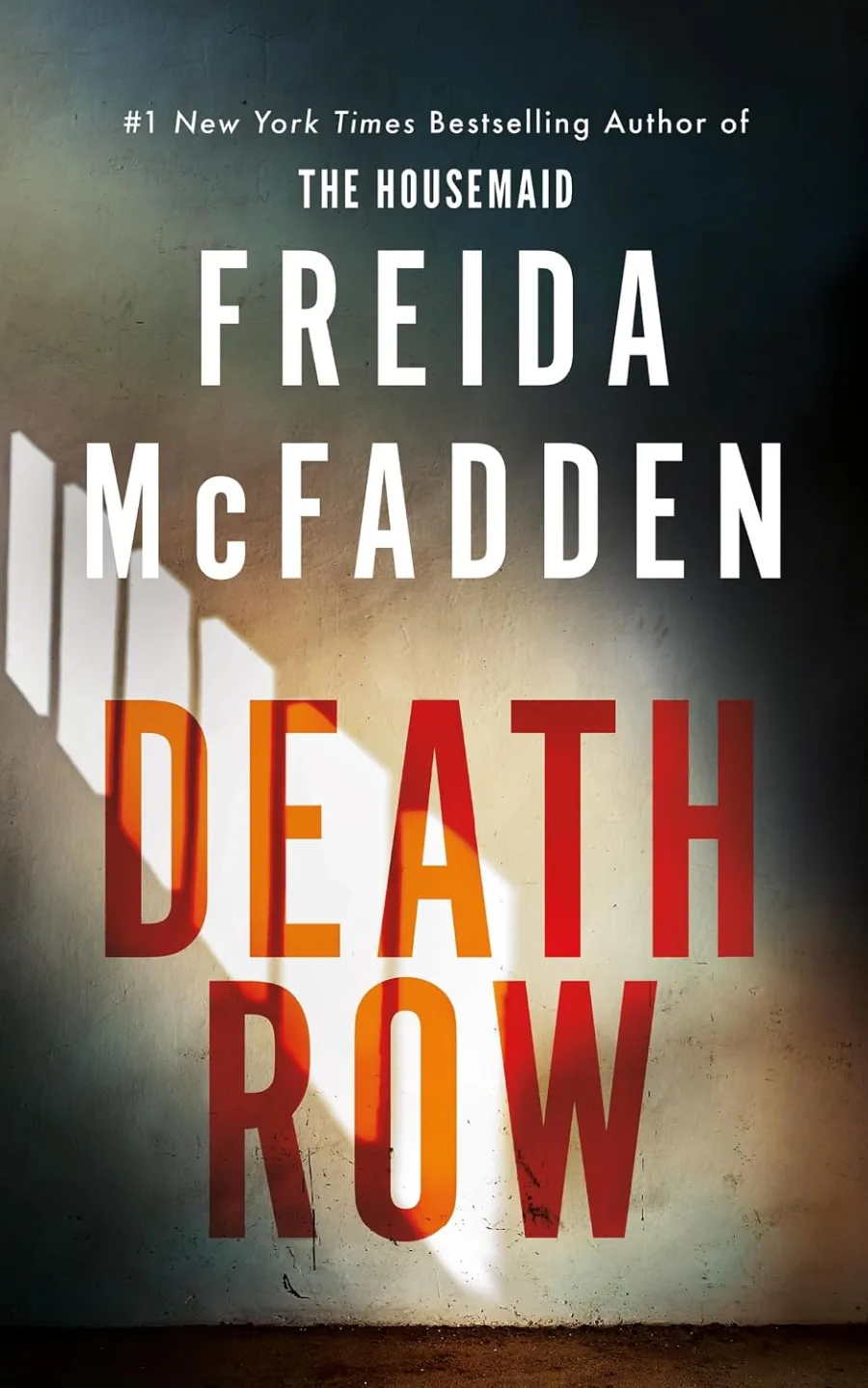
Death Row
Paperback
• 80 Pages
• USD 10.99
• English
• 9798256510381
No ratings yet
| Publisher | Poisoned Pen Press |
|---|---|
| ISBN13 | 9798256510381 |
| ASIN/SKU | B0H5DLL52B |
| Book Format | Paperback |
| Language | English |
| Pages | 80 |
| List Price | USD 10.99 |
| Publishing Date | 04/08/2026 |
| Dimensions | 5 x 0.2 x 8 inches |
| Weight | 1 pounds |
| Book Code | BD00054788 |
Buy this Book
Amazon Stores
Ebook Stores
Other Stores
Discover Death Row by Freida McFadden. This book is published by Poisoned Pen Press in Paperback format, ISBN 9798256510381, ASIN B0H5DLL52B, under Mystery, Thriller and Suspense, Thriller, Fiction.
Book Description
A thrilling novella from #1 New York Times bestselling author Freida McFadden!
Death is coming for her… unless she finds the truth first.
Talia Kemper is on death row for murdering her husband. She had an alibi and no known motive, yet Talia's unwavering protestations of innocence have always been ignored.
Then one day in the visiting area, she sees a man she's certain is her husband. The person she's been convicted of killing may not be dead after all.
But as the days tick away toward Talia's execution, what will it take for her to be believed?
With all hope of an appeal fading away, the fate of a condemned murderess takes a shocking turn in a breathtaking novella from the #1 New York Times bestselling author of The Housemaid!
Death is coming for her… unless she finds the truth first.
Talia Kemper is on death row for murdering her husband. She had an alibi and no known motive, yet Talia's unwavering protestations of innocence have always been ignored.
Then one day in the visiting area, she sees a man she's certain is her husband. The person she's been convicted of killing may not be dead after all.
But as the days tick away toward Talia's execution, what will it take for her to be believed?
With all hope of an appeal fading away, the fate of a condemned murderess takes a shocking turn in a breathtaking novella from the #1 New York Times bestselling author of The Housemaid!
Author Biography
#1 New York Times, Amazon Charts, USA Today, Washington Post, Wall Street Journal, Sunday Times, and Publisher's Weekly bestselling author Freida McFadden is a physician who has penned multiple bestselling psychological thrillers and medical humor novels. Freida is the winner of the International Thriller Writer Award for Best Paperback Original, the Goodreads Choice Award for Best Thriller, and was honored as one of TIME 100’s most influential people in the world for 2026. Her novels have been translated into more than 45 languages.
Freida lives with her family and cat in a centuries-old three-story home overlooking the ocean, with staircases that creak and moan with each step, and nobody could hear you if you scream. Unless you scream really loudly, maybe.
To hear Freida talk about herself more in the third person, check out her website freidamcfadden dot com.
Freida lives with her family and cat in a centuries-old three-story home overlooking the ocean, with staircases that creak and moan with each step, and nobody could hear you if you scream. Unless you scream really loudly, maybe.
To hear Freida talk about herself more in the third person, check out her website freidamcfadden dot com.
Editorial Reviews
Editorial Reviews will be added soon…
Book Summary
Freida McFadden’s Death Row is a fast-paced psychological thriller built around fear, uncertainty, and the question of whether truth can survive when a person’s life is almost over. Like many of McFadden’s suspense novels, the story is written in a direct, highly readable style that keeps the tension moving quickly. The novel places the reader inside a nightmare: a woman is sitting on death row, only hours away from execution, while insisting that she is innocent. From the very beginning, the book creates a sense of claustrophobia and emotional urgency. Time is running out, the system has already made its decision, and the possibility that a terrible mistake has been made hangs over every page.
The main character is Talia Kemper, a woman convicted of murdering her husband. At the start of the novel, she has exhausted every legal option and is facing the final hours before her execution. The situation is terrifying not only because of the punishment itself, but because Talia continues to maintain that she did not commit the crime. This sets up the novel’s central tension: is she telling the truth, or is she simply another convicted killer claiming innocence at the last moment? Freida McFadden plays with this uncertainty very effectively. The reader is drawn into Talia’s perspective, sharing her fear, confusion, and desperation, but the novel also leaves enough room for doubt to remain. This makes the early part of the story especially gripping, because every memory and every detail feels loaded with possible meaning.
As the novel unfolds, the narrative moves between the present moment on death row and the events that led to Talia’s conviction. Through these shifts, the reader gradually learns about her marriage, her husband’s death, and the evidence that seemed strong enough to convince a jury that she was guilty. McFadden is skilled at presenting facts in a way that feels unstable. What first appears obvious begins to look less certain, and what seems minor may turn out to be crucial. Talia’s life before prison is shown as far more complicated than the simple image presented by her conviction. Her marriage was not perfect, and there were tensions, secrets, and emotional pressures beneath the surface. These details give the novel depth beyond the immediate crisis and help show how a person’s life can be reduced and distorted by the legal system into a single, terrible accusation.
One of the strongest aspects of Death Row is the way it explores fear on multiple levels. There is the obvious fear of impending execution, which gives the novel its relentless urgency. But there is also the fear of not being believed, the fear of memory failing, and the fear that the truth may never matter once a public story has hardened into official judgment. Talia’s voice carries much of this emotional weight. Whether the reader fully trusts her or not, her terror feels immediate and real. The death row setting intensifies everything, making even ordinary reflections feel sharper because they are happening under the shadow of death. McFadden uses that setting well, keeping the reader aware that this is not just a mystery to be solved at leisure. It is a race against irreversible finality.
The novel also raises questions about justice, perception, and how easily people can be trapped by appearances. McFadden does not turn the book into a broad social or political novel, but she does make the reader think about how legal outcomes depend on narrative as much as evidence. Once someone is seen as guilty, every action can be reinterpreted through that lens. Talia’s behavior, her relationships, and even her attempts to defend herself become part of a story built against her. The thriller works in part because it shows how frightening it is to lose control over your own story. The truth may exist, but if no one listens, it becomes almost meaningless.
As more pieces of the past come into view, the book becomes less about whether something bad happened and more about what exactly happened, who shaped the version of events that reached the courtroom, and what motives may have been hidden beneath the surface. McFadden is known for twists, and Death Row follows that pattern by steadily destabilizing the reader’s assumptions. Characters who seemed trustworthy become suspicious, while details that looked settled begin to shift. The novel thrives on reversal and revelation, encouraging the reader to keep changing their mind. This is one of the reasons her books are so compulsively readable. They are designed to create momentum through uncertainty, and Death Row uses that technique very effectively.
Another compelling part of the novel is how it portrays isolation. Talia is physically isolated on death row, cut off from normal life and from meaningful hope. But she is also emotionally isolated by the fact that no one seems able, or willing, to truly understand her. Even when people are present, she remains trapped inside her own fear and memory. This isolation becomes part of the suspense. The closer she gets to execution, the more alone she feels, and the more urgent it becomes to figure out whether any path to the truth still exists. That emotional loneliness gives the story a bleak intensity that goes beyond standard mystery plotting.
McFadden keeps the prose simple and accessible, which suits the material. The writing is not heavily literary or descriptive; instead, it is clean, fast, and focused on tension. This style allows the emotional stakes and the twists to drive the reading experience. The chapters are likely structured to end in ways that push the reader onward, making the book feel difficult to put down. While the story may not dwell deeply on every psychological or legal complexity, it succeeds in doing what a thriller is meant to do: create suspense, provoke doubt, and deliver a series of revelations that reshape the reader’s understanding of what happened.
As the novel reaches its climax, the truth begins to emerge in a way that forces the reader to reconsider almost everything that came before. The final revelations are designed to be shocking, but they also fit the larger themes of manipulation, misjudgment, and hidden motive. The ending carries emotional force because the stakes have been so extreme from the beginning. By setting the mystery against the countdown to execution, McFadden ensures that every answer matters in the most literal way possible. The resolution is not just about solving a crime but about whether justice can arrive before it is too late.
Overall, Death Row is a tense and addictive thriller about innocence, guilt, and the terrifying consequences of getting the truth wrong. Freida McFadden builds the story around a powerful premise and keeps the suspense alive through shifting perspectives, buried secrets, and constant uncertainty. The novel works because it taps into a very deep fear: that a person can be judged, condemned, and destroyed while the real story remains hidden. It is a quick but emotionally charged read that combines courtroom dread, psychological tension, and last-minute revelations into a story that keeps the reader questioning everything until the very end.
The main character is Talia Kemper, a woman convicted of murdering her husband. At the start of the novel, she has exhausted every legal option and is facing the final hours before her execution. The situation is terrifying not only because of the punishment itself, but because Talia continues to maintain that she did not commit the crime. This sets up the novel’s central tension: is she telling the truth, or is she simply another convicted killer claiming innocence at the last moment? Freida McFadden plays with this uncertainty very effectively. The reader is drawn into Talia’s perspective, sharing her fear, confusion, and desperation, but the novel also leaves enough room for doubt to remain. This makes the early part of the story especially gripping, because every memory and every detail feels loaded with possible meaning.
As the novel unfolds, the narrative moves between the present moment on death row and the events that led to Talia’s conviction. Through these shifts, the reader gradually learns about her marriage, her husband’s death, and the evidence that seemed strong enough to convince a jury that she was guilty. McFadden is skilled at presenting facts in a way that feels unstable. What first appears obvious begins to look less certain, and what seems minor may turn out to be crucial. Talia’s life before prison is shown as far more complicated than the simple image presented by her conviction. Her marriage was not perfect, and there were tensions, secrets, and emotional pressures beneath the surface. These details give the novel depth beyond the immediate crisis and help show how a person’s life can be reduced and distorted by the legal system into a single, terrible accusation.
One of the strongest aspects of Death Row is the way it explores fear on multiple levels. There is the obvious fear of impending execution, which gives the novel its relentless urgency. But there is also the fear of not being believed, the fear of memory failing, and the fear that the truth may never matter once a public story has hardened into official judgment. Talia’s voice carries much of this emotional weight. Whether the reader fully trusts her or not, her terror feels immediate and real. The death row setting intensifies everything, making even ordinary reflections feel sharper because they are happening under the shadow of death. McFadden uses that setting well, keeping the reader aware that this is not just a mystery to be solved at leisure. It is a race against irreversible finality.
The novel also raises questions about justice, perception, and how easily people can be trapped by appearances. McFadden does not turn the book into a broad social or political novel, but she does make the reader think about how legal outcomes depend on narrative as much as evidence. Once someone is seen as guilty, every action can be reinterpreted through that lens. Talia’s behavior, her relationships, and even her attempts to defend herself become part of a story built against her. The thriller works in part because it shows how frightening it is to lose control over your own story. The truth may exist, but if no one listens, it becomes almost meaningless.
As more pieces of the past come into view, the book becomes less about whether something bad happened and more about what exactly happened, who shaped the version of events that reached the courtroom, and what motives may have been hidden beneath the surface. McFadden is known for twists, and Death Row follows that pattern by steadily destabilizing the reader’s assumptions. Characters who seemed trustworthy become suspicious, while details that looked settled begin to shift. The novel thrives on reversal and revelation, encouraging the reader to keep changing their mind. This is one of the reasons her books are so compulsively readable. They are designed to create momentum through uncertainty, and Death Row uses that technique very effectively.
Another compelling part of the novel is how it portrays isolation. Talia is physically isolated on death row, cut off from normal life and from meaningful hope. But she is also emotionally isolated by the fact that no one seems able, or willing, to truly understand her. Even when people are present, she remains trapped inside her own fear and memory. This isolation becomes part of the suspense. The closer she gets to execution, the more alone she feels, and the more urgent it becomes to figure out whether any path to the truth still exists. That emotional loneliness gives the story a bleak intensity that goes beyond standard mystery plotting.
McFadden keeps the prose simple and accessible, which suits the material. The writing is not heavily literary or descriptive; instead, it is clean, fast, and focused on tension. This style allows the emotional stakes and the twists to drive the reading experience. The chapters are likely structured to end in ways that push the reader onward, making the book feel difficult to put down. While the story may not dwell deeply on every psychological or legal complexity, it succeeds in doing what a thriller is meant to do: create suspense, provoke doubt, and deliver a series of revelations that reshape the reader’s understanding of what happened.
As the novel reaches its climax, the truth begins to emerge in a way that forces the reader to reconsider almost everything that came before. The final revelations are designed to be shocking, but they also fit the larger themes of manipulation, misjudgment, and hidden motive. The ending carries emotional force because the stakes have been so extreme from the beginning. By setting the mystery against the countdown to execution, McFadden ensures that every answer matters in the most literal way possible. The resolution is not just about solving a crime but about whether justice can arrive before it is too late.
Overall, Death Row is a tense and addictive thriller about innocence, guilt, and the terrifying consequences of getting the truth wrong. Freida McFadden builds the story around a powerful premise and keeps the suspense alive through shifting perspectives, buried secrets, and constant uncertainty. The novel works because it taps into a very deep fear: that a person can be judged, condemned, and destroyed while the real story remains hidden. It is a quick but emotionally charged read that combines courtroom dread, psychological tension, and last-minute revelations into a story that keeps the reader questioning everything until the very end.
Sample Chapters
Sample Chapters will be added soon…
Reader Reviews
No reviews yet.
Death Row