
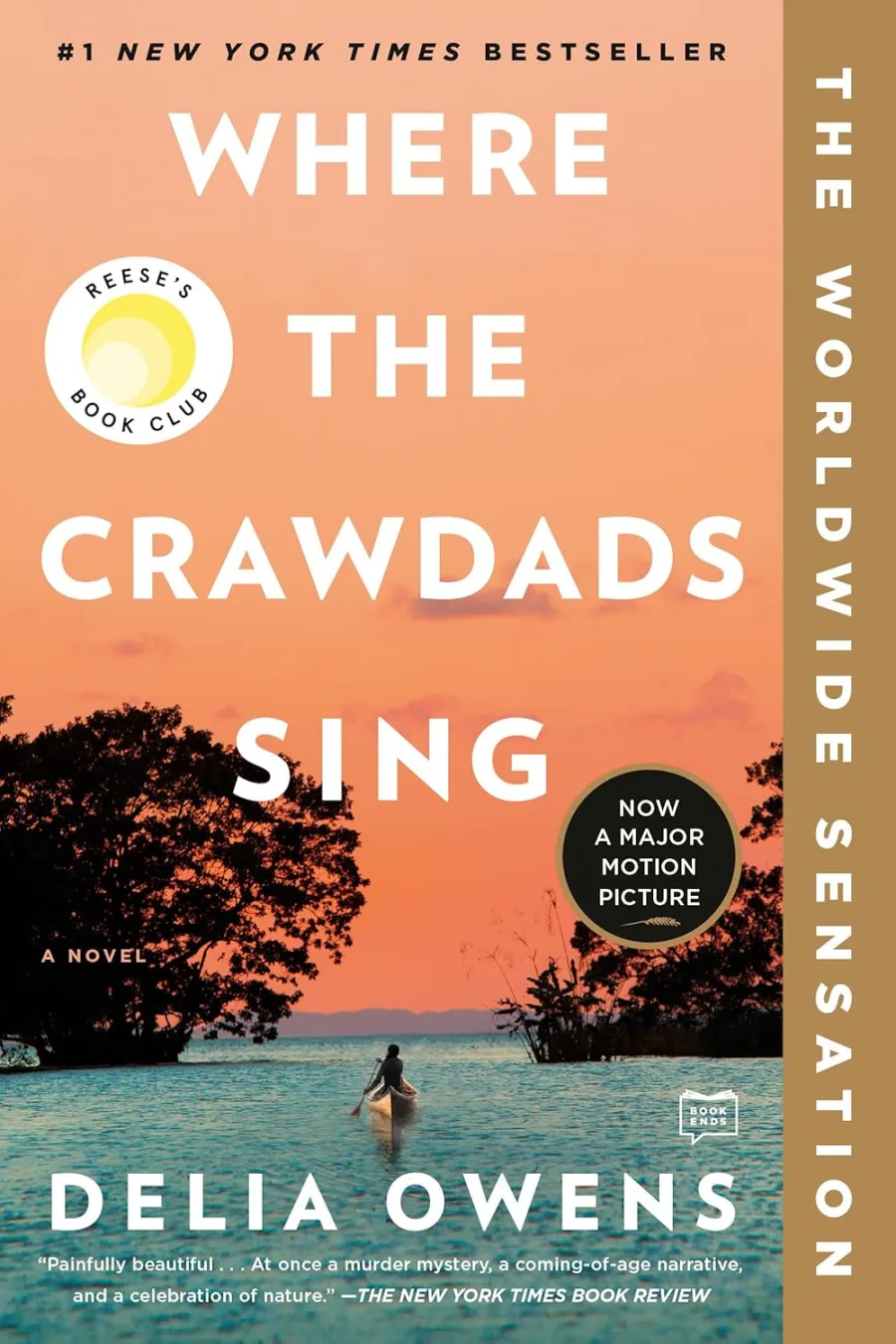
Where the Crawdads Sing
Paperback
• 400 Pages
• USD 18.00
• English
• 9780735219106
No ratings yet
| Publisher | G.P. Putnam's Sons |
|---|---|
| ISBN13 | 9780735219106 |
| ASIN/SKU | 0735219109 |
| Book Format | Paperback |
| Language | English |
| Pages | 400 |
| List Price | USD 18.00 |
| Publishing Date | 30/03/2021 |
| Dimensions | 5.47 x 0.83 x 8.21 inches |
| Weight | 2.31 pounds |
| Book Code | BD00054871 |
Buy this Book
Amazon Stores
Ebook Stores
Other Stores
Discover Where the Crawdads Sing by Delia Owens. This book is published by G.P. Putnam's Sons in Paperback format, ISBN 9780735219106, ASIN 0735219109, under Literature and Fiction, Contemporary Women Fiction, Coming of Age Fiction.
Book Description
NOW A MAJOR MOTION PICTURE—The #1 New York Times bestselling worldwide sensation with more than 18 million copies sold, hailed by The New York Times Book Review as “a painfully beautiful first novel that is at once a murder mystery, a coming-of-age narrative and a celebration of nature.”
New York Times Readers Pick: 100 Best Books of the 21st Century
For years, rumors of the “Marsh Girl” have haunted Barkley Cove, a quiet town on the North Carolina coast. So in late 1969, when handsome Chase Andrews is found dead, the locals immediately suspect Kya Clark, the so-called Marsh Girl. But Kya is not what they say. Sensitive and intelligent, she has survived for years alone in the marsh that she calls home, finding friends in the gulls and lessons in the sand. Then the time comes when she yearns to be touched and loved. When two young men from town become intrigued by her wild beauty, Kya opens herself to a new life—until the unthinkable happens.
Where the Crawdads Sing is at once an exquisite ode to the natural world, a heartbreaking coming-of-age story, and a surprising tale of possible murder. Owens reminds us that we are forever shaped by the children we once were, and that we are all subject to the beautiful and violent secrets that nature keeps.
New York Times Readers Pick: 100 Best Books of the 21st Century
For years, rumors of the “Marsh Girl” have haunted Barkley Cove, a quiet town on the North Carolina coast. So in late 1969, when handsome Chase Andrews is found dead, the locals immediately suspect Kya Clark, the so-called Marsh Girl. But Kya is not what they say. Sensitive and intelligent, she has survived for years alone in the marsh that she calls home, finding friends in the gulls and lessons in the sand. Then the time comes when she yearns to be touched and loved. When two young men from town become intrigued by her wild beauty, Kya opens herself to a new life—until the unthinkable happens.
Where the Crawdads Sing is at once an exquisite ode to the natural world, a heartbreaking coming-of-age story, and a surprising tale of possible murder. Owens reminds us that we are forever shaped by the children we once were, and that we are all subject to the beautiful and violent secrets that nature keeps.
Author Biography
Delia Owens is the coauthor of three internationally bestselling nonfiction books about her life as a wildlife scientist in Africa. She holds a BS in Zoology from the University of Georgia and a PhD in Animal Behavior from the University of California at Davis. She has won the John Burroughs Award for Nature Writing and has been published in Nature, The African Journal of Ecology, and International Wildlife, among many others. She lives in the mountains of North Carolina. Where the Crawdads Sing is her first novel.
Editorial Reviews
“A painfully beautiful first novel that is at once a murder mystery, a coming-of-age narrative and a celebration of nature....Owens here surveys the desolate marshlands of the North Carolina coast through the eyes of an abandoned child. And in her isolation that child makes us open our own eyes to the secret wonders—and dangers—of her private world.”—The New York Times Book Review
“Steeped in the rhythms and shadows of the coastal marshes of North Carolina’s Outer Banks, this fierce and hauntingly beautiful novel centers on...Kya’s heartbreaking story of learning to trust human connections, intertwine[d] with a gripping murder mystery, revealing savage truths. An astonishing debut.”—People
“This lush mystery is perfect for fans of Barbara Kingsolver.”—Bustle
“A lush debut novel, Owens delivers her mystery wrapped in gorgeous, lyrical prose. It’s clear she’s from this place—the land of the southern coasts, but also the emotional terrain—you can feel it in the pages. A magnificent achievement, ambitious, credible and very timely.”—Alexandra Fuller, New York Times bestselling author of Don’t Let’s Go to the Dogs Tonight
“Heart-wrenching...A fresh exploration of isolation and nature from a female perspective along with a compelling love story.”—Entertainment Weekly
“This wonderful novel has a bit of everything—mystery, romance, and fascinating characters, all told in a story that takes place in North Carolina.”—Nicholas Sparks, New York Times bestselling author of Every Breath
“Delia Owen’s gorgeous novel is both a coming-of-age tale and an engrossing whodunit.”—Real Simple
“Evocative...Kya makes for an unforgettable heroine.”—Publishers Weekly
“The New Southern novel...A lyrical debut.”—Southern Living
“A nature-infused romance with a killer twist.”—Refinery29
“Anyone who liked The Great Alone will want to read Where the Crawdads Sing....This astonishing debut is a beautiful and haunting novel that packs a powerful punch. It’s the first novel in a long time that made me cry.”—Kristin Hannah, author ofThe Great AloneandThe Nightingale
“Both a coming-of-age story and a mysterious account of a murder investigation told from the perspective of a young girl...Through Kya’s story, Owens explores how isolation affects human behavior, and the deep effect that rejection can have on our lives.”—Vanity Fair
“Lyrical...Its appeal ris[es] from Kya’s deep connection to the place where makes her home, and to all of its creatures.”—Booklist
“This beautiful, evocative novel is likely to stay with you for many days afterward....absorbing.”—AARP
“This haunting tale captivates every bit as much for its crime drama elements as for the humanity at its core.” —Mystery & Suspense Magazine
“Compelling, original...A mystery, a courtroom drama, a romance and a coming-of-age story, Where the Crawdads Sing is a moving, beautiful tale. Readers will remember Kya for a long, long time.”—ShelfAwareness
“Steeped in the rhythms and shadows of the coastal marshes of North Carolina’s Outer Banks, this fierce and hauntingly beautiful novel centers on...Kya’s heartbreaking story of learning to trust human connections, intertwine[d] with a gripping murder mystery, revealing savage truths. An astonishing debut.”—People
“This lush mystery is perfect for fans of Barbara Kingsolver.”—Bustle
“A lush debut novel, Owens delivers her mystery wrapped in gorgeous, lyrical prose. It’s clear she’s from this place—the land of the southern coasts, but also the emotional terrain—you can feel it in the pages. A magnificent achievement, ambitious, credible and very timely.”—Alexandra Fuller, New York Times bestselling author of Don’t Let’s Go to the Dogs Tonight
“Heart-wrenching...A fresh exploration of isolation and nature from a female perspective along with a compelling love story.”—Entertainment Weekly
“This wonderful novel has a bit of everything—mystery, romance, and fascinating characters, all told in a story that takes place in North Carolina.”—Nicholas Sparks, New York Times bestselling author of Every Breath
“Delia Owen’s gorgeous novel is both a coming-of-age tale and an engrossing whodunit.”—Real Simple
“Evocative...Kya makes for an unforgettable heroine.”—Publishers Weekly
“The New Southern novel...A lyrical debut.”—Southern Living
“A nature-infused romance with a killer twist.”—Refinery29
“Anyone who liked The Great Alone will want to read Where the Crawdads Sing....This astonishing debut is a beautiful and haunting novel that packs a powerful punch. It’s the first novel in a long time that made me cry.”—Kristin Hannah, author ofThe Great AloneandThe Nightingale
“Both a coming-of-age story and a mysterious account of a murder investigation told from the perspective of a young girl...Through Kya’s story, Owens explores how isolation affects human behavior, and the deep effect that rejection can have on our lives.”—Vanity Fair
“Lyrical...Its appeal ris[es] from Kya’s deep connection to the place where makes her home, and to all of its creatures.”—Booklist
“This beautiful, evocative novel is likely to stay with you for many days afterward....absorbing.”—AARP
“This haunting tale captivates every bit as much for its crime drama elements as for the humanity at its core.” —Mystery & Suspense Magazine
“Compelling, original...A mystery, a courtroom drama, a romance and a coming-of-age story, Where the Crawdads Sing is a moving, beautiful tale. Readers will remember Kya for a long, long time.”—ShelfAwareness
Book Summary
Delia Owens’ mesmerizing novel, "Where the Crawdads Sing," weaves together a poignant coming-of-age story and a gripping murder mystery, set against the hauntingly beautiful backdrop of the North Carolina coastal marshlands. The narrative unfolds across two timelines that eventually converge in the late 1960s. At the heart of the story is Kya Clark, known derisively by the locals of Barkley Cove as the "Marsh Girl." The novel opens in 1969 with the discovery of the body of Chase Andrews, the town’s handsome and popular golden boy, lying dead in the mud beneath a fire tower. The local authorities immediately suspect foul play, and the town's deep-seated prejudice quickly points them toward the enigmatic and isolated Kya. From this intriguing premise, the story pulls back to the early 1950s to trace Kya’s heartbreaking journey from a vulnerable child to an incredibly resilient young woman, leaving the mystery of Chase's death hanging over her life story like a dark cloud.
Kya’s story begins in intense tragedy. Growing up in a dilapidated shack deep within the marsh, she watches her family systematically fracture. First, her mother, unable to endure the physical and emotional abuse inflicted by Kya’s alcoholic father, walks down the sandy lane and never returns. One by one, Kya’s older siblings also flee the violence, leaving a young, barefoot Kya entirely alone with a volatile man. Eventually, even her father vanishes, forcing Kya to fend for herself at a remarkably tender age. Instead of seeking help from a town that has only ever shown her scorn, Kya turns to the marsh itself for survival. The natural world becomes her mother, her school, and her sanctuary. She learns to harvest mussels and smoke fish, trading them for basic supplies with Jumpin’, a kind-hearted Black man who runs the local bait dock. Jumpin’ and his wife, Mabel, become the closest thing Kya has to a family, offering quiet protection and essential necessities while respecting her fierce independence.
As Kya grows into her teenage years, her almost spiritual connection to the flora and fauna deepens, but so does her profound loneliness. This isolation is momentarily broken by Tate Walker, a gentle older boy who had known Kya’s brother. Tate recognizes Kya’s brilliant, observant mind and takes the time to teach her how to read and write. Through Tate, a whole new world opens up. She begins to catalog the vast ecosystem around her, creating meticulous illustrations of the shells, feathers, and insects she collects. Tate and Kya share a quiet, blossoming romance rooted in mutual respect. However, the harsh reality of their different worlds eventually tears them apart when Tate leaves for college and fails to return on a promised date, deeply wounding Kya and reinforcing her belief that humans cannot be trusted and that love only leads to abandonment.
Years later, a now-adult and strikingly beautiful Kya catches the attention of Chase Andrews. Unlike Tate, Chase represents the privileged, conventional society of Barkley Cove that has always rejected Kya. Chase is drawn to Kya’s wildness and mystery, pursuing her relentlessly. Vulnerable and aching for human connection, Kya tentatively lets him into her life, despite the stark differences in their values. Their relationship is fraught with secrecy, as Chase hides Kya from his public life in town. This complex dynamic ultimately leads to heartbreak and betrayal, setting the stage for the tragic events of 1969. When Chase is found dead, the narrative merges Kya’s past with the present investigation. The local sheriff arrests Kya, and the story shifts into a tense courtroom drama. The trial becomes less about the evidence of the crime and more about the town's prejudice against an outsider. As the prosecution builds a circumstantial case against her, the reader is left on the edge of their seat, wondering whether Kya is a victim of a biased justice system or if the wild laws of nature she learned pushed her to commit an unthinkable act.
Woven deeply into this atmospheric tale of survival and suspense are several profound life lessons that resonate long after the reading experience. While the mystery of the fire tower keeps the pages turning, the underlying thematic weight of the novel focuses on human nature, the environment, and the societal structures that govern our empathy. Through Kya’s incredibly difficult yet inspiring life, the author masterfully highlights essential truths about isolation, prejudice, and the intrinsic connection between humanity and the earth.
One of the most prominent lessons is the astonishing resilience of the human spirit. Kya’s ability to survive absolute abandonment as a young child is a testament to the sheer will to live. When the human world fails her entirely, she does not give up; instead, she adapts. She learns to read the tides, understand the behavior of wildlife, and navigate the treacherous waters of her environment to feed and clothe herself. Her journey demonstrates that even in the face of insurmountable odds, individuals possess an incredible capacity to not only survive but to find beauty and purpose in their existence. Kya channels her trauma into art and scientific discovery, proving that inner strength can be forged in the fires of extreme hardship.
Another crucial lesson is the healing and nurturing power of nature. For Kya, the marsh is never a desolate wasteland; it is a breathing, providing entity. When she lacks a mother, the marsh guides her. When she lacks friends, the gulls provide company. The novel illustrates how human beings are inextricably linked to their environment, teaching us that observing and respecting nature can offer profound wisdom about life and survival. Kya’s deep understanding of biology and animal behavior ultimately shapes her understanding of human interactions, suggesting that we have much to learn from the natural order if we simply take the time to pay attention.
Finally, the novel serves as a powerful cautionary tale about the destructive nature of prejudice and societal judgment. The town of Barkley Cove ostracizes Kya not because she is dangerous, but because she is different and impoverished. The label of "Marsh Girl" strips her of her humanity, allowing the townspeople to ignore a neglected child in their own backyard. This collective apathy and rush to judgment culminate in the murder trial, where the jury must grapple with their own biases. The story starkly illustrates how easily society condemns those it fails to understand, reminding readers of the vital importance of empathy, compassion, and looking beyond superficial labels to see the true worth of an individual.
Kya’s story begins in intense tragedy. Growing up in a dilapidated shack deep within the marsh, she watches her family systematically fracture. First, her mother, unable to endure the physical and emotional abuse inflicted by Kya’s alcoholic father, walks down the sandy lane and never returns. One by one, Kya’s older siblings also flee the violence, leaving a young, barefoot Kya entirely alone with a volatile man. Eventually, even her father vanishes, forcing Kya to fend for herself at a remarkably tender age. Instead of seeking help from a town that has only ever shown her scorn, Kya turns to the marsh itself for survival. The natural world becomes her mother, her school, and her sanctuary. She learns to harvest mussels and smoke fish, trading them for basic supplies with Jumpin’, a kind-hearted Black man who runs the local bait dock. Jumpin’ and his wife, Mabel, become the closest thing Kya has to a family, offering quiet protection and essential necessities while respecting her fierce independence.
As Kya grows into her teenage years, her almost spiritual connection to the flora and fauna deepens, but so does her profound loneliness. This isolation is momentarily broken by Tate Walker, a gentle older boy who had known Kya’s brother. Tate recognizes Kya’s brilliant, observant mind and takes the time to teach her how to read and write. Through Tate, a whole new world opens up. She begins to catalog the vast ecosystem around her, creating meticulous illustrations of the shells, feathers, and insects she collects. Tate and Kya share a quiet, blossoming romance rooted in mutual respect. However, the harsh reality of their different worlds eventually tears them apart when Tate leaves for college and fails to return on a promised date, deeply wounding Kya and reinforcing her belief that humans cannot be trusted and that love only leads to abandonment.
Years later, a now-adult and strikingly beautiful Kya catches the attention of Chase Andrews. Unlike Tate, Chase represents the privileged, conventional society of Barkley Cove that has always rejected Kya. Chase is drawn to Kya’s wildness and mystery, pursuing her relentlessly. Vulnerable and aching for human connection, Kya tentatively lets him into her life, despite the stark differences in their values. Their relationship is fraught with secrecy, as Chase hides Kya from his public life in town. This complex dynamic ultimately leads to heartbreak and betrayal, setting the stage for the tragic events of 1969. When Chase is found dead, the narrative merges Kya’s past with the present investigation. The local sheriff arrests Kya, and the story shifts into a tense courtroom drama. The trial becomes less about the evidence of the crime and more about the town's prejudice against an outsider. As the prosecution builds a circumstantial case against her, the reader is left on the edge of their seat, wondering whether Kya is a victim of a biased justice system or if the wild laws of nature she learned pushed her to commit an unthinkable act.
Woven deeply into this atmospheric tale of survival and suspense are several profound life lessons that resonate long after the reading experience. While the mystery of the fire tower keeps the pages turning, the underlying thematic weight of the novel focuses on human nature, the environment, and the societal structures that govern our empathy. Through Kya’s incredibly difficult yet inspiring life, the author masterfully highlights essential truths about isolation, prejudice, and the intrinsic connection between humanity and the earth.
One of the most prominent lessons is the astonishing resilience of the human spirit. Kya’s ability to survive absolute abandonment as a young child is a testament to the sheer will to live. When the human world fails her entirely, she does not give up; instead, she adapts. She learns to read the tides, understand the behavior of wildlife, and navigate the treacherous waters of her environment to feed and clothe herself. Her journey demonstrates that even in the face of insurmountable odds, individuals possess an incredible capacity to not only survive but to find beauty and purpose in their existence. Kya channels her trauma into art and scientific discovery, proving that inner strength can be forged in the fires of extreme hardship.
Another crucial lesson is the healing and nurturing power of nature. For Kya, the marsh is never a desolate wasteland; it is a breathing, providing entity. When she lacks a mother, the marsh guides her. When she lacks friends, the gulls provide company. The novel illustrates how human beings are inextricably linked to their environment, teaching us that observing and respecting nature can offer profound wisdom about life and survival. Kya’s deep understanding of biology and animal behavior ultimately shapes her understanding of human interactions, suggesting that we have much to learn from the natural order if we simply take the time to pay attention.
Finally, the novel serves as a powerful cautionary tale about the destructive nature of prejudice and societal judgment. The town of Barkley Cove ostracizes Kya not because she is dangerous, but because she is different and impoverished. The label of "Marsh Girl" strips her of her humanity, allowing the townspeople to ignore a neglected child in their own backyard. This collective apathy and rush to judgment culminate in the murder trial, where the jury must grapple with their own biases. The story starkly illustrates how easily society condemns those it fails to understand, reminding readers of the vital importance of empathy, compassion, and looking beyond superficial labels to see the true worth of an individual.
Sample Chapters
Sample Chapters will be added soon…
Reader Reviews
No reviews yet.
Where the Crawdads Sing
Download Cover Image
Do you want to download the full cover image for Where the Crawdads Sing?