
The Psychology of Money: Timeless lessons on wealth, greed, and happiness
Paperback
• 256 Pages
• USD 8.99
• English
• 9780857197689
No ratings yet
| Publisher | Harriman House |
|---|---|
| ISBN13 | 9780857197689 |
| ASIN/SKU | 0857197681 |
| Book Format | Paperback |
| Language | English |
| Pages | 256 |
| List Price | USD 8.99 |
| Publishing Date | 08/09/2020 |
| Dimensions | 5.4 x 0.7 x 8.4 inches |
| Weight | 2.31 pounds |
| Book Code | BD00054932 |
Buy this Book
Amazon Stores
Ebook Stores
Other Stores
Discover The Psychology of Money: Timeless lessons on wealth, greed, and happiness by Morgan Housel. This book is published by Harriman House in Paperback format, ISBN 9780857197689, ASIN 0857197681, under Business and Money, Finance, Self Help.
Book Description
**OVER 10 MILLION COPIES SOLD AROUND THE WORLD… The Psychology of Money is the original bestselling classic from the author of the new book, The Art of Spending Money.**
Doing well with money isn’t necessarily about what you know. It’s about how you behave. And behavior is hard to teach, even to really smart people.
Money―investing, personal finance, and business decisions―is typically taught as a math-based field, where data and formulas tell us exactly what to do. But in the real world people don’t make financial decisions on a spreadsheet. They make them at the dinner table, or in a meeting room, where personal history, your own unique view of the world, ego, pride, marketing, and odd incentives are scrambled together.
In The Psychology of Money, award-winning author Morgan Housel shares 19 short stories exploring the different ways people think about money and teaches you how to make better sense of one of life’s most important topics.
Doing well with money isn’t necessarily about what you know. It’s about how you behave. And behavior is hard to teach, even to really smart people.
Money―investing, personal finance, and business decisions―is typically taught as a math-based field, where data and formulas tell us exactly what to do. But in the real world people don’t make financial decisions on a spreadsheet. They make them at the dinner table, or in a meeting room, where personal history, your own unique view of the world, ego, pride, marketing, and odd incentives are scrambled together.
In The Psychology of Money, award-winning author Morgan Housel shares 19 short stories exploring the different ways people think about money and teaches you how to make better sense of one of life’s most important topics.
Author Biography
Morgan Housel is a partner at The Collaborative Fund. He is a two-time winner of the Best in Business Award from the Society of American Business Editors and Writers, winner of the New York Times Sidney Award, and a two-time finalist for the Gerald Loeb Award for Distinguished Business and Financial Journalism. He lives in Seattle with his wife and two kids.
Editorial Reviews
"It’s one of the best and most original finance books in years." -- Jason Zweig, The Wall Street Journal
"The Psychology of Money is bursting with interesting ideas and practical takeaways. Quite simply, it is essential reading for anyone interested in being better with money. Everyone should own a copy." -- James Clear, Author, million-copy bestseller, Atomic Habits
"Morgan Housel is that rare writer who can translate complex concepts into gripping, easy-to-digest narrative. The Psychology of Money is a fast-paced, engaging read that will leave you with both the knowledge to understand why we make bad financial decisions and the tools to make better ones." -- Annie Duke, Author, Thinking in Bets
"Housel's observations often hit the daily double: they say things that haven't been said before, and they make sense." -- Howard Marks, Director and Co-Chairman, Oaktree Capital & Author, The Most Important Thing and Mastering the Market Cycle
"Morgan Housel is one of the brightest new lights among financial writers. He is accessible to everyone wanting to learn more about the psychology of money. I highly recommend this book." -- James P. O’Shaughnessy, Author, What Works on Wall Street
"Few people write about finance with the graceful clarity of Morgan Housel. The Psychology of Money is an essential read for anyone who wants to make wiser decisions or live a richer life." -- Daniel H. Pink, #1 New York Times Bestselling Author of When, To Sell Is Human, and Drive Review
"The Psychology of Money is bursting with interesting ideas and practical takeaways. Quite simply, it is essential reading for anyone interested in being better with money. Everyone should own a copy." -- James Clear, Author, million-copy bestseller, Atomic Habits
"Morgan Housel is that rare writer who can translate complex concepts into gripping, easy-to-digest narrative. The Psychology of Money is a fast-paced, engaging read that will leave you with both the knowledge to understand why we make bad financial decisions and the tools to make better ones." -- Annie Duke, Author, Thinking in Bets
"Housel's observations often hit the daily double: they say things that haven't been said before, and they make sense." -- Howard Marks, Director and Co-Chairman, Oaktree Capital & Author, The Most Important Thing and Mastering the Market Cycle
"Morgan Housel is one of the brightest new lights among financial writers. He is accessible to everyone wanting to learn more about the psychology of money. I highly recommend this book." -- James P. O’Shaughnessy, Author, What Works on Wall Street
"Few people write about finance with the graceful clarity of Morgan Housel. The Psychology of Money is an essential read for anyone who wants to make wiser decisions or live a richer life." -- Daniel H. Pink, #1 New York Times Bestselling Author of When, To Sell Is Human, and Drive Review
Book Summary
Morgan Housel’s The Psychology of Money: Timeless lessons on wealth, greed, and happiness fundamentally redefines how we think about personal finance. Unlike traditional financial literature that treats money management as a hard science driven by mathematical formulas, data, and precise calculations, Housel’s book approaches money as a soft skill. The central premise is as simple as it is profound: doing well with money has very little to do with how smart you are, and almost everything to do with how you behave. Through a series of engaging, short stories and historical anecdotes, Housel illustrates that financial success is not about what you know, but rather how you navigate greed, fear, and the unpredictable nature of the world. He argues that we are all emotional creatures making decisions at dinner tables and in corporate boardrooms, influenced by our own unique histories, pride, marketing, and a host of other psychological factors.
One of the most compelling foundational concepts in the book is the realization that no one is crazy when it comes to money. Every individual views the financial world through a distinctly different lens, shaped entirely by the era and environment in which they were raised. A person who grew up during the Great Depression or a period of hyperinflation will inevitably harbor a completely different understanding of risk and reward compared to someone who came of age during a booming bull market. We all make financial decisions based on our personal experiences, which make perfect sense to us at the time, even if they seem irrational to others. Hand in hand with this idea is the acknowledgment of luck and risk as identical siblings. Housel eloquently explains that every outcome in life is guided by forces other than individual effort. Success is rarely the result of hard work alone, and failure is seldom just the product of bad decisions. Recognizing the role of luck keeps us humble during our victories and prevents us from being overly harsh on ourselves when things go wrong.
Another critical distinction Housel makes is the profound difference between getting wealthy and staying wealthy. Getting money requires taking calculated risks, being deeply optimistic, and putting oneself out there. However, keeping that money requires the exact opposite mindset. It demands frugality, a healthy dose of paranoia, and the humble acceptance that everything you have built could be taken away in an instant. Survival, rather than sheer intelligence, is the most crucial skill in investing. This ties directly into the concept of compounding, which Housel views as the eighth wonder of the world. He uses Warren Buffett as the ultimate example, noting that while Buffett is an exceptional investor, his true secret is time. The vast majority of his immense fortune was accumulated after his sixty-fifth birthday, simply because he started investing as a child and never stopped. Compounding only works if you can give an asset years and years to grow, which means your primary goal should be to survive financial winters without being forced to panic and sell.
Equally important is the book’s exploration of what it means to be wealthy versus what it means to be rich. Rich is a current condition, highly visible in the form of expensive cars, large mansions, and luxury goods. Wealth, on the other hand, is hidden. Wealth is the money not spent; it is the financial assets that haven't yet been converted into the stuff you see. Housel argues that true wealth provides the ultimate dividend: control over your own time. Having the financial cushion to wake up every morning and know you can do whatever you want, with whoever you want, for as long as you want, is the highest form of success money can buy. Yet, many people sabotage this freedom because they do not know when they have enough. Driven by social comparison, they continuously move the goalposts, risking what they already have and need for money they do not actually need.
Ultimately, The Psychology of Money encourages readers to strive for being reasonable rather than coldly rational. While financial models and spreadsheets dictate a perfectly rational approach to money, human beings are incredibly emotional and messy. A perfectly rational financial plan is useless if it is so rigid that you abandon it the moment the stock market crashes. Instead, building a reasonable plan that allows you to sleep peacefully at night, leaves room for error, and accommodates the unpredictable twists and turns of life is far more effective in the long run. Housel leaves readers with a profound sense of clarity: true financial success is a quiet, personal journey. It is about understanding your own psychological quirks, respecting the immense power of time, keeping your ego in check, and prioritizing the ultimate freedom that comes from simply having enough.
One of the most compelling foundational concepts in the book is the realization that no one is crazy when it comes to money. Every individual views the financial world through a distinctly different lens, shaped entirely by the era and environment in which they were raised. A person who grew up during the Great Depression or a period of hyperinflation will inevitably harbor a completely different understanding of risk and reward compared to someone who came of age during a booming bull market. We all make financial decisions based on our personal experiences, which make perfect sense to us at the time, even if they seem irrational to others. Hand in hand with this idea is the acknowledgment of luck and risk as identical siblings. Housel eloquently explains that every outcome in life is guided by forces other than individual effort. Success is rarely the result of hard work alone, and failure is seldom just the product of bad decisions. Recognizing the role of luck keeps us humble during our victories and prevents us from being overly harsh on ourselves when things go wrong.
Another critical distinction Housel makes is the profound difference between getting wealthy and staying wealthy. Getting money requires taking calculated risks, being deeply optimistic, and putting oneself out there. However, keeping that money requires the exact opposite mindset. It demands frugality, a healthy dose of paranoia, and the humble acceptance that everything you have built could be taken away in an instant. Survival, rather than sheer intelligence, is the most crucial skill in investing. This ties directly into the concept of compounding, which Housel views as the eighth wonder of the world. He uses Warren Buffett as the ultimate example, noting that while Buffett is an exceptional investor, his true secret is time. The vast majority of his immense fortune was accumulated after his sixty-fifth birthday, simply because he started investing as a child and never stopped. Compounding only works if you can give an asset years and years to grow, which means your primary goal should be to survive financial winters without being forced to panic and sell.
Equally important is the book’s exploration of what it means to be wealthy versus what it means to be rich. Rich is a current condition, highly visible in the form of expensive cars, large mansions, and luxury goods. Wealth, on the other hand, is hidden. Wealth is the money not spent; it is the financial assets that haven't yet been converted into the stuff you see. Housel argues that true wealth provides the ultimate dividend: control over your own time. Having the financial cushion to wake up every morning and know you can do whatever you want, with whoever you want, for as long as you want, is the highest form of success money can buy. Yet, many people sabotage this freedom because they do not know when they have enough. Driven by social comparison, they continuously move the goalposts, risking what they already have and need for money they do not actually need.
Ultimately, The Psychology of Money encourages readers to strive for being reasonable rather than coldly rational. While financial models and spreadsheets dictate a perfectly rational approach to money, human beings are incredibly emotional and messy. A perfectly rational financial plan is useless if it is so rigid that you abandon it the moment the stock market crashes. Instead, building a reasonable plan that allows you to sleep peacefully at night, leaves room for error, and accommodates the unpredictable twists and turns of life is far more effective in the long run. Housel leaves readers with a profound sense of clarity: true financial success is a quiet, personal journey. It is about understanding your own psychological quirks, respecting the immense power of time, keeping your ego in check, and prioritizing the ultimate freedom that comes from simply having enough.
Sample Chapters
Sample Chapters will be added soon…
Reader Reviews
No reviews yet.
The Psychology of Money: Timeless lessons on wealth, greed, and happiness
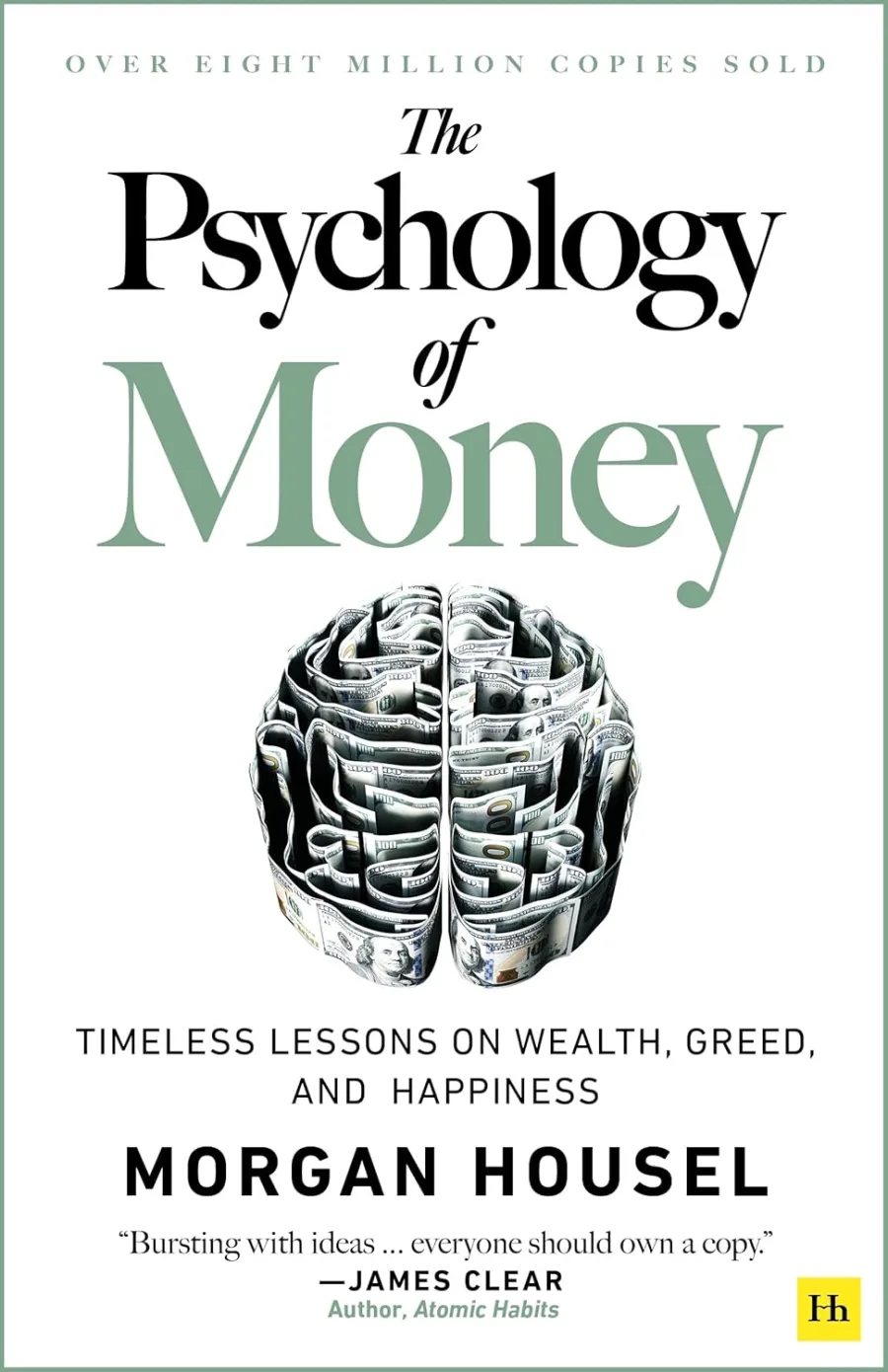
Download Cover Image
Do you want to download the full cover image for The Psychology of Money: Timeless lessons on wealth, greed, and happiness?