
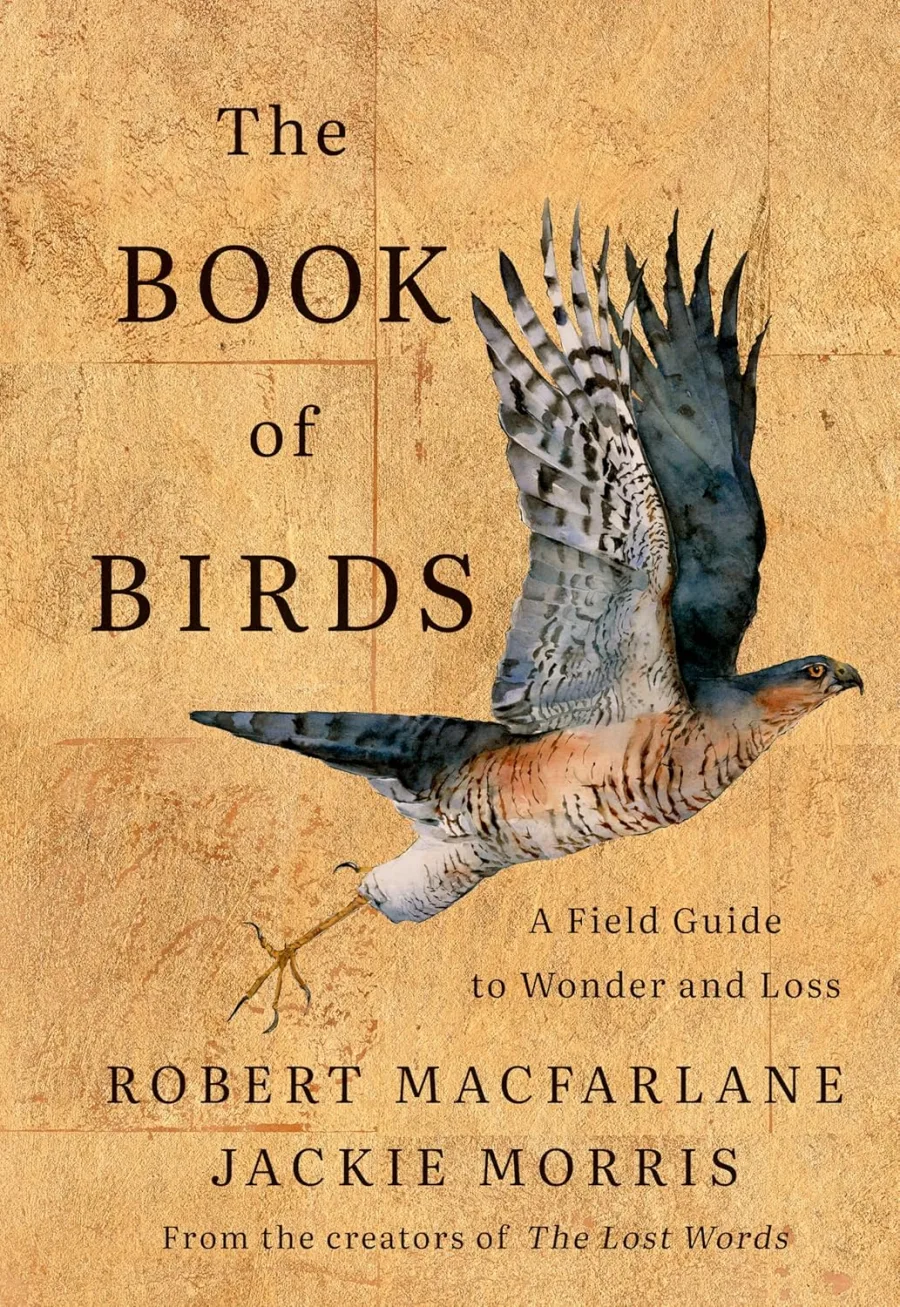
The Book of Birds: A Field Guide to Wonder and Loss
Robert Macfarlane, Jackie Morris
Hardcover
• 384 Pages
• USD 35.00
• English
• 9781324006848
No ratings yet
| Publisher | W. W. Norton & Company |
|---|---|
| ISBN13 | 9781324006848 |
| ASIN/SKU | 1324006846 |
| Book Format | Hardcover |
| Language | English |
| Pages | 384 |
| List Price | USD 35.00 |
| Publishing Date | 09/06/2026 |
| Dimensions | 6.9 x 1.4 x 10 inches |
| Weight | 2.5 pounds |
| Book Code | BD00054961 |
Buy this Book
Amazon Stores
Ebook Stores
Other Stores
Discover The Book of Birds: A Field Guide to Wonder and Loss by Robert Macfarlane. This book is published by W. W. Norton and Company in Hardcover format, ISBN 9781324006848, ASIN 1324006846, under Science and Math, Ornithology, Biology of Wildlife.
Book Description
A New York Times Bestseller
From the best-selling authors of The Lost Words, a dazzling celebration of endangered birds.
The Book of Birds is a field guide with a difference: It shows readers not just how to identify birds, but also how to identify with them. Robert Macfarlane and Jackie Morris conjure the unique spirit of nearly fifty once-common species: avocet to yellowhammer, kestrel to kingfisher, skylark to nightingale. In lyrical and incantatory essays, Macfarlane describes each bird’s habits and habitats, their patterns of flight and patterns of song, how they hunt or fish or scavenge or gather, how they nest and raise their chicks, the myths that attend them, the threats that shadow them―and how their lives intersect with our own. On every page we encounter Morris’s exhilarating artwork, painted from life in watercolor and gold leaf, and animated with an extraordinary attention to detail. The Book of Birds is a love letter to the thrilling variety and mysteries of birdlife, and a clarion call to halt the rapid depletion of our skies.
From the best-selling authors of The Lost Words, a dazzling celebration of endangered birds.
The Book of Birds is a field guide with a difference: It shows readers not just how to identify birds, but also how to identify with them. Robert Macfarlane and Jackie Morris conjure the unique spirit of nearly fifty once-common species: avocet to yellowhammer, kestrel to kingfisher, skylark to nightingale. In lyrical and incantatory essays, Macfarlane describes each bird’s habits and habitats, their patterns of flight and patterns of song, how they hunt or fish or scavenge or gather, how they nest and raise their chicks, the myths that attend them, the threats that shadow them―and how their lives intersect with our own. On every page we encounter Morris’s exhilarating artwork, painted from life in watercolor and gold leaf, and animated with an extraordinary attention to detail. The Book of Birds is a love letter to the thrilling variety and mysteries of birdlife, and a clarion call to halt the rapid depletion of our skies.
Author Biography
Robert Macfarlane is the author of prize-winning and bestselling books about landscape, nature, people and place, including Mountains of the Mind: A History of a Fascination (2003), The Wild Places (2007), The Old Ways (2012), Holloway (2013, with Stanley Donwood and Dan Richards), Landmarks (2015), The Lost Words: A Spell Book (with the artist Jackie Morris, 2017) and Underland: A Deep Time Journey (2019). His work has been translated into many languages, won prizes around the world, and his books have been widely adapted for film, television, stage and radio. He has collaborated with artists, film-makers, actors, photographers and musicians, including Hauschka, Willem Dafoe, Karine Polwart and Stanley Donwood. In 2017 he was awarded the EM Forster Prize for Literature by the American Academy of Arts and Letters.
Editorial Reviews
"You’ve never read a bird book like this one, written and illustrated in a spirit of determined awareness, augmenting facts with spirited play. . . . In this book words and pictures have equal importance. Ms. Morris’s illustrations don’t give us the usual frozen portraits of guide books, but birds in flight, in conflict or comedy. She’s less concerned with depicting every feather than offering us glimpses of vitality. . . . The Book of Birds is, like poetry, a form of memory, recovery and ritualizing delight. . . . The book educates without dullness."
― David Mason, Wall Street Journal
"A love letter to our feathered friends. . . . Each entry is a prose poem aimed at evoking the spirit and the unique qualities of each bird"
― Fiona Sturges, Guardian
"[T]he joys of bird-watching span the globe, as does [Robert Macfarlane and Jackie Morris's] invitation to revel in and protect the multispecies worlds of which we humans are one part."
― Barbara J. King, NPR
"From flight patterns to song, myth and mating rituals, each bird is celebrated in Morris’s vibrant paintings and Macfarlane’s lyrical accompanying notes."
― National Geographic
"The Book of Birds is no mere catalog of endangered species. It’s a lovingly produced introduction to what Macfarlane calls 'the seven wonders of birds' . . . Full-throated prose poems flag distinguishing habitats, habits, and character traits that make the birds come alive in a way that more traditional field guides do not."
― Heller McAlpin, Christian Science Mointor
"It is love that radiates from the pages of Robert Macfarlane and Jackie Morris’s exquisite The Book of Birds. . . . No one has drawn out the poetry of birds more truthfully, more tenderly than Robert Macfarlane, his rhythmic incantations summoning the birds one by one, subject by subject, in all their fierce, fragile wonder."
― Maria Popova, The Marginalian
"In this field guide like no other, preeminent nature writer Robert Macfarlane and artist Jackie Morris have again joined forces to inform and entrance. . . . Gorgeous and lyrical. . . . Macfarlane's dynamic descriptions are veritable prose poems in their rhythmic cadence, imaginative metaphors, and evocation of each bird's distinct personality. . . . [alongside] Morris's spirited and elegant paintings. A radiant, exhilarating, and invaluable creation."
― Donna Seaman, Booklist
"The ordinary becomes extraordinary in this ode to the wonders of the natural world. Bird lovers will be delighted."
― Publishers Weekly (starred review)
"Detailed, sumptuous. . . an evocation or a prayer over the memory of birds that risk being forgotten."
― Kirkus Reviews
"With paintings by Morris and words by Macfarlane, the book is a twist on the classic field guides that inspired both authors, evoking the spirit and poetry of birds from avocet to yellowhammer."
― Patrick Barkham, Guardian (UK)
"A love letter to our feathered friends."
― Observer
― David Mason, Wall Street Journal
"A love letter to our feathered friends. . . . Each entry is a prose poem aimed at evoking the spirit and the unique qualities of each bird"
― Fiona Sturges, Guardian
"[T]he joys of bird-watching span the globe, as does [Robert Macfarlane and Jackie Morris's] invitation to revel in and protect the multispecies worlds of which we humans are one part."
― Barbara J. King, NPR
"From flight patterns to song, myth and mating rituals, each bird is celebrated in Morris’s vibrant paintings and Macfarlane’s lyrical accompanying notes."
― National Geographic
"The Book of Birds is no mere catalog of endangered species. It’s a lovingly produced introduction to what Macfarlane calls 'the seven wonders of birds' . . . Full-throated prose poems flag distinguishing habitats, habits, and character traits that make the birds come alive in a way that more traditional field guides do not."
― Heller McAlpin, Christian Science Mointor
"It is love that radiates from the pages of Robert Macfarlane and Jackie Morris’s exquisite The Book of Birds. . . . No one has drawn out the poetry of birds more truthfully, more tenderly than Robert Macfarlane, his rhythmic incantations summoning the birds one by one, subject by subject, in all their fierce, fragile wonder."
― Maria Popova, The Marginalian
"In this field guide like no other, preeminent nature writer Robert Macfarlane and artist Jackie Morris have again joined forces to inform and entrance. . . . Gorgeous and lyrical. . . . Macfarlane's dynamic descriptions are veritable prose poems in their rhythmic cadence, imaginative metaphors, and evocation of each bird's distinct personality. . . . [alongside] Morris's spirited and elegant paintings. A radiant, exhilarating, and invaluable creation."
― Donna Seaman, Booklist
"The ordinary becomes extraordinary in this ode to the wonders of the natural world. Bird lovers will be delighted."
― Publishers Weekly (starred review)
"Detailed, sumptuous. . . an evocation or a prayer over the memory of birds that risk being forgotten."
― Kirkus Reviews
"With paintings by Morris and words by Macfarlane, the book is a twist on the classic field guides that inspired both authors, evoking the spirit and poetry of birds from avocet to yellowhammer."
― Patrick Barkham, Guardian (UK)
"A love letter to our feathered friends."
― Observer
Book Summary
The Book of Birds: A Field Guide to Wonder and Loss is a lyrical, illustrated celebration of birds that is also a warning about how fragile their future has become. Rather than treating birds as entries in a standard nature guide, Robert Macfarlane and Jackie Morris invite readers to think of them as living neighbors with their own histories, habits, voices, and vulnerabilities.
At the heart of the book is a simple but powerful idea: to truly care for birds, people must learn not only how to identify them, but how to understand them. The book presents forty-nine bird species, from Avocet to Yellowhammer, all of them species that are currently declining or endangered in Britain, and each one is given space to appear as more than just a specimen or checklist item. Macfarlane’s prose is described as lyrical, playful, and precise, while Morris’s watercolors bring each bird to life with movement, detail, and a sense of wonder.
The book is structured around seven broad themes that celebrate what Macfarlane calls the “seven wonders” of birdlife: nest, egg, beak, song, feather, flight, and migration. These sections give the book a rhythm and shape, but they also underline the idea that birds are linked by shared marvels as well as by individual difference. Instead of offering dry facts alone, the book combines natural history, myth, poetry, and personal reflection, so that each bird becomes part of a larger story about memory, language, and belonging.
A major thread running through the book is loss. The authors make clear that birds are disappearing in alarming numbers, and that this thinning of the skies is not an abstract issue but a real erosion of everyday life, sound, and season. The book’s tone is therefore both celebratory and mournful: it delights in the beauty of birds while also asking what it means to live in a world where dawns and springs are becoming quieter. This tension gives the book its emotional force, because it suggests that wonder and grief are not opposites here, but companions.
Macfarlane’s approach is not simply to educate readers, but to change the way they relate to the natural world. He asks readers to move from “What is that bird?” to “Who is that bird?”, which is a subtle but important shift. That change turns birdwatching into something more ethical and more intimate, because it encourages respect, identification, and kinship rather than detached observation. In that sense, the book is as much about attention as it is about conservation.
Jackie Morris’s illustrations deepen this effect. Her paintings do not freeze birds into static diagrams; instead, they show them in motion, often with a feeling of energy, tenderness, or urgency. The artwork helps the book feel alive on every page, and it reinforces the sense that birds are not disappearing concepts but vivid presences that still inhabit the world. The visual style also makes the book feel less like a manual and more like an act of devotion.
What makes The Book of Birds memorable is that it refuses to separate beauty from responsibility. It is full of admiration, but it is not sentimental; it acknowledges that many birds are under threat and that human choices are part of the reason. At the same time, it insists that loss is not the final word, because attention, language, art, and care still matter. The book becomes a kind of plea: to notice birds, to name them, to love them, and, through that love, to protect what remains.
Overall, the book reads like a love letter to birds and a call to action at once. It is designed for bird-lovers, but it also reaches beyond that audience, because its deeper message is about how people live with the more-than-human world. In simple terms, it says that birds are not just part of nature in the background of life; they are part of the shared life of the planet, and their disappearance should matter to everyone.
At the heart of the book is a simple but powerful idea: to truly care for birds, people must learn not only how to identify them, but how to understand them. The book presents forty-nine bird species, from Avocet to Yellowhammer, all of them species that are currently declining or endangered in Britain, and each one is given space to appear as more than just a specimen or checklist item. Macfarlane’s prose is described as lyrical, playful, and precise, while Morris’s watercolors bring each bird to life with movement, detail, and a sense of wonder.
The book is structured around seven broad themes that celebrate what Macfarlane calls the “seven wonders” of birdlife: nest, egg, beak, song, feather, flight, and migration. These sections give the book a rhythm and shape, but they also underline the idea that birds are linked by shared marvels as well as by individual difference. Instead of offering dry facts alone, the book combines natural history, myth, poetry, and personal reflection, so that each bird becomes part of a larger story about memory, language, and belonging.
A major thread running through the book is loss. The authors make clear that birds are disappearing in alarming numbers, and that this thinning of the skies is not an abstract issue but a real erosion of everyday life, sound, and season. The book’s tone is therefore both celebratory and mournful: it delights in the beauty of birds while also asking what it means to live in a world where dawns and springs are becoming quieter. This tension gives the book its emotional force, because it suggests that wonder and grief are not opposites here, but companions.
Macfarlane’s approach is not simply to educate readers, but to change the way they relate to the natural world. He asks readers to move from “What is that bird?” to “Who is that bird?”, which is a subtle but important shift. That change turns birdwatching into something more ethical and more intimate, because it encourages respect, identification, and kinship rather than detached observation. In that sense, the book is as much about attention as it is about conservation.
Jackie Morris’s illustrations deepen this effect. Her paintings do not freeze birds into static diagrams; instead, they show them in motion, often with a feeling of energy, tenderness, or urgency. The artwork helps the book feel alive on every page, and it reinforces the sense that birds are not disappearing concepts but vivid presences that still inhabit the world. The visual style also makes the book feel less like a manual and more like an act of devotion.
What makes The Book of Birds memorable is that it refuses to separate beauty from responsibility. It is full of admiration, but it is not sentimental; it acknowledges that many birds are under threat and that human choices are part of the reason. At the same time, it insists that loss is not the final word, because attention, language, art, and care still matter. The book becomes a kind of plea: to notice birds, to name them, to love them, and, through that love, to protect what remains.
Overall, the book reads like a love letter to birds and a call to action at once. It is designed for bird-lovers, but it also reaches beyond that audience, because its deeper message is about how people live with the more-than-human world. In simple terms, it says that birds are not just part of nature in the background of life; they are part of the shared life of the planet, and their disappearance should matter to everyone.
Sample Chapters
Sample Chapters will be added soon…
Reader Reviews
No reviews yet.
The Book of Birds: A Field Guide to Wonder and Loss
Download Cover Image
Do you want to download the full cover image for The Book of Birds: A Field Guide to Wonder and Loss?