
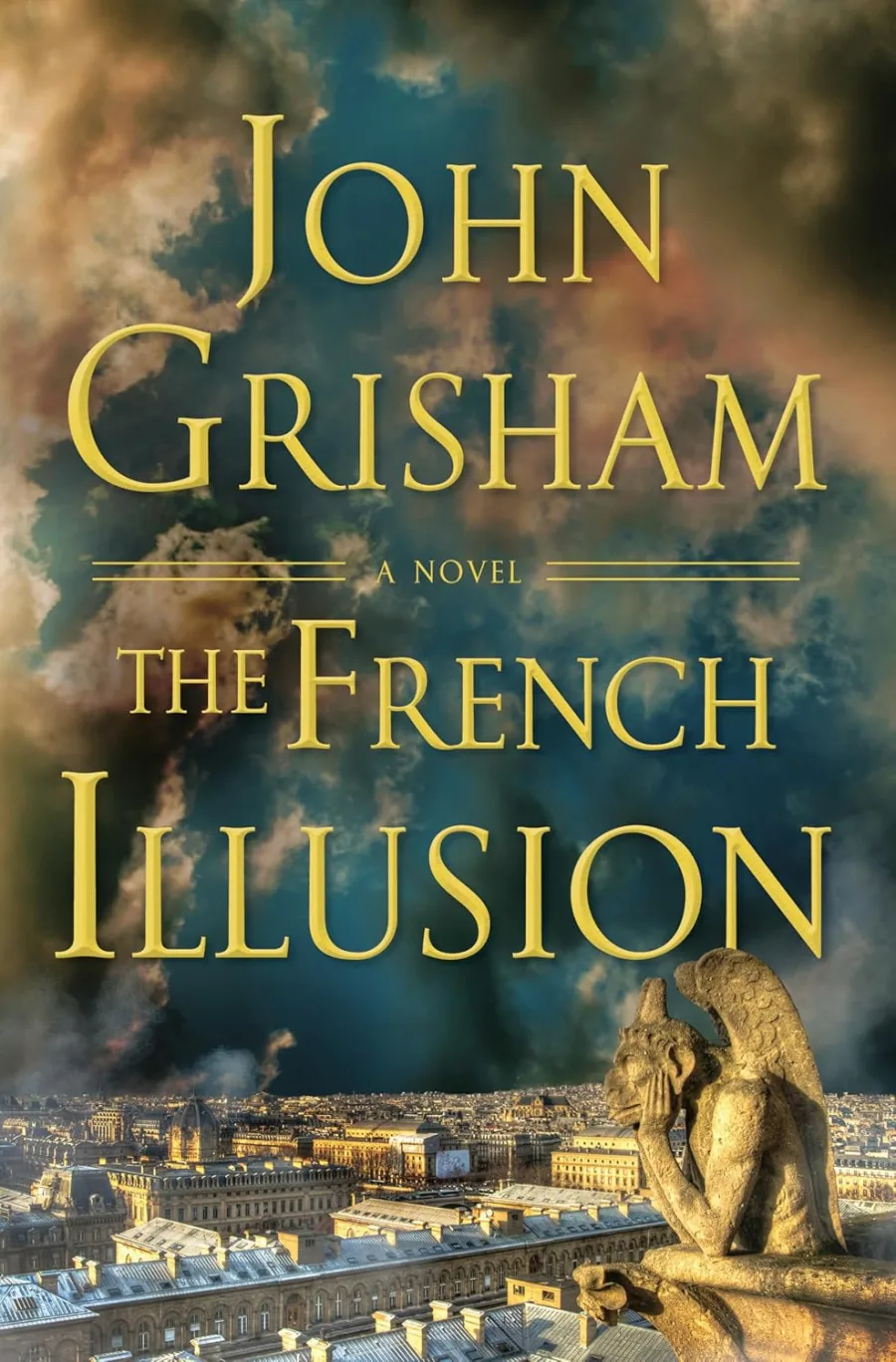
The French Illusion: A Novel
Hardcover
• 352 Pages
• USD 35.00
• English
• 9780385550543
No ratings yet
| Publisher | Doubleday |
|---|---|
| ISBN13 | 9780385550543 |
| ASIN/SKU | 0385550545 |
| Book Format | Hardcover |
| Language | English |
| Pages | 352 |
| List Price | USD 35.00 |
| Publishing Date | 29/09/2026 |
| Dimensions | 6.13 x 0.88 x 9.25 inches |
| Weight | 1.33 pounds |
| Book Code | BD00054979 |
Buy this Book
Amazon Stores
Ebook Stores
Other Stores
Discover The French Illusion: A Novel by John Grisham. This book is published by Doubleday in Hardcover format, ISBN 9780385550543, ASIN 0385550545, under Mystery, Thriller and Suspense, Espionage Thrillers, Suspense Thrillers.
Book Description
#1 New York Times bestselling author John Grisham delivers a gripping, suspenseful page-turner about a Paris honeymoon gone horribly wrong—and the nightmare that follows.
After Paul and Chelsea Tanner’s fairytale wedding, their future is full of promise. But their honeymoon to Paris takes a dark, shocking turn when they are kidnapped while on a day trip to the French countryside. Who would target them, and why? It turns out this is not the first crime of its kind. The search for clues soon stretches across borders, with the FBI, CIA, and French Intelligence trying to work together to put the pieces of the puzzle together. Struggling to find answers, a young lawyer is recruited to be the bait in an elaborate CIA operation.
Propulsive and surprising, The French Illusion is an unmistakable Grisham thrill ride—gripping and impossible to put down.
After Paul and Chelsea Tanner’s fairytale wedding, their future is full of promise. But their honeymoon to Paris takes a dark, shocking turn when they are kidnapped while on a day trip to the French countryside. Who would target them, and why? It turns out this is not the first crime of its kind. The search for clues soon stretches across borders, with the FBI, CIA, and French Intelligence trying to work together to put the pieces of the puzzle together. Struggling to find answers, a young lawyer is recruited to be the bait in an elaborate CIA operation.
Propulsive and surprising, The French Illusion is an unmistakable Grisham thrill ride—gripping and impossible to put down.
Author Biography
John Grisham is the author of more than fifty consecutive #1 bestsellers, which have been translated into nearly fifty languages. His recent books include The Boys From Biloxi, The Judge's List, Sooley, and his third Jake Brigance novel, A Time for Mercy, which is being developed by HBO as a limited series.
Grisham is a two-time winner of the Harper Lee Prize for Legal Fiction and was honored with the Library of Congress Creative Achievement Award for Fiction.
When he's not writing, Grisham serves on the board of directors of the Innocence Project and of Centurion Ministries, two national organizations dedicated to exonerating those who have been wrongfully convicted. Much of his fiction explores deep-seated problems in our criminal justice system.
John lives on a farm in central Virginia.
Grisham is a two-time winner of the Harper Lee Prize for Legal Fiction and was honored with the Library of Congress Creative Achievement Award for Fiction.
When he's not writing, Grisham serves on the board of directors of the Innocence Project and of Centurion Ministries, two national organizations dedicated to exonerating those who have been wrongfully convicted. Much of his fiction explores deep-seated problems in our criminal justice system.
John lives on a farm in central Virginia.
Editorial Reviews
Editorial Reviews will be added soon…
Book Summary
The French Illusion by John Grisham is a fast-paced international thriller that begins as a romantic honeymoon story and gradually becomes a complex tale of kidnapping, espionage, revenge, terrorism, and the dangerous consequences of secrets. Published by Doubleday on September 29, 2026, the novel marks Grisham's move into a more explicitly international spy-thriller territory. It combines the author's familiar interest in law, government institutions, hidden motives, and ordinary people caught in extraordinary circumstances with the atmosphere of a European espionage novel. Grisham himself has said that he enjoys espionage fiction and was influenced by writers such as John le Carré, Ken Follett, Robert Ludlum, and Len Deighton.
At the centre of the story are Paul and Chelsea Tanner, newlyweds who travel to Paris for an eight-day honeymoon. Their marriage is new, their future appears secure, and Paris seems like the perfect place to begin their life together. Chelsea has a particularly strong emotional connection to the city. She first visited Paris as a child with her mother, later studied there, and has remained fascinated by French culture and language. Paul, meanwhile, is drawn to the city's military history and is especially eager to visit the beaches of Normandy. Their interests are different, but the honeymoon is meant to be a celebration of their new life together.
The happiness, however, is being observed from the beginning. Unknown to Paul and Chelsea, someone is monitoring them. Their hotel contains a mole who provides information about guests to criminals. Chelsea's extensive social-media activity makes the surveillance even easier. She enthusiastically posts photographs and details about their itinerary, effectively announcing where the couple will be and what they plan to do. The kidnappers do not have to spend weeks searching for them; the newlyweds' own digital footprint supplies much of the information they need.
This is one of the novel's most contemporary ideas. Paul and Chelsea believe that their online posts are simply expressions of happiness, but to criminals they become a detailed map of the couple's movements. Grisham turns an ordinary habit of modern life—sharing photographs and travel plans—into a source of danger. The contrast between Chelsea's innocent enthusiasm and the cold efficiency of the people watching her creates the first major tension in the story.
The kidnapping takes place during the couple's day trip to Normandy. Paul has arranged for a private driver because he wants to visit the D-Day beaches and military sites. Their driver, Malik, is professional and trustworthy, and Chelsea quickly begins speaking with him in French. Nothing seems threatening. They visit the American Cemetery at Colleville-sur-Mer, where Paul finds the grave of a distant relative who died during the Normandy invasion. The scene is emotionally significant because Paul is deeply connected to military history and the sacrifice of earlier generations.
While the couple is sightseeing, however, the kidnappers are preparing their trap. In Bayeux, Malik is deliberately drugged after being distracted by an orchestrated disturbance. A man posing as a replacement driver then takes control of the Peugeot. He tells Paul and Chelsea that Malik has had a family emergency and must return to Paris. The explanation sounds plausible, and the couple has no reason to suspect that the man is lying.
The vehicle is driven away from the normal route. Paul and Chelsea soon become dizzy and lose consciousness. Their kidnappers have carefully planned the operation, including the vehicle, the false driver, and the concealment of their movements. The kidnapping is therefore not a spontaneous crime but part of a highly organized operation.
When the Tanners disappear, their families are thrown into a nightmare. The kidnappers demand $2 million from Chelsea's wealthy parents and later make the same demand of Paul's less affluent family. The difference between the two families becomes important. Chelsea's father, Lowell Clayburn, is a successful orthopedic surgeon with substantial financial resources. Paul's parents, by contrast, have nowhere near that level of wealth.
The ransom demands place both families under enormous pressure. Lowell chooses to pay without immediately involving law enforcement, hoping that his money will bring his daughter home safely. He raises the ransom and follows the kidnappers' instructions. Chelsea is eventually released. For a brief moment, it seems that the crisis has ended.
But then the story takes a disturbing turn.
Paul is not released.
His family has also been ordered to pay $2 million. They sell their home, liquidate assets, and borrow money from the Clayburn family to raise the enormous amount. Yet even after the money is paid, Paul remains captive. This makes the kidnapping highly unusual. As FBI deputy director Andrew Strong explains, the situation does not fit the normal pattern of a ransom kidnapping.
The unanswered question becomes the central mystery: Why was Chelsea released while Paul was kept?
At first, Paul himself hopes that the crime is simply about money. If the kidnappers are motivated by greed, then perhaps another payment will eventually secure his freedom. But the investigators soon realize that money cannot explain the entire operation.
The FBI begins looking more closely at the circumstances. What initially appeared to be a single kidnapping is connected to other cases. Paul is not the first man with a military or government background to disappear during a honeymoon in France. The investigators discover a pattern involving other American men who had served in the armed forces or government. This changes the investigation completely. The Tanners were not selected randomly. Someone has been deliberately targeting a particular kind of victim.
The mystery therefore moves from ordinary criminal kidnapping toward international espionage and terrorism. The FBI, CIA, and French intelligence agencies must cooperate, even though each organization has its own priorities, procedures, and secrets. The investigation becomes complicated by the need to protect information from the media and to prevent the kidnappers from learning how much the authorities know.
This section of the novel shows Grisham working with a familiar theme in a new setting: the tension between institutions and individuals. Families want immediate answers, while government agencies want to control the investigation. Intelligence officials need secrecy, but secrecy can also make it difficult for frightened families to understand what is happening. Everyone believes that they are acting in the interests of the victims, but their methods and priorities do not always align.
Chelsea, meanwhile, must deal with the trauma of returning home without her husband. She has been released, but emotionally she remains trapped by what happened. Her freedom cannot feel complete while Paul is still missing. The joy that should have surrounded her new marriage has been replaced by fear, guilt, and uncertainty.
Paul's captivity is equally important because the novel allows the reader to understand that the kidnapping is not merely an external mystery. For Paul, every passing day becomes a psychological struggle. He does not know whether he will survive, whether Chelsea is safe, or why he has been singled out. His captors have stripped away his freedom and information, leaving him dependent upon people whose motives he cannot understand.
Eventually, investigators discover that the kidnappers' motivations are more complicated than financial gain. The operation is connected to grievances involving American military and intelligence activities. The victims have been selected because of their professional histories and the roles they played within the American government and military world. Revenge and a desire for justice are mixed with criminal greed. Kirkus specifically notes that the kidnappers' motives involve justice, revenge, and money, rather than a single straightforward objective.
This distinction is central to the novel. Grisham does not present the kidnapping simply as a battle between innocent Americans and criminals who want money. Instead, he gradually reveals a history of political violence, imprisonment, and perceived injustice. The kidnappers believe that they are correcting wrongs committed by powerful institutions. Their methods, however, involve abducting innocent people and using their suffering as a form of punishment.
The novel therefore raises difficult questions about revenge. Can violence committed in the name of justice ever truly produce justice? What happens when people who believe they have been wronged decide that they are entitled to punish others? And how much responsibility should individuals bear for the actions of institutions they once served?
As the FBI and CIA investigate, they turn to Rae Claire Russo, a CIA operative, and Stuart Nash, a former Department of Justice prosecutor who worked on cases involving detainees at Guantanamo Bay. Stuart's background makes him particularly useful to the investigation because the kidnappers' motives are connected to the controversial history of American detention and counterterrorism operations. He understands the legal and political landscape behind the kidnappers' grievances in a way that many ordinary investigators do not.
The authorities eventually develop an unconventional plan. Instead of waiting passively for another kidnapping, they decide to create one. Stuart agrees to marry Rae so that they can pose as honeymooners and deliberately present themselves as attractive targets. The operation is designed to lure the kidnappers into revealing themselves. The young lawyer becomes bait in an elaborate CIA operation, exactly as the publisher's description indicates.
This changes the novel from a traditional kidnapping investigation into a counterintelligence operation. The investigators are now attempting to manipulate the criminals into making a move. But the strategy is dangerous because the kidnappers are experienced, suspicious, and willing to use violence. Rae and Stuart must convincingly behave like newlyweds while knowing that every detail of their fake honeymoon may be scrutinized.
Their operation also creates an interesting parallel with Paul and Chelsea. The original couple's honeymoon was genuine, while Rae and Stuart's marriage is part of an elaborate deception. Paul and Chelsea shared their lives openly and became vulnerable because they were too trusting. Rae and Stuart must deliberately construct a false identity and hope that their deception is convincing enough to fool people whose profession is deception.
The title The French Illusion becomes increasingly meaningful through this contrast. Paris initially appears as a romantic dream, a city of art, history, food, architecture, and love. But beneath that beautiful surface is a hidden world of surveillance, criminal networks, intelligence operations, and danger. The "illusion" is not simply that Paris is unsafe. It is the illusion that appearances can be trusted.
The honeymoon itself becomes an illusion. Chelsea believes she is sharing the beginning of a wonderful life with Paul, but strangers are already planning their abduction. The kidnappers present false identities and stories. Intelligence agents create false marriages. Families conceal information from friends and the press. Even the authorities cannot reveal everything they know.
Nearly everyone is performing some kind of role.
This makes deception one of the novel's central themes. Grisham shows how difficult it becomes to distinguish truth from performance when criminals and intelligence agencies are both operating through secrecy. The people who are supposed to protect the victims must sometimes lie themselves, creating an uncomfortable moral landscape.
The novel also explores the dangers of digital exposure. Chelsea's social-media posts help the kidnappers predict her movements. Her openness is not inherently wrong, but in the wrong hands information becomes a weapon. The story therefore reflects a modern anxiety: people can unknowingly make themselves easier to target by sharing too much about where they are, where they are going, and who they are with. The published excerpt emphasizes exactly this vulnerability.
Another major theme is the lasting shadow of America's post-9/11 counterterrorism policies. The kidnappers' grievances are connected to people who experienced detention and mistreatment in the American-led war on terror. Stuart's professional history at Guantanamo makes him an important bridge between the legal world and the intelligence investigation. The story consequently asks readers to consider what happens when governments use extraordinary methods in the name of security and when those affected later seek revenge.
Yet Grisham does not make the issue simple. The kidnappers' grievances may have origins in genuine suffering, but their decision to abduct innocent people cannot erase the moral responsibility attached to their actions. The novel's tension comes partly from this uncomfortable overlap between legitimate grievances and illegitimate violence.
By the later stages of the story, the investigation becomes a race against time. The authorities must identify the network, locate Paul, and prevent further kidnappings. Rae and Stuart's operation puts them directly in the path of the criminals, while Paul remains the human face of the danger that began with the honeymoon.
The rescue of Paul and the exposure of the kidnapping operation ultimately bring together the different strands of the novel: the families' suffering, the FBI investigation, the CIA's covert operation, French cooperation, and the history that motivated the kidnappers. What began with a romantic trip to Paris has grown into an international confrontation involving crime, intelligence, and political revenge.
At the emotional centre of the novel is the Tanner marriage. Paul and Chelsea begin the story believing that their honeymoon represents the start of their life together. Their kidnapping tests that relationship almost immediately. Chelsea's release does not feel like freedom because Paul is still missing, while Paul's captivity forces him to survive without knowing what has happened to his wife.
Their ordeal demonstrates how quickly ordinary happiness can be destroyed by circumstances beyond a person's control. At the same time, their determination to survive and reunite gives the story its emotional foundation.
Ultimately, The French Illusion is about the dangerous gap between appearance and reality. A honeymoon becomes a kidnapping. A ransom crime becomes an international espionage case. A seemingly random victim becomes part of a carefully selected pattern. A young lawyer becomes an undercover decoy. And a beautiful European setting becomes the stage for a violent confrontation between criminals, intelligence agencies, and people seeking revenge.
The novel also represents an interesting expansion of John Grisham's storytelling. Although Grisham remains interested in lawyers, government institutions, and questions of justice, the story moves beyond the courtroom and into the world of international intelligence. His legal instincts remain visible in the way he explores responsibility, government power, secrecy, and the consequences of institutional decisions, but the narrative is driven primarily by suspense and espionage. Grisham himself has described the novel as his first attempt to apply the craftsmanship of major international suspense writers to his own work.
In the end, The French Illusion leaves the reader with a powerful reminder that danger often begins where people feel safest. Paul and Chelsea believe they are enjoying an idyllic honeymoon, but their openness makes them vulnerable. The criminals believe they can turn suffering into justice, but their revenge creates another cycle of suffering. The intelligence agencies believe they can control the situation, but their own deceptions carry risks.
The deepest message of the novel is that truth becomes especially valuable in a world built on deception. Paul and Chelsea survive because people continue searching for answers rather than accepting the first explanation. The investigators succeed by recognizing patterns that initially seem unrelated. And the operation against the kidnappers works because the authorities understand that sometimes the only way to expose an illusion is to create one of their own.
The French Illusion ultimately transforms a seemingly perfect Paris honeymoon into a tense international thriller about love, fear, loyalty, revenge, and justice. Behind the romance lies surveillance; behind the kidnapping lies history; and behind the mystery lies a difficult question about whether justice can ever be achieved through vengeance. Grisham uses the beauty of Paris and the vulnerability of newlyweds to create a story in which almost nothing is what it first appears to be. The result is a suspenseful novel about the human cost of secrets and the lengths people will go to when love, money, power, and revenge collide.
At the centre of the story are Paul and Chelsea Tanner, newlyweds who travel to Paris for an eight-day honeymoon. Their marriage is new, their future appears secure, and Paris seems like the perfect place to begin their life together. Chelsea has a particularly strong emotional connection to the city. She first visited Paris as a child with her mother, later studied there, and has remained fascinated by French culture and language. Paul, meanwhile, is drawn to the city's military history and is especially eager to visit the beaches of Normandy. Their interests are different, but the honeymoon is meant to be a celebration of their new life together.
The happiness, however, is being observed from the beginning. Unknown to Paul and Chelsea, someone is monitoring them. Their hotel contains a mole who provides information about guests to criminals. Chelsea's extensive social-media activity makes the surveillance even easier. She enthusiastically posts photographs and details about their itinerary, effectively announcing where the couple will be and what they plan to do. The kidnappers do not have to spend weeks searching for them; the newlyweds' own digital footprint supplies much of the information they need.
This is one of the novel's most contemporary ideas. Paul and Chelsea believe that their online posts are simply expressions of happiness, but to criminals they become a detailed map of the couple's movements. Grisham turns an ordinary habit of modern life—sharing photographs and travel plans—into a source of danger. The contrast between Chelsea's innocent enthusiasm and the cold efficiency of the people watching her creates the first major tension in the story.
The kidnapping takes place during the couple's day trip to Normandy. Paul has arranged for a private driver because he wants to visit the D-Day beaches and military sites. Their driver, Malik, is professional and trustworthy, and Chelsea quickly begins speaking with him in French. Nothing seems threatening. They visit the American Cemetery at Colleville-sur-Mer, where Paul finds the grave of a distant relative who died during the Normandy invasion. The scene is emotionally significant because Paul is deeply connected to military history and the sacrifice of earlier generations.
While the couple is sightseeing, however, the kidnappers are preparing their trap. In Bayeux, Malik is deliberately drugged after being distracted by an orchestrated disturbance. A man posing as a replacement driver then takes control of the Peugeot. He tells Paul and Chelsea that Malik has had a family emergency and must return to Paris. The explanation sounds plausible, and the couple has no reason to suspect that the man is lying.
The vehicle is driven away from the normal route. Paul and Chelsea soon become dizzy and lose consciousness. Their kidnappers have carefully planned the operation, including the vehicle, the false driver, and the concealment of their movements. The kidnapping is therefore not a spontaneous crime but part of a highly organized operation.
When the Tanners disappear, their families are thrown into a nightmare. The kidnappers demand $2 million from Chelsea's wealthy parents and later make the same demand of Paul's less affluent family. The difference between the two families becomes important. Chelsea's father, Lowell Clayburn, is a successful orthopedic surgeon with substantial financial resources. Paul's parents, by contrast, have nowhere near that level of wealth.
The ransom demands place both families under enormous pressure. Lowell chooses to pay without immediately involving law enforcement, hoping that his money will bring his daughter home safely. He raises the ransom and follows the kidnappers' instructions. Chelsea is eventually released. For a brief moment, it seems that the crisis has ended.
But then the story takes a disturbing turn.
Paul is not released.
His family has also been ordered to pay $2 million. They sell their home, liquidate assets, and borrow money from the Clayburn family to raise the enormous amount. Yet even after the money is paid, Paul remains captive. This makes the kidnapping highly unusual. As FBI deputy director Andrew Strong explains, the situation does not fit the normal pattern of a ransom kidnapping.
The unanswered question becomes the central mystery: Why was Chelsea released while Paul was kept?
At first, Paul himself hopes that the crime is simply about money. If the kidnappers are motivated by greed, then perhaps another payment will eventually secure his freedom. But the investigators soon realize that money cannot explain the entire operation.
The FBI begins looking more closely at the circumstances. What initially appeared to be a single kidnapping is connected to other cases. Paul is not the first man with a military or government background to disappear during a honeymoon in France. The investigators discover a pattern involving other American men who had served in the armed forces or government. This changes the investigation completely. The Tanners were not selected randomly. Someone has been deliberately targeting a particular kind of victim.
The mystery therefore moves from ordinary criminal kidnapping toward international espionage and terrorism. The FBI, CIA, and French intelligence agencies must cooperate, even though each organization has its own priorities, procedures, and secrets. The investigation becomes complicated by the need to protect information from the media and to prevent the kidnappers from learning how much the authorities know.
This section of the novel shows Grisham working with a familiar theme in a new setting: the tension between institutions and individuals. Families want immediate answers, while government agencies want to control the investigation. Intelligence officials need secrecy, but secrecy can also make it difficult for frightened families to understand what is happening. Everyone believes that they are acting in the interests of the victims, but their methods and priorities do not always align.
Chelsea, meanwhile, must deal with the trauma of returning home without her husband. She has been released, but emotionally she remains trapped by what happened. Her freedom cannot feel complete while Paul is still missing. The joy that should have surrounded her new marriage has been replaced by fear, guilt, and uncertainty.
Paul's captivity is equally important because the novel allows the reader to understand that the kidnapping is not merely an external mystery. For Paul, every passing day becomes a psychological struggle. He does not know whether he will survive, whether Chelsea is safe, or why he has been singled out. His captors have stripped away his freedom and information, leaving him dependent upon people whose motives he cannot understand.
Eventually, investigators discover that the kidnappers' motivations are more complicated than financial gain. The operation is connected to grievances involving American military and intelligence activities. The victims have been selected because of their professional histories and the roles they played within the American government and military world. Revenge and a desire for justice are mixed with criminal greed. Kirkus specifically notes that the kidnappers' motives involve justice, revenge, and money, rather than a single straightforward objective.
This distinction is central to the novel. Grisham does not present the kidnapping simply as a battle between innocent Americans and criminals who want money. Instead, he gradually reveals a history of political violence, imprisonment, and perceived injustice. The kidnappers believe that they are correcting wrongs committed by powerful institutions. Their methods, however, involve abducting innocent people and using their suffering as a form of punishment.
The novel therefore raises difficult questions about revenge. Can violence committed in the name of justice ever truly produce justice? What happens when people who believe they have been wronged decide that they are entitled to punish others? And how much responsibility should individuals bear for the actions of institutions they once served?
As the FBI and CIA investigate, they turn to Rae Claire Russo, a CIA operative, and Stuart Nash, a former Department of Justice prosecutor who worked on cases involving detainees at Guantanamo Bay. Stuart's background makes him particularly useful to the investigation because the kidnappers' motives are connected to the controversial history of American detention and counterterrorism operations. He understands the legal and political landscape behind the kidnappers' grievances in a way that many ordinary investigators do not.
The authorities eventually develop an unconventional plan. Instead of waiting passively for another kidnapping, they decide to create one. Stuart agrees to marry Rae so that they can pose as honeymooners and deliberately present themselves as attractive targets. The operation is designed to lure the kidnappers into revealing themselves. The young lawyer becomes bait in an elaborate CIA operation, exactly as the publisher's description indicates.
This changes the novel from a traditional kidnapping investigation into a counterintelligence operation. The investigators are now attempting to manipulate the criminals into making a move. But the strategy is dangerous because the kidnappers are experienced, suspicious, and willing to use violence. Rae and Stuart must convincingly behave like newlyweds while knowing that every detail of their fake honeymoon may be scrutinized.
Their operation also creates an interesting parallel with Paul and Chelsea. The original couple's honeymoon was genuine, while Rae and Stuart's marriage is part of an elaborate deception. Paul and Chelsea shared their lives openly and became vulnerable because they were too trusting. Rae and Stuart must deliberately construct a false identity and hope that their deception is convincing enough to fool people whose profession is deception.
The title The French Illusion becomes increasingly meaningful through this contrast. Paris initially appears as a romantic dream, a city of art, history, food, architecture, and love. But beneath that beautiful surface is a hidden world of surveillance, criminal networks, intelligence operations, and danger. The "illusion" is not simply that Paris is unsafe. It is the illusion that appearances can be trusted.
The honeymoon itself becomes an illusion. Chelsea believes she is sharing the beginning of a wonderful life with Paul, but strangers are already planning their abduction. The kidnappers present false identities and stories. Intelligence agents create false marriages. Families conceal information from friends and the press. Even the authorities cannot reveal everything they know.
Nearly everyone is performing some kind of role.
This makes deception one of the novel's central themes. Grisham shows how difficult it becomes to distinguish truth from performance when criminals and intelligence agencies are both operating through secrecy. The people who are supposed to protect the victims must sometimes lie themselves, creating an uncomfortable moral landscape.
The novel also explores the dangers of digital exposure. Chelsea's social-media posts help the kidnappers predict her movements. Her openness is not inherently wrong, but in the wrong hands information becomes a weapon. The story therefore reflects a modern anxiety: people can unknowingly make themselves easier to target by sharing too much about where they are, where they are going, and who they are with. The published excerpt emphasizes exactly this vulnerability.
Another major theme is the lasting shadow of America's post-9/11 counterterrorism policies. The kidnappers' grievances are connected to people who experienced detention and mistreatment in the American-led war on terror. Stuart's professional history at Guantanamo makes him an important bridge between the legal world and the intelligence investigation. The story consequently asks readers to consider what happens when governments use extraordinary methods in the name of security and when those affected later seek revenge.
Yet Grisham does not make the issue simple. The kidnappers' grievances may have origins in genuine suffering, but their decision to abduct innocent people cannot erase the moral responsibility attached to their actions. The novel's tension comes partly from this uncomfortable overlap between legitimate grievances and illegitimate violence.
By the later stages of the story, the investigation becomes a race against time. The authorities must identify the network, locate Paul, and prevent further kidnappings. Rae and Stuart's operation puts them directly in the path of the criminals, while Paul remains the human face of the danger that began with the honeymoon.
The rescue of Paul and the exposure of the kidnapping operation ultimately bring together the different strands of the novel: the families' suffering, the FBI investigation, the CIA's covert operation, French cooperation, and the history that motivated the kidnappers. What began with a romantic trip to Paris has grown into an international confrontation involving crime, intelligence, and political revenge.
At the emotional centre of the novel is the Tanner marriage. Paul and Chelsea begin the story believing that their honeymoon represents the start of their life together. Their kidnapping tests that relationship almost immediately. Chelsea's release does not feel like freedom because Paul is still missing, while Paul's captivity forces him to survive without knowing what has happened to his wife.
Their ordeal demonstrates how quickly ordinary happiness can be destroyed by circumstances beyond a person's control. At the same time, their determination to survive and reunite gives the story its emotional foundation.
Ultimately, The French Illusion is about the dangerous gap between appearance and reality. A honeymoon becomes a kidnapping. A ransom crime becomes an international espionage case. A seemingly random victim becomes part of a carefully selected pattern. A young lawyer becomes an undercover decoy. And a beautiful European setting becomes the stage for a violent confrontation between criminals, intelligence agencies, and people seeking revenge.
The novel also represents an interesting expansion of John Grisham's storytelling. Although Grisham remains interested in lawyers, government institutions, and questions of justice, the story moves beyond the courtroom and into the world of international intelligence. His legal instincts remain visible in the way he explores responsibility, government power, secrecy, and the consequences of institutional decisions, but the narrative is driven primarily by suspense and espionage. Grisham himself has described the novel as his first attempt to apply the craftsmanship of major international suspense writers to his own work.
In the end, The French Illusion leaves the reader with a powerful reminder that danger often begins where people feel safest. Paul and Chelsea believe they are enjoying an idyllic honeymoon, but their openness makes them vulnerable. The criminals believe they can turn suffering into justice, but their revenge creates another cycle of suffering. The intelligence agencies believe they can control the situation, but their own deceptions carry risks.
The deepest message of the novel is that truth becomes especially valuable in a world built on deception. Paul and Chelsea survive because people continue searching for answers rather than accepting the first explanation. The investigators succeed by recognizing patterns that initially seem unrelated. And the operation against the kidnappers works because the authorities understand that sometimes the only way to expose an illusion is to create one of their own.
The French Illusion ultimately transforms a seemingly perfect Paris honeymoon into a tense international thriller about love, fear, loyalty, revenge, and justice. Behind the romance lies surveillance; behind the kidnapping lies history; and behind the mystery lies a difficult question about whether justice can ever be achieved through vengeance. Grisham uses the beauty of Paris and the vulnerability of newlyweds to create a story in which almost nothing is what it first appears to be. The result is a suspenseful novel about the human cost of secrets and the lengths people will go to when love, money, power, and revenge collide.
Sample Chapters
Sample Chapters will be added soon…
Reader Reviews
No reviews yet.
The French Illusion: A Novel
Download Cover Image
Do you want to download the full cover image for The French Illusion: A Novel?