
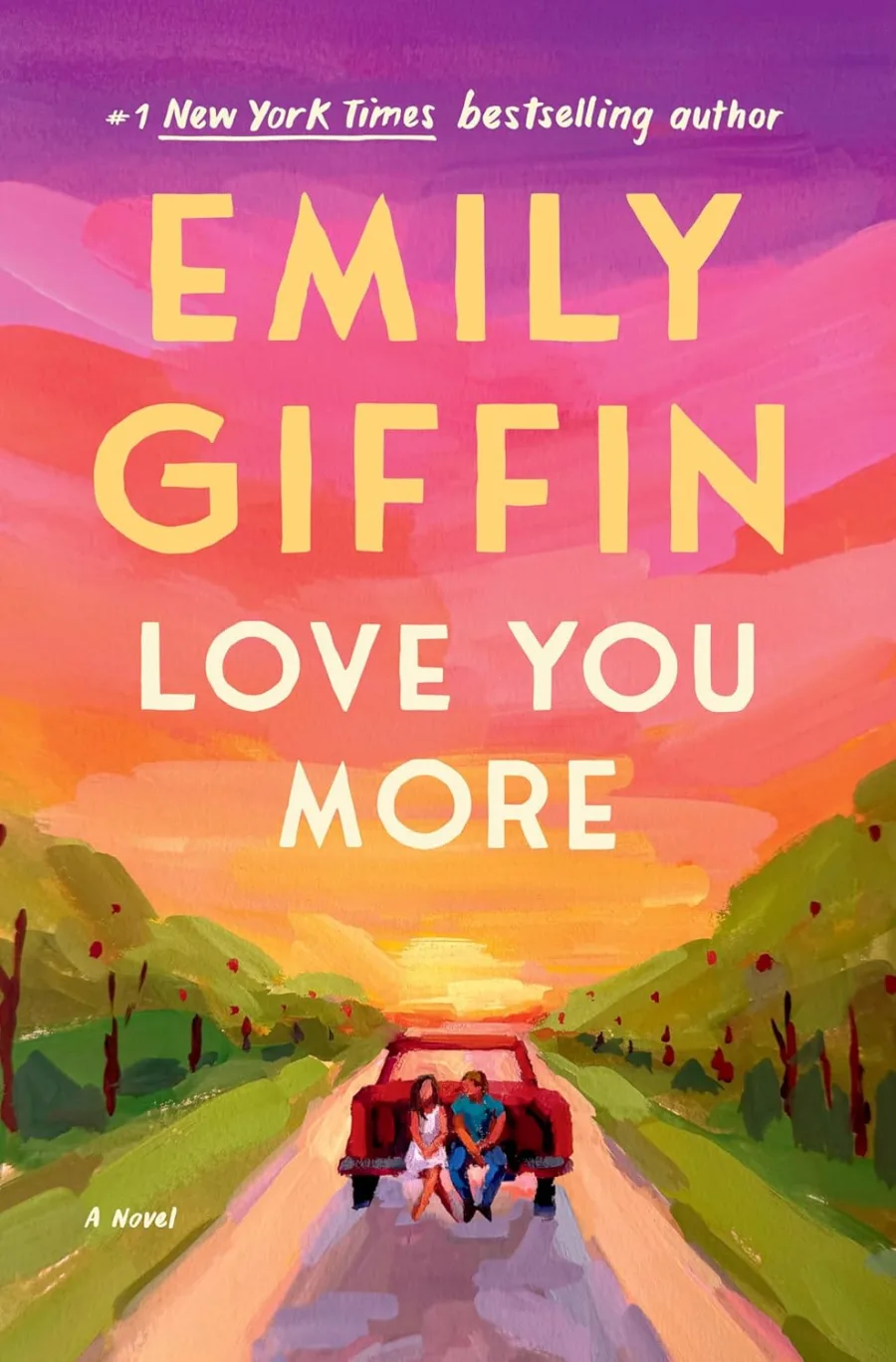
Love You More: A Novel
Hardcover
• 320 Pages
• USD 32.00
• English
• 9780593600320
No ratings yet
| Publisher | Ballantine Books |
|---|---|
| ISBN13 | 9780593600320 |
| ASIN/SKU | 0593600320 |
| Book Format | Hardcover |
| Language | English |
| Pages | 320 |
| List Price | USD 32.00 |
| Publishing Date | 07/07/2026 |
| Dimensions | 6.4 x 1.1 x 9.54 inches |
| Weight | 1.05 pounds |
| Book Code | BD00054983 |
Buy this Book
Amazon Stores
Ebook Stores
Other Stores
Discover Love You More: A Novel by Emily Giffin. This book is published by Ballantine Books in Hardcover format, ISBN 9780593600320, ASIN 0593600320, under Literature and Fiction, Women's Friendship Fiction, Contemporary Women Fiction.
Book Description
A woman is newly engaged to a man she adores when she receives a call from her first love with news that shatters her carefully ordered world, in this emotionally powerful novel from the #1 New York Times bestselling author of The Summer Pact.
Billie has built the perfect life. Her medical practice in New York City is thriving, and she’s finally found the right partner in Dean after years spent trying to move on from her high-school sweetheart, Mick. Their young love had been intense and true, but distance and ambition pulled them apart when she left Wisconsin for medical school.
Then one morning, just after she’s accepted Dean’s romantic marriage proposal, Billie’s phone rings. It’s Mick—calling for the first time in nearly a decade. His news is urgent and in a moment, everything changes.
As Billie boards a plane back to Wisconsin, her past comes rushing in—her hometown friendships, the love she and Mick shared, and the choices that shaped them all. What awaits her is a reckoning with what she’s lost, what she’s built, and what she still wants.
Gripping and deeply moving, Love You More is a story about the plot twists life throws at us—and how love, in all its forms, has the power to change everything.
Billie has built the perfect life. Her medical practice in New York City is thriving, and she’s finally found the right partner in Dean after years spent trying to move on from her high-school sweetheart, Mick. Their young love had been intense and true, but distance and ambition pulled them apart when she left Wisconsin for medical school.
Then one morning, just after she’s accepted Dean’s romantic marriage proposal, Billie’s phone rings. It’s Mick—calling for the first time in nearly a decade. His news is urgent and in a moment, everything changes.
As Billie boards a plane back to Wisconsin, her past comes rushing in—her hometown friendships, the love she and Mick shared, and the choices that shaped them all. What awaits her is a reckoning with what she’s lost, what she’s built, and what she still wants.
Gripping and deeply moving, Love You More is a story about the plot twists life throws at us—and how love, in all its forms, has the power to change everything.
Author Biography
Emily Giffin is a graduate of Wake Forest University and the University of Virginia School of Law. After practicing litigation at a Manhattan firm for several years, she moved to London to write full time. The author of seven New York Times bestselling novels, Something Borrowed, Something Blue, Baby Proof, Love The One You're With, Heart of the Matter, Where We Belong, and The One & Only, she lives in Atlanta with her husband and three young children. Visit www.emilygiffin.com.
Editorial Reviews
“Reading this love story and totally obsessed . . . It might be Giffin’s best—and that’s saying something.”—Harlan Coben
“Emily Giffin . . . specializes in un-put-downable stories featuring messy, no-win romantic dilemmas. . . . Another must-read.”—Woman’s World
“Remember Sweet Home Alabama? Giffin has given us a modern Midwestern update of that classic story. . .”—The New York Times Book Review
“Giffin will once again galvanize her legions of readers with another of her engrossing signature tales in which there are no easy answers.”—Booklist
“Giffin knows how to do drama, and she ratchets up the stakes with every page as she continues to reveal new obstacles for Billie. . . . The nostalgia-filled ride is full of twists and turns that will keep readers flipping the pages. A deliciously dramatic look at how one woman’s past influences her future.”—Kirkus Reviews
“Emily Giffin . . . specializes in un-put-downable stories featuring messy, no-win romantic dilemmas. . . . Another must-read.”—Woman’s World
“Remember Sweet Home Alabama? Giffin has given us a modern Midwestern update of that classic story. . .”—The New York Times Book Review
“Giffin will once again galvanize her legions of readers with another of her engrossing signature tales in which there are no easy answers.”—Booklist
“Giffin knows how to do drama, and she ratchets up the stakes with every page as she continues to reveal new obstacles for Billie. . . . The nostalgia-filled ride is full of twists and turns that will keep readers flipping the pages. A deliciously dramatic look at how one woman’s past influences her future.”—Kirkus Reviews
Book Summary
Love You More by Emily Giffin is an emotionally layered novel about motherhood, marriage, and the complicated space between the life you have and the life you once imagined. At its center is Tess Monaghan, a woman in her late thirties who appears to have everything in order: a stable marriage, a comfortable home, and a young daughter she adores. But beneath that surface, Tess is quietly restless. The choices she made years ago—whom to marry, when to settle down, what dreams to set aside—still echo in her mind, especially when she thinks about the man she loved before her husband and the version of herself she might have become. The novel explores how one unexpected encounter can reopen old questions, force difficult truths into the light, and challenge what “love” really means when you’re responsible for more than just yourself.
Tess’s marriage to her husband, Andrew, is not a disaster; it’s steady and functional, marked by routines, shared responsibilities, and the kind of familiarity that comes from years of living alongside someone. They care about each other, they raise their daughter together, and on most days, their life looks like success. But Tess begins to feel that their relationship has slipped into something more like partnership than passion. The spark they once had is dimmer, buried under childcare, bills, and the constant effort of pretending everything is fine. This quiet dissatisfaction doesn’t always have words—she isn’t sure if she’s unhappy, or simply haunted by “what if.” That uncertainty is central to the book: Tess is not a villain or a saint, but a woman standing at a crossroads inside her own mind.
Her emotional balance is shattered when she unexpectedly runs into Sam, the man she loved deeply years ago and had never fully stopped thinking about. Sam was the intense, soulful, complicated love of her youth—the person she believed she might build a life with before circumstances and missteps pulled them apart. Seeing him again, older but still familiar, floods her with memories and feelings she thought she had tamed. Their history was marked by strong chemistry but also by miscommunication and pain, and those unresolved threads make their reunion both exhilarating and dangerous. As they reconnect, Tess realizes how much of her heart she had quietly preserved for the idea of Sam, even while living as a devoted wife and mother. The novel doesn’t treat this as simple infidelity or temptation; instead, it explores the painful honesty of admitting that your heart isn’t as tidy as your life looks.
At the same time, Tess’s identity as a mother is deeply important to her. Her daughter is the center of her world, and her love for her child is unconditional and fierce. That love complicates everything. Tess knows that any choice she makes about Sam, about her marriage, about her future, will not affect only her—it will shape her daughter’s life, her sense of security, her image of family. The title “Love You More” speaks to this conflict: Tess loves her daughter more than anything, but she also has to confront the possibility that loving herself and acknowledging her own needs might eventually clash with being the “perfect” mother and wife. Giffin portrays Tess’s internal struggle with nuance, showing how guilt, longing, and duty collide inside a woman who desperately wants to do right by everyone but cannot ignore her own heart forever.
As Tess spends more time with Sam, she is forced to revisit the story of why they broke up and what part she played in their downfall. Old wounds resurface: decisions made in fear, assumptions about each other’s priorities, and the way youth can turn small misunderstandings into irreversible choices. Sam, too, has changed. He carries his own regrets and vulnerabilities, and he is not simply the romantic ideal Tess has been holding in her mind. Their conversations are filled with unspoken questions—could they have made it work then, can they make it work now, or is the idea of “meant to be” just a comforting illusion? The chemistry between them is undeniable, but it sits inside a much more complicated reality: Tess is no longer the free young woman who can simply follow desire wherever it leads.
Meanwhile, Andrew is not a caricature of the “wrong man.” He is a decent, caring husband who has also invested years of love and effort into their family. He may have blind spots and may have grown complacent, but he is not cruel or indifferent. Giffin uses him to show how marriages can suffer not from dramatic betrayals but from slow erosion, silence, and the assumption that time alone will keep two people close. As Tess begins to pull inward, Andrew senses that something is wrong but cannot immediately name it. Their interactions are filled with small moments—missed chances to talk honestly, half-hearted attempts to rekindle connection, and the constant presence of their child, who both binds them together and distracts them from truly facing each other. The novel makes clear that when love changes shape, both people bear responsibility for what happens next.
The tension in Tess’s life rises as she tries to keep all the pieces from falling apart: her secret emotional storm over Sam, her obligations at home, her sense of being torn between two versions of herself. She vacillates between wanting to stay, to fix what she has, and wanting to leap into something that feels more alive and authentic. This emotional seesaw is exhausting, and Giffin captures the painful truth that there is no choice available that doesn’t hurt someone. Any path forward involves loss—either the loss of a marriage and its stability, or the loss of a chance to follow her deepest feelings. “Love You More” doesn’t rush this conflict; it lets Tess live in that uncomfortable space, revealing how difficult it is to act when the heart and conscience pull in different directions.
Over the course of the story, Tess begins to understand that she must confront her desires and fears honestly, rather than hiding behind duty or nostalgia. She realizes that the fantasy of Sam—the idea that he represents everything she gave up—may be just that: a fantasy. Real love is messy, flawed, and full of mundane compromises. She also sees that staying in a marriage out of fear, rather than genuine commitment, is its own kind of betrayal, both to herself and to Andrew. The emotional turning point comes when Tess stops asking “Which man is right?” and instead asks “Who do I want to be?” That shift reframes the entire story. The novel becomes less about choosing between two loves and more about choosing how to live with integrity, once you know your own truth.
By the end, Tess’s journey leads her to a place where the meaning of love is broader and more complicated than it was at the beginning. Loving “more” doesn’t mean choosing one person over another in a simple hierarchy; it means recognizing that love can hurt, heal, bind, and break all at once. She has to accept the consequences of her choices, face the people she has wounded, and rebuild a sense of self that isn’t defined solely by her relationship status. Motherhood remains central, but now it includes the recognition that children need adults who are honest about their lives, not martyrs who silently erase themselves. The final chapters carry a bittersweet tone—there is no perfectly neat happiness, but there is growth, maturity, and a hard-won understanding that our hearts are capable of more than one kind of love, and that the hardest part is learning how to live with that truth without losing ourselves.
In Love You More, Emily Giffin delivers a story that feels intimate and familiar, especially for anyone who has ever looked at their life and wondered 'what if'. Through Tess’s struggle, the novel asks whether it is possible to honor the commitments you’ve made while still listening to the quiet voice inside that says you are meant for something more—or something different. It acknowledges that there are no easy answers, only choices, and that love—romantic, familial, and self-love—is rarely simple. Instead, it is a shifting, demanding force that pushes us to face who we truly are, and to decide, day by day, what we are willing to risk in order to live a life that feels honest and whole.
Tess’s marriage to her husband, Andrew, is not a disaster; it’s steady and functional, marked by routines, shared responsibilities, and the kind of familiarity that comes from years of living alongside someone. They care about each other, they raise their daughter together, and on most days, their life looks like success. But Tess begins to feel that their relationship has slipped into something more like partnership than passion. The spark they once had is dimmer, buried under childcare, bills, and the constant effort of pretending everything is fine. This quiet dissatisfaction doesn’t always have words—she isn’t sure if she’s unhappy, or simply haunted by “what if.” That uncertainty is central to the book: Tess is not a villain or a saint, but a woman standing at a crossroads inside her own mind.
Her emotional balance is shattered when she unexpectedly runs into Sam, the man she loved deeply years ago and had never fully stopped thinking about. Sam was the intense, soulful, complicated love of her youth—the person she believed she might build a life with before circumstances and missteps pulled them apart. Seeing him again, older but still familiar, floods her with memories and feelings she thought she had tamed. Their history was marked by strong chemistry but also by miscommunication and pain, and those unresolved threads make their reunion both exhilarating and dangerous. As they reconnect, Tess realizes how much of her heart she had quietly preserved for the idea of Sam, even while living as a devoted wife and mother. The novel doesn’t treat this as simple infidelity or temptation; instead, it explores the painful honesty of admitting that your heart isn’t as tidy as your life looks.
At the same time, Tess’s identity as a mother is deeply important to her. Her daughter is the center of her world, and her love for her child is unconditional and fierce. That love complicates everything. Tess knows that any choice she makes about Sam, about her marriage, about her future, will not affect only her—it will shape her daughter’s life, her sense of security, her image of family. The title “Love You More” speaks to this conflict: Tess loves her daughter more than anything, but she also has to confront the possibility that loving herself and acknowledging her own needs might eventually clash with being the “perfect” mother and wife. Giffin portrays Tess’s internal struggle with nuance, showing how guilt, longing, and duty collide inside a woman who desperately wants to do right by everyone but cannot ignore her own heart forever.
As Tess spends more time with Sam, she is forced to revisit the story of why they broke up and what part she played in their downfall. Old wounds resurface: decisions made in fear, assumptions about each other’s priorities, and the way youth can turn small misunderstandings into irreversible choices. Sam, too, has changed. He carries his own regrets and vulnerabilities, and he is not simply the romantic ideal Tess has been holding in her mind. Their conversations are filled with unspoken questions—could they have made it work then, can they make it work now, or is the idea of “meant to be” just a comforting illusion? The chemistry between them is undeniable, but it sits inside a much more complicated reality: Tess is no longer the free young woman who can simply follow desire wherever it leads.
Meanwhile, Andrew is not a caricature of the “wrong man.” He is a decent, caring husband who has also invested years of love and effort into their family. He may have blind spots and may have grown complacent, but he is not cruel or indifferent. Giffin uses him to show how marriages can suffer not from dramatic betrayals but from slow erosion, silence, and the assumption that time alone will keep two people close. As Tess begins to pull inward, Andrew senses that something is wrong but cannot immediately name it. Their interactions are filled with small moments—missed chances to talk honestly, half-hearted attempts to rekindle connection, and the constant presence of their child, who both binds them together and distracts them from truly facing each other. The novel makes clear that when love changes shape, both people bear responsibility for what happens next.
The tension in Tess’s life rises as she tries to keep all the pieces from falling apart: her secret emotional storm over Sam, her obligations at home, her sense of being torn between two versions of herself. She vacillates between wanting to stay, to fix what she has, and wanting to leap into something that feels more alive and authentic. This emotional seesaw is exhausting, and Giffin captures the painful truth that there is no choice available that doesn’t hurt someone. Any path forward involves loss—either the loss of a marriage and its stability, or the loss of a chance to follow her deepest feelings. “Love You More” doesn’t rush this conflict; it lets Tess live in that uncomfortable space, revealing how difficult it is to act when the heart and conscience pull in different directions.
Over the course of the story, Tess begins to understand that she must confront her desires and fears honestly, rather than hiding behind duty or nostalgia. She realizes that the fantasy of Sam—the idea that he represents everything she gave up—may be just that: a fantasy. Real love is messy, flawed, and full of mundane compromises. She also sees that staying in a marriage out of fear, rather than genuine commitment, is its own kind of betrayal, both to herself and to Andrew. The emotional turning point comes when Tess stops asking “Which man is right?” and instead asks “Who do I want to be?” That shift reframes the entire story. The novel becomes less about choosing between two loves and more about choosing how to live with integrity, once you know your own truth.
By the end, Tess’s journey leads her to a place where the meaning of love is broader and more complicated than it was at the beginning. Loving “more” doesn’t mean choosing one person over another in a simple hierarchy; it means recognizing that love can hurt, heal, bind, and break all at once. She has to accept the consequences of her choices, face the people she has wounded, and rebuild a sense of self that isn’t defined solely by her relationship status. Motherhood remains central, but now it includes the recognition that children need adults who are honest about their lives, not martyrs who silently erase themselves. The final chapters carry a bittersweet tone—there is no perfectly neat happiness, but there is growth, maturity, and a hard-won understanding that our hearts are capable of more than one kind of love, and that the hardest part is learning how to live with that truth without losing ourselves.
In Love You More, Emily Giffin delivers a story that feels intimate and familiar, especially for anyone who has ever looked at their life and wondered 'what if'. Through Tess’s struggle, the novel asks whether it is possible to honor the commitments you’ve made while still listening to the quiet voice inside that says you are meant for something more—or something different. It acknowledges that there are no easy answers, only choices, and that love—romantic, familial, and self-love—is rarely simple. Instead, it is a shifting, demanding force that pushes us to face who we truly are, and to decide, day by day, what we are willing to risk in order to live a life that feels honest and whole.
Sample Chapters
Sample Chapters will be added soon…
Reader Reviews
No reviews yet.
Love You More: A Novel
Download Cover Image
Do you want to download the full cover image for Love You More: A Novel?