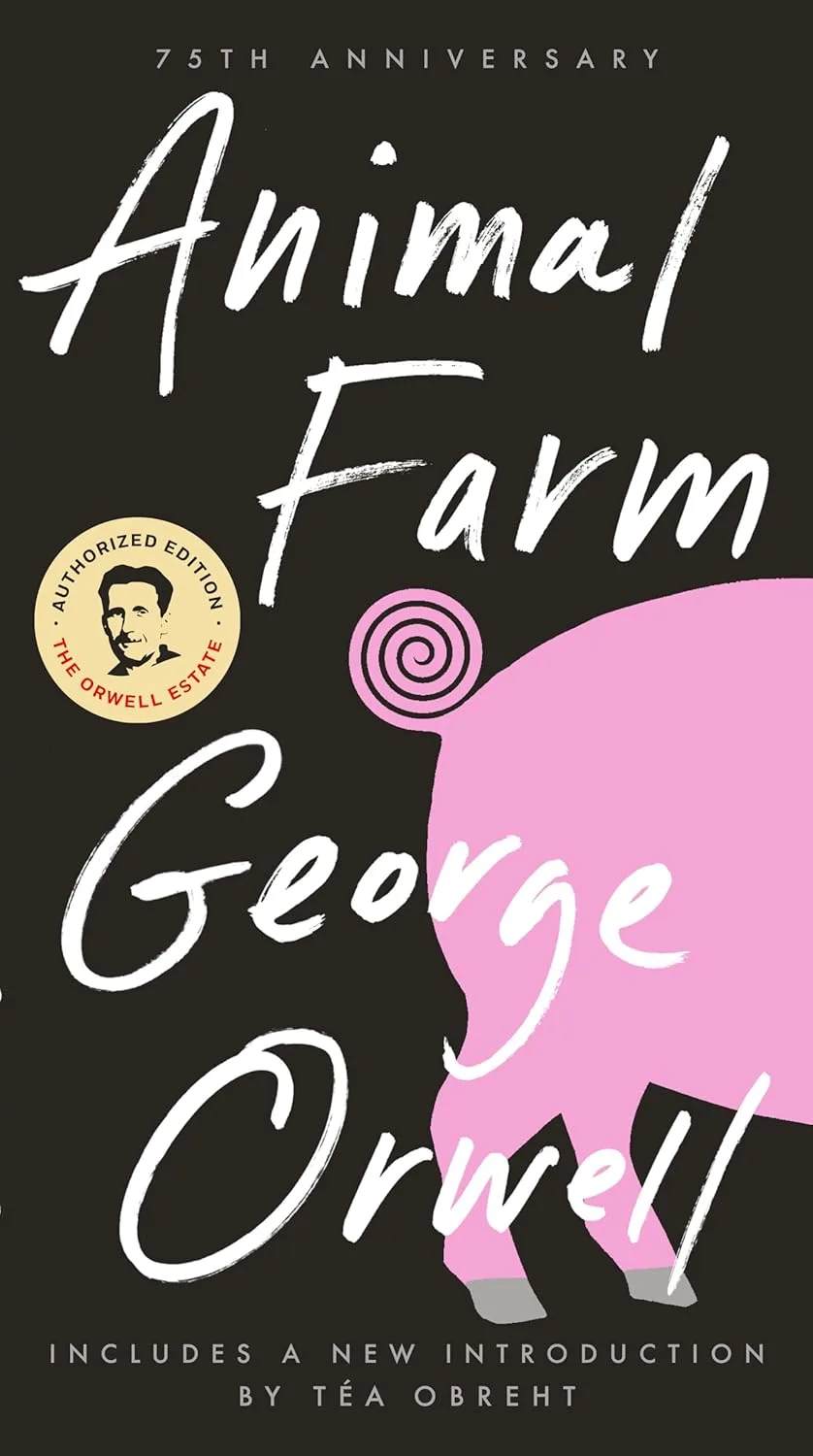
Animal Farm
Mass Market Paperback
• 140 Pages
• USD 12.00
• English
• 9780451526342
No ratings yet
| Publisher | Signet |
|---|---|
| ISBN13 | 9780451526342 |
| ASIN/SKU | 0451526341 |
| Book Format | Mass Market Paperback |
| Language | English |
| Pages | 140 |
| List Price | USD 12.00 |
| Publishing Date | 06/04/2004 |
| Dimensions | 4.25 x 0.52 x 7.56 inches |
| Weight | 2.31 pounds |
| Book Code | BD00055173 |
Buy this Book
Amazon Stores
Ebook Stores
Other Stores
Discover Animal Farm by George Orwell. This book is published by Signet in Mass Market Paperback format, ISBN 9780451526342, ASIN 0451526341, under Literature and Fiction, Contemporary Literature and Fiction, Fiction Satire.
Book Description
75th Anniversary Edition—Includes a New Introduction by Téa Obreht
George Orwell's timeless and timely allegorical novel—a scathing satire of a downtrodden society’s blind march towards totalitarianism.
“All animals are equal, but some animals are more equal than others.”
A farm is taken over by its overworked, mistreated animals. With flaming idealism and stirring slogans, they set out to create a paradise of progress, justice, and equality. Thus the stage is set for one of the most telling satiric fables ever penned—a razor-edged fairy tale for grown-ups that records the evolution from revolution against tyranny to a totalitarianism just as terrible.
When Animal Farm was first published, Stalinist Russia was seen as its target. Today it is devastatingly clear that wherever and whenever freedom is attacked, under whatever banner, the cutting clarity and savage comedy of George Orwell’s masterpiece have a meaning and message still ferociously fresh.
The metadata of this book has been prepared at Booksdata .org.
George Orwell's timeless and timely allegorical novel—a scathing satire of a downtrodden society’s blind march towards totalitarianism.
“All animals are equal, but some animals are more equal than others.”
A farm is taken over by its overworked, mistreated animals. With flaming idealism and stirring slogans, they set out to create a paradise of progress, justice, and equality. Thus the stage is set for one of the most telling satiric fables ever penned—a razor-edged fairy tale for grown-ups that records the evolution from revolution against tyranny to a totalitarianism just as terrible.
When Animal Farm was first published, Stalinist Russia was seen as its target. Today it is devastatingly clear that wherever and whenever freedom is attacked, under whatever banner, the cutting clarity and savage comedy of George Orwell’s masterpiece have a meaning and message still ferociously fresh.
The metadata of this book has been prepared at Booksdata .org.
Author Biography
George Orwell (pseudonym for Eric Blair [1903-50]) was born in Bengal and educated at Eton; after service with the Indian Imperial Police in Burma, he returned to Europe to earn his living penning novels and essays. He was essentially a political writer who focused his attention on his own times, a man of intense feelings and intense hates. An opponent of totalitarianism, he served in the Loyalist forces in the Spanish Civil War. Besides his classic Animal Farm, his works include a novel based on his experiences as a colonial policeman, Burmese Days, two firsthand studies of poverty, Down and Out in Paris and London and The Road to Wigan Pier, an account of his experiences in the Spanish Civil War, Homage to Catalonia; and the extraordinary novel of political prophecy whose title became part of our language, 1984.
Editorial Reviews
“Animal Farm remains our great satire on the darker face of modern history.”—Malcolm Bradbury
“As lucid as glass and quite as sharp…[Animal Farm] has the double meaning, the sharp edge, and the lucidity of Swift.”—Atlantic Monthly
“A wise, compassionate, and illuminating fable for our times.”—The New York Times
“Orwell has worked out his theme with a simplicity, a wit, and a dryness that are close to La Fontaine and Gay, and has written in a prose so plain and spare, so admirably proportioned to his purpose, that Animal Farm even seems very creditable if we compare it with Voltaire and Swift.”—Edmund Wilson, The New Yorker
“Orwell’s satire here is amply broad, cleverly conceived, and delightfully written.”—San Francisco Chronicle
“The book for everyone and Everyman, its brightness undimmed after fifty years.”—Ruth Rendell
“As lucid as glass and quite as sharp…[Animal Farm] has the double meaning, the sharp edge, and the lucidity of Swift.”—Atlantic Monthly
“A wise, compassionate, and illuminating fable for our times.”—The New York Times
“Orwell has worked out his theme with a simplicity, a wit, and a dryness that are close to La Fontaine and Gay, and has written in a prose so plain and spare, so admirably proportioned to his purpose, that Animal Farm even seems very creditable if we compare it with Voltaire and Swift.”—Edmund Wilson, The New Yorker
“Orwell’s satire here is amply broad, cleverly conceived, and delightfully written.”—San Francisco Chronicle
“The book for everyone and Everyman, its brightness undimmed after fifty years.”—Ruth Rendell
Book Summary
George Orwell’s Animal Farm is a brilliantly crafted allegorical tale where farmyard animals overthrow their human oppressors, only to discover that their utopian dream can easily be hijacked by those seeking absolute power. It is a story where the pursuit of freedom tragically paves the road to a new, far more insidious form of tyranny.
Introduction: A Rebellion in the English Countryside
Set against the pastoral backdrop of the Manor Farm in England, the narrative unfolds as a collective struggle rather than a traditional single-protagonist journey. The "protagonist" is essentially the working-class animals of the farm—most poignantly represented by Boxer, a loyal and tirelessly hard-working cart-horse, and the early, idealistic iteration of the animal collective. Their central conflict is the fight to establish and maintain a free, egalitarian society in the wake of a successful revolution. They must battle both the external threat of human interference and the internal rot of political corruption.
What makes Animal Farm entirely unique is its format. Orwell disguises a scathing, historically accurate critique of the Russian Revolution and the subsequent rise of Stalinism within the seemingly innocent framework of an animal fable. By replacing historical figures with pigs, horses, and dogs, Orwell distills complex political theory into a universally accessible, timeless narrative about human nature and the mechanics of oppression.
Expanded Plot Overview
The inciting incident occurs when Old Major, an aging and highly respected prize boar, gathers the farm animals to share a revolutionary dream. He paints a vision of a world where animals are no longer exploited, beaten, or slaughtered by humans. He teaches them a stirring anthem, "Beasts of England," sparking a fire of rebellion in their hearts. Shortly after Old Major’s death, the animals, pushed to the brink by the drunken and neglectful farmer Mr. Jones, spontaneously rise up. They chase Jones and his men off the property, successfully taking control of the land and renaming it "Animal Farm."
The animals’ primary goal is to build a utopian society based on the principles of "Animalism." They distill Old Major’s teachings into Seven Commandments, painted on the barn wall, the most important being: "All animals are equal." Initially, the farm prospers. The animals work harder and more efficiently than ever before, bound together by the shared joy of working for their own benefit rather than enriching a human master. Snowball, a brilliant and idealistic pig, attempts to educate the animals and plans a windmill to modernize the farm and reduce their labor.
However, the animals face severe obstacles. Externally, they must defend their new home from human farmers who seek to squash the rebellion (the Battle of the Cowshed). Internally, a much darker obstacle emerges: the rising ambition of Napoleon, a ruthless and taciturn Berkshire boar. Rather than contributing to the collective, Napoleon secretly raises a litter of puppies into a private, vicious security force.
When Snowball’s popularity threatens his control, Napoleon uses his attack dogs to violently exile Snowball from the farm. From this point forward, the utopian goal is systematically dismantled. Napoleon seizes absolute control, ending democratic meetings and ruling by decree. Through the insidious use of propaganda, revisionist history, and the constant threat of violence, the pigs elevate themselves to a ruling class. The animals face grueling labor, starvation, and the heartbreak of watching their foundational commandments be secretly rewritten in the dead of night to justify the pigs' increasingly human-like vices.
Main Characters
The characters in Animal Farm serve as direct allegorical counterparts to historical figures and societal classes from the Soviet era:
• Old Major: A composite of Karl Marx and Vladimir Lenin. He is the visionary philosopher whose ideals spark the revolution but who dies before seeing how his theories are corrupted in practice.
• Napoleon: The Stalin figure. A large, fierce-looking boar who is not much of a talker but has a reputation for getting his own way. He represents the political tyrant who relies on military force (his dogs) and fear-mongering to consolidate absolute power.
• Snowball: The Trotsky figure. Intellectual, passionate, and genuinely invested in improving the lives of the animals. His strategic brilliance makes him a hero, but his lack of ruthlessness allows him to be outmaneuvered and scapegoated by Napoleon.
• Boxer: The tragic heart of the novel, representing the dedicated, uneducated working class. His immense strength and naive loyalty are summed up by his two personal maxims: "I will work harder" and "Napoleon is always right." He is exploited relentlessly by the regime he helped create.
• Squealer: The propaganda machine, representing the Soviet press (like Pravda). Silver-tongued and manipulative, Squealer can "turn black into white." He constantly justifies the pigs' hoarding of resources and rewrites the farm's history to confuse and control the masses.
• Mr. Jones: The Tsar Nicholas II figure. The original human owner of Manor Farm whose cruelty, incompetence, and alcoholism create the perfect breeding ground for revolution.
• Benjamin: The cynical donkey who represents the older, skeptical generation of intellectuals in Russia. He recognizes the pigs' corruption from the start but chooses to remain silent and apathetic, a tragic flaw that costs his closest friend, Boxer, dearly.
Themes
While Orwell’s work is deeply political, it touches on profound, universal human themes:
• The Subversion of Justice: The novel explores how the pursuit of justice can be twisted. The animals initially seek justice against the cruelty of Mr. Jones, but the pigs gradually pervert the legal code (the Seven Commandments) to serve their own selfish desires, proving that laws are only as just as those who enforce them.
• The Corrupting Nature of Power: The overarching theme of the novel is that power invariably corrupts. The pigs, who originally suffered alongside the other animals, eventually adopt the exact same oppressive tactics—and even the clothing and habits—of the humans they overthrew.
• Propaganda and the Erasure of Truth: Orwell brilliantly illustrates how easily reality can be manipulated. Through Squealer, the pigs alter the animals' memories of the past, proving that controlling information and language is the most effective way to control a population.
• Grief and Betrayal: There is a profound sense of grief that permeates the latter half of the book. It is not just grief for the physical loss of friends, but a deep, melancholic mourning for the loss of an ideal. The animals watch their hard-won freedom slip away, replaced by a betrayal so absolute they can no longer articulate their despair.
Writing Style
Orwell’s writing style in Animal Farm is intentionally sparse, straightforward, and unadorned. It is written in the tradition of a fable or fairy tale, moving at a remarkably fast pace. This simplicity is deeply deceptive. By using plain, objective prose, Orwell allows the dramatic irony and the horror of the animals’ situation to speak for itself. The tone is deeply satirical and increasingly melancholic. There is no heavy-handed moralizing from the narrator; the tragedy unfolds with a quiet, inevitable dread, making the emotional impact of the pigs' betrayal all the more devastating.
Who Should Read It?
Animal Farm is an essential read for anyone over the age of twelve. It is specifically highly recommended for:
• Students of History and Politics: To understand the mechanics of totalitarianism, the Russian Revolution, and the cyclical nature of political regimes.
• Fans of Dystopian Fiction: It serves as a foundational text for understanding dystopian narratives, pairing perfectly with Orwell's 1984.
• General Readers: Because of its short length and engaging narrative, it is perfect for anyone looking for a profoundly thought-provoking book that can be read in a single sitting.
Key Takeaways
• The Fragility of Freedom: A successful revolution does not guarantee a free society; vigilance is required to prevent new leaders from becoming new dictators.
• The Danger of a Naive Populace: The animals' inability to read, remember their own history, or articulate their thoughts allows the pigs to exploit them. An educated and questioning public is the only defense against tyranny.
• Language is a Weapon: The gradual alteration of the Seven Commandments showcases how those in power can manipulate language to justify the unjustifiable.
• The Ultimate Betrayal: The novel culminates in the chilling realization that the oppressed have become indistinguishable from their former oppressors, immortalized in the paradox: "All animals are equal, but some animals are more equal than others."
Introduction: A Rebellion in the English Countryside
Set against the pastoral backdrop of the Manor Farm in England, the narrative unfolds as a collective struggle rather than a traditional single-protagonist journey. The "protagonist" is essentially the working-class animals of the farm—most poignantly represented by Boxer, a loyal and tirelessly hard-working cart-horse, and the early, idealistic iteration of the animal collective. Their central conflict is the fight to establish and maintain a free, egalitarian society in the wake of a successful revolution. They must battle both the external threat of human interference and the internal rot of political corruption.
What makes Animal Farm entirely unique is its format. Orwell disguises a scathing, historically accurate critique of the Russian Revolution and the subsequent rise of Stalinism within the seemingly innocent framework of an animal fable. By replacing historical figures with pigs, horses, and dogs, Orwell distills complex political theory into a universally accessible, timeless narrative about human nature and the mechanics of oppression.
Expanded Plot Overview
The inciting incident occurs when Old Major, an aging and highly respected prize boar, gathers the farm animals to share a revolutionary dream. He paints a vision of a world where animals are no longer exploited, beaten, or slaughtered by humans. He teaches them a stirring anthem, "Beasts of England," sparking a fire of rebellion in their hearts. Shortly after Old Major’s death, the animals, pushed to the brink by the drunken and neglectful farmer Mr. Jones, spontaneously rise up. They chase Jones and his men off the property, successfully taking control of the land and renaming it "Animal Farm."
The animals’ primary goal is to build a utopian society based on the principles of "Animalism." They distill Old Major’s teachings into Seven Commandments, painted on the barn wall, the most important being: "All animals are equal." Initially, the farm prospers. The animals work harder and more efficiently than ever before, bound together by the shared joy of working for their own benefit rather than enriching a human master. Snowball, a brilliant and idealistic pig, attempts to educate the animals and plans a windmill to modernize the farm and reduce their labor.
However, the animals face severe obstacles. Externally, they must defend their new home from human farmers who seek to squash the rebellion (the Battle of the Cowshed). Internally, a much darker obstacle emerges: the rising ambition of Napoleon, a ruthless and taciturn Berkshire boar. Rather than contributing to the collective, Napoleon secretly raises a litter of puppies into a private, vicious security force.
When Snowball’s popularity threatens his control, Napoleon uses his attack dogs to violently exile Snowball from the farm. From this point forward, the utopian goal is systematically dismantled. Napoleon seizes absolute control, ending democratic meetings and ruling by decree. Through the insidious use of propaganda, revisionist history, and the constant threat of violence, the pigs elevate themselves to a ruling class. The animals face grueling labor, starvation, and the heartbreak of watching their foundational commandments be secretly rewritten in the dead of night to justify the pigs' increasingly human-like vices.
Main Characters
The characters in Animal Farm serve as direct allegorical counterparts to historical figures and societal classes from the Soviet era:
• Old Major: A composite of Karl Marx and Vladimir Lenin. He is the visionary philosopher whose ideals spark the revolution but who dies before seeing how his theories are corrupted in practice.
• Napoleon: The Stalin figure. A large, fierce-looking boar who is not much of a talker but has a reputation for getting his own way. He represents the political tyrant who relies on military force (his dogs) and fear-mongering to consolidate absolute power.
• Snowball: The Trotsky figure. Intellectual, passionate, and genuinely invested in improving the lives of the animals. His strategic brilliance makes him a hero, but his lack of ruthlessness allows him to be outmaneuvered and scapegoated by Napoleon.
• Boxer: The tragic heart of the novel, representing the dedicated, uneducated working class. His immense strength and naive loyalty are summed up by his two personal maxims: "I will work harder" and "Napoleon is always right." He is exploited relentlessly by the regime he helped create.
• Squealer: The propaganda machine, representing the Soviet press (like Pravda). Silver-tongued and manipulative, Squealer can "turn black into white." He constantly justifies the pigs' hoarding of resources and rewrites the farm's history to confuse and control the masses.
• Mr. Jones: The Tsar Nicholas II figure. The original human owner of Manor Farm whose cruelty, incompetence, and alcoholism create the perfect breeding ground for revolution.
• Benjamin: The cynical donkey who represents the older, skeptical generation of intellectuals in Russia. He recognizes the pigs' corruption from the start but chooses to remain silent and apathetic, a tragic flaw that costs his closest friend, Boxer, dearly.
Themes
While Orwell’s work is deeply political, it touches on profound, universal human themes:
• The Subversion of Justice: The novel explores how the pursuit of justice can be twisted. The animals initially seek justice against the cruelty of Mr. Jones, but the pigs gradually pervert the legal code (the Seven Commandments) to serve their own selfish desires, proving that laws are only as just as those who enforce them.
• The Corrupting Nature of Power: The overarching theme of the novel is that power invariably corrupts. The pigs, who originally suffered alongside the other animals, eventually adopt the exact same oppressive tactics—and even the clothing and habits—of the humans they overthrew.
• Propaganda and the Erasure of Truth: Orwell brilliantly illustrates how easily reality can be manipulated. Through Squealer, the pigs alter the animals' memories of the past, proving that controlling information and language is the most effective way to control a population.
• Grief and Betrayal: There is a profound sense of grief that permeates the latter half of the book. It is not just grief for the physical loss of friends, but a deep, melancholic mourning for the loss of an ideal. The animals watch their hard-won freedom slip away, replaced by a betrayal so absolute they can no longer articulate their despair.
Writing Style
Orwell’s writing style in Animal Farm is intentionally sparse, straightforward, and unadorned. It is written in the tradition of a fable or fairy tale, moving at a remarkably fast pace. This simplicity is deeply deceptive. By using plain, objective prose, Orwell allows the dramatic irony and the horror of the animals’ situation to speak for itself. The tone is deeply satirical and increasingly melancholic. There is no heavy-handed moralizing from the narrator; the tragedy unfolds with a quiet, inevitable dread, making the emotional impact of the pigs' betrayal all the more devastating.
Who Should Read It?
Animal Farm is an essential read for anyone over the age of twelve. It is specifically highly recommended for:
• Students of History and Politics: To understand the mechanics of totalitarianism, the Russian Revolution, and the cyclical nature of political regimes.
• Fans of Dystopian Fiction: It serves as a foundational text for understanding dystopian narratives, pairing perfectly with Orwell's 1984.
• General Readers: Because of its short length and engaging narrative, it is perfect for anyone looking for a profoundly thought-provoking book that can be read in a single sitting.
Key Takeaways
• The Fragility of Freedom: A successful revolution does not guarantee a free society; vigilance is required to prevent new leaders from becoming new dictators.
• The Danger of a Naive Populace: The animals' inability to read, remember their own history, or articulate their thoughts allows the pigs to exploit them. An educated and questioning public is the only defense against tyranny.
• Language is a Weapon: The gradual alteration of the Seven Commandments showcases how those in power can manipulate language to justify the unjustifiable.
• The Ultimate Betrayal: The novel culminates in the chilling realization that the oppressed have become indistinguishable from their former oppressors, immortalized in the paradox: "All animals are equal, but some animals are more equal than others."
Sample Chapters
Sample Chapters will be added soon…
Reader Reviews
No reviews yet.
Animal Farm