
Pardon My Book: Ten Years of the Best (and Worst) in Sports from Pardon My Take
Hardcover
• 336 Pages
• USD 35.00
• English
• 9780063510807
No ratings yet
| Publisher | Harper |
|---|---|
| ISBN13 | 9780063510807 |
| ASIN/SKU | 0063510804 |
| Book Format | Hardcover |
| Language | English |
| Pages | 336 |
| List Price | USD 35.00 |
| Publishing Date | 18/08/2026 |
| Dimensions | 6 x 1.03 x 9 inches |
| Weight | 1.42 pounds |
| Book Code | BD00055219 |
Buy this Book
Amazon Stores
Ebook Stores
Other Stores
Discover Pardon My Book: Ten Years of the Best (and Worst) in Sports from Pardon My Take by Big Cat. This book is published by Harper in Hardcover format, ISBN 9780063510807, ASIN 0063510804, under Sports and Outdoors, Sports History.
Book Description
In celebration of its tenth anniversary, the long-awaited, definitive, authorized—and occasionally accurate—guide to the #1 sports podcast, Pardon My Take.
It’s finally here! Pardon My Book is packed with ten years of crazy content from the wildest, most irreverent sports podcast of all time. Written and curated by Big Cat and PFT with the help of the PMT crew, this entertaining yearbook takes fans behind the scenes of the show, covering topics as honorable—and as stupid—as:
The origin story of Pardon My Take and the most pivotal 30 hours in human history
How Grit Week started, what grit actually means, and what happens when you spend way too many hours trapped in an RV with your best friends
The Rules and 4 Keys to Making a successful podcast that are in no way complete and total luck
The funniest guests who embraced our chaos (Blake Bortles, Coach O, Jerry O’Connell, Ryan Whitney, the Long brothers, and many others)
Testimonials from reporting legends and loyal fans of the show, including Joe Buck, Scott Van Pelt, Chris Berman, Mike Florio, and Adam Schefter
Original contributions from the entire PMT universe, including PFT’s definitive ranking of the greatest fullbacks of all time, Big Cat’s 10 Rules to Gambling, Hank on golf, Zac on icecream (yes, one word), and, naturally, a deeply serious Mount Rushmore of Best Italian American Athletes
“Extracurriculars,” a collection of stories, disasters, arguments, rankings, and side quests that didn’t fit anywhere else in the book
And much, much more!
It’s finally here! Pardon My Book is packed with ten years of crazy content from the wildest, most irreverent sports podcast of all time. Written and curated by Big Cat and PFT with the help of the PMT crew, this entertaining yearbook takes fans behind the scenes of the show, covering topics as honorable—and as stupid—as:
The origin story of Pardon My Take and the most pivotal 30 hours in human history
How Grit Week started, what grit actually means, and what happens when you spend way too many hours trapped in an RV with your best friends
The Rules and 4 Keys to Making a successful podcast that are in no way complete and total luck
The funniest guests who embraced our chaos (Blake Bortles, Coach O, Jerry O’Connell, Ryan Whitney, the Long brothers, and many others)
Testimonials from reporting legends and loyal fans of the show, including Joe Buck, Scott Van Pelt, Chris Berman, Mike Florio, and Adam Schefter
Original contributions from the entire PMT universe, including PFT’s definitive ranking of the greatest fullbacks of all time, Big Cat’s 10 Rules to Gambling, Hank on golf, Zac on icecream (yes, one word), and, naturally, a deeply serious Mount Rushmore of Best Italian American Athletes
“Extracurriculars,” a collection of stories, disasters, arguments, rankings, and side quests that didn’t fit anywhere else in the book
And much, much more!
Author Biography
Big Cat is Dan Katz, and PFT Commenter is Eric Sollenberger. They’ve been the co-hosts of Pardon My Take since 2016.
Editorial Reviews
Editorial Reviews will be added soon…
Book Summary
Pardon My Book: Ten Years of the Best (and Worst) in Sports from Pardon My Take is a celebration of a decade of chaos, friendship, sports obsession, bad opinions, ridiculous arguments, memorable interviews, and the strange culture built around the podcast Pardon My Take. Written and curated by Big Cat and PFT Commenter with help from the wider PMT crew, the 336-page book was published by Harper in August 2026 to mark the show's tenth anniversary. Rather than presenting a conventional history of sports, it looks back at the people, jokes, arguments, disasters, traditions, and accidental legends that made Pardon My Take what it is.
At its core, the book is about how Pardon My Take grew from an unconventional sports podcast into a cultural phenomenon. Big Cat, whose real name is Dan Katz, and PFT Commenter, Eric Sollenberger, have co-hosted the show since 2016. Their chemistry is central to its identity: neither treats sports coverage as something that must always be serious or respectable. Instead, they combine genuine sports knowledge with deliberate stupidity, exaggerated confidence, running jokes, absurd debates, and a willingness to make themselves the butt of the joke. The book captures that particular voice by describing the show's history from the inside, with an intentionally self-deprecating attitude. Even its description calls itself “authorized—and occasionally accurate,” establishing that readers should expect humor rather than a solemn corporate history.
One of the book's major themes is the origin story of Pardon My Take and the unlikely circumstances that allowed the show to become successful. The authors revisit what they call the pivotal early period of the podcast and explain how its distinctive personality developed. The emphasis is not simply on numbers or professional achievements but on the moments when the hosts discovered what worked: irreverent interviews, exaggerated sports takes, recurring characters, arguments that became bits, and a willingness to follow an idea long after a normal sports program would have abandoned it. The result is a portrait of a media project whose success appears, at least from the authors' comic perspective, to be a mixture of instinct, persistence, friendship, and an enormous amount of luck.
Grit Week receives particular attention because it represents the show's ability to turn sports culture into an adventure. The book looks at how the tradition began, what “grit” means within the PMT universe, and what happens when the hosts and crew spend extended periods traveling together in an RV. What might ordinarily be a promotional tour becomes a source of stories, arguments, exhaustion, inside jokes, and unexpected encounters. Grit Week demonstrates one of the book's larger ideas: some of the most memorable moments in sports media are not carefully planned. They emerge from putting entertaining people into unpredictable situations and allowing their personalities to collide.
The book also examines the show's famous interviews and guests. Rather than treating celebrity interviews as polished promotional appearances, Pardon My Take often tries to create an atmosphere in which athletes, coaches, entertainers, and media personalities can participate in the show's particular brand of chaos. Guests such as Blake Bortles, Coach O, Jerry O'Connell, Ryan Whitney, and the Long brothers are highlighted as people who embraced that spirit. The book also includes testimonials from respected sports journalists and broadcasters, including Joe Buck, Scott Van Pelt, Chris Berman, Mike Florio, and Adam Schefter. Their presence reinforces how unusual PMT's position has become: a deliberately unserious program has developed relationships with many of the serious figures who shape sports media.
Another important part of the book is the “Embrace Debate” philosophy. Sports fans naturally argue about rankings, players, teams, and historical questions, but PMT turns those arguments into entertainment. The book revisits debates about subjects such as the greatest fullbacks, whether the media correctly evaluated LeBron James, and the recurring “Blake of the Year” discussion. These topics are funny partly because they are simultaneously ridiculous and strangely important to the people discussing them. The book understands that sports fandom is filled with arguments that have no real consequence but can nevertheless become deeply meaningful to fans.
Gambling and bad bets form another recurring thread. The book includes Big Cat's 10 Rules to Gambling, stories about terrible wagers, and the legendary Larry the Gambling Goldfish. The humor comes from the contradiction between the confidence with which sports predictions are presented and the inevitable reality that sports are unpredictable. By turning failed predictions into stories rather than hiding them, the book celebrates one of PMT's defining characteristics: being willing to be spectacularly wrong and then laughing about it.
The book also gives space to the broader PMT universe. Contributions from staff members such as Hank, Max, Zac, and Memes show that the program is not simply the product of two hosts. Over ten years, producers and recurring personalities have become characters in the show's mythology. Their individual obsessions and eccentricities have helped create a community that feels larger than the podcast itself. Essays on golf, ice cream, gambling, sports rankings, and other seemingly random subjects reinforce the idea that PMT's world is built from many small interests that become funny through repetition and personality.
Perhaps the most revealing sections are the “Extracurriculars”: stories, disasters, arguments, rankings, investigations, conspiracies, scandals, and side quests that do not fit neatly into the main structure. These episodes of controlled disorder show how the podcast's identity has always depended on following unusual ideas. The “art of the Take” is essentially the art of having a strong, entertaining opinion and committing to it, even when the opinion is questionable. That approach transforms ordinary sports discussion into a form of performance comedy.
Ultimately, Pardon My Book is less a traditional sports history than a memory book for a particular sports community. Its real subject is not wins and losses but the culture surrounding sports: friendships formed through fandom, arguments that become traditions, personalities who become legends, and jokes that remain funny because people have shared them for years. The book's Mount Rushmore of PMT moments, running bits, and iconic pieces of “dumb stuff” captures this perfectly.
The humane appeal of the book lies in its understanding that sports fandom is rarely rational. People care intensely about games, players, predictions, rivalries, and completely meaningless debates because these things give them something to share with other people. Pardon My Book celebrates that irrationality. It suggests that sometimes the value of sports is not found in being right, but in having someone to argue with, laugh with, travel with, listen to, and remember the ridiculous moments with. In that sense, the book becomes a tribute not only to Pardon My Take but to the strange, joyful, and wonderfully unserious community that grew around it over ten years.
At its core, the book is about how Pardon My Take grew from an unconventional sports podcast into a cultural phenomenon. Big Cat, whose real name is Dan Katz, and PFT Commenter, Eric Sollenberger, have co-hosted the show since 2016. Their chemistry is central to its identity: neither treats sports coverage as something that must always be serious or respectable. Instead, they combine genuine sports knowledge with deliberate stupidity, exaggerated confidence, running jokes, absurd debates, and a willingness to make themselves the butt of the joke. The book captures that particular voice by describing the show's history from the inside, with an intentionally self-deprecating attitude. Even its description calls itself “authorized—and occasionally accurate,” establishing that readers should expect humor rather than a solemn corporate history.
One of the book's major themes is the origin story of Pardon My Take and the unlikely circumstances that allowed the show to become successful. The authors revisit what they call the pivotal early period of the podcast and explain how its distinctive personality developed. The emphasis is not simply on numbers or professional achievements but on the moments when the hosts discovered what worked: irreverent interviews, exaggerated sports takes, recurring characters, arguments that became bits, and a willingness to follow an idea long after a normal sports program would have abandoned it. The result is a portrait of a media project whose success appears, at least from the authors' comic perspective, to be a mixture of instinct, persistence, friendship, and an enormous amount of luck.
Grit Week receives particular attention because it represents the show's ability to turn sports culture into an adventure. The book looks at how the tradition began, what “grit” means within the PMT universe, and what happens when the hosts and crew spend extended periods traveling together in an RV. What might ordinarily be a promotional tour becomes a source of stories, arguments, exhaustion, inside jokes, and unexpected encounters. Grit Week demonstrates one of the book's larger ideas: some of the most memorable moments in sports media are not carefully planned. They emerge from putting entertaining people into unpredictable situations and allowing their personalities to collide.
The book also examines the show's famous interviews and guests. Rather than treating celebrity interviews as polished promotional appearances, Pardon My Take often tries to create an atmosphere in which athletes, coaches, entertainers, and media personalities can participate in the show's particular brand of chaos. Guests such as Blake Bortles, Coach O, Jerry O'Connell, Ryan Whitney, and the Long brothers are highlighted as people who embraced that spirit. The book also includes testimonials from respected sports journalists and broadcasters, including Joe Buck, Scott Van Pelt, Chris Berman, Mike Florio, and Adam Schefter. Their presence reinforces how unusual PMT's position has become: a deliberately unserious program has developed relationships with many of the serious figures who shape sports media.
Another important part of the book is the “Embrace Debate” philosophy. Sports fans naturally argue about rankings, players, teams, and historical questions, but PMT turns those arguments into entertainment. The book revisits debates about subjects such as the greatest fullbacks, whether the media correctly evaluated LeBron James, and the recurring “Blake of the Year” discussion. These topics are funny partly because they are simultaneously ridiculous and strangely important to the people discussing them. The book understands that sports fandom is filled with arguments that have no real consequence but can nevertheless become deeply meaningful to fans.
Gambling and bad bets form another recurring thread. The book includes Big Cat's 10 Rules to Gambling, stories about terrible wagers, and the legendary Larry the Gambling Goldfish. The humor comes from the contradiction between the confidence with which sports predictions are presented and the inevitable reality that sports are unpredictable. By turning failed predictions into stories rather than hiding them, the book celebrates one of PMT's defining characteristics: being willing to be spectacularly wrong and then laughing about it.
The book also gives space to the broader PMT universe. Contributions from staff members such as Hank, Max, Zac, and Memes show that the program is not simply the product of two hosts. Over ten years, producers and recurring personalities have become characters in the show's mythology. Their individual obsessions and eccentricities have helped create a community that feels larger than the podcast itself. Essays on golf, ice cream, gambling, sports rankings, and other seemingly random subjects reinforce the idea that PMT's world is built from many small interests that become funny through repetition and personality.
Perhaps the most revealing sections are the “Extracurriculars”: stories, disasters, arguments, rankings, investigations, conspiracies, scandals, and side quests that do not fit neatly into the main structure. These episodes of controlled disorder show how the podcast's identity has always depended on following unusual ideas. The “art of the Take” is essentially the art of having a strong, entertaining opinion and committing to it, even when the opinion is questionable. That approach transforms ordinary sports discussion into a form of performance comedy.
Ultimately, Pardon My Book is less a traditional sports history than a memory book for a particular sports community. Its real subject is not wins and losses but the culture surrounding sports: friendships formed through fandom, arguments that become traditions, personalities who become legends, and jokes that remain funny because people have shared them for years. The book's Mount Rushmore of PMT moments, running bits, and iconic pieces of “dumb stuff” captures this perfectly.
The humane appeal of the book lies in its understanding that sports fandom is rarely rational. People care intensely about games, players, predictions, rivalries, and completely meaningless debates because these things give them something to share with other people. Pardon My Book celebrates that irrationality. It suggests that sometimes the value of sports is not found in being right, but in having someone to argue with, laugh with, travel with, listen to, and remember the ridiculous moments with. In that sense, the book becomes a tribute not only to Pardon My Take but to the strange, joyful, and wonderfully unserious community that grew around it over ten years.
Sample Chapters
Sample Chapters will be added soon…
Reader Reviews
No reviews yet.
Pardon My Book: Ten Years of the Best (and Worst) in Sports from Pardon My Take
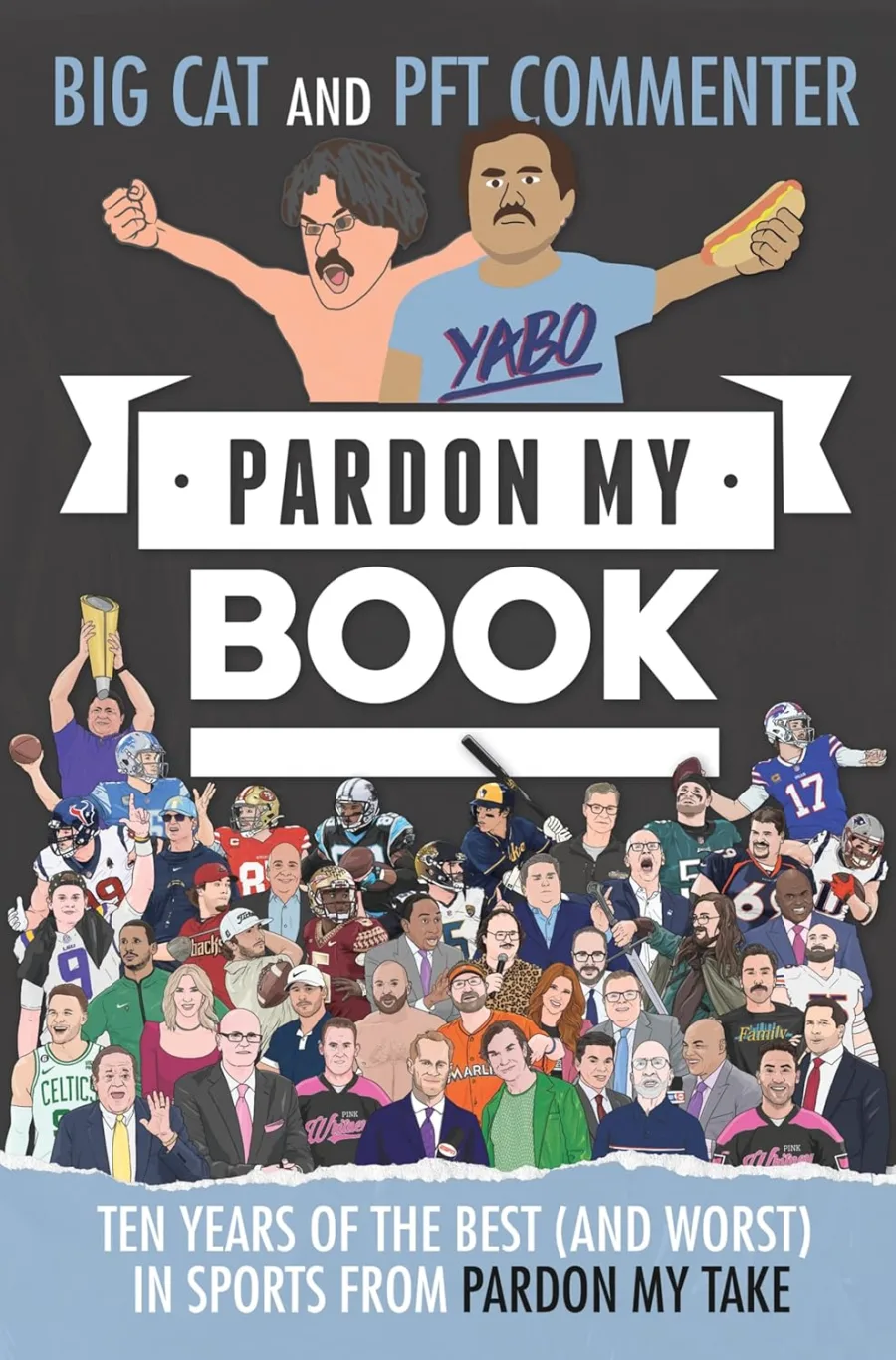
Download Cover Image
Do you want to download the full cover image for Pardon My Book: Ten Years of the Best (and Worst) in Sports from Pardon My Take?