
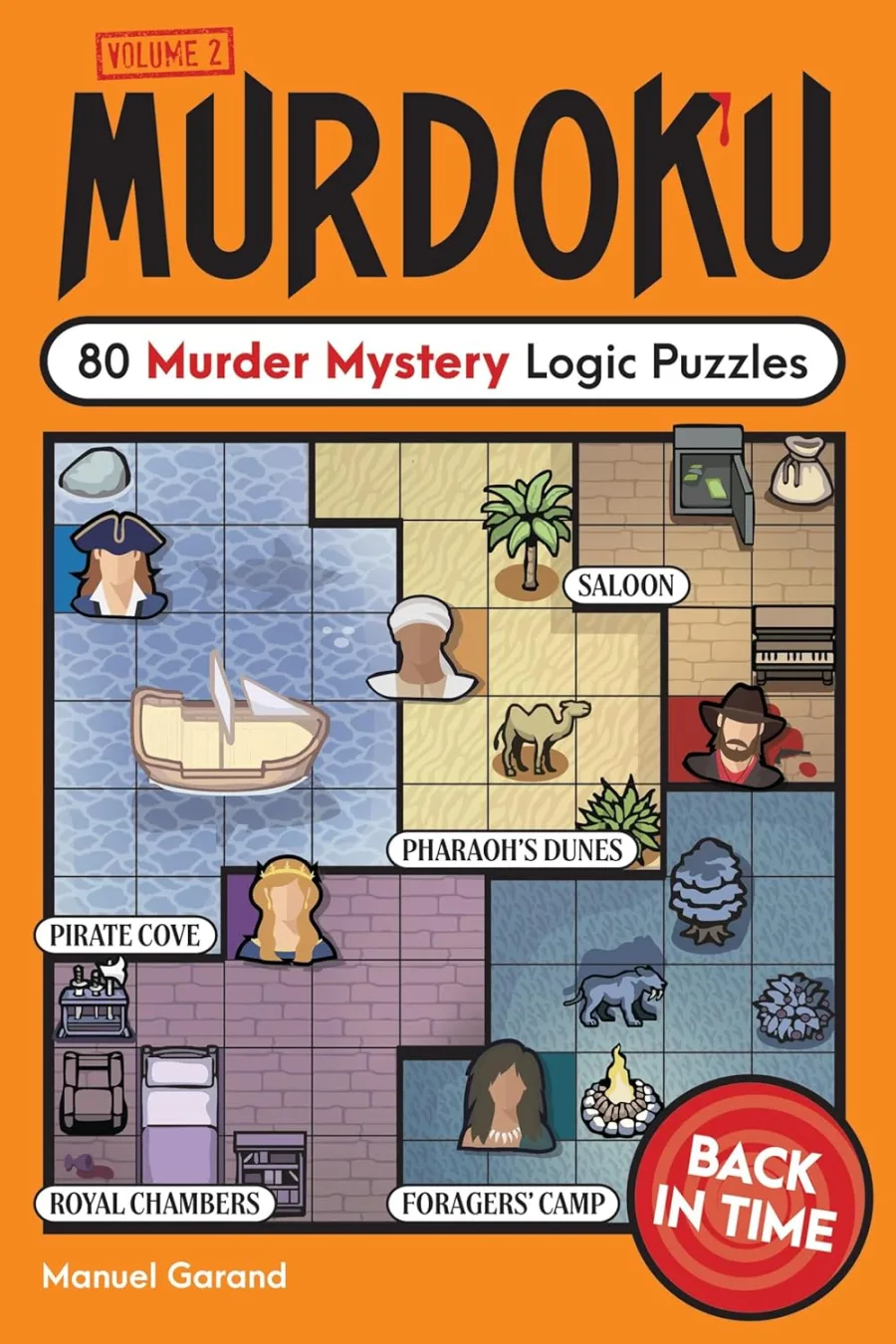
Murdoku Volume 2: Back in Time: 80 Murder Mystery Logic Puzzles
Paperback
• 224 Pages
• USD 18.99
• English
• 9781454961802
No ratings yet
| Publisher | Puzzlewright Press |
|---|---|
| ISBN13 | 9781454961802 |
| ASIN/SKU | 1454961805 |
| Book Format | Paperback |
| Language | English |
| Pages | 224 |
| List Price | USD 18.99 |
| Publishing Date | 19/05/2026 |
| Dimensions | 6.03 x 0.59 x 9.02 inches |
| Weight | 14.9 ounces |
| Book Code | BD00055221 |
Buy this Book
Amazon Stores
Ebook Stores
Other Stores
Discover Murdoku Volume 2: Back in Time: 80 Murder Mystery Logic Puzzles by Manuel Garand. This book is published by Puzzlewright Press in Paperback format, ISBN 9781454961802, ASIN 1454961805, under Humor and Entertainment, Puzzles, Sudoku.
Book Description
A truly innovative puzzle that incorporates murder mysteries, environmental storytelling, sudoku-like logic ... and now, time travel!
Place the suspects, reveal the killer!
These visually appealing, addictive puzzles drop solvers into immersive mini murder mysteries, combining features of classic Japanese-style logic puzzles like sudoku with the storytelling of classic grid logic problems. Each Murdoku grid is its own unique crime scene in which every detail is important: rooms, furniture, plants, animals, and most importantly, the suspects.
Using the clues, you must find each suspect's location to reveal the killer. This time, though, there's a twist: you've stumbled upon a time portal that's brought you to the past. You'll visit the Stone Age, medieval times, the Old West, ancient Egypt, and the Golden Age of Piracy on your way back to your own time.
Each era has its own flavor, but one thing is always true: there are murders to solve. Are you up for the challenge?
Place the suspects, reveal the killer!
These visually appealing, addictive puzzles drop solvers into immersive mini murder mysteries, combining features of classic Japanese-style logic puzzles like sudoku with the storytelling of classic grid logic problems. Each Murdoku grid is its own unique crime scene in which every detail is important: rooms, furniture, plants, animals, and most importantly, the suspects.
Using the clues, you must find each suspect's location to reveal the killer. This time, though, there's a twist: you've stumbled upon a time portal that's brought you to the past. You'll visit the Stone Age, medieval times, the Old West, ancient Egypt, and the Golden Age of Piracy on your way back to your own time.
Each era has its own flavor, but one thing is always true: there are murders to solve. Are you up for the challenge?
Author Biography
Manuel Garand is a puzzle designer and artist from Montreal, Canada, whose puzzles have appeared in the Financial Times. When he’s not inventing new logic puzzles, he’s spending time with his two favourite sidekicks – his two-year-old and six-month-old sons – and his wife, Cindy, who was the first to get hooked on his puzzles and remains his most passionate (and competitive) test-solver.
Editorial Reviews
"One of the richest and most rewarding puzzles I've ever done. Murdoku is deeply satisfying and filled with layers of strategy and variety."―Peter McPherson, Origins Award-winning designer of Tiny Towns
Book Summary
“Murdoku Volume 2” by Manuel Garand is not a traditional novel, but a puzzle book built around 80 murder mystery logic challenges. Its main appeal is the way it combines the satisfaction of sudoku-style deduction with the atmosphere of a crime story, turning each puzzle into a small mystery scene that the reader has to solve through clues, logic, and careful attention to detail. The book is designed to feel playful, immersive, and steadily more difficult as it moves forward, making it both a brain teaser and a storytelling experience.
The book’s setup is simple but clever. A mysterious time machine sends the solver backwards through different historical eras, and each chapter or section places the reader in a new setting with its own visual style, rules, and puzzle mechanics. Instead of solving the same kind of grid over and over, the reader is dropped into the Stone Age, medieval times, Ancient Egypt, the Golden Age of Piracy, and the Wild West. Each era gives the puzzles a different mood, so one case may involve a temple, another a pirate cove, another a tavern, and another a frontier town. The time-travel frame gives the book variety and keeps the experience from feeling repetitive.
At the center of each puzzle is a murder mystery that must be unraveled by placing suspects correctly on a grid. The clues tell the reader where each person, object, or detail belongs, and the goal is to figure out who was alone with the victim, which in turn reveals the killer. The solving process depends on deduction rather than guesswork, so the book rewards patience, pattern recognition, and logical thinking. The puzzles are presented in full color and are heavily illustrated, which makes them feel more like mini crime scenes than abstract number games.
One of the book’s biggest strengths is that it is accessible to different kinds of solvers. The puzzles are said to range from easier warm-up challenges to much harder late-book cases, so beginners can learn the system while experienced puzzlers still have room to be tested. That progression creates a sense of momentum, since each success builds confidence while the later mysteries demand more concentration. The book is meant to be addictive in the best sense: each solved grid gives a feeling of completion, but the next case immediately invites another round of detective work.
The visual storytelling is also a major part of the appeal. Every crime scene is packed with small details, and those details matter because they help the solver place suspects and eliminate possibilities. The settings are not just decorative; they are part of the logic. Furniture, animals, objects, and environmental clues all become part of the deduction process, which makes the puzzles feel richer than a standard grid exercise. The full-color artwork helps each mystery feel distinct, and the historical settings give the whole book a playful sense of adventure.
The overall structure of the book suggests a journey as much as a puzzle collection. The reader is not just solving disconnected cases; they are traveling through time while trying to find their way home. That frame gives the book a light narrative spine, enough to make the sequence of puzzles feel like one long expedition through history. The historical chapters create the feeling of moving from one world to another, while the recurring murder-mystery format keeps the challenge consistent. The result is a book that feels both varied and cohesive.
“Murdoku” is a clever mix of logic puzzle book, time-travel adventure, and murder mystery game. It offers 80 self-contained cases that ask the reader to think like a detective, use visual and verbal clues carefully, and solve each scene with methodical reasoning. The book’s charm lies in the combination of rich illustration, historical imagination, and clean deductive structure. It is meant for anyone who enjoys puzzles that feel a little more theatrical than usual, and for readers who like the idea of solving crimes one grid at a time while hopping across history.
The book’s setup is simple but clever. A mysterious time machine sends the solver backwards through different historical eras, and each chapter or section places the reader in a new setting with its own visual style, rules, and puzzle mechanics. Instead of solving the same kind of grid over and over, the reader is dropped into the Stone Age, medieval times, Ancient Egypt, the Golden Age of Piracy, and the Wild West. Each era gives the puzzles a different mood, so one case may involve a temple, another a pirate cove, another a tavern, and another a frontier town. The time-travel frame gives the book variety and keeps the experience from feeling repetitive.
At the center of each puzzle is a murder mystery that must be unraveled by placing suspects correctly on a grid. The clues tell the reader where each person, object, or detail belongs, and the goal is to figure out who was alone with the victim, which in turn reveals the killer. The solving process depends on deduction rather than guesswork, so the book rewards patience, pattern recognition, and logical thinking. The puzzles are presented in full color and are heavily illustrated, which makes them feel more like mini crime scenes than abstract number games.
One of the book’s biggest strengths is that it is accessible to different kinds of solvers. The puzzles are said to range from easier warm-up challenges to much harder late-book cases, so beginners can learn the system while experienced puzzlers still have room to be tested. That progression creates a sense of momentum, since each success builds confidence while the later mysteries demand more concentration. The book is meant to be addictive in the best sense: each solved grid gives a feeling of completion, but the next case immediately invites another round of detective work.
The visual storytelling is also a major part of the appeal. Every crime scene is packed with small details, and those details matter because they help the solver place suspects and eliminate possibilities. The settings are not just decorative; they are part of the logic. Furniture, animals, objects, and environmental clues all become part of the deduction process, which makes the puzzles feel richer than a standard grid exercise. The full-color artwork helps each mystery feel distinct, and the historical settings give the whole book a playful sense of adventure.
The overall structure of the book suggests a journey as much as a puzzle collection. The reader is not just solving disconnected cases; they are traveling through time while trying to find their way home. That frame gives the book a light narrative spine, enough to make the sequence of puzzles feel like one long expedition through history. The historical chapters create the feeling of moving from one world to another, while the recurring murder-mystery format keeps the challenge consistent. The result is a book that feels both varied and cohesive.
“Murdoku” is a clever mix of logic puzzle book, time-travel adventure, and murder mystery game. It offers 80 self-contained cases that ask the reader to think like a detective, use visual and verbal clues carefully, and solve each scene with methodical reasoning. The book’s charm lies in the combination of rich illustration, historical imagination, and clean deductive structure. It is meant for anyone who enjoys puzzles that feel a little more theatrical than usual, and for readers who like the idea of solving crimes one grid at a time while hopping across history.
Sample Chapters
Sample Chapters will be added soon…
Reader Reviews
No reviews yet.
Murdoku Volume 2: Back in Time: 80 Murder Mystery Logic Puzzles
Download Cover Image
Do you want to download the full cover image for Murdoku Volume 2: Back in Time: 80 Murder Mystery Logic Puzzles?