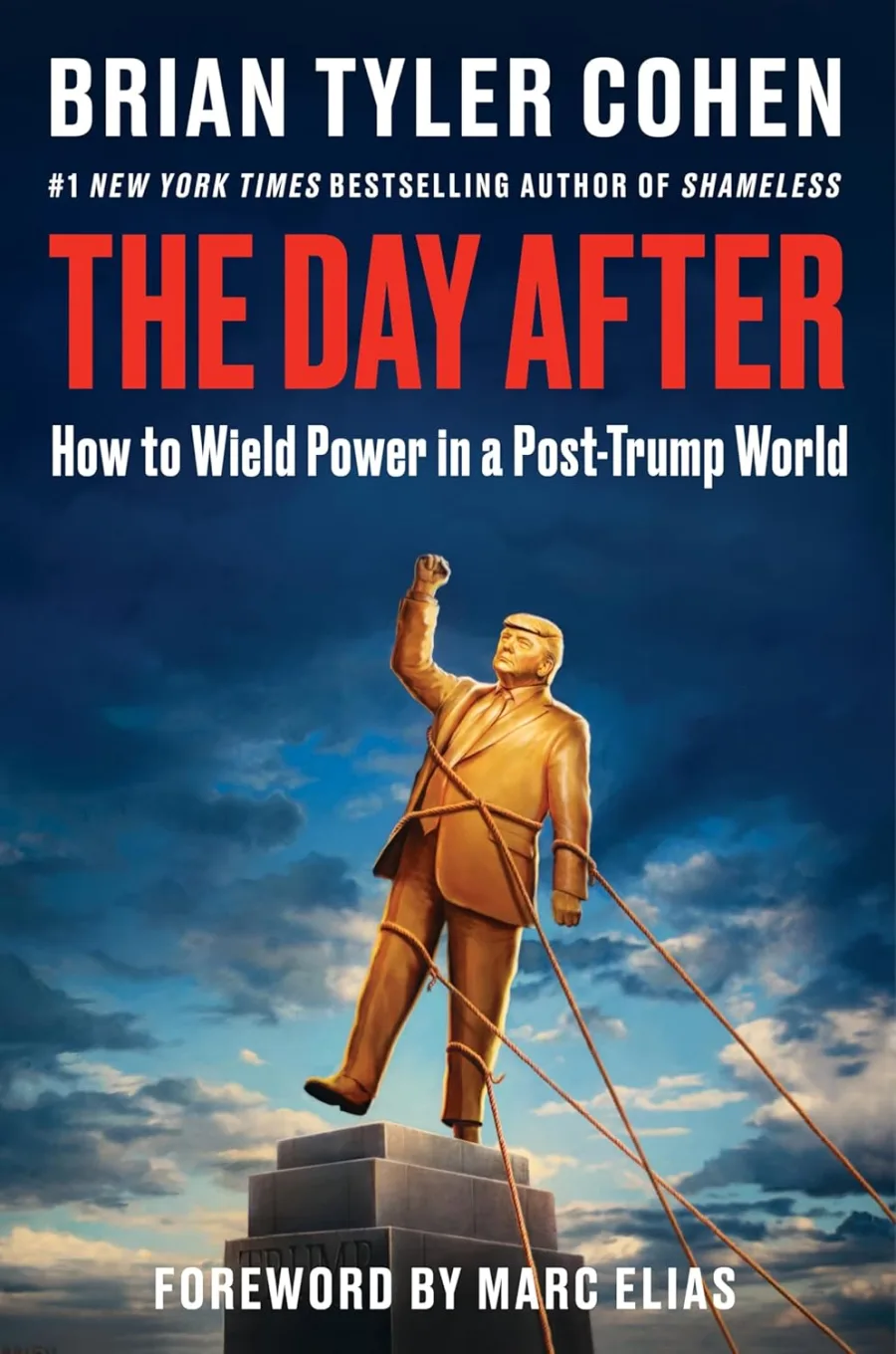
The Day After
Hardcover
• 208 Pages
• USD 28.99
• English
• 9780063495104
No ratings yet
| Publisher | Harper |
|---|---|
| ISBN13 | 9780063495104 |
| ASIN/SKU | 0063495104 |
| Book Format | Hardcover |
| Language | English |
| Pages | 208 |
| List Price | USD 28.99 |
| Publishing Date | 14/07/2026 |
| Dimensions | 10 x 2 x 2.7 inches |
| Weight | 11.9 ounces |
| Book Code | BD00055222 |
Buy this Book
Amazon Stores
Ebook Stores
Other Stores
Discover The Day After by Brian Tyler Cohen. This book is published by Harper in Hardcover format, ISBN 9780063495104, ASIN 0063495104, under Politics and Social Sciences, Political Corruption and Misconduct, Political Parties.
Book Description
From the #1 New York Times bestselling author of Shameless, Brian Tyler Cohen explores how Republicans have abused power, how Democrats have refused to exercise power when they held it, and how progressives should wield power if they are fortunate enough to win a free and fair election in a post-Trump world.
This book is a wake-up call about the decades-long project that led to Trump’s America.
It’s the playbook for progressives who want to do far more than restore the status quo.
This is how we build a stronger country, with hope and opportunity for all — before our democracy slides into a distant memory.
This book is a wake-up call about the decades-long project that led to Trump’s America.
It’s the playbook for progressives who want to do far more than restore the status quo.
This is how we build a stronger country, with hope and opportunity for all — before our democracy slides into a distant memory.
Author Biography
Brian Tyler Cohen is a progressive independent media creator. He has over 13 million subscribers across all social media platforms, including a YouTube channel with five billion views and counting. His show, No Lie with Brian Tyler Cohen, is a destination for the top names in politics. His first book, Shameless, was a #1 New York Times bestseller.
Editorial Reviews
"A battle cry for 'complacent friends of democracy' to bestir themselves to meaningful action." — Kirkus Reviews
"We like to believe that democracy is something permanent. Something fixed. Something that cannot be taken from us. History says otherwise. So does the present moment we are living in. What Brian understands, and what this book makes impossible to ignore, is that power does not disappear when it is defeated. It adapts. It waits. It returns in forms we think we recognize, until we realize we don’t. This is not a warning about the future. It is a confrontation with the present. And if you read it honestly, it will leave you with a question you cannot escape: when the moment comes again, and it will, what will you do?" — Don Lemon
"Brian Tyler Cohen is one of the most astute observers of American politics. In The Day After, he confronts the question that will define the next Democratic era: will the party finally wield power like it means it — reforming the courts, killing the filibuster, going on offense — or will it retreat into the same good-governance timidity that's handed Republicans victory after victory?" — Dan Pfeiffer, co-host of Pod Save America
“The time for moving past the Trump era is fast approaching and Democrats need a plan to remake how we exercise power, reform, and restore the rule of law. That’s where Brian Tyler Cohen comes in. His urgent plea for a Democratic party that’s going to fight back to meet this moment complete with a game plan of how we can use history as our guide to do just that couldn’t be timelier and more necessary. We can’t just talk about our problems anymore—we must solve them with the ruthlessness and precision that Republicans have wielded for decades.” — Jessica Tarlov
"We like to believe that democracy is something permanent. Something fixed. Something that cannot be taken from us. History says otherwise. So does the present moment we are living in. What Brian understands, and what this book makes impossible to ignore, is that power does not disappear when it is defeated. It adapts. It waits. It returns in forms we think we recognize, until we realize we don’t. This is not a warning about the future. It is a confrontation with the present. And if you read it honestly, it will leave you with a question you cannot escape: when the moment comes again, and it will, what will you do?" — Don Lemon
"Brian Tyler Cohen is one of the most astute observers of American politics. In The Day After, he confronts the question that will define the next Democratic era: will the party finally wield power like it means it — reforming the courts, killing the filibuster, going on offense — or will it retreat into the same good-governance timidity that's handed Republicans victory after victory?" — Dan Pfeiffer, co-host of Pod Save America
“The time for moving past the Trump era is fast approaching and Democrats need a plan to remake how we exercise power, reform, and restore the rule of law. That’s where Brian Tyler Cohen comes in. His urgent plea for a Democratic party that’s going to fight back to meet this moment complete with a game plan of how we can use history as our guide to do just that couldn’t be timelier and more necessary. We can’t just talk about our problems anymore—we must solve them with the ruthlessness and precision that Republicans have wielded for decades.” — Jessica Tarlov
Book Summary
The Day After by Brian Tyler Cohen is a political thriller that imagines the chaos, fear, and moral pressure in the immediate aftermath of a shocking assassination of a sitting U.S. president. Set in a sharply polarized America that feels very close to our present reality, the novel follows a handful of key characters—a young, ambitious political host named Tyler, members of the administration, security officials, and ordinary citizens—as they navigate a country suddenly thrown into crisis. The assassination doesn’t just remove one leader; it shatters the illusion of stability, exposes deep fractures in the system, and forces people to decide who they are when the guardrails of democracy look like they might fail. Cohen, who in real life is known for his political commentary, brings that sensibility into fiction, building a story that’s full of real-world echoes: media manipulation, online outrage, conspiracy theories, and the question of whether institutions can withstand deliberate attacks from within.
The book opens on the day after the assassination, when confusion and fear are at their peak. No one knows exactly who is responsible, and rumors fill the vacuum. The vice president, cabinet members, and security agencies scramble to assert control, but their efforts are hampered by suspicion and partisan hostility. Some characters are convinced this is the work of foreign enemies; others suspect domestic extremists; others still believe it might be an inside job. Against this tense backdrop, Tyler—a progressive political host who is used to analyzing events from the outside—finds himself drawn into the heart of the crisis. He has spent his career warning about the erosion of democratic norms and the dangers of authoritarianism, and now those fears seem to be materializing in real time. The gap between commentary and reality vanishes, and he has to decide whether he will remain a critic from the sidelines or take real risks to influence what happens next.
From the start, Cohen shows how quickly a modern crisis turns into a narrative war. Cable networks, podcasts, social media feeds, and anonymous message boards all compete to tell the “truth” about the assassination. Each side pushes its own story, often without evidence, and the country begins to fracture along familiar lines. People retreat into their preferred information bubbles, and this fragmentation becomes one of the main threats in the novel: it is not only bullets that put the country in danger, but lies, distortions, and weaponized confusion. Tyler is painfully aware of how easily outrage can be manufactured and directed, and he tries to use his platform to calm, fact-check, and warn his audience. Yet he also realizes that calm analysis may not be enough when those who want power are willing to seize the moment and twist it to their advantage.
The political machinery in Washington reacts quickly. Certain figures in the administration and in Congress see the assassination as an opportunity rather than a tragedy. They begin maneuvering to consolidate control, weaken opponents, and set in motion plans that had previously been too controversial to implement openly. Emergency powers, national security rhetoric, and calls for “unity” become tools in a quiet struggle over who will shape the country’s future. In this environment, the line between protecting the nation and exploiting fear grows dangerously thin. Cohen uses these political maneuvers to show how fragile democracy can be when rules are bent under the cover of crisis. The question that hangs over the story is whether the system is strong enough to resist those who want permanent power, or whether the shock of assassination will give them the leverage they need.
At the same time, the book assigns emotional weight to people outside government. Families who supported the president feel grief and anger; those who opposed him feel conflicted, hesitant to admit that anything about his death might be tragic. Ordinary citizens worry about riots, breakdowns of law and order, and whether their rights will be curtailed in the name of security. Cohen emphasizes that the crisis is not just about headlines and speeches; it is about fear in living rooms, arguments among friends, and the way people’s private beliefs evolve when they feel the country might be slipping away. Tyler’s own relationships—friends, allies, and people who disagree with him—become a lens through which the reader sees how the assassination affects every layer of society.
As the plot develops, Tyler uncovers disturbing information suggesting that the assassination is part of a larger plan. Clues point toward a coordinated effort to destabilize the system and usher in a more authoritarian order. He discovers connections between radical groups, political operatives, and those in power who benefit from chaos. The thriller element ramps up: Tyler becomes both investigator and potential target, as those who fear exposure move to silence dissenting voices. The tension is not just about whether he can uncover the truth, but whether anyone will listen once he does, in a country already drowning in conflicting narratives. This dynamic—truth versus “truth,” evidence versus spin—is central to the novel’s message.
Cohen, drawing on his own background in political media, portrays how information can be both a weapon and a shield. Tyler’s show, which once felt like a safe channel for commentary, becomes a risky platform. Episodes that call out lies and warn about creeping authoritarianism attract both support and dangerous attention. The novel raises difficult questions about the role of journalists, commentators, and influencers in times of national emergency. Should they strive for balance when one side is clearly abusing power? Should they call out specific individuals, even if doing so places them in personal danger? How much responsibility do they bear for what their audience believes and does? Tyler’s internal struggle over these questions adds depth to the thriller, making it not just a plot-driven chase but also a meditation on conscience.
Alongside the politics and suspense, “The Day After” explores the psychological impact of living through a potentially world-changing event. Characters experience paranoia, mistrust, and emotional exhaustion. Some grow radicalized, deciding that peaceful process is too slow or too easily blocked. Others withdraw, overwhelmed by the noise and uncertainty. Cohen suggests that the greatest threat to democracy may not be a single violent act, but the slow erosion of civic trust that follows. If people no longer believe in institutions, no longer trust elections, and no longer share a common reality, then the ground is fertile for strongmen and demagogues. The novel forces readers to confront how close the fictional world is to the anxieties of real life.
As the story moves toward its climax, Tyler and a small circle of allies race to expose the deeper conspiracy before it can fully reshape the country. The narrative accelerates, combining investigative work, on-air revelations, public protests, and behind-the-scenes confrontations. The “day after” becomes the beginning of a crucial period in which the citizens and their representatives must decide whether fear will drive them to surrender freedoms or whether they will demand accountability. Cohen keeps the tension high, but he also grounds the outcome in believable human decisions rather than convenient heroics. No single speech or action magically fixes everything; instead, small acts of courage and clarity begin to push back against the tide.
The Day After, the reader is left with a sense that the battle for democracy is ongoing and fragile, never fully won or lost in one moment. The assassination and its aftermath serve as a wake-up call for Tyler and others who had treated democracy as something stable in the background rather than something that needs constant protection. The book closes on a note that mixes caution with determination: institutions have survived—for now—but only because enough people chose truth over lies, accountability over silence, and participation over apathy. Cohen’s novel thus operates as both a gripping political thriller and a warning, suggesting that the true danger is not only in dramatic acts of violence, but in what happens—or doesn’t happen—the day after.
The book opens on the day after the assassination, when confusion and fear are at their peak. No one knows exactly who is responsible, and rumors fill the vacuum. The vice president, cabinet members, and security agencies scramble to assert control, but their efforts are hampered by suspicion and partisan hostility. Some characters are convinced this is the work of foreign enemies; others suspect domestic extremists; others still believe it might be an inside job. Against this tense backdrop, Tyler—a progressive political host who is used to analyzing events from the outside—finds himself drawn into the heart of the crisis. He has spent his career warning about the erosion of democratic norms and the dangers of authoritarianism, and now those fears seem to be materializing in real time. The gap between commentary and reality vanishes, and he has to decide whether he will remain a critic from the sidelines or take real risks to influence what happens next.
From the start, Cohen shows how quickly a modern crisis turns into a narrative war. Cable networks, podcasts, social media feeds, and anonymous message boards all compete to tell the “truth” about the assassination. Each side pushes its own story, often without evidence, and the country begins to fracture along familiar lines. People retreat into their preferred information bubbles, and this fragmentation becomes one of the main threats in the novel: it is not only bullets that put the country in danger, but lies, distortions, and weaponized confusion. Tyler is painfully aware of how easily outrage can be manufactured and directed, and he tries to use his platform to calm, fact-check, and warn his audience. Yet he also realizes that calm analysis may not be enough when those who want power are willing to seize the moment and twist it to their advantage.
The political machinery in Washington reacts quickly. Certain figures in the administration and in Congress see the assassination as an opportunity rather than a tragedy. They begin maneuvering to consolidate control, weaken opponents, and set in motion plans that had previously been too controversial to implement openly. Emergency powers, national security rhetoric, and calls for “unity” become tools in a quiet struggle over who will shape the country’s future. In this environment, the line between protecting the nation and exploiting fear grows dangerously thin. Cohen uses these political maneuvers to show how fragile democracy can be when rules are bent under the cover of crisis. The question that hangs over the story is whether the system is strong enough to resist those who want permanent power, or whether the shock of assassination will give them the leverage they need.
At the same time, the book assigns emotional weight to people outside government. Families who supported the president feel grief and anger; those who opposed him feel conflicted, hesitant to admit that anything about his death might be tragic. Ordinary citizens worry about riots, breakdowns of law and order, and whether their rights will be curtailed in the name of security. Cohen emphasizes that the crisis is not just about headlines and speeches; it is about fear in living rooms, arguments among friends, and the way people’s private beliefs evolve when they feel the country might be slipping away. Tyler’s own relationships—friends, allies, and people who disagree with him—become a lens through which the reader sees how the assassination affects every layer of society.
As the plot develops, Tyler uncovers disturbing information suggesting that the assassination is part of a larger plan. Clues point toward a coordinated effort to destabilize the system and usher in a more authoritarian order. He discovers connections between radical groups, political operatives, and those in power who benefit from chaos. The thriller element ramps up: Tyler becomes both investigator and potential target, as those who fear exposure move to silence dissenting voices. The tension is not just about whether he can uncover the truth, but whether anyone will listen once he does, in a country already drowning in conflicting narratives. This dynamic—truth versus “truth,” evidence versus spin—is central to the novel’s message.
Cohen, drawing on his own background in political media, portrays how information can be both a weapon and a shield. Tyler’s show, which once felt like a safe channel for commentary, becomes a risky platform. Episodes that call out lies and warn about creeping authoritarianism attract both support and dangerous attention. The novel raises difficult questions about the role of journalists, commentators, and influencers in times of national emergency. Should they strive for balance when one side is clearly abusing power? Should they call out specific individuals, even if doing so places them in personal danger? How much responsibility do they bear for what their audience believes and does? Tyler’s internal struggle over these questions adds depth to the thriller, making it not just a plot-driven chase but also a meditation on conscience.
Alongside the politics and suspense, “The Day After” explores the psychological impact of living through a potentially world-changing event. Characters experience paranoia, mistrust, and emotional exhaustion. Some grow radicalized, deciding that peaceful process is too slow or too easily blocked. Others withdraw, overwhelmed by the noise and uncertainty. Cohen suggests that the greatest threat to democracy may not be a single violent act, but the slow erosion of civic trust that follows. If people no longer believe in institutions, no longer trust elections, and no longer share a common reality, then the ground is fertile for strongmen and demagogues. The novel forces readers to confront how close the fictional world is to the anxieties of real life.
As the story moves toward its climax, Tyler and a small circle of allies race to expose the deeper conspiracy before it can fully reshape the country. The narrative accelerates, combining investigative work, on-air revelations, public protests, and behind-the-scenes confrontations. The “day after” becomes the beginning of a crucial period in which the citizens and their representatives must decide whether fear will drive them to surrender freedoms or whether they will demand accountability. Cohen keeps the tension high, but he also grounds the outcome in believable human decisions rather than convenient heroics. No single speech or action magically fixes everything; instead, small acts of courage and clarity begin to push back against the tide.
The Day After, the reader is left with a sense that the battle for democracy is ongoing and fragile, never fully won or lost in one moment. The assassination and its aftermath serve as a wake-up call for Tyler and others who had treated democracy as something stable in the background rather than something that needs constant protection. The book closes on a note that mixes caution with determination: institutions have survived—for now—but only because enough people chose truth over lies, accountability over silence, and participation over apathy. Cohen’s novel thus operates as both a gripping political thriller and a warning, suggesting that the true danger is not only in dramatic acts of violence, but in what happens—or doesn’t happen—the day after.
Sample Chapters
Sample Chapters will be added soon…
Reader Reviews
No reviews yet.
The Day After