
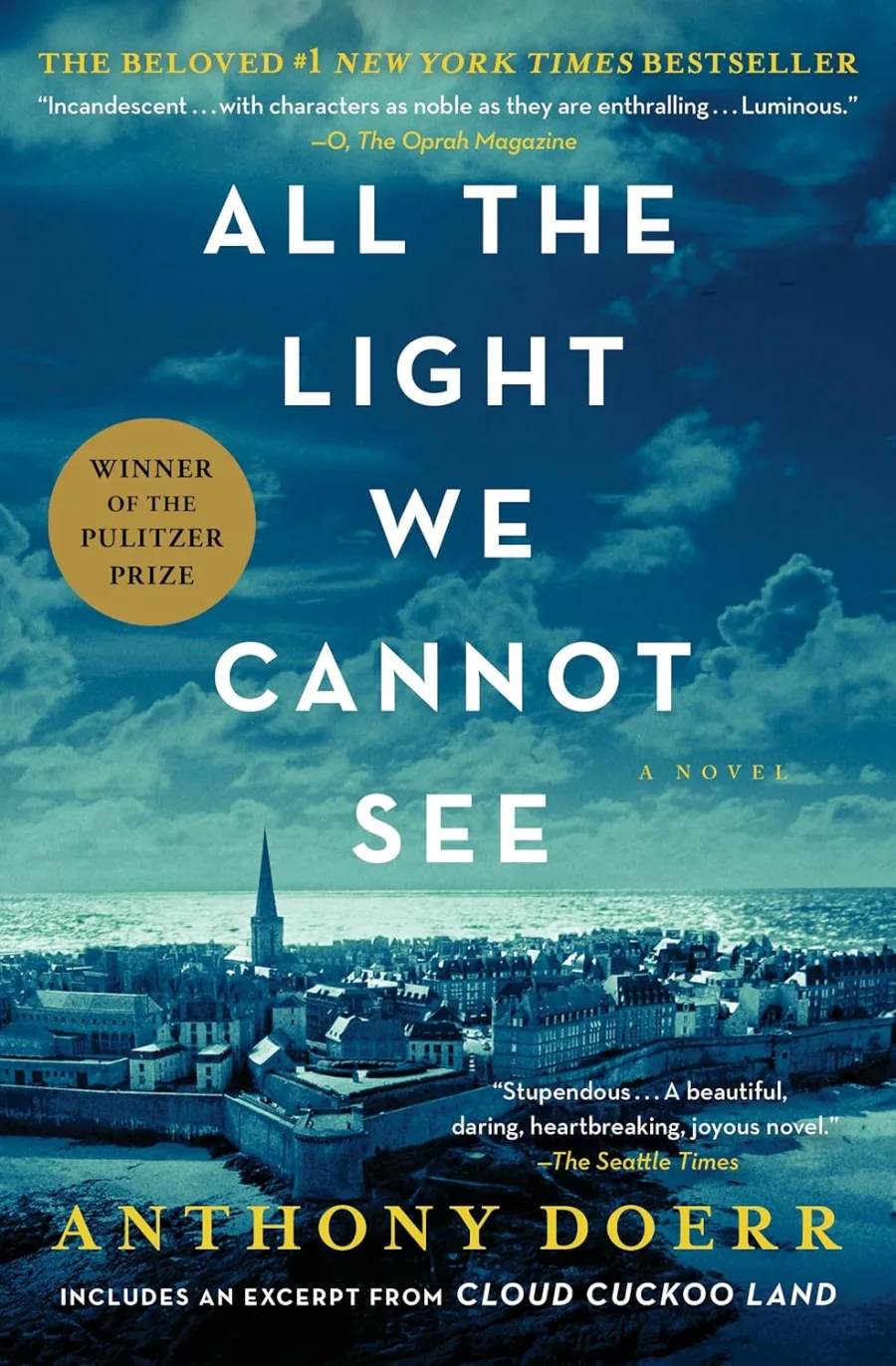
All the Light We Cannot See: A Novel
Paperback
• 544 Pages
• USD 18.00
• English
• 9781501173219
No ratings yet
| Publisher | Scribner |
|---|---|
| ISBN13 | 9781501173219 |
| ASIN/SKU | 1501173219 |
| Book Format | Paperback |
| Language | English |
| Pages | 544 |
| List Price | USD 18.00 |
| Publishing Date | 04/04/2017 |
| Dimensions | 5.2 x 7.91 x 1.18 inches |
| Weight | 15.2 ounces |
| Book Code | BD00055318 |
Buy this Book
Amazon Stores
Ebook Stores
Other Stores
Discover All the Light We Cannot See: A Novel by Anthony Doerr. This book is published by Scribner in Paperback format, ISBN 9781501173219, ASIN 1501173219, under Literature and Fiction, Military Historical Fiction, War Fiction.
Book Description
*NOW A NETFLIX LIMITED SERIES—from producer and director Shawn Levy (Stranger Things) starring Mark Ruffalo, Hugh Laurie, and newcomer Aria Mia Loberti*
Winner of the Pulitzer Prize and National Book Award finalist, the beloved instant New York Times bestseller and New York Times Book Review Top 10 Book about a blind French girl and a German boy whose paths collide in occupied France as both try to survive the devastation of World War II.
Marie-Laure lives with her father in Paris near the Museum of Natural History where he works as the master of its thousands of locks. When she is six, Marie-Laure goes blind and her father builds a perfect miniature of their neighborhood so she can memorize it by touch and navigate her way home. When she is twelve, the Nazis occupy Paris, and father and daughter flee to the walled citadel of Saint-Malo, where Marie-Laure’s reclusive great uncle lives in a tall house by the sea. With them they carry what might be the museum’s most valuable and dangerous jewel.
In a mining town in Germany, the orphan Werner grows up with his younger sister, enchanted by a crude radio they find. Werner becomes an expert at building and fixing these crucial new instruments, a talent that wins him a place at a brutal academy for Hitler Youth, then a special assignment to track the Resistance. More and more aware of the human cost of his intelligence, Werner travels through the heart of the war and, finally, into Saint-Malo, where his story and Marie-Laure’s converge.
Doerr’s “stunning sense of physical detail and gorgeous metaphors” (San Francisco Chronicle) are dazzling. Deftly interweaving the lives of Marie-Laure and Werner, he illuminates the ways, against all odds, people try to be good to one another. Ten years in the writing, All the Light We Cannot See is a magnificent, deeply moving novel from a writer “whose sentences never fail to thrill” (Los Angeles Times).
Winner of the Pulitzer Prize and National Book Award finalist, the beloved instant New York Times bestseller and New York Times Book Review Top 10 Book about a blind French girl and a German boy whose paths collide in occupied France as both try to survive the devastation of World War II.
Marie-Laure lives with her father in Paris near the Museum of Natural History where he works as the master of its thousands of locks. When she is six, Marie-Laure goes blind and her father builds a perfect miniature of their neighborhood so she can memorize it by touch and navigate her way home. When she is twelve, the Nazis occupy Paris, and father and daughter flee to the walled citadel of Saint-Malo, where Marie-Laure’s reclusive great uncle lives in a tall house by the sea. With them they carry what might be the museum’s most valuable and dangerous jewel.
In a mining town in Germany, the orphan Werner grows up with his younger sister, enchanted by a crude radio they find. Werner becomes an expert at building and fixing these crucial new instruments, a talent that wins him a place at a brutal academy for Hitler Youth, then a special assignment to track the Resistance. More and more aware of the human cost of his intelligence, Werner travels through the heart of the war and, finally, into Saint-Malo, where his story and Marie-Laure’s converge.
Doerr’s “stunning sense of physical detail and gorgeous metaphors” (San Francisco Chronicle) are dazzling. Deftly interweaving the lives of Marie-Laure and Werner, he illuminates the ways, against all odds, people try to be good to one another. Ten years in the writing, All the Light We Cannot See is a magnificent, deeply moving novel from a writer “whose sentences never fail to thrill” (Los Angeles Times).
Author Biography
Anthony Doerr has won numerous prizes for his fiction, including the Pulitzer Prize and the Carnegie Medal. His novel, 'All the Light We Cannot See,' was a #1 New York Times Bestseller and his new novel, 'Cloud Cuckoo Land,' published in September of 2021, was a finalist for the National Book Award. Learn more at www.anthonydoerr.com.
Editorial Reviews
“Exquisite…Mesmerizing…Nothing short of brilliant.” -- Alice Evans ― Portland Oregonian
“Hauntingly beautiful.” -- Janet Maslin ― The New York Times
“History intertwines with irresistible fiction—secret radio broadcasts, a cursed diamond, a soldier’s deepest doubts—into a richly compelling, bittersweet package.” -- Mary Pols ― People (3 1/2 stars)
“Anthony Doerr again takes language beyond mortal limits.” -- Elissa Schappell ― Vanity Fair
“The whole enthralls.” ― Good Housekeeping
“Enthrallingly told, beautifully written…Every piece of back story reveals information that charges the emerging narrative with significance, until at last the puzzle-box of the plot slides open to reveal the treasure hidden inside.” -- Amanda Vaill ― Washington Post
“Stupendous…A beautiful, daring, heartbreaking, oddly joyous novel.” -- David Laskin ― The Seattle Times
“Stunning and ultimately uplifting… Doerr’s not-to-be-missed tale is a testament to the buoyancy of our dreams, carrying us into the light through the darkest nights.” ― Entertainment Weekly
“Doerr has packed each of his scenes with such refractory material that All the Light We Cannot See reflects a dazzling array of themes….Startlingly fresh.” -- John Freeman ― The Boston Globe
“Gorgeous… moves with the pace of a thriller… Doerr imagines the unseen grace, the unseen light that, occasionally, surprisingly, breaks to the surface even in the worst of times.” -- Dan Cryer ― San Francisco Chronicle
“Incandescent… a luminous work of strife and transcendence… with characters as noble as they are enthralling” -- Hamilton Cain ― O, the Oprah magazine
“Perfectly captured…Doerr writes sentences that are clear-eyed, taut, sweetly lyrical.” -- Josh Cook ― Minneapolis Star Tribune
“A beautiful, expansive tale…Ambitious and majestic.” -- Steph Cha ― Los Angeles Times
“This tough-to-put-down book proves its worth page after lyrical page…Each and every person in this finely spun assemblage is distinct and true.” -- Sharon Peters ― USA Today
“Doerr is an exquisite stylist; his talents are on full display.” -- Alan Cheuse ― NPR
“Vivid…[All the Light We Cannot See] brims with scrupulous reverence for all forms of life. The invisible light of the title shines long after the last page.” -- Tricia Springstubb ― Cleveland Plain Dealer
“Intricate… A meditation on fate, free will, and the way that, in wartime, small choices can have vast consequences.” ― New Yorker
“Doerr deftly guides All the Light We Cannot See toward the day Werner’s and Marie-Laure lives intersect during the bombing of Saint-Malo in what may be his best work to date.” -- Yvonne Zipp ― Christian Science Monitor
“To open a book by Anthony Doerr is to open a door on humanity…His sentences shimmer…His paragraphs are luminous with bright, sparkling beauty.” -- Martha Anne Toll ― Washington Independent Review of Books
“Hauntingly beautiful.” -- Janet Maslin ― The New York Times
“History intertwines with irresistible fiction—secret radio broadcasts, a cursed diamond, a soldier’s deepest doubts—into a richly compelling, bittersweet package.” -- Mary Pols ― People (3 1/2 stars)
“Anthony Doerr again takes language beyond mortal limits.” -- Elissa Schappell ― Vanity Fair
“The whole enthralls.” ― Good Housekeeping
“Enthrallingly told, beautifully written…Every piece of back story reveals information that charges the emerging narrative with significance, until at last the puzzle-box of the plot slides open to reveal the treasure hidden inside.” -- Amanda Vaill ― Washington Post
“Stupendous…A beautiful, daring, heartbreaking, oddly joyous novel.” -- David Laskin ― The Seattle Times
“Stunning and ultimately uplifting… Doerr’s not-to-be-missed tale is a testament to the buoyancy of our dreams, carrying us into the light through the darkest nights.” ― Entertainment Weekly
“Doerr has packed each of his scenes with such refractory material that All the Light We Cannot See reflects a dazzling array of themes….Startlingly fresh.” -- John Freeman ― The Boston Globe
“Gorgeous… moves with the pace of a thriller… Doerr imagines the unseen grace, the unseen light that, occasionally, surprisingly, breaks to the surface even in the worst of times.” -- Dan Cryer ― San Francisco Chronicle
“Incandescent… a luminous work of strife and transcendence… with characters as noble as they are enthralling” -- Hamilton Cain ― O, the Oprah magazine
“Perfectly captured…Doerr writes sentences that are clear-eyed, taut, sweetly lyrical.” -- Josh Cook ― Minneapolis Star Tribune
“A beautiful, expansive tale…Ambitious and majestic.” -- Steph Cha ― Los Angeles Times
“This tough-to-put-down book proves its worth page after lyrical page…Each and every person in this finely spun assemblage is distinct and true.” -- Sharon Peters ― USA Today
“Doerr is an exquisite stylist; his talents are on full display.” -- Alan Cheuse ― NPR
“Vivid…[All the Light We Cannot See] brims with scrupulous reverence for all forms of life. The invisible light of the title shines long after the last page.” -- Tricia Springstubb ― Cleveland Plain Dealer
“Intricate… A meditation on fate, free will, and the way that, in wartime, small choices can have vast consequences.” ― New Yorker
“Doerr deftly guides All the Light We Cannot See toward the day Werner’s and Marie-Laure lives intersect during the bombing of Saint-Malo in what may be his best work to date.” -- Yvonne Zipp ― Christian Science Monitor
“To open a book by Anthony Doerr is to open a door on humanity…His sentences shimmer…His paragraphs are luminous with bright, sparkling beauty.” -- Martha Anne Toll ― Washington Independent Review of Books
Book Summary
“All the Light We Cannot See” is a moving World War II novel about two young people whose lives are shaped by war from opposite sides of Europe. One is Marie-Laure LeBlanc, a blind French girl who grows up in Paris with her father, Daniel, who works at the Museum of Natural History. The other is Werner Pfennig, a German orphan with a remarkable gift for repairing radios and understanding how they work. Their stories unfold separately for much of the novel, but the book gradually brings them together in the occupied French seaside city of Saint-Malo, where both are forced to live through the devastation of war.
Marie-Laure’s early life is gentle and careful, shaped by her blindness and by her father’s love. When she begins losing her sight at a young age, Daniel helps her adapt by building detailed miniature models of their neighborhood so she can learn the streets through touch before navigating them in real life. This act of care becomes one of the novel’s most beautiful symbols, because it shows how trust and patience can help someone face a world that feels impossible to move through. Marie-Laure learns to live with discipline and courage, and her father becomes her guide not just through the city, but through the fear and uncertainty that later come with war.
At the museum, Daniel is connected to a legendary diamond called the Sea of Flames, a jewel surrounded by stories that it brings immortality but also terrible misfortune to anyone who owns it and everyone they love. Whether the curse is real or not becomes less important than the fear it creates, because it shapes the choices made by people around it. When the Germans occupy Paris, Daniel and Marie-Laure flee to Saint-Malo, carrying with them what may be the real stone or a copy of it, and they settle in the house of her reclusive great-uncle Etienne, who lives with old grief and hidden fears of his own.
Saint-Malo becomes the center of the novel’s emotional and historical climax. Etienne, who is shell-shocked from the First World War, has long lived as a shut-in, but he also maintains a secret radio transmitter and uses it to broadcast resistance messages. Marie-Laure becomes part of that hidden world as she adapts to life in the occupied city. The house, once a place of retreat, turns into a place of risk and bravery, showing how ordinary homes can become battlefields in wartime. Meanwhile, German forces close in, and the city itself becomes a trap as the Allied bombing and the German occupation tighten around everyone inside it.
Werner’s story offers a painful contrast. He grows up in a German mining town with his younger sister Jutta, and the two are fascinated by a crude radio they find. That radio opens a window to the wider world and sparks Werner’s passion for science, music, and distant voices. His talent eventually earns him a place in a brutal Hitler Youth academy, where his intelligence is used for the Nazi war machine. Though he becomes expert at tracking illegal broadcasts, the more he sees of the regime, the more aware he becomes of its cruelty and the human cost of his own obedience.
Werner is not portrayed as a simple villain or hero. He is intelligent, lonely, and deeply conflicted, and much of the novel’s force comes from the fact that he understands too much to remain innocent, yet not enough to fully resist. His work takes him across war-torn Europe, and eventually to Saint-Malo, where his path converges with Marie-Laure’s. That meeting is the heart of the novel, because it brings together two people who should have been enemies but instead recognize something fragile and humane in each other.
The novel builds toward the siege of Saint-Malo in 1944, when the city is bombed and chaos spreads through its narrow streets and stone houses. In the middle of that destruction, Marie-Laure must survive almost entirely on her own, using her memory, courage, and the skills her father taught her. Werner, meanwhile, is caught between duty and conscience, and his choices in the final part of the book reveal how far he has moved from the blind obedience demanded by the regime. Their connection in these final scenes is quiet but powerful, showing that human contact can still matter even in the worst conditions.
One of the novel’s greatest strengths is the way it links light and darkness, science and mystery, fear and hope. Radios, maps, models, stones, and sounds all become ways of understanding the world when sight and certainty fail. The title itself points to the idea that much of life cannot be seen directly, but still shapes everything. The book suggests that kindness, memory, and moral courage are forms of light that survive even when the physical world is consumed by war.
By the end, All the Light We Cannot See is less about victory than about endurance. It shows how war destroys families and places, but also how love, knowledge, and connection can endure in small but lasting ways. Marie-Laure and Werner are both changed by what they witness, and their lives become part of a larger meditation on innocence lost and compassion preserved. The novel is heartbreaking, lyrical, and deeply human, telling a story in which survival depends not only on strength, but on the ability to hold on to wonder, trust, and decency in a broken world.
Marie-Laure’s early life is gentle and careful, shaped by her blindness and by her father’s love. When she begins losing her sight at a young age, Daniel helps her adapt by building detailed miniature models of their neighborhood so she can learn the streets through touch before navigating them in real life. This act of care becomes one of the novel’s most beautiful symbols, because it shows how trust and patience can help someone face a world that feels impossible to move through. Marie-Laure learns to live with discipline and courage, and her father becomes her guide not just through the city, but through the fear and uncertainty that later come with war.
At the museum, Daniel is connected to a legendary diamond called the Sea of Flames, a jewel surrounded by stories that it brings immortality but also terrible misfortune to anyone who owns it and everyone they love. Whether the curse is real or not becomes less important than the fear it creates, because it shapes the choices made by people around it. When the Germans occupy Paris, Daniel and Marie-Laure flee to Saint-Malo, carrying with them what may be the real stone or a copy of it, and they settle in the house of her reclusive great-uncle Etienne, who lives with old grief and hidden fears of his own.
Saint-Malo becomes the center of the novel’s emotional and historical climax. Etienne, who is shell-shocked from the First World War, has long lived as a shut-in, but he also maintains a secret radio transmitter and uses it to broadcast resistance messages. Marie-Laure becomes part of that hidden world as she adapts to life in the occupied city. The house, once a place of retreat, turns into a place of risk and bravery, showing how ordinary homes can become battlefields in wartime. Meanwhile, German forces close in, and the city itself becomes a trap as the Allied bombing and the German occupation tighten around everyone inside it.
Werner’s story offers a painful contrast. He grows up in a German mining town with his younger sister Jutta, and the two are fascinated by a crude radio they find. That radio opens a window to the wider world and sparks Werner’s passion for science, music, and distant voices. His talent eventually earns him a place in a brutal Hitler Youth academy, where his intelligence is used for the Nazi war machine. Though he becomes expert at tracking illegal broadcasts, the more he sees of the regime, the more aware he becomes of its cruelty and the human cost of his own obedience.
Werner is not portrayed as a simple villain or hero. He is intelligent, lonely, and deeply conflicted, and much of the novel’s force comes from the fact that he understands too much to remain innocent, yet not enough to fully resist. His work takes him across war-torn Europe, and eventually to Saint-Malo, where his path converges with Marie-Laure’s. That meeting is the heart of the novel, because it brings together two people who should have been enemies but instead recognize something fragile and humane in each other.
The novel builds toward the siege of Saint-Malo in 1944, when the city is bombed and chaos spreads through its narrow streets and stone houses. In the middle of that destruction, Marie-Laure must survive almost entirely on her own, using her memory, courage, and the skills her father taught her. Werner, meanwhile, is caught between duty and conscience, and his choices in the final part of the book reveal how far he has moved from the blind obedience demanded by the regime. Their connection in these final scenes is quiet but powerful, showing that human contact can still matter even in the worst conditions.
One of the novel’s greatest strengths is the way it links light and darkness, science and mystery, fear and hope. Radios, maps, models, stones, and sounds all become ways of understanding the world when sight and certainty fail. The title itself points to the idea that much of life cannot be seen directly, but still shapes everything. The book suggests that kindness, memory, and moral courage are forms of light that survive even when the physical world is consumed by war.
By the end, All the Light We Cannot See is less about victory than about endurance. It shows how war destroys families and places, but also how love, knowledge, and connection can endure in small but lasting ways. Marie-Laure and Werner are both changed by what they witness, and their lives become part of a larger meditation on innocence lost and compassion preserved. The novel is heartbreaking, lyrical, and deeply human, telling a story in which survival depends not only on strength, but on the ability to hold on to wonder, trust, and decency in a broken world.
Sample Chapters
Sample Chapters will be added soon…
Reader Reviews
No reviews yet.
All the Light We Cannot See: A Novel
Download Cover Image
Do you want to download the full cover image for All the Light We Cannot See: A Novel?