
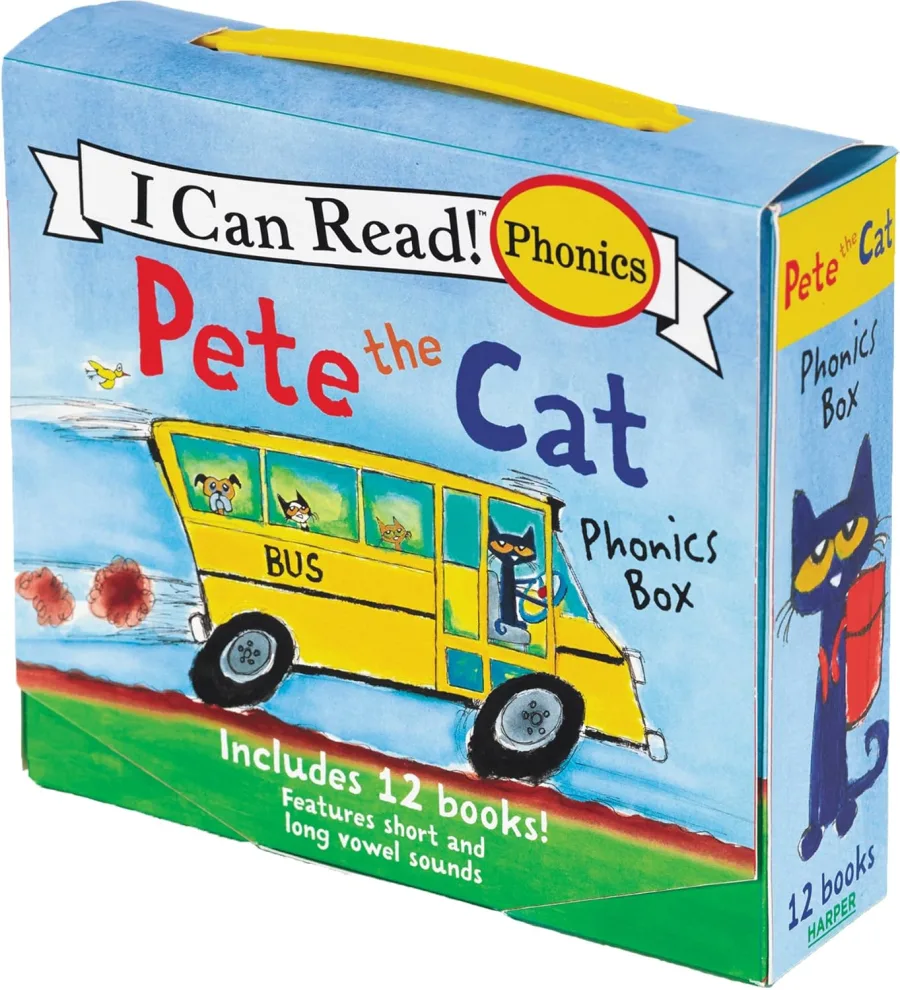
Pete the Cat 12-Book Phonics Fun!: A Box of 12 Mini-Books Featuring Short and Long Vowel Sounds
Paperback
• 144 Pages
• USD 11.99
• English
• 9780062404527
No ratings yet
| Publisher | HarperCollins |
|---|---|
| ISBN13 | 9780062404527 |
| ASIN/SKU | 0062404520 |
| Book Format | Paperback |
| Language | English |
| Pages | 144 |
| List Price | USD 11.99 |
| Publishing Date | 03/01/2017 |
| Dimensions | 1.9 x 5.5 x 6 inches |
| Weight | 10.4 ounces |
| Book Code | BD00055366 |
Buy this Book
Amazon Stores
Ebook Stores
Other Stores
Discover Pete the Cat 12-Book Phonics Fun!: A Box of 12 Mini-Books Featuring Short and Long Vowel Sounds by James Dean. This book is published by HarperCollins in Paperback format, ISBN 9780062404527, ASIN 0062404520, under Children's Books, Curriculum and Lesson Plans, Children's Cat Books.
Book Description
Pete the Cat helps kids learn to read with phonics! Who knew reading could be so groovy?
This set of 12 simple and
fun Pete the Cat storybooks is an excellent choice to share with your beginning reader. It’s a fun
way to learn to read and as a supplement for activity books for children ages 3
to 6. Enter into the world of reading with My First I Can Read!
Reviewed by a phonics expert, these 12 short full-color books feature repeated examples of short and long vowel sounds and common sight words. Each of the simple stories in this box set is designed to teach kids how to master reading while rocking out with Pete the Cat.
Phonics teaches children the relationship between letters and the sounds they make. A child who has mastered these relationships has an excellent foundation for learning to read and spell. According to the National Institute of Child Health & Human Development, a child who has learned phonics has a method to recognize familiar words and “decode” unfamiliar ones.
Report an issue with th
This set of 12 simple and
fun Pete the Cat storybooks is an excellent choice to share with your beginning reader. It’s a fun
way to learn to read and as a supplement for activity books for children ages 3
to 6. Enter into the world of reading with My First I Can Read!
Reviewed by a phonics expert, these 12 short full-color books feature repeated examples of short and long vowel sounds and common sight words. Each of the simple stories in this box set is designed to teach kids how to master reading while rocking out with Pete the Cat.
Phonics teaches children the relationship between letters and the sounds they make. A child who has mastered these relationships has an excellent foundation for learning to read and spell. According to the National Institute of Child Health & Human Development, a child who has learned phonics has a method to recognize familiar words and “decode” unfamiliar ones.
Report an issue with th
Author Biography
In 2004, Kimberly & James Dean sat down at their kitchen table to collaborate on a children's book together. Their dream finally became a reality with the release of Pete the Cat and His Magic Sunglasses. Both left corporate jobs in the late nineties (James was an electrical engineer, Kimberly worked in the press office of the governor of Georgia) to pursue their passion for art, and they have experienced a life made up of strange and wonderful coincidences ever since. Pete the Cat has brought magic into their lives.
Editorial Reviews
Editorial Reviews will be added soon…
Book Summary
Pete the Cat 12-Book Phonics Fun!: A Box of 12 Mini-Books Featuring Short and Long Vowel Sounds by James Dean is a playful early-reading collection designed to help young children build confidence with phonics while enjoying the familiar world of Pete the Cat. Rather than presenting phonics as a dry series of rules, the collection turns beginning reading practice into something cheerful, manageable, and entertaining. The set contains twelve small books, each focusing on short- or long-vowel sounds and simple words appropriate for children who are beginning to connect letters with sounds. Its basic educational purpose is straightforward: help young readers recognize vowel patterns, sound out words, and gradually become more independent readers.
The strength of the collection begins with its use of familiar characters and short, accessible stories. Pete the Cat is already associated with humor, friendship, music, adventure, and a relaxed attitude toward mistakes. That personality makes him a natural guide for children who may feel nervous about learning to read. Instead of confronting a child with a long page of unfamiliar text, the mini-books create a sense of accomplishment. A child can finish one small story, recognize several words, and feel that reading is something achievable. This emotional element matters because early literacy is not only about learning sounds; it is also about developing the confidence to keep trying.
The collection concentrates particularly on short and long vowel sounds, which are fundamental building blocks of English phonics. Young readers must learn that vowels can behave differently in different words. A short vowel can be heard clearly in words such as cat, bed, pig, hot, and sun, while long vowels often make the vowel sound closer to the letter's name, as in cake, Pete, bike, home, and cute. Understanding these patterns allows children to move beyond memorizing individual words. They begin to see that letters follow recognizable relationships between spelling and pronunciation.
Each mini-book therefore provides repeated opportunities to notice, pronounce, and read vowel patterns in context. This is important because phonics becomes meaningful when children can use it while reading an actual sentence. A child does not simply learn that a particular letter represents a sound; the child practices combining sounds into words and words into meaningful statements. Repetition reinforces recognition, while the story context gives the words a purpose. The result is a gentle bridge between phonics drills and genuine reading.
The books are also designed around beginning-reader vocabulary and sentence structures. Early readers benefit from text that is predictable enough to support success but not so repetitive that reading becomes meaningless. Short sentences reduce the cognitive load on a child who is still concentrating on decoding. When a child can focus on sounding out one or two unfamiliar words without becoming overwhelmed by the entire page, reading becomes less intimidating. The small format of the books reinforces this sense of progress: finishing a complete book can provide an immediate feeling of achievement.
James Dean's illustrations play an important supporting role. Pete the Cat's colorful world gives children visual clues and emotional engagement without replacing the need to read the words. Pictures can help a child understand what is happening in a story, predict meaning, and connect unfamiliar vocabulary with recognizable situations. For beginning readers, this combination of visual storytelling and controlled text is especially useful because it makes the reading experience feel like a real story rather than an exercise.
Another important feature is the collection's emphasis on practice through variety. Twelve separate mini-books provide enough repetition for reinforcement while offering different situations and combinations of words. Children can read one book at a time rather than facing a large volume of material. This makes the set useful for short daily reading sessions, bedtime practice, classroom literacy centers, homeschooling, or parent-child reading time. The modular structure also allows adults to adjust the pace according to the child's ability. A child who is struggling with a particular vowel pattern can return to the relevant books, while a confident reader can move ahead.
The collection can also encourage shared reading between children and adults. Parents, teachers, and caregivers can listen while a child sounds out words, provide help when necessary, and celebrate successful decoding. This kind of interaction is valuable because children often need emotional encouragement as much as technical instruction. A supportive adult can turn mistakes into learning opportunities instead of allowing them to become sources of embarrassment. Pete's upbeat personality reinforces that message: getting a word wrong is not a catastrophe; it is simply part of learning.
At a deeper level, the collection teaches children an important lesson about how reading works. Strong readers do not necessarily know every word immediately. They use patterns, sounds, context, memory, and repeated exposure to figure things out. Phonics gives children one of the most useful tools in this process. Once they understand common vowel patterns, they can begin applying that knowledge to words they have never seen before. This is a significant step toward reading independence because the child is no longer dependent entirely on an adult or on memorizing every word.
The collection is particularly effective because it keeps its educational purpose hidden inside fun and familiarity. Young children are naturally more willing to practice when practice feels like play. Pete the Cat's humor and recognizable character create a welcoming environment in which children can experiment with sounds and words without feeling that they are being tested. The stories give children a reason to continue turning pages, while the phonics structure quietly reinforces essential reading skills.
Ultimately, Pete the Cat 12-Book Phonics Fun! is best understood as a confidence-building introduction to phonics and early reading. Its goal is not to teach every aspect of literacy at once, but to strengthen a crucial foundation: hearing and recognizing short and long vowel sounds, connecting those sounds to spelling patterns, decoding simple words, and experiencing the satisfaction of reading a complete story.
The collection's greatest strength is its humane approach to beginning literacy. Learning to read can sometimes feel difficult for a child, especially when unfamiliar words seem to turn every page into a challenge. By breaking practice into twelve small, friendly books and placing phonics inside Pete the Cat's cheerful world, James Dean makes the process less intimidating. Children are encouraged to take small steps, make mistakes, try again, and discover that they really can read. The larger lesson is wonderfully simple: reading gets easier with practice, and learning can be fun.
The strength of the collection begins with its use of familiar characters and short, accessible stories. Pete the Cat is already associated with humor, friendship, music, adventure, and a relaxed attitude toward mistakes. That personality makes him a natural guide for children who may feel nervous about learning to read. Instead of confronting a child with a long page of unfamiliar text, the mini-books create a sense of accomplishment. A child can finish one small story, recognize several words, and feel that reading is something achievable. This emotional element matters because early literacy is not only about learning sounds; it is also about developing the confidence to keep trying.
The collection concentrates particularly on short and long vowel sounds, which are fundamental building blocks of English phonics. Young readers must learn that vowels can behave differently in different words. A short vowel can be heard clearly in words such as cat, bed, pig, hot, and sun, while long vowels often make the vowel sound closer to the letter's name, as in cake, Pete, bike, home, and cute. Understanding these patterns allows children to move beyond memorizing individual words. They begin to see that letters follow recognizable relationships between spelling and pronunciation.
Each mini-book therefore provides repeated opportunities to notice, pronounce, and read vowel patterns in context. This is important because phonics becomes meaningful when children can use it while reading an actual sentence. A child does not simply learn that a particular letter represents a sound; the child practices combining sounds into words and words into meaningful statements. Repetition reinforces recognition, while the story context gives the words a purpose. The result is a gentle bridge between phonics drills and genuine reading.
The books are also designed around beginning-reader vocabulary and sentence structures. Early readers benefit from text that is predictable enough to support success but not so repetitive that reading becomes meaningless. Short sentences reduce the cognitive load on a child who is still concentrating on decoding. When a child can focus on sounding out one or two unfamiliar words without becoming overwhelmed by the entire page, reading becomes less intimidating. The small format of the books reinforces this sense of progress: finishing a complete book can provide an immediate feeling of achievement.
James Dean's illustrations play an important supporting role. Pete the Cat's colorful world gives children visual clues and emotional engagement without replacing the need to read the words. Pictures can help a child understand what is happening in a story, predict meaning, and connect unfamiliar vocabulary with recognizable situations. For beginning readers, this combination of visual storytelling and controlled text is especially useful because it makes the reading experience feel like a real story rather than an exercise.
Another important feature is the collection's emphasis on practice through variety. Twelve separate mini-books provide enough repetition for reinforcement while offering different situations and combinations of words. Children can read one book at a time rather than facing a large volume of material. This makes the set useful for short daily reading sessions, bedtime practice, classroom literacy centers, homeschooling, or parent-child reading time. The modular structure also allows adults to adjust the pace according to the child's ability. A child who is struggling with a particular vowel pattern can return to the relevant books, while a confident reader can move ahead.
The collection can also encourage shared reading between children and adults. Parents, teachers, and caregivers can listen while a child sounds out words, provide help when necessary, and celebrate successful decoding. This kind of interaction is valuable because children often need emotional encouragement as much as technical instruction. A supportive adult can turn mistakes into learning opportunities instead of allowing them to become sources of embarrassment. Pete's upbeat personality reinforces that message: getting a word wrong is not a catastrophe; it is simply part of learning.
At a deeper level, the collection teaches children an important lesson about how reading works. Strong readers do not necessarily know every word immediately. They use patterns, sounds, context, memory, and repeated exposure to figure things out. Phonics gives children one of the most useful tools in this process. Once they understand common vowel patterns, they can begin applying that knowledge to words they have never seen before. This is a significant step toward reading independence because the child is no longer dependent entirely on an adult or on memorizing every word.
The collection is particularly effective because it keeps its educational purpose hidden inside fun and familiarity. Young children are naturally more willing to practice when practice feels like play. Pete the Cat's humor and recognizable character create a welcoming environment in which children can experiment with sounds and words without feeling that they are being tested. The stories give children a reason to continue turning pages, while the phonics structure quietly reinforces essential reading skills.
Ultimately, Pete the Cat 12-Book Phonics Fun! is best understood as a confidence-building introduction to phonics and early reading. Its goal is not to teach every aspect of literacy at once, but to strengthen a crucial foundation: hearing and recognizing short and long vowel sounds, connecting those sounds to spelling patterns, decoding simple words, and experiencing the satisfaction of reading a complete story.
The collection's greatest strength is its humane approach to beginning literacy. Learning to read can sometimes feel difficult for a child, especially when unfamiliar words seem to turn every page into a challenge. By breaking practice into twelve small, friendly books and placing phonics inside Pete the Cat's cheerful world, James Dean makes the process less intimidating. Children are encouraged to take small steps, make mistakes, try again, and discover that they really can read. The larger lesson is wonderfully simple: reading gets easier with practice, and learning can be fun.
Sample Chapters
Sample Chapters will be added soon…
Reader Reviews
No reviews yet.
Pete the Cat 12-Book Phonics Fun!: A Box of 12 Mini-Books Featuring Short and Long Vowel Sounds
Download Cover Image
Do you want to download the full cover image for Pete the Cat 12-Book Phonics Fun!: A Box of 12 Mini-Books Featuring Short and Long Vowel Sounds?