
Brown Bear, Brown Bear, What Do You See?: 50th Anniversary Edition
Board Book
• 28 Pages
• USD 4.82
• English
• 9780805047905
No ratings yet
| Publisher | Henry Holt and Co. (BYR) |
|---|---|
| ISBN13 | 9780805047905 |
| ASIN/SKU | 0805047905 |
| Book Format | Board Book |
| Language | English |
| Pages | 28 |
| List Price | USD 4.82 |
| Publishing Date | 15/09/1996 |
| Dimensions | 4.95 x 0.55 x 6.95 inches |
| Weight | 6.9 ounces |
| Book Code | BD00055384 |
Buy this Book
Amazon Stores
Ebook Stores
Other Stores
Discover Brown Bear, Brown Bear, What Do You See?: 50th Anniversary Edition by Bill Martin Jr.. This book is published by Henry Holt and Co. (BYR) in Board Book format, ISBN 9780805047905, ASIN 0805047905, under Children's Books, Children's Colors Books, Children's Bear Books.
Book Description
With more than twenty million copies sold, Brown Bear, Brown Bear, What Do You See? has opened up a world of learning to a generation of children. Now, even the youngest reader can join in on the fun with this built-to-last board book edition.
A big happy frog, a plump purple cat, a handsome blue horse, and a soft yellow duck--all parade across the pages of this delightful classic children's book, Brown Bear, Brown Bear, What Do You See? Children will immediately respond to Eric Carle's vibrant, boldly colored collages that compliment Bill Martin Jr's infectious, melodic text.
Make sure to pick up the rest of the books in the Brown Bear and Friends series!
• Baby Bear, Baby Bear, What Do You See?
• Polar Bear, Polar Bear, What Do you Hear?
• Panda Bear, Panda Bear, What Do You See?
A big happy frog, a plump purple cat, a handsome blue horse, and a soft yellow duck--all parade across the pages of this delightful classic children's book, Brown Bear, Brown Bear, What Do You See? Children will immediately respond to Eric Carle's vibrant, boldly colored collages that compliment Bill Martin Jr's infectious, melodic text.
Make sure to pick up the rest of the books in the Brown Bear and Friends series!
• Baby Bear, Baby Bear, What Do You See?
• Polar Bear, Polar Bear, What Do you Hear?
• Panda Bear, Panda Bear, What Do You See?
Author Biography
Bill Martin Jr, an elementary-school principal, teacher, writer, and poet, held a doctoral degree in early childhood education. His many books, among them the bestselling classics Brown Bear, Brown Bear, What Do You See?; Polar Bear, Polar Bear, What Do You Hear?; Panda Bear, Panda Bear, What Do You See?; and Chicka Chicka Boom Boom, are a testament to his ability to speak directly to children.
Editorial Reviews
“To celebrate this beloved book's 25th birthday, Eric Carle has energized his original artwork, providing bold, fresh colors and his now familiar menagerie.” ―Publishers Weekly
“The contemporary classic . . . perfect for sharing with a group of preschoolers.” ―The Horn Book Guide
“A picture book full of rhyme and repetition that will appeal to preschoolers. Carle's large collages bursting with color are perfect for the text.” ―Booklist
“The contemporary classic . . . perfect for sharing with a group of preschoolers.” ―The Horn Book Guide
“A picture book full of rhyme and repetition that will appeal to preschoolers. Carle's large collages bursting with color are perfect for the text.” ―Booklist
Book Summary
Bill Martin Jr. and Eric Carle’s Brown Bear, Brown Bear, What Do You See?, first published in 1967, stands as an undisputed titan of early childhood literature. Unlike traditional narratives that rely on plot, conflict, and character development, this beloved picture book operates on an entirely different frequency. It is a masterpiece of sensory engagement, stripping away the complexities of storytelling to focus purely on rhythm, repetition, and vibrant visual stimulation. For over half a century, it has served as an essential rite of passage for toddlers and preschoolers, acting not just as a book to be read, but as a foundational tool for language acquisition, cognitive development, and visual literacy. The genius of the work lies in its profound simplicity, demonstrating how an elemental combination of cadence and color can completely captivate the developing human mind.
The text, crafted by Bill Martin Jr., is a masterclass in auditory design. Martin, who struggled with reading as a child, understood that language is fundamentally musical. He constructed the book entirely around a hypnotic, call-and-response rhythmic structure. Each page turn is driven by a simple, repeating couplet: a question asking an animal what it sees, followed immediately by the animal’s response introducing the next creature in the sequence. This predictable, metronomic bouncing rhythm—asking the brown bear what it sees, only for it to spot a red bird, which in turn spots a yellow duck—functions almost like an incantation. For very young children, this predictability is not boring; it is profoundly empowering. It allows them to anticipate what comes next, encouraging them to chime in and “read” the book long before they can actually decode written letters. The rhythmic chanting builds phonological awareness, helping children hear the distinct sounds and syllables that form the building blocks of early literacy.
Equally responsible for the book’s legendary status is Eric Carle’s groundbreaking visual artistry. Carle utilized his signature collage technique, created by painting translucent tissue papers with bright, textured acrylics, then cutting and layering them to form the animal figures. Placed against stark, unadorned white backgrounds, these animals practically vibrate with energy. The brown bear is not just flat brown; it is a rich tapestry of umber, mahogany, and earthy streaks that give the impression of coarse, thick fur. The red bird is a brilliant splash of crimson and scarlet, its wings seemingly caught mid-flap. By removing all background scenery and environmental context, Carle ensures that the child’s absolute focus remains completely locked on the central subject. This minimalist approach prevents visual overstimulation while maximizing the impact of the bold, saturated colors that define early childhood visual processing.
Beyond its aesthetic brilliance, the book is a highly sophisticated educational instrument disguised as simple fun. It seamlessly introduces the core concepts of color identification and animal recognition in a way that feels organic rather than instructional. However, the authors brilliantly subvert expectations to stretch the child’s imagination. While a brown bear and a yellow duck are grounded in reality, the sudden introduction of a blue horse and a purple cat introduces a delightful element of surrealism. This playful departure from strict realism teaches children that art and imagination are not bound by the rigid rules of the physical world. A horse can be blue, and a cat can be purple, simply because the artist wills it so. This gentle disruption encourages cognitive flexibility and invites children to view the world through a deeply creative, unrestrained lens.
As the sequential parade of colorful animals unfolds, the narrative builds a gentle momentum that culminates in a brilliant shift in perspective. After journeying through the animal kingdom—from the green frog to the black sheep to the goldfish—the book suddenly pivots to the human realm. The goldfish sees a teacher looking at it, and the teacher, in turn, sees a classroom full of children. This transition is profoundly grounding. It pulls the young reader out of the abstract world of colorful creatures and places them directly into a familiar, comforting social context. The children illustrated in the book serve as a mirror for the child reading the book, validating their own experience of observing, pointing, and learning.
The conclusion of the book acts as a brilliant cognitive reinforcement exercise. When the teacher asks the children what they see, the final page spread reveals a glorious, miniature chorus line of every single animal encountered throughout the story. The children recite the entire list in order, recalling the brown bear, the red bird, the yellow duck, and all the rest of the vibrant cast. This final recap is not just a satisfying narrative wrap-up; it is an active exercise in working memory and sequential recall. It challenges the child to look back and process the journey they have just taken, solidifying the vocabulary and color associations they have absorbed over the previous pages.
Ultimately, Brown Bear, Brown Bear, What Do You See? endures because it speaks the native language of early childhood with absolute fluency. It does not talk down to its audience, nor does it overcomplicate its mission. Through a perfect alchemy of Martin’s infectious, musical poetry and Carle’s bold, joyous illustrations, it creates a deeply comforting, enriching environment where learning feels like play. It remains a timeless testament to the power of a perfectly crafted picture book, proving that sometimes the most profound impact is made not through complex narratives, but through the simple, rhythmic joy of discovering the world, one color and one animal at a time.
The text, crafted by Bill Martin Jr., is a masterclass in auditory design. Martin, who struggled with reading as a child, understood that language is fundamentally musical. He constructed the book entirely around a hypnotic, call-and-response rhythmic structure. Each page turn is driven by a simple, repeating couplet: a question asking an animal what it sees, followed immediately by the animal’s response introducing the next creature in the sequence. This predictable, metronomic bouncing rhythm—asking the brown bear what it sees, only for it to spot a red bird, which in turn spots a yellow duck—functions almost like an incantation. For very young children, this predictability is not boring; it is profoundly empowering. It allows them to anticipate what comes next, encouraging them to chime in and “read” the book long before they can actually decode written letters. The rhythmic chanting builds phonological awareness, helping children hear the distinct sounds and syllables that form the building blocks of early literacy.
Equally responsible for the book’s legendary status is Eric Carle’s groundbreaking visual artistry. Carle utilized his signature collage technique, created by painting translucent tissue papers with bright, textured acrylics, then cutting and layering them to form the animal figures. Placed against stark, unadorned white backgrounds, these animals practically vibrate with energy. The brown bear is not just flat brown; it is a rich tapestry of umber, mahogany, and earthy streaks that give the impression of coarse, thick fur. The red bird is a brilliant splash of crimson and scarlet, its wings seemingly caught mid-flap. By removing all background scenery and environmental context, Carle ensures that the child’s absolute focus remains completely locked on the central subject. This minimalist approach prevents visual overstimulation while maximizing the impact of the bold, saturated colors that define early childhood visual processing.
Beyond its aesthetic brilliance, the book is a highly sophisticated educational instrument disguised as simple fun. It seamlessly introduces the core concepts of color identification and animal recognition in a way that feels organic rather than instructional. However, the authors brilliantly subvert expectations to stretch the child’s imagination. While a brown bear and a yellow duck are grounded in reality, the sudden introduction of a blue horse and a purple cat introduces a delightful element of surrealism. This playful departure from strict realism teaches children that art and imagination are not bound by the rigid rules of the physical world. A horse can be blue, and a cat can be purple, simply because the artist wills it so. This gentle disruption encourages cognitive flexibility and invites children to view the world through a deeply creative, unrestrained lens.
As the sequential parade of colorful animals unfolds, the narrative builds a gentle momentum that culminates in a brilliant shift in perspective. After journeying through the animal kingdom—from the green frog to the black sheep to the goldfish—the book suddenly pivots to the human realm. The goldfish sees a teacher looking at it, and the teacher, in turn, sees a classroom full of children. This transition is profoundly grounding. It pulls the young reader out of the abstract world of colorful creatures and places them directly into a familiar, comforting social context. The children illustrated in the book serve as a mirror for the child reading the book, validating their own experience of observing, pointing, and learning.
The conclusion of the book acts as a brilliant cognitive reinforcement exercise. When the teacher asks the children what they see, the final page spread reveals a glorious, miniature chorus line of every single animal encountered throughout the story. The children recite the entire list in order, recalling the brown bear, the red bird, the yellow duck, and all the rest of the vibrant cast. This final recap is not just a satisfying narrative wrap-up; it is an active exercise in working memory and sequential recall. It challenges the child to look back and process the journey they have just taken, solidifying the vocabulary and color associations they have absorbed over the previous pages.
Ultimately, Brown Bear, Brown Bear, What Do You See? endures because it speaks the native language of early childhood with absolute fluency. It does not talk down to its audience, nor does it overcomplicate its mission. Through a perfect alchemy of Martin’s infectious, musical poetry and Carle’s bold, joyous illustrations, it creates a deeply comforting, enriching environment where learning feels like play. It remains a timeless testament to the power of a perfectly crafted picture book, proving that sometimes the most profound impact is made not through complex narratives, but through the simple, rhythmic joy of discovering the world, one color and one animal at a time.
Sample Chapters
Sample Chapters will be added soon…
Reader Reviews
No reviews yet.
Brown Bear, Brown Bear, What Do You See?: 50th Anniversary Edition
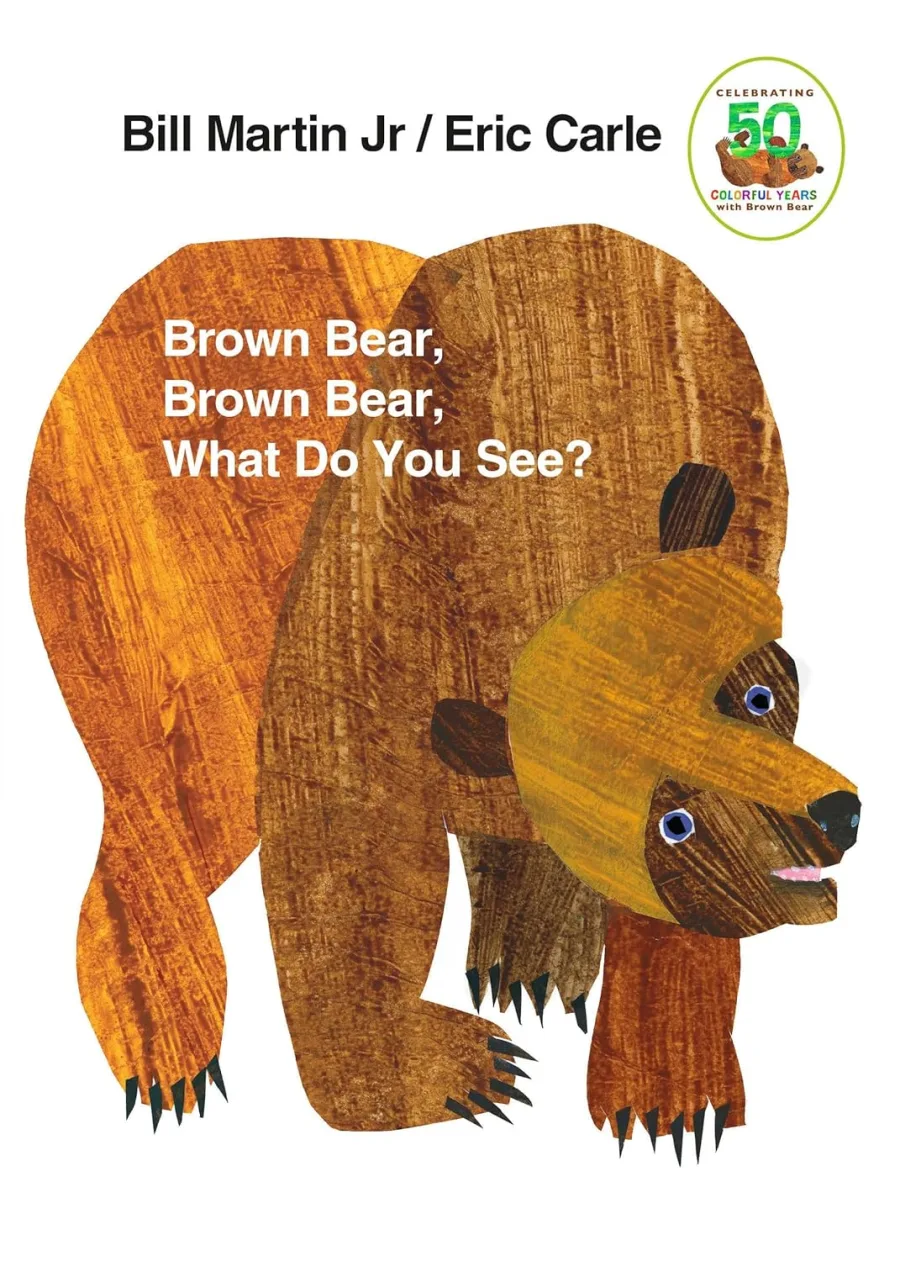
Download Cover Image
Do you want to download the full cover image for Brown Bear, Brown Bear, What Do You See?: 50th Anniversary Edition?