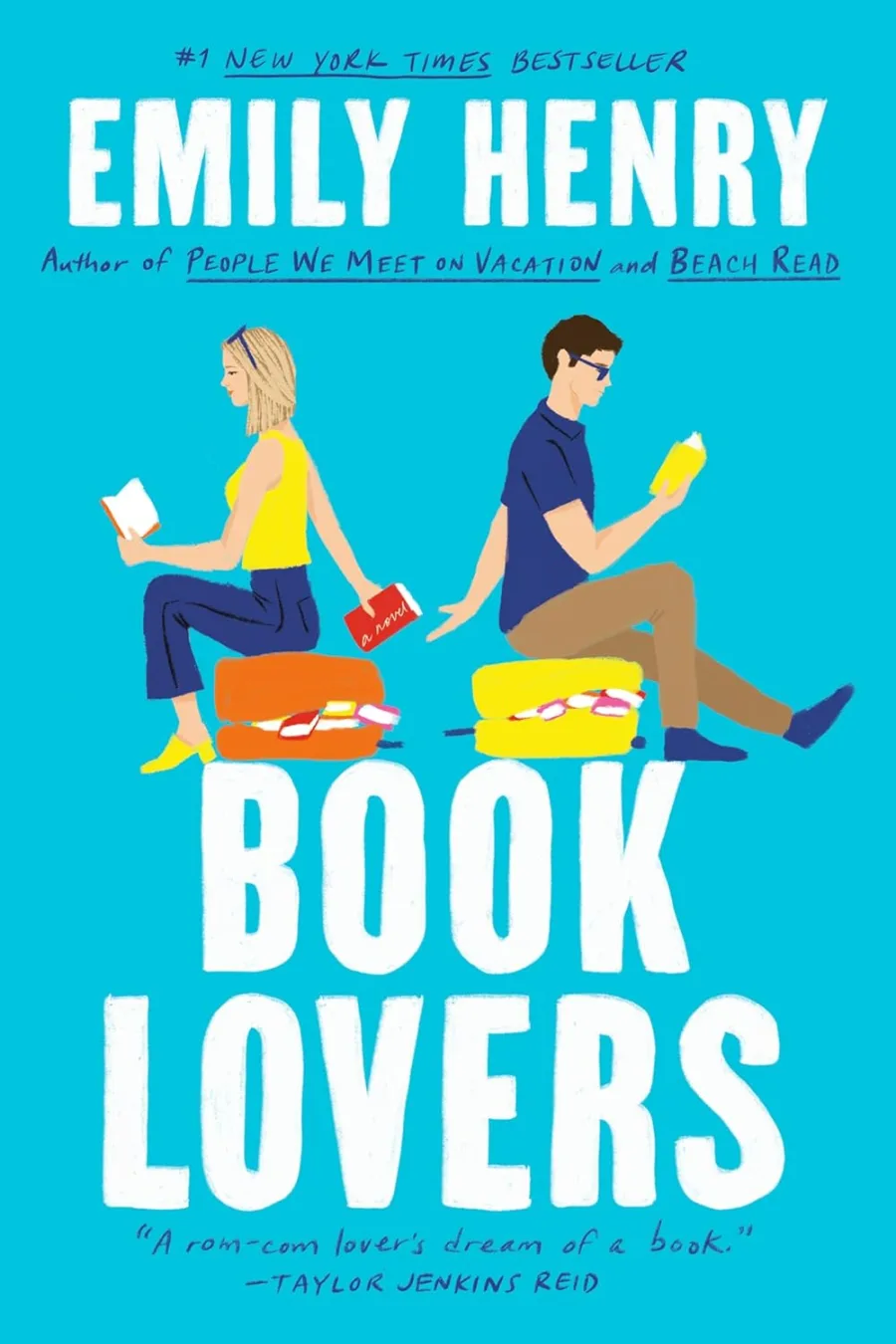
Book Lovers
Paperback
• 416 Pages
• USD 17.00
• English
• 9780593334836
No ratings yet
| Publisher | Berkley |
|---|---|
| ISBN13 | 9780593334836 |
| ASIN/SKU | 0593334833 |
| Book Format | Paperback |
| Language | English |
| Pages | 416 |
| List Price | USD 17.00 |
| Publishing Date | 03/05/2022 |
| Dimensions | 5.45 x 1.03 x 8.18 inches |
| Weight | 2.31 pounds |
| Book Code | BD00055470 |
Buy this Book
Amazon Stores
Ebook Stores
Other Stores
Discover Book Lovers by Emily Henry. This book is published by Berkley in Paperback format, ISBN 9780593334836, ASIN 0593334833, under Literature and Fiction, Romantic Comedy, Contemporary Women Fiction.
Book Description
An insightful, delightful, instant #1 New York Times bestseller from the author of Funny Story.
“One of my favorite authors.”—Colleen Hoover
One summer. Two rivals. A plot twist they didn't see coming...
Nora Stephens' life is books—she’s read them all—and she is not that type of heroine. Not the plucky one, not the laidback dream girl, and especially not the sweetheart. In fact, the only people Nora is a heroine for are her clients, for whom she lands enormous deals as a cutthroat literary agent, and her beloved little sister Libby.
Which is why she agrees to go to Sunshine Falls, North Carolina for the month of August when Libby begs her for a sisters’ trip away—with visions of a small town transformation for Nora, who she’s convinced needs to become the heroine in her own story. But instead of picnics in meadows, or run-ins with a handsome country doctor or bulging-forearmed bartender, Nora keeps bumping into Charlie Lastra, a bookish brooding editor from back in the city. It would be a meet-cute if not for the fact that they’ve met many times and it’s never been cute.
If Nora knows she’s not an ideal heroine, Charlie knows he’s nobody’s hero, but as they are thrown together again and again—in a series of coincidences no editor worth their salt would allow—what they discover might just unravel the carefully crafted stories they’ve written about themselves.
“One of my favorite authors.”—Colleen Hoover
One summer. Two rivals. A plot twist they didn't see coming...
Nora Stephens' life is books—she’s read them all—and she is not that type of heroine. Not the plucky one, not the laidback dream girl, and especially not the sweetheart. In fact, the only people Nora is a heroine for are her clients, for whom she lands enormous deals as a cutthroat literary agent, and her beloved little sister Libby.
Which is why she agrees to go to Sunshine Falls, North Carolina for the month of August when Libby begs her for a sisters’ trip away—with visions of a small town transformation for Nora, who she’s convinced needs to become the heroine in her own story. But instead of picnics in meadows, or run-ins with a handsome country doctor or bulging-forearmed bartender, Nora keeps bumping into Charlie Lastra, a bookish brooding editor from back in the city. It would be a meet-cute if not for the fact that they’ve met many times and it’s never been cute.
If Nora knows she’s not an ideal heroine, Charlie knows he’s nobody’s hero, but as they are thrown together again and again—in a series of coincidences no editor worth their salt would allow—what they discover might just unravel the carefully crafted stories they’ve written about themselves.
Author Biography
Emily Henry is the #1 New York Times bestselling author of Great Big Beautiful Life, Funny Story, Happy Place, Book Lovers, People We Meet on Vacation, and Beach Read. She studied creative writing at Hope College, and now spends most of her time in Cincinnati, Ohio, and the part of Kentucky just beneath it. Find her on Instagram @emilyhenrywrites.
Editorial Reviews
"[Book Lovers] is multilayered and the characters' familial challenges are complex. . . . [T]his novel delivers an insightful comedic meditation on love, family and going your own way."—NPR
“[Emily Henry] is a master at witty repartee."—Associated Press
“It is humanly impossible for Emily Henry to write a bad book. . . . Whatever Henry decides to spear, be it literary posturing or vacation rom-com, she subverts her subjects in the most delicious ways."—Entertainment Weekly
“Book Lovers is a treat from start to finish, flipping the conventional small-town love story trope on its head.”—USA Today
“One of my favorite authors.”—Colleen Hoover, #1 New York Times bestselling author
“Book Lovers is a rom-com lover's dream of a book. . . . Readers know that Emily Henry never fails to deliver great banter and a romance to swoon over but this may just be her best yet.”—Taylor Jenkins Reid, New York Times bestselling author of Malibu Rising
“Book Lovers is sexy, funny, and smart. Another perfectly satisfying read from the unstoppable Emily Henry.”—Emma Straub, New York Times bestselling author of All Adults Here
"Emily Henry's books are a gift, the perfect balance between steamy and sweet. The prose is effortless, the characters charming. The only downside is reaching the end."—V.E. Schwab, New York Times bestselling author The Invisible Life of Addie LaRue
"Charming, earnest, and clever, Book Lovers is Schitt's Creek for book nerds. A total delight . . . Nobody does it quite like Emily Henry.”—Casey McQuiston, New York Times bestselling author of One Last Stop
"I could not devour Book Lovers fast enough. Emily Henry is pure delight. I’m utterly enchanted by her wry, self-aware sense of humor, the relish that she brings to every cleverly crafted sentence, and her irrepressible love for love.”—Katherine Center, New York Times bestselling author of Things You Save in a Fire and How to Walk Away
“Emily Henry writes romantic comedy with such sass and humour, she has that gift for making you laugh and cry within the space of a few sentences. . . . Her characters fizz like good champagne, they leap off the page and into your heart."—Josie Silver, New York Times bestselling author of One Night on the Island
“Magical, delightful, and utterly one of a kind: Emily Henry's writing is a gift to the world."—Ali Hazelwood, New York Times bestselling author of The Love Hypothesis
“Heartfelt, funny, and full of joy.”—Tia Williams, New York Times bestselling author of Seven Days in June
“I loved every page, every line. It's so smart, so funny and so sexy.”— Beth O’Leary, international bestselling author of The No-Show
“[A] fun and flirty romance.”—Cosmopolitan
“Book Lovers uses classic romance tropes with purpose and intention . . . a smart, charming and dazzling book.”—Shelf Awareness
“[Emily Henry] is a master at witty repartee."—Associated Press
“It is humanly impossible for Emily Henry to write a bad book. . . . Whatever Henry decides to spear, be it literary posturing or vacation rom-com, she subverts her subjects in the most delicious ways."—Entertainment Weekly
“Book Lovers is a treat from start to finish, flipping the conventional small-town love story trope on its head.”—USA Today
“One of my favorite authors.”—Colleen Hoover, #1 New York Times bestselling author
“Book Lovers is a rom-com lover's dream of a book. . . . Readers know that Emily Henry never fails to deliver great banter and a romance to swoon over but this may just be her best yet.”—Taylor Jenkins Reid, New York Times bestselling author of Malibu Rising
“Book Lovers is sexy, funny, and smart. Another perfectly satisfying read from the unstoppable Emily Henry.”—Emma Straub, New York Times bestselling author of All Adults Here
"Emily Henry's books are a gift, the perfect balance between steamy and sweet. The prose is effortless, the characters charming. The only downside is reaching the end."—V.E. Schwab, New York Times bestselling author The Invisible Life of Addie LaRue
"Charming, earnest, and clever, Book Lovers is Schitt's Creek for book nerds. A total delight . . . Nobody does it quite like Emily Henry.”—Casey McQuiston, New York Times bestselling author of One Last Stop
"I could not devour Book Lovers fast enough. Emily Henry is pure delight. I’m utterly enchanted by her wry, self-aware sense of humor, the relish that she brings to every cleverly crafted sentence, and her irrepressible love for love.”—Katherine Center, New York Times bestselling author of Things You Save in a Fire and How to Walk Away
“Emily Henry writes romantic comedy with such sass and humour, she has that gift for making you laugh and cry within the space of a few sentences. . . . Her characters fizz like good champagne, they leap off the page and into your heart."—Josie Silver, New York Times bestselling author of One Night on the Island
“Magical, delightful, and utterly one of a kind: Emily Henry's writing is a gift to the world."—Ali Hazelwood, New York Times bestselling author of The Love Hypothesis
“Heartfelt, funny, and full of joy.”—Tia Williams, New York Times bestselling author of Seven Days in June
“I loved every page, every line. It's so smart, so funny and so sexy.”— Beth O’Leary, international bestselling author of The No-Show
“[A] fun and flirty romance.”—Cosmopolitan
“Book Lovers uses classic romance tropes with purpose and intention . . . a smart, charming and dazzling book.”—Shelf Awareness
Book Summary
Book Lovers by Emily Henry is a smart, witty, and tender romance about two people who seem to fit every possible romantic cliché except the one everyone expects. At the center of the story is Nora Stephens, a sharp, ambitious literary agent in New York City who has spent her life being the reliable one: the sister who works too hard, worries too much, and takes care of everyone else. Nora is successful in her career, deeply knowledgeable about books, and very good at her job, but her personal life has been built around sacrifice. She often feels like she is the supporting character in everyone else’s story, especially compared with her younger sister Libby, who is warm, impulsive, and far more interested in traditional romance and family life than Nora is. When Libby persuades Nora to take a summer trip to the small town of Sunshine Falls, North Carolina, Nora reluctantly agrees, expecting the usual charming escape into a picturesque setting where self-discovery and love might conveniently happen.
Nora, however, is not interested in becoming the heroine of a cozy small-town fantasy. She knows exactly what she wants from life, and it is not the kind of transformation romance novels often promise. She doesn’t need to be “fixed,” and she resists the idea that her value depends on finding the right man or settling into a simpler, softer version of herself. This is part of what makes the book feel fresh: Nora is aware of the familiar tropes around her, and she often sees her own life in relation to books and publishing clichés. She is clever, a little guarded, and more emotionally complicated than people tend to assume. Her trip to Sunshine Falls becomes a chance to spend time with Libby, who is pregnant and looking for a break, and to step outside the routines that have defined Nora for years.
Once in town, Nora unexpectedly runs into Charlie Lastra, a grumpy, serious book editor she knows from work in New York. Their first impression of each other is far from romantic spark and instant charm. They have a history of professional friction, and both are intelligent enough to see through surface-level behavior. Charlie is the kind of man who seems reserved and a little intense, but as the story progresses, he reveals himself to be thoughtful, observant, and emotionally steady in ways that gradually matter more than flashy charm ever could. The book builds their relationship slowly, through conversations, shared experiences, and a growing recognition that they understand each other better than most people in their lives do. Their chemistry is not based on grand gestures or dramatic misunderstandings, but on mutual respect, wit, and the quiet comfort of being seen accurately.
The novel also deepens through Nora’s relationship with Libby. Their sisterhood is one of the emotional anchors of the book. Nora has spent much of her life looking after Libby, while also carrying a fair amount of resentment and guilt about how different they are. Libby represents the kind of open-hearted, family-centered life Nora has sometimes been expected to want, while Nora represents the version of womanhood that is often undervalued because it is more practical, more career-focused, and less obviously sentimental. As the sisters spend time together in Sunshine Falls, their bond becomes more honest and more vulnerable. They talk about grief, fear, expectations, and what they each need from life. Through Libby, Nora begins to understand that love does not have to mean becoming a different person. It can also mean being accepted as you already are.
One of the most compelling aspects of “Book Lovers” is the way it uses the publishing world and romance conventions as part of the story itself. Nora works in a field where stories are packaged, sold, and categorized, and she is keenly aware of how women are expected to behave in books. The novel plays with those expectations by making Nora a woman who is often seen as cold or work-obsessed but is actually deeply caring and loyal. Sunshine Falls, with its bookstore-ish charm and small-town atmosphere, might seem like it is setting her up for a classic reinvention plot, but Emily Henry uses that setting to challenge the assumption that every woman needs to fall in love with a place, a man, or a “simpler” lifestyle to be complete. Instead, Nora’s journey is about recognizing her own worth outside those narratives.
Charlie’s own emotional life is also more layered than it first appears. He is not simply the brooding love interest. He carries disappointment, responsibility, and a quiet seriousness that comes from having lived through difficult realities. His connection with Nora grows because he doesn’t try to make her into someone more traditionally lovable. He accepts her ambition, her bluntness, her love of work, and her resistance to sentimentality. In return, Nora sees that Charlie’s calm exterior hides his own fears and longings. Their romance becomes an exchange between two people who are tired of being misunderstood. What makes them compelling is not that they are opposites, but that they are similar in the ways that matter most: both are intelligent, guarded, and capable of real care.
The story moves toward a deeper emotional resolution when Nora is forced to confront what she has been avoiding in her own life. Her identity has long been shaped by being needed, by keeping everything running, and by making herself useful. But usefulness is not the same as fulfillment. In Sunshine Falls, with Libby and Charlie and the temporary distance from her old habits, Nora starts to imagine a different kind of future. She still loves her career, still values her independence, and still does not want to be flattened into a romance-novel stereotype. But she begins to see that opening herself to love does not mean losing herself. It means allowing someone else to know her fully and still stay.
By the end of “Book Lovers,” Nora has not become a different person, and that is exactly the point. She remains smart, driven, and funny, but she is also more open to vulnerability and connection. Her relationship with Charlie is built on honesty rather than fantasy, and her bond with Libby is strengthened by real understanding rather than obligation alone. The novel’s ending offers a satisfying blend of romance and self-knowledge, showing that the best happy ending is not one that forces a woman into a mold, but one that lets her define her own story. Emily Henry gives readers a love story that is playful and emotionally rich, but also quietly radical in its insistence that a woman can love books, love her family, love her work, and still deserve a love story on her own terms.
Nora, however, is not interested in becoming the heroine of a cozy small-town fantasy. She knows exactly what she wants from life, and it is not the kind of transformation romance novels often promise. She doesn’t need to be “fixed,” and she resists the idea that her value depends on finding the right man or settling into a simpler, softer version of herself. This is part of what makes the book feel fresh: Nora is aware of the familiar tropes around her, and she often sees her own life in relation to books and publishing clichés. She is clever, a little guarded, and more emotionally complicated than people tend to assume. Her trip to Sunshine Falls becomes a chance to spend time with Libby, who is pregnant and looking for a break, and to step outside the routines that have defined Nora for years.
Once in town, Nora unexpectedly runs into Charlie Lastra, a grumpy, serious book editor she knows from work in New York. Their first impression of each other is far from romantic spark and instant charm. They have a history of professional friction, and both are intelligent enough to see through surface-level behavior. Charlie is the kind of man who seems reserved and a little intense, but as the story progresses, he reveals himself to be thoughtful, observant, and emotionally steady in ways that gradually matter more than flashy charm ever could. The book builds their relationship slowly, through conversations, shared experiences, and a growing recognition that they understand each other better than most people in their lives do. Their chemistry is not based on grand gestures or dramatic misunderstandings, but on mutual respect, wit, and the quiet comfort of being seen accurately.
The novel also deepens through Nora’s relationship with Libby. Their sisterhood is one of the emotional anchors of the book. Nora has spent much of her life looking after Libby, while also carrying a fair amount of resentment and guilt about how different they are. Libby represents the kind of open-hearted, family-centered life Nora has sometimes been expected to want, while Nora represents the version of womanhood that is often undervalued because it is more practical, more career-focused, and less obviously sentimental. As the sisters spend time together in Sunshine Falls, their bond becomes more honest and more vulnerable. They talk about grief, fear, expectations, and what they each need from life. Through Libby, Nora begins to understand that love does not have to mean becoming a different person. It can also mean being accepted as you already are.
One of the most compelling aspects of “Book Lovers” is the way it uses the publishing world and romance conventions as part of the story itself. Nora works in a field where stories are packaged, sold, and categorized, and she is keenly aware of how women are expected to behave in books. The novel plays with those expectations by making Nora a woman who is often seen as cold or work-obsessed but is actually deeply caring and loyal. Sunshine Falls, with its bookstore-ish charm and small-town atmosphere, might seem like it is setting her up for a classic reinvention plot, but Emily Henry uses that setting to challenge the assumption that every woman needs to fall in love with a place, a man, or a “simpler” lifestyle to be complete. Instead, Nora’s journey is about recognizing her own worth outside those narratives.
Charlie’s own emotional life is also more layered than it first appears. He is not simply the brooding love interest. He carries disappointment, responsibility, and a quiet seriousness that comes from having lived through difficult realities. His connection with Nora grows because he doesn’t try to make her into someone more traditionally lovable. He accepts her ambition, her bluntness, her love of work, and her resistance to sentimentality. In return, Nora sees that Charlie’s calm exterior hides his own fears and longings. Their romance becomes an exchange between two people who are tired of being misunderstood. What makes them compelling is not that they are opposites, but that they are similar in the ways that matter most: both are intelligent, guarded, and capable of real care.
The story moves toward a deeper emotional resolution when Nora is forced to confront what she has been avoiding in her own life. Her identity has long been shaped by being needed, by keeping everything running, and by making herself useful. But usefulness is not the same as fulfillment. In Sunshine Falls, with Libby and Charlie and the temporary distance from her old habits, Nora starts to imagine a different kind of future. She still loves her career, still values her independence, and still does not want to be flattened into a romance-novel stereotype. But she begins to see that opening herself to love does not mean losing herself. It means allowing someone else to know her fully and still stay.
By the end of “Book Lovers,” Nora has not become a different person, and that is exactly the point. She remains smart, driven, and funny, but she is also more open to vulnerability and connection. Her relationship with Charlie is built on honesty rather than fantasy, and her bond with Libby is strengthened by real understanding rather than obligation alone. The novel’s ending offers a satisfying blend of romance and self-knowledge, showing that the best happy ending is not one that forces a woman into a mold, but one that lets her define her own story. Emily Henry gives readers a love story that is playful and emotionally rich, but also quietly radical in its insistence that a woman can love books, love her family, love her work, and still deserve a love story on her own terms.
Sample Chapters
PROLOGUE
When books are your life—or in my case, your job— you get pretty good at guessing where a story is going. The tropes, the archetypes, the common plot twists all start to organize themselves into a catalogue inside your brain, divided by category and genre.
The husband is the killer.
The nerd gets a makeover, and without her glasses, she’s smoking hot.
The guy gets the girl—or the other girl does.
Someone explains a complicated scientific concept, and someone else says, “Um, in English, please?”
The details may change from book to book, but there’s nothing truly new under the sun.
Take, for example, the small-town love story.
The kind where a cynical hotshot from New York or Los Angeles gets shipped off to Smalltown, USA—to, like, run a family-owned Christmas tree farm out of business to make room for a soulless corporation.
But while said City Person is in town, things don’t go to plan. Because, of course, the Christmas tree farm—or bakery, or whatever the hero’s been sent to destroy—is owned and operated by someone ridiculously attractive and suitably available for wooing.
Back in the city, the lead has a romantic partner. Someone ruthless who encourages him to do what he’s set out to do and ruin some lives in exchange for that big promotion. He fields calls from her, during which she interrupts him, barking heartless advice from the seat of her Peloton bike.
You can tell she’s evil because her hair is an unnatural blond, slicked back à la Sharon Stone in Basic Instinct, and also, she hates Christmas decorations.
As the hero spends more time with the charming baker/seamstress/tree farm . . . person, things change for him. He learns the true meaning of life!
He returns home, transformed by the love of a good woman. There he asks his ice-queen girlfriend to take a walk with him. She gapes, says something like, In these Manolos?
It will be fun, he tells her. On the walk, he might ask her to look up at the stars.
She snaps, You know I can’t look up right now! I just got Botox!
And then he realizes: he can’t go back to his old life. He doesn’t want to! He ends his cold, unsatisfying relationship and proposes to his new sweetheart. (Who needs dating?)
At this point, you find yourself screaming at the book, You don’t even know her! What’s her middle name, bitch? From across the room, your sister, Libby, hushes you, throws popcorn at your head without lifting her gaze from her own crinkly-covered library book.
And that’s why I’m running late to this lunch meeting.
Because that’s my life. The trope that governs my days. The archetype over which my details are superimposed.
I’m the city person. Not the one who meets the hot farmer. The other one.
The uptight, manicured literary agent, reading manuscripts from atop her Peloton while a serene beach scene screen saver drifts, unnoticed, across her computer screen.
I’m the one who gets dumped.
I’ve read this story, and lived it, enough to know it’s happening again right now, as I’m weaving through late-afternoon foot traffic in Midtown, my phone clutched to my ear.
He hasn’t said it yet, but the hairs on the back of my neck are rising, the pit opening in my stomach as he maneuvers the conversation toward a cartoon-style drop off a cliff.
Grant was only supposed to be in Texas for two weeks, just long enough to help close a deal between his company and the boutique hotel they were trying to acquire outside San Antonio. Having already experienced two post–work trip breakups, I reacted to the news of his trip as if he’d announced he’d joined the navy and was shipping out in the morning.
Libby tried to convince me I was overreacting, but I wasn’t surprised when Grant missed our nightly phone call three times in a row, or when he cut two others short. I knew how this ended.
And then, three days ago, hours before his return flight, it happened.
A force majeure intervened to keep him in San Antonio longer than planned. His appendix burst.
Theoretically, I could’ve booked a flight right then, met him at the hospital. But I was in the middle of a huge sale and needed to be glued to my phone with stable Wi-Fi access. My client was counting on me. This was a life-changing chance for her. And besides, Grant pointed out that an appendectomy was a routine procedure. His exact words were “no big deal.”
So I stayed, and deep down, I knew I was releasing Grant to the small-town-romance-novel gods to do with what they do best.
Now, three days later, as I’m practically sprinting to lunch in my Good Luck heels, my knuckles white against my phone, the reverberation of the nail in my relationship’s coffin rattles through me in the form of Grant’s voice.
“Say that again.” I mean to say it as a question. It comes out as an order.
Grant sighs. “I’m not coming back, Nora. Things have changed for me this past week.” He chuckles. “I’ve changed.”
A thud goes through my cold, city-person heart. “Is she a baker?” I ask.
He’s silent for a beat. “What?”
“Is she a baker?” I say, like that’s a perfectly reasonable first question to ask when your boyfriend dumps you over the phone. “The woman you’re leaving me for.”
After a brief silence, he gives in: “She’s the daughter of the couple who own the hotel. They’ve decided not to sell. I’m going to stay on, help them run it.”
I can’t help it: I laugh. That’s always been my reaction to bad news. It’s probably how I won the role of Evil Villainess in my own life, but what else am I supposed to do? Melt into a crying puddle on this packed sidewalk? What good would that do?
I stop outside the restaurant and gently knead at my eyes. “So, to be clear,” I say, “you’re giving up your amazing job, your amazing apartment, and me, and you’re moving to Texas. To be with someone whose career can best be described as the daughter of the couple who own the hotel?”
“There’s more important things in life than money and a fancy career, Nora,” he spits.
I laugh again. “I can’t tell if you think you’re being serious.”
Grant is the son of a billionaire hotel mogul. “Raised with a silver spoon” doesn’t even begin to cover it. He probably had gold-leaf toilet paper.
For Grant, college was a formality. Internships were a formality. Hell, wearing pants was a formality! He got his job through sheer nepotism.
Which is precisely what makes his last comment so rich, both figuratively and literally.
I must say this last part aloud, because he demands, “What’s that supposed to mean?”
I peer through the window of the restaurant, then check the time on my phone. I’m late—I’m never late. Not the first impression I was aiming for.
“Grant, you’re a thirty-four-year-old heir. For most of us, our jobs are tied directly to our ability to eat.”
“See?” he says. “This is the kind of worldview I’m done with. You can be so cold sometimes, Nora. Chastity and I want to—”
It’s not intentional—I’m not trying to be cutting—when I cackle out her name. It’s just that, when hilariously bad things happen, I leave my body. I watch them happen from outside myself and think, Really? This is what the universe has chosen to do? A bit on the nose, isn’t it?
In this case, it’s chosen to guide my boyfriend into the arms of a woman named after the ability to keep a hymen intact. I mean, it is funny.
He huffs on the other end of the line. “These people are good people, Nora. They’re salt of the earth. That’s the kind of person I want to be. Look, Nora, don’t act upset—”
“Who’s acting?”
“You’ve never needed me—”
“Of course I don’t!” I’ve worked hard to build a life that’s my own, that no one else could pull a plug on to send me swirling down a cosmic drain.
“You’ve never even stayed over at my place—” he says.
“My mattress is objectively better!” I researched it for nine and a half months before buying it. Of course, that’s also pretty much how I date, and still, I end up here.
“—so don’t pretend you’re heartbroken,” Grant says. “I’m not sure you’re even capable of being heartbroken.”
Again, I have to laugh.
Because on this, he’s wrong. It’s just that once you’ve had your heart truly shattered, a phone call like this is nothing. A heart-twinge, maybe a murmur. Certainly not a break.
Grant’s on a roll now: “I’ve never even seen you cry.”
You’re welcome, I consider saying. How many times had Mom told us, laughing through her tears, that her latest beau had told her she was too emotional?
That’s the thing about women. There’s no good way to be one. Wear your emotions on your sleeve and you’re hysterical. Keep them tucked away where your boyfriend doesn’t have to tend to them and you’re a heartless bitch.
“I’ve got to go, Grant,” I say.
“Of course you do,” he replies.
When books are your life—or in my case, your job— you get pretty good at guessing where a story is going. The tropes, the archetypes, the common plot twists all start to organize themselves into a catalogue inside your brain, divided by category and genre.
The husband is the killer.
The nerd gets a makeover, and without her glasses, she’s smoking hot.
The guy gets the girl—or the other girl does.
Someone explains a complicated scientific concept, and someone else says, “Um, in English, please?”
The details may change from book to book, but there’s nothing truly new under the sun.
Take, for example, the small-town love story.
The kind where a cynical hotshot from New York or Los Angeles gets shipped off to Smalltown, USA—to, like, run a family-owned Christmas tree farm out of business to make room for a soulless corporation.
But while said City Person is in town, things don’t go to plan. Because, of course, the Christmas tree farm—or bakery, or whatever the hero’s been sent to destroy—is owned and operated by someone ridiculously attractive and suitably available for wooing.
Back in the city, the lead has a romantic partner. Someone ruthless who encourages him to do what he’s set out to do and ruin some lives in exchange for that big promotion. He fields calls from her, during which she interrupts him, barking heartless advice from the seat of her Peloton bike.
You can tell she’s evil because her hair is an unnatural blond, slicked back à la Sharon Stone in Basic Instinct, and also, she hates Christmas decorations.
As the hero spends more time with the charming baker/seamstress/tree farm . . . person, things change for him. He learns the true meaning of life!
He returns home, transformed by the love of a good woman. There he asks his ice-queen girlfriend to take a walk with him. She gapes, says something like, In these Manolos?
It will be fun, he tells her. On the walk, he might ask her to look up at the stars.
She snaps, You know I can’t look up right now! I just got Botox!
And then he realizes: he can’t go back to his old life. He doesn’t want to! He ends his cold, unsatisfying relationship and proposes to his new sweetheart. (Who needs dating?)
At this point, you find yourself screaming at the book, You don’t even know her! What’s her middle name, bitch? From across the room, your sister, Libby, hushes you, throws popcorn at your head without lifting her gaze from her own crinkly-covered library book.
And that’s why I’m running late to this lunch meeting.
Because that’s my life. The trope that governs my days. The archetype over which my details are superimposed.
I’m the city person. Not the one who meets the hot farmer. The other one.
The uptight, manicured literary agent, reading manuscripts from atop her Peloton while a serene beach scene screen saver drifts, unnoticed, across her computer screen.
I’m the one who gets dumped.
I’ve read this story, and lived it, enough to know it’s happening again right now, as I’m weaving through late-afternoon foot traffic in Midtown, my phone clutched to my ear.
He hasn’t said it yet, but the hairs on the back of my neck are rising, the pit opening in my stomach as he maneuvers the conversation toward a cartoon-style drop off a cliff.
Grant was only supposed to be in Texas for two weeks, just long enough to help close a deal between his company and the boutique hotel they were trying to acquire outside San Antonio. Having already experienced two post–work trip breakups, I reacted to the news of his trip as if he’d announced he’d joined the navy and was shipping out in the morning.
Libby tried to convince me I was overreacting, but I wasn’t surprised when Grant missed our nightly phone call three times in a row, or when he cut two others short. I knew how this ended.
And then, three days ago, hours before his return flight, it happened.
A force majeure intervened to keep him in San Antonio longer than planned. His appendix burst.
Theoretically, I could’ve booked a flight right then, met him at the hospital. But I was in the middle of a huge sale and needed to be glued to my phone with stable Wi-Fi access. My client was counting on me. This was a life-changing chance for her. And besides, Grant pointed out that an appendectomy was a routine procedure. His exact words were “no big deal.”
So I stayed, and deep down, I knew I was releasing Grant to the small-town-romance-novel gods to do with what they do best.
Now, three days later, as I’m practically sprinting to lunch in my Good Luck heels, my knuckles white against my phone, the reverberation of the nail in my relationship’s coffin rattles through me in the form of Grant’s voice.
“Say that again.” I mean to say it as a question. It comes out as an order.
Grant sighs. “I’m not coming back, Nora. Things have changed for me this past week.” He chuckles. “I’ve changed.”
A thud goes through my cold, city-person heart. “Is she a baker?” I ask.
He’s silent for a beat. “What?”
“Is she a baker?” I say, like that’s a perfectly reasonable first question to ask when your boyfriend dumps you over the phone. “The woman you’re leaving me for.”
After a brief silence, he gives in: “She’s the daughter of the couple who own the hotel. They’ve decided not to sell. I’m going to stay on, help them run it.”
I can’t help it: I laugh. That’s always been my reaction to bad news. It’s probably how I won the role of Evil Villainess in my own life, but what else am I supposed to do? Melt into a crying puddle on this packed sidewalk? What good would that do?
I stop outside the restaurant and gently knead at my eyes. “So, to be clear,” I say, “you’re giving up your amazing job, your amazing apartment, and me, and you’re moving to Texas. To be with someone whose career can best be described as the daughter of the couple who own the hotel?”
“There’s more important things in life than money and a fancy career, Nora,” he spits.
I laugh again. “I can’t tell if you think you’re being serious.”
Grant is the son of a billionaire hotel mogul. “Raised with a silver spoon” doesn’t even begin to cover it. He probably had gold-leaf toilet paper.
For Grant, college was a formality. Internships were a formality. Hell, wearing pants was a formality! He got his job through sheer nepotism.
Which is precisely what makes his last comment so rich, both figuratively and literally.
I must say this last part aloud, because he demands, “What’s that supposed to mean?”
I peer through the window of the restaurant, then check the time on my phone. I’m late—I’m never late. Not the first impression I was aiming for.
“Grant, you’re a thirty-four-year-old heir. For most of us, our jobs are tied directly to our ability to eat.”
“See?” he says. “This is the kind of worldview I’m done with. You can be so cold sometimes, Nora. Chastity and I want to—”
It’s not intentional—I’m not trying to be cutting—when I cackle out her name. It’s just that, when hilariously bad things happen, I leave my body. I watch them happen from outside myself and think, Really? This is what the universe has chosen to do? A bit on the nose, isn’t it?
In this case, it’s chosen to guide my boyfriend into the arms of a woman named after the ability to keep a hymen intact. I mean, it is funny.
He huffs on the other end of the line. “These people are good people, Nora. They’re salt of the earth. That’s the kind of person I want to be. Look, Nora, don’t act upset—”
“Who’s acting?”
“You’ve never needed me—”
“Of course I don’t!” I’ve worked hard to build a life that’s my own, that no one else could pull a plug on to send me swirling down a cosmic drain.
“You’ve never even stayed over at my place—” he says.
“My mattress is objectively better!” I researched it for nine and a half months before buying it. Of course, that’s also pretty much how I date, and still, I end up here.
“—so don’t pretend you’re heartbroken,” Grant says. “I’m not sure you’re even capable of being heartbroken.”
Again, I have to laugh.
Because on this, he’s wrong. It’s just that once you’ve had your heart truly shattered, a phone call like this is nothing. A heart-twinge, maybe a murmur. Certainly not a break.
Grant’s on a roll now: “I’ve never even seen you cry.”
You’re welcome, I consider saying. How many times had Mom told us, laughing through her tears, that her latest beau had told her she was too emotional?
That’s the thing about women. There’s no good way to be one. Wear your emotions on your sleeve and you’re hysterical. Keep them tucked away where your boyfriend doesn’t have to tend to them and you’re a heartless bitch.
“I’ve got to go, Grant,” I say.
“Of course you do,” he replies.
Reader Reviews
No reviews yet.
Book Lovers