
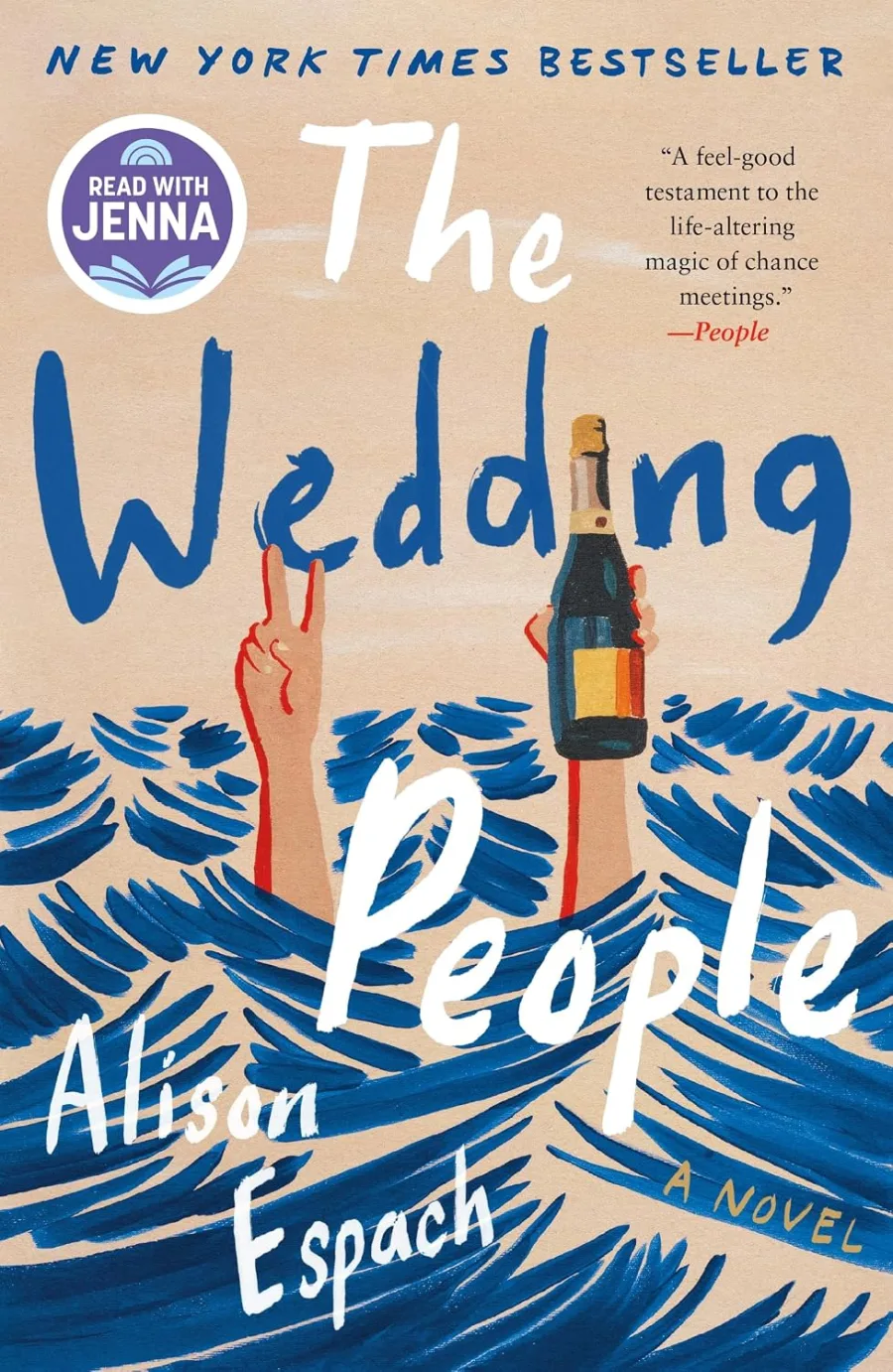
The Wedding People: A Novel
Paperback
• 384 Pages
• USD 18.99
• English
• 9781250899552
No ratings yet
| Publisher | Holt Paperbacks |
|---|---|
| ISBN13 | 9781250899552 |
| ASIN/SKU | 1250899559 |
| Book Format | Paperback |
| Language | English |
| Pages | 384 |
| List Price | USD 18.99 |
| Publishing Date | 28/07/2026 |
| Dimensions | 5.4 x 0.86 x 8.25 inches |
| Weight | 10.5 ounces |
| Book Code | BD00055480 |
Buy this Book
Amazon Stores
Ebook Stores
Other Stores
Discover The Wedding People: A Novel by Alison Espach. This book is published by Holt Paperbacks in Paperback format, ISBN 9781250899552, ASIN 1250899559, under Literature and Fiction, Dark Humor, Contemporary Women Fiction.
Book Description
The runaway New York Times bestselling Today Show Read With Jenna Book Club Pick, with more than 1.5 million copies sold, about an unexpected wedding guest and the surprising people who help her start anew.
Named a Best Book of the Year by The Guardian, Time, Chicago Tribune, Elle, Real Simple, and Glamour
It’s a beautiful day in Newport, Rhode Island, when Phoebe Stone arrives at the grand Cornwall Inn wearing a green dress and gold heels, not a bag in sight, alone. She’s immediately mistaken by everyone in the lobby for one of the wedding people, but she’s actually the only guest at the Cornwall who isn’t here for the big event. Phoebe is here because she’s dreamed of coming for years―she hoped to shuck oysters and take sunset sails with her husband, only now she’s here without him, at rock bottom, and determined to have one last decadent splurge on herself. Meanwhile, the bride has accounted for every detail and every possible disaster the weekend might yield except for, well, Phoebe and Phoebe's plan―which makes it that much more surprising when the two women can’t stop confiding in each other.
In turns absurdly funny and devastatingly tender, Alison Espach’s The Wedding People is ultimately an incredibly nuanced and resonant look at the winding paths we can take to places we never imagined―and the chance encounters it sometimes takes to reroute us.
Named a Best Book of the Year by The Guardian, Time, Chicago Tribune, Elle, Real Simple, and Glamour
It’s a beautiful day in Newport, Rhode Island, when Phoebe Stone arrives at the grand Cornwall Inn wearing a green dress and gold heels, not a bag in sight, alone. She’s immediately mistaken by everyone in the lobby for one of the wedding people, but she’s actually the only guest at the Cornwall who isn’t here for the big event. Phoebe is here because she’s dreamed of coming for years―she hoped to shuck oysters and take sunset sails with her husband, only now she’s here without him, at rock bottom, and determined to have one last decadent splurge on herself. Meanwhile, the bride has accounted for every detail and every possible disaster the weekend might yield except for, well, Phoebe and Phoebe's plan―which makes it that much more surprising when the two women can’t stop confiding in each other.
In turns absurdly funny and devastatingly tender, Alison Espach’s The Wedding People is ultimately an incredibly nuanced and resonant look at the winding paths we can take to places we never imagined―and the chance encounters it sometimes takes to reroute us.
Author Biography
Alison Espach is the author of the novels The Wedding People, Notes on Your Sudden Disappearance, an Indie Next Pick and Amazon Editors’ Pick for 2022, and The Adults, a New York Times Editor’s Choice and Barnes and Noble Discover pick. She has written for McSweeney’s, Vogue, Outside Magazine, Joyland and other places. She teaches creative writing at Providence College in Rhode Island.
Editorial Reviews
MORE THAN 1.5 MILLION COPIES SOLD
A Today Show Read With Jenna Book Club Pick, New York Times Book Review Editors’ Choice, Book of the Month Club Pick, and a #1 Indie Next Pick
Named a Best Book of the Year by The Guardian, Time, Chicago Tribune, HuffPost, US Magazine, Elle, Real Simple, and Glamour
Finalist for the 2026 Thurber Prize for American Humor
Winner of the Goodreads Choice Award
“The Wedding People is the perfect book to wrap up your summer reading. . . . heartwarming [and] hilarious.”
―Jenna Bush Hager, The Today Show's Read with Jenna
“A collision of diametrically opposed life events and general drama, the likes of which we haven’t seen since Maggie Shipstead’s Seating Arrangements. . . . Espach has an eye for the full gamut of emotions that go hand in hand with lifelong commitment, from humor to self-involvement to pathos.”
―The New York Times Book Review
“Espach’s wit and warmth deliver a gratifying story about how people who have given up might find a reason to start caring again.”
―The Washington Post
“Deeply satisfying. . . . A story of what it means to lift oneself out of one life and into another through acts of individual will and fellowship with others. . . . Espach is now three for three on delivering funny, emotionally moving explorations of the difficulties people have in being themselves.”
―Chicago Tribune
“A feel-good testament to the life-altering magic of chance meetings.”
―People
“Deceptively complex...Espach’s story of a life-changing chance encounter is as rewarding as it is unexpected.”
―Time
“A refreshingly sharp and funny examination of loss, love and wrestling with the expectations we have for our lives. This book is the rare lush escape that avoids falling into predictability; the characters feel full and real, and offer genuine moments of insight and warmth amidst their quirky circumstances.”
―HuffPost
“Espach thumbs the depths of emotions most of us would fear speaking aloud, not to mention pour out on the page. It's honest, wry and delightfully unpredictable.”
―USA Today
“Full of witty dialogue and lovably imperfect characters you’ll root for till the end.”
―Real Simple
“They say a good actor can read a phone book and still keep an audience spellbound. Alison Espach is that kind of writer. She is a master of taking the seemingly mundane and creating moments that transfix.”
―Star Tribune
“Filled with hilarious scenes and brilliant banter.”
―Newsday
“By deftly invoking many popular romantic comedy tropes, Espach fills this novel with champagne-tinged fizz, while never losing sight of the more sober emotional truths that kicked off her narrative.”
―Bustle
“It’s simply delightful, entertaining, and heartfelt.”
―Glamour
“Think: Eleanor Oliphant and Meredith, Alone vibes. As of this writing, The Wedding People is my favorite book of 2024.”
―Camille Styles
A Today Show Read With Jenna Book Club Pick, New York Times Book Review Editors’ Choice, Book of the Month Club Pick, and a #1 Indie Next Pick
Named a Best Book of the Year by The Guardian, Time, Chicago Tribune, HuffPost, US Magazine, Elle, Real Simple, and Glamour
Finalist for the 2026 Thurber Prize for American Humor
Winner of the Goodreads Choice Award
“The Wedding People is the perfect book to wrap up your summer reading. . . . heartwarming [and] hilarious.”
―Jenna Bush Hager, The Today Show's Read with Jenna
“A collision of diametrically opposed life events and general drama, the likes of which we haven’t seen since Maggie Shipstead’s Seating Arrangements. . . . Espach has an eye for the full gamut of emotions that go hand in hand with lifelong commitment, from humor to self-involvement to pathos.”
―The New York Times Book Review
“Espach’s wit and warmth deliver a gratifying story about how people who have given up might find a reason to start caring again.”
―The Washington Post
“Deeply satisfying. . . . A story of what it means to lift oneself out of one life and into another through acts of individual will and fellowship with others. . . . Espach is now three for three on delivering funny, emotionally moving explorations of the difficulties people have in being themselves.”
―Chicago Tribune
“A feel-good testament to the life-altering magic of chance meetings.”
―People
“Deceptively complex...Espach’s story of a life-changing chance encounter is as rewarding as it is unexpected.”
―Time
“A refreshingly sharp and funny examination of loss, love and wrestling with the expectations we have for our lives. This book is the rare lush escape that avoids falling into predictability; the characters feel full and real, and offer genuine moments of insight and warmth amidst their quirky circumstances.”
―HuffPost
“Espach thumbs the depths of emotions most of us would fear speaking aloud, not to mention pour out on the page. It's honest, wry and delightfully unpredictable.”
―USA Today
“Full of witty dialogue and lovably imperfect characters you’ll root for till the end.”
―Real Simple
“They say a good actor can read a phone book and still keep an audience spellbound. Alison Espach is that kind of writer. She is a master of taking the seemingly mundane and creating moments that transfix.”
―Star Tribune
“Filled with hilarious scenes and brilliant banter.”
―Newsday
“By deftly invoking many popular romantic comedy tropes, Espach fills this novel with champagne-tinged fizz, while never losing sight of the more sober emotional truths that kicked off her narrative.”
―Bustle
“It’s simply delightful, entertaining, and heartfelt.”
―Glamour
“Think: Eleanor Oliphant and Meredith, Alone vibes. As of this writing, The Wedding People is my favorite book of 2024.”
―Camille Styles
Book Summary
“The Wedding People” by Alison Espach is a moving and funny novel about grief, surprise connection, and the possibility of beginning again after life has fallen apart. The story follows Phoebe Stone, a middle-aged English professor who arrives alone at a luxury hotel in Newport, Rhode Island, planning to end her life after a long stretch of disappointment, heartbreak, and emotional exhaustion. She has recently gone through a painful divorce, her career feels stalled, and even the small comforts that once sustained her seem to have disappeared. What she wants is one final, elegant night for herself in a place she had always hoped to visit. Instead, she walks straight into the middle of an elaborate wedding weekend.
At the hotel, Phoebe is immediately mistaken for one of the wedding guests, and that accidental confusion changes everything. The bride, Lila, is energetic, controlling, and highly stressed, having planned every detail of the celebration with great intensity. Phoebe becomes an unexpected presence in the middle of this carefully managed event, and the bride is initially alarmed when she learns that Phoebe is not there for the wedding at all. Phoebe’s original plan collides with the chaos of the weekend, and the novel begins to explore what happens when a person who expects to disappear instead finds herself surrounded by people who start paying attention to her.
The relationship between Phoebe and Lila becomes one of the most important parts of the novel. At first, they seem like complete opposites. Phoebe is exhausted, detached, and quietly despairing, while Lila is polished, forceful, and determined to have control over every detail. But as the story moves forward, the two women begin to confide in each other in surprising ways. Lila, despite her demanding personality, is also carrying her own anxieties and uncertainty about the marriage she is about to enter. Phoebe, meanwhile, is forced to face the fact that she has reached a breaking point not simply because of one event, but because of years of feeling unseen, unfulfilled, and emotionally stranded. Their conversations give the novel much of its emotional depth, because both women reveal vulnerabilities that are hidden beneath their outward behavior.
As the wedding weekend unfolds, Phoebe becomes increasingly involved in the lives of the people around her. What starts as a bizarre mistake slowly turns into a strange kind of rescue. She is pulled into meals, conversations, awkward encounters, and moments of honesty that she never expected. The wedding guests, who initially see her as a curiosity, begin to include her in their plans. Phoebe’s presence, in turn, disrupts the artificial perfection of the event and exposes the tension beneath its surface. The wedding party is full of people trying to perform happiness, stability, and success, but the novel gently reveals how fragile those performances can be. Beneath the polished image of celebration, there is confusion, fear, vanity, longing, and unresolved pain.
Phoebe’s inner life is at the heart of the novel. Her decision to die comes from a place of deep weariness rather than drama. Espach does not treat her pain lightly, but she also does not reduce Phoebe to it. Instead, the novel lets her remain witty, observant, and often unexpectedly funny, even at her lowest point. That balance gives the book its emotional power. Phoebe is not a heroic figure in a traditional sense. She is simply a person who has been hurt badly and who has forgotten how to imagine a future. As she spends time with the wedding people, she begins to reconnect with the world through small acts of attention, awkward intimacy, and the realization that she is still capable of being known by others.
The title reflects one of the novel’s main ideas: weddings are not only about romance, but about community, performance, memory, and pressure. People gather to celebrate love, but they also bring their own histories, disappointments, and hopes into the event. Espach uses the wedding setting to examine how people construct the appearance of happiness while quietly struggling underneath. The contrast between the wedding’s polished surfaces and Phoebe’s raw honesty creates both comedy and sadness. The novel is full of sharp observations about human behavior, but it never loses sight of its emotional center.
Over the course of the weekend, Phoebe’s outlook begins to change. She does not suddenly become carefree, and the novel does not pretend that one good weekend solves everything. Instead, her shift is quieter and more believable. Being around people who make room for her, even imperfectly, helps her remember that her life is not over. The novel suggests that connection can arrive in unexpected forms and that even a deeply damaged person can still be drawn back toward life by empathy, humor, and chance encounters. The ending carries a sense of openness rather than easy resolution, which fits the book’s tone well.
In the end, “The Wedding People” is a novel about survival, human closeness, and the strange ways people interrupt one another’s despair. It is funny without being shallow and emotional without becoming sentimental. At its core, it asks what might happen if a person on the edge of giving up is accidentally pulled into other people’s lives long enough to remember that she still belongs to the world.
At the hotel, Phoebe is immediately mistaken for one of the wedding guests, and that accidental confusion changes everything. The bride, Lila, is energetic, controlling, and highly stressed, having planned every detail of the celebration with great intensity. Phoebe becomes an unexpected presence in the middle of this carefully managed event, and the bride is initially alarmed when she learns that Phoebe is not there for the wedding at all. Phoebe’s original plan collides with the chaos of the weekend, and the novel begins to explore what happens when a person who expects to disappear instead finds herself surrounded by people who start paying attention to her.
The relationship between Phoebe and Lila becomes one of the most important parts of the novel. At first, they seem like complete opposites. Phoebe is exhausted, detached, and quietly despairing, while Lila is polished, forceful, and determined to have control over every detail. But as the story moves forward, the two women begin to confide in each other in surprising ways. Lila, despite her demanding personality, is also carrying her own anxieties and uncertainty about the marriage she is about to enter. Phoebe, meanwhile, is forced to face the fact that she has reached a breaking point not simply because of one event, but because of years of feeling unseen, unfulfilled, and emotionally stranded. Their conversations give the novel much of its emotional depth, because both women reveal vulnerabilities that are hidden beneath their outward behavior.
As the wedding weekend unfolds, Phoebe becomes increasingly involved in the lives of the people around her. What starts as a bizarre mistake slowly turns into a strange kind of rescue. She is pulled into meals, conversations, awkward encounters, and moments of honesty that she never expected. The wedding guests, who initially see her as a curiosity, begin to include her in their plans. Phoebe’s presence, in turn, disrupts the artificial perfection of the event and exposes the tension beneath its surface. The wedding party is full of people trying to perform happiness, stability, and success, but the novel gently reveals how fragile those performances can be. Beneath the polished image of celebration, there is confusion, fear, vanity, longing, and unresolved pain.
Phoebe’s inner life is at the heart of the novel. Her decision to die comes from a place of deep weariness rather than drama. Espach does not treat her pain lightly, but she also does not reduce Phoebe to it. Instead, the novel lets her remain witty, observant, and often unexpectedly funny, even at her lowest point. That balance gives the book its emotional power. Phoebe is not a heroic figure in a traditional sense. She is simply a person who has been hurt badly and who has forgotten how to imagine a future. As she spends time with the wedding people, she begins to reconnect with the world through small acts of attention, awkward intimacy, and the realization that she is still capable of being known by others.
The title reflects one of the novel’s main ideas: weddings are not only about romance, but about community, performance, memory, and pressure. People gather to celebrate love, but they also bring their own histories, disappointments, and hopes into the event. Espach uses the wedding setting to examine how people construct the appearance of happiness while quietly struggling underneath. The contrast between the wedding’s polished surfaces and Phoebe’s raw honesty creates both comedy and sadness. The novel is full of sharp observations about human behavior, but it never loses sight of its emotional center.
Over the course of the weekend, Phoebe’s outlook begins to change. She does not suddenly become carefree, and the novel does not pretend that one good weekend solves everything. Instead, her shift is quieter and more believable. Being around people who make room for her, even imperfectly, helps her remember that her life is not over. The novel suggests that connection can arrive in unexpected forms and that even a deeply damaged person can still be drawn back toward life by empathy, humor, and chance encounters. The ending carries a sense of openness rather than easy resolution, which fits the book’s tone well.
In the end, “The Wedding People” is a novel about survival, human closeness, and the strange ways people interrupt one another’s despair. It is funny without being shallow and emotional without becoming sentimental. At its core, it asks what might happen if a person on the edge of giving up is accidentally pulled into other people’s lives long enough to remember that she still belongs to the world.
Sample Chapters
Sample Chapters will be added soon…
Reader Reviews
No reviews yet.
The Wedding People: A Novel
Download Cover Image
Do you want to download the full cover image for The Wedding People: A Novel?