
Harry Potter and the Cursed Child, Parts One and Two
Paperback
• 336 Pages
• USD 12.99
• English
• 9781338216660
No ratings yet
| Publisher | Arthur A. Levine Books |
|---|---|
| ISBN13 | 9781338216660 |
| ASIN/SKU | 133821666X |
| Book Format | Paperback |
| Language | English |
| Pages | 336 |
| List Price | USD 12.99 |
| Publishing Date | 31/07/2017 |
| Dimensions | 5.5 x 1.25 x 7.75 inches |
| Weight | 8.3 ounces |
| Book Code | BD00055488 |
Buy this Book
Amazon Stores
Ebook Stores
Other Stores
Discover Harry Potter and the Cursed Child, Parts One and Two by J. K. Rowling. This book is published by Arthur A. Levine Books in Paperback format, ISBN 9781338216660, ASIN 133821666X, under Children's Books, Children's Dramas and Plays, Children's Theater Books.
Book Description
The Eighth Story. Nineteen Years Later. Based on an original story by J.K. Rowling, John Tiffany, and Jack Thorne, a play by Jack Thorne.
It was always difficult being Harry Potter and it isn’t much easier now that he is an overworked employee of the Ministry of Magic, a husband, and father of three school-age children.
While Harry grapples with a past that refuses to stay where it belongs, his youngest son, Albus, must struggle with the weight of a family legacy he never wanted. As past and present fuse ominously, both father and son learn the uncomfortable truth: Sometimes, darkness comes from unexpected places.
The playscript for Harry Potter and the Cursed Child was originally released as a "special rehearsal edition" alongside the opening of Jack Thorne’s play in London’s West End in summer 2016. Based on an original story by J.K. Rowling, John Tiffany, and Jack Thorne, the play opened to rapturous reviews from theatergoers and critics alike, while the official playscript became an immediate global bestseller.
It was always difficult being Harry Potter and it isn’t much easier now that he is an overworked employee of the Ministry of Magic, a husband, and father of three school-age children.
While Harry grapples with a past that refuses to stay where it belongs, his youngest son, Albus, must struggle with the weight of a family legacy he never wanted. As past and present fuse ominously, both father and son learn the uncomfortable truth: Sometimes, darkness comes from unexpected places.
The playscript for Harry Potter and the Cursed Child was originally released as a "special rehearsal edition" alongside the opening of Jack Thorne’s play in London’s West End in summer 2016. Based on an original story by J.K. Rowling, John Tiffany, and Jack Thorne, the play opened to rapturous reviews from theatergoers and critics alike, while the official playscript became an immediate global bestseller.
Author Biography
J.K. Rowling is the author of the enduringly popular Harry Potter books. After the idea for Harry Potter came to her on a delayed train journey in 1990, she plotted out and started writing the series of seven books and the first was published as Harry Potter and the Philosopher’s Stone in the UK in 1997. The series took another ten years to complete, concluding in 2007 with the publication of Harry Potter and the Deathly Hallows.
To accompany the series, J.K. Rowling wrote three short companion volumes for charity, Quidditch Through the Agesand Fantastic Beasts and Where to Find Them, in aid of Comic Relief and Lumos, and The Tales of Beedle the Bard, in aid of Lumos. She also collaborated on the writing of a stage play, Harry Potter and the Cursed Child, which was published as a script book.
Her other books for children include the fairy tale The Ickabog and The Christmas Pig, which were published in 2020 and 2021 respectively and have also been bestsellers. She is also the author of books for adults, including a bestselling crime fiction series.
J.K. Rowling has received many awards and honors for her writing. She also supports a number of causes through her charitable trust Volant and is the founder of the children’s charity Lumos.
To find out more about J.K. Rowling visit jkrowlingstories.com
To accompany the series, J.K. Rowling wrote three short companion volumes for charity, Quidditch Through the Agesand Fantastic Beasts and Where to Find Them, in aid of Comic Relief and Lumos, and The Tales of Beedle the Bard, in aid of Lumos. She also collaborated on the writing of a stage play, Harry Potter and the Cursed Child, which was published as a script book.
Her other books for children include the fairy tale The Ickabog and The Christmas Pig, which were published in 2020 and 2021 respectively and have also been bestsellers. She is also the author of books for adults, including a bestselling crime fiction series.
J.K. Rowling has received many awards and honors for her writing. She also supports a number of causes through her charitable trust Volant and is the founder of the children’s charity Lumos.
To find out more about J.K. Rowling visit jkrowlingstories.com
Editorial Reviews
Praise for the playscript of Harry Potter and the Cursed Child Parts One and Two
"A compelling, stay-up-all-night read... The suspense here is electric and nonstop." -- The New York Times
"Fans can breathe easy knowing this play has been respectfully and lovingly wrought. Tensions thrum, spells fly but at center stage, as always in the Potterverse, is the overriding importance of love and friendship, especially in the face of danger.” -- Booklist, starred review
"Whether encountered on stage or on the page, this trip back into the magical world of Hogwarts is thrilling." -- Telegraph
"A compelling, stay-up-all-night read... The suspense here is electric and nonstop." -- The New York Times
"Fans can breathe easy knowing this play has been respectfully and lovingly wrought. Tensions thrum, spells fly but at center stage, as always in the Potterverse, is the overriding importance of love and friendship, especially in the face of danger.” -- Booklist, starred review
"Whether encountered on stage or on the page, this trip back into the magical world of Hogwarts is thrilling." -- Telegraph
Book Summary
Harry Potter and the Cursed Child takes place nineteen years after the events of “Harry Potter and the Deathly Hallows” and follows a new generation while still deeply tied to Harry’s past. Harry is now an overworked employee at the Ministry of Magic, married to Ginny, and father to three children: James, Albus, and Lily. The story focuses mostly on Albus Severus Potter, who struggles under the heavy weight of his father’s fame and the expectations that come with being “the Boy Who Lived’s” son. Unlike his confident older brother, Albus feels misunderstood, distant from Harry, and deeply insecure. When he goes to Hogwarts, he is sorted into Slytherin instead of Gryffindor, which shocks both him and others and instantly sets him apart. He befriends Scorpius Malfoy, the lonely and intelligent son of Draco Malfoy. Scorpius is rumored to be Voldemort’s secret child, a cruel lie that makes him an outcast. These two boys, both burdened by their fathers’ reputations, form a close friendship that becomes the emotional core of the story.
As Albus and Harry’s relationship becomes more strained, a new problem appears in the form of the Time-Turner. Officially, all Time-Turners were destroyed, but the Ministry discovers a more advanced version that allows someone to travel back in time more flexibly. Meanwhile, Amos Diggory, elderly and still grieving the death of his son Cedric, visits Harry. He begs Harry to use this Time-Turner to go back and save Cedric from dying in the Triwizard Tournament, believing that this would be an act of justice. Harry refuses, arguing that time travel is too dangerous and that they cannot rewrite the past. Albus overhears this and is upset by Harry’s decision and by his own feeling that he can never live up to his father. Wanting to do something that matters and prove that he is more than a disappointment, Albus decides to take action himself.
Albus joins forces with Scorpius and a mysterious young woman named Delphi, who claims to be Amos Diggory’s niece and caretaker. Delphi appears kind, understanding, and sympathetic, especially toward Albus’s desire to help Cedric. Encouraged by her, the boys steal the Time-Turner and travel back to the time of the Triwizard Tournament, hoping to change events so Cedric survives. However, each attempt to “fix” the past causes serious and frightening changes in the present. Their first interference doesn’t seem too bad at first, but when they return, they find small differences that hint at larger consequences. As they continue to use the Time-Turner, things grow more unstable. Reality keeps reshaping itself around their actions, and they begin to see how fragile the timeline really is.
In one altered timeline, Cedric survives but the ripple effect turns him bitter, eventually driving him toward dark choices that strengthen Voldemort’s power. In another, Harry dies and Voldemort wins the war, creating a terrible reality where Hogwarts is under dark control and the world is ruled by fear. In this version, Albus doesn’t even exist, and Scorpius finds himself in a world where he is part of the powerful dark elite. The story uses these alternate timelines to show how even well-meant changes can have catastrophic outcomes, and how the past is woven tightly into the present. Scorpius, who often feels unimportant, is suddenly forced to become the hero who must restore reality. He is the one who finally manages to reverse the worst timeline, showing his quiet bravery and intelligence.
Meanwhile, in the main reality, Harry, Ginny, Hermione, Ron, and Draco are all dealing with the disappearance of Albus and Scorpius. The adults must confront their own fears and failures as parents and friends. Harry struggles with nightmares and lingering trauma from his childhood, including visions that seem to suggest Voldemort’s shadow still hangs over him. His scar, long dormant, begins to hurt again, hinting that something dark is returning. Hermione, now Minister for Magic, and Ron, still light-hearted but loyal, join him in trying to track the boys and understand what has gone wrong. Draco, who has matured and softened since his school days, also becomes an important ally, especially because of his love for Scorpius and his knowledge of his own family’s past.
The true twist of the story comes when Delphi’s real identity is revealed. She is not Amos Diggory’s niece at all, but Voldemort’s daughter, born from a union between Voldemort and Bellatrix Lestrange shortly before Voldemort’s defeat. She has been manipulating Albus and Scorpius from the start, using their desire to help Cedric and their resentment toward their fathers to push them into changing the timeline in ways that suit her goal. Delphi believes she can go back in time, meet Voldemort before his downfall, and help him win, effectively remaking history and giving herself the dark legacy she believes she deserves. Once her true nature is uncovered, the tone shifts sharply toward suspense and danger, and the adults and children must work together to stop her.
The climax of the story unfolds when Delphi travels back to the night Voldemort killed Harry’s parents. She wants to prevent Voldemort’s defeat and ensure the prophecy plays out differently. Harry, Albus, and the others follow, but they cannot directly interfere with the key events without risking destroying reality completely. Instead, they must find a way to stop Delphi while allowing the original timeline—Lily and James’s deaths, Voldemort’s curse rebounding on baby Harry—to remain intact. This is a painful and haunting situation for Harry, who has to relive the worst moment of his life and watch his parents die again, knowing he cannot save them if the future is to exist as it does. It becomes a powerful scene of acceptance: he understands that his identity, and the peace now possible in the wizarding world, are built on those sacrifices.
Eventually, the group manages to defeat Delphi and ensure that time remains as it was. The Time-Turner is destroyed, and Delphi is captured, preventing her from threatening the timeline again. Albus and Harry, having gone through this terrifying experience together, begin to truly understand one another. Harry realizes he has been trying to protect Albus in a way that felt like pressure rather than love, and Albus sees that his father’s past, though legendary, was filled with pain and doubt, not simple heroism. Their relationship, while not perfect, becomes more honest and gentle. Scorpius, too, comes out of the adventure with a stronger sense of self and a hopeful place in the world, no longer defined only by rumors and his family’s dark history.
By the end of “Harry Potter and the Cursed Child,” the story is less about defeating a new Voldemort and more about healing the wounds left by the old one. It explores what it means to grow up in the shadow of a famous past, the difficulties of parenting, and the complicated legacy of war and trauma. Harry learns that he cannot shield his children from every danger, but he can listen and share the truth. Albus learns that he doesn’t have to be his father’s copy to have value. The play closes on a quiet, reflective note, as father and son visit the grave of Cedric Diggory and talk openly about loss, love, and the weight of history. In doing so, it suggests that the future, though shaped by the past, can still be chosen with courage and compassion.
As Albus and Harry’s relationship becomes more strained, a new problem appears in the form of the Time-Turner. Officially, all Time-Turners were destroyed, but the Ministry discovers a more advanced version that allows someone to travel back in time more flexibly. Meanwhile, Amos Diggory, elderly and still grieving the death of his son Cedric, visits Harry. He begs Harry to use this Time-Turner to go back and save Cedric from dying in the Triwizard Tournament, believing that this would be an act of justice. Harry refuses, arguing that time travel is too dangerous and that they cannot rewrite the past. Albus overhears this and is upset by Harry’s decision and by his own feeling that he can never live up to his father. Wanting to do something that matters and prove that he is more than a disappointment, Albus decides to take action himself.
Albus joins forces with Scorpius and a mysterious young woman named Delphi, who claims to be Amos Diggory’s niece and caretaker. Delphi appears kind, understanding, and sympathetic, especially toward Albus’s desire to help Cedric. Encouraged by her, the boys steal the Time-Turner and travel back to the time of the Triwizard Tournament, hoping to change events so Cedric survives. However, each attempt to “fix” the past causes serious and frightening changes in the present. Their first interference doesn’t seem too bad at first, but when they return, they find small differences that hint at larger consequences. As they continue to use the Time-Turner, things grow more unstable. Reality keeps reshaping itself around their actions, and they begin to see how fragile the timeline really is.
In one altered timeline, Cedric survives but the ripple effect turns him bitter, eventually driving him toward dark choices that strengthen Voldemort’s power. In another, Harry dies and Voldemort wins the war, creating a terrible reality where Hogwarts is under dark control and the world is ruled by fear. In this version, Albus doesn’t even exist, and Scorpius finds himself in a world where he is part of the powerful dark elite. The story uses these alternate timelines to show how even well-meant changes can have catastrophic outcomes, and how the past is woven tightly into the present. Scorpius, who often feels unimportant, is suddenly forced to become the hero who must restore reality. He is the one who finally manages to reverse the worst timeline, showing his quiet bravery and intelligence.
Meanwhile, in the main reality, Harry, Ginny, Hermione, Ron, and Draco are all dealing with the disappearance of Albus and Scorpius. The adults must confront their own fears and failures as parents and friends. Harry struggles with nightmares and lingering trauma from his childhood, including visions that seem to suggest Voldemort’s shadow still hangs over him. His scar, long dormant, begins to hurt again, hinting that something dark is returning. Hermione, now Minister for Magic, and Ron, still light-hearted but loyal, join him in trying to track the boys and understand what has gone wrong. Draco, who has matured and softened since his school days, also becomes an important ally, especially because of his love for Scorpius and his knowledge of his own family’s past.
The true twist of the story comes when Delphi’s real identity is revealed. She is not Amos Diggory’s niece at all, but Voldemort’s daughter, born from a union between Voldemort and Bellatrix Lestrange shortly before Voldemort’s defeat. She has been manipulating Albus and Scorpius from the start, using their desire to help Cedric and their resentment toward their fathers to push them into changing the timeline in ways that suit her goal. Delphi believes she can go back in time, meet Voldemort before his downfall, and help him win, effectively remaking history and giving herself the dark legacy she believes she deserves. Once her true nature is uncovered, the tone shifts sharply toward suspense and danger, and the adults and children must work together to stop her.
The climax of the story unfolds when Delphi travels back to the night Voldemort killed Harry’s parents. She wants to prevent Voldemort’s defeat and ensure the prophecy plays out differently. Harry, Albus, and the others follow, but they cannot directly interfere with the key events without risking destroying reality completely. Instead, they must find a way to stop Delphi while allowing the original timeline—Lily and James’s deaths, Voldemort’s curse rebounding on baby Harry—to remain intact. This is a painful and haunting situation for Harry, who has to relive the worst moment of his life and watch his parents die again, knowing he cannot save them if the future is to exist as it does. It becomes a powerful scene of acceptance: he understands that his identity, and the peace now possible in the wizarding world, are built on those sacrifices.
Eventually, the group manages to defeat Delphi and ensure that time remains as it was. The Time-Turner is destroyed, and Delphi is captured, preventing her from threatening the timeline again. Albus and Harry, having gone through this terrifying experience together, begin to truly understand one another. Harry realizes he has been trying to protect Albus in a way that felt like pressure rather than love, and Albus sees that his father’s past, though legendary, was filled with pain and doubt, not simple heroism. Their relationship, while not perfect, becomes more honest and gentle. Scorpius, too, comes out of the adventure with a stronger sense of self and a hopeful place in the world, no longer defined only by rumors and his family’s dark history.
By the end of “Harry Potter and the Cursed Child,” the story is less about defeating a new Voldemort and more about healing the wounds left by the old one. It explores what it means to grow up in the shadow of a famous past, the difficulties of parenting, and the complicated legacy of war and trauma. Harry learns that he cannot shield his children from every danger, but he can listen and share the truth. Albus learns that he doesn’t have to be his father’s copy to have value. The play closes on a quiet, reflective note, as father and son visit the grave of Cedric Diggory and talk openly about loss, love, and the weight of history. In doing so, it suggests that the future, though shaped by the past, can still be chosen with courage and compassion.
Sample Chapters
Sample Chapters will be added soon…
Reader Reviews
No reviews yet.
Harry Potter and the Cursed Child, Parts One and Two
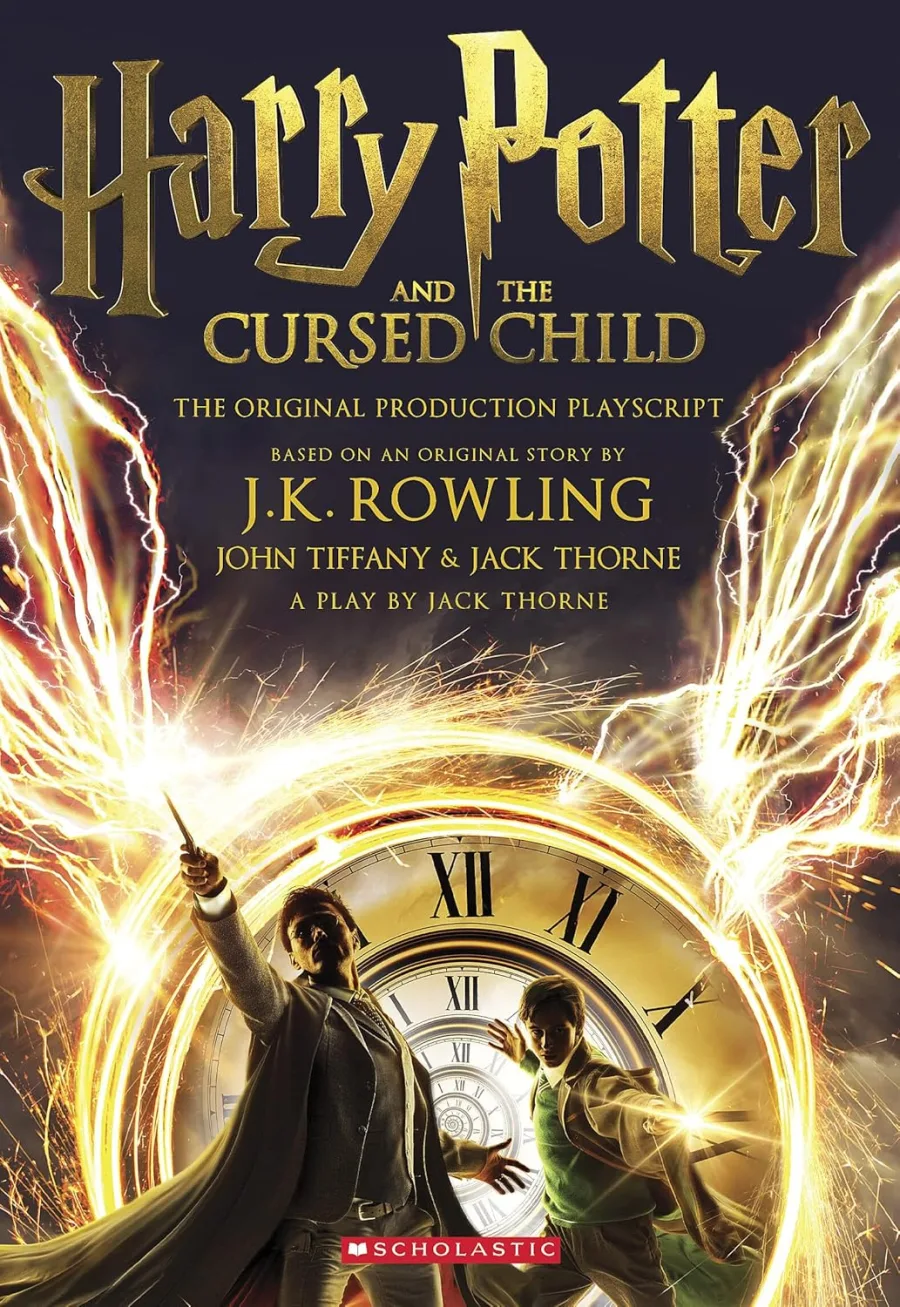
Download Cover Image
Do you want to download the full cover image for Harry Potter and the Cursed Child, Parts One and Two?