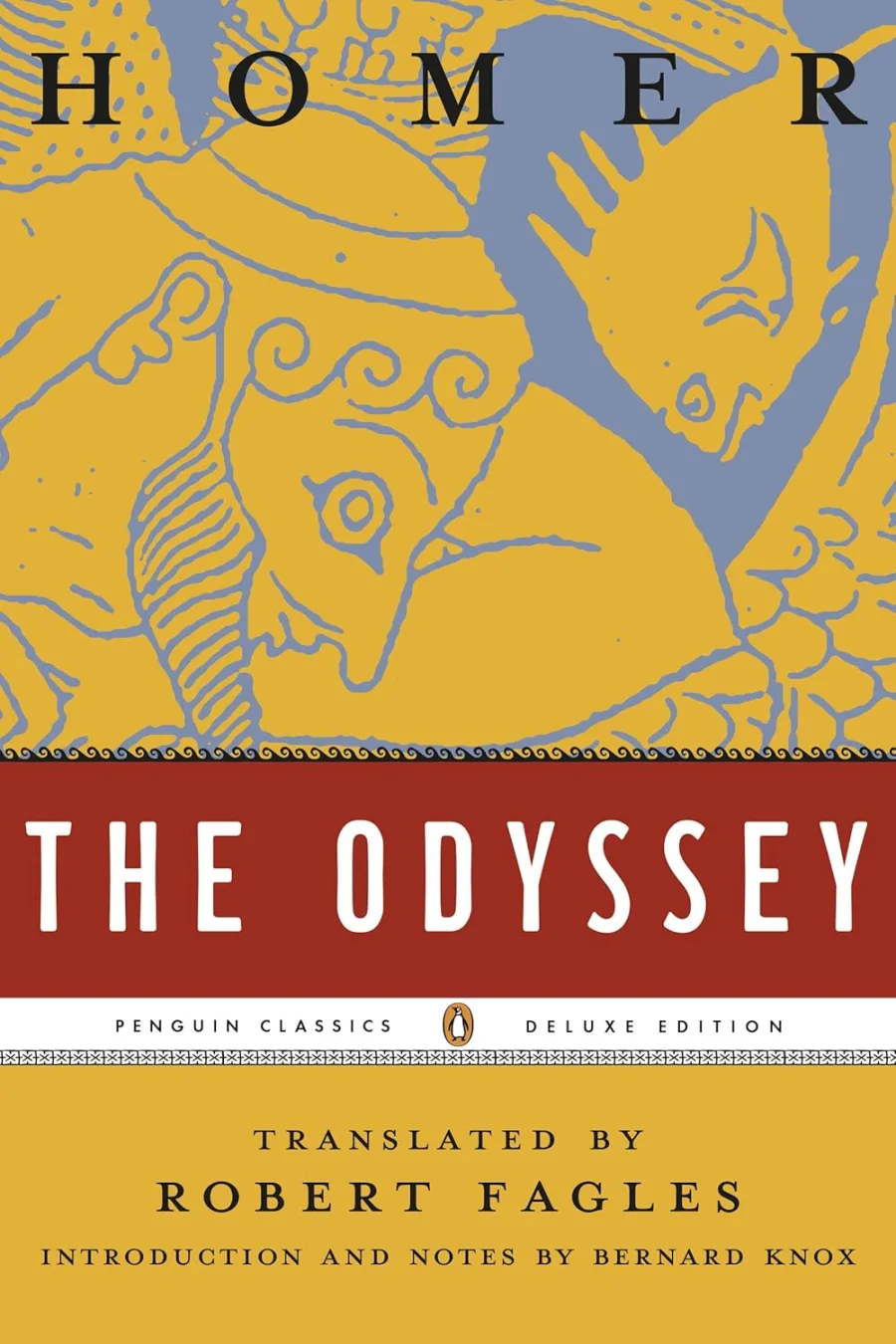
The Odyssey
Paperback
• 541 Pages
• USD 22.00
• English
• 9780140268867
No ratings yet
| Publisher | Penguin Classics |
|---|---|
| ISBN13 | 9780140268867 |
| ASIN/SKU | 0140268863 |
| Book Format | Paperback |
| Language | English |
| Pages | 541 |
| List Price | USD 22.00 |
| Publishing Date | 29/11/1999 |
| Dimensions | 8.4 x 5.7 x 1.5 inches |
| Weight | 1.32 pounds |
| Book Code | BD00055500 |
Buy this Book
Amazon Stores
Ebook Stores
Other Stores
Discover The Odyssey by Homer. This book is published by Penguin Classics in Paperback format, ISBN 9780140268867, ASIN 0140268863, under Literature and Fiction, Ancient and Medieval Literature, Ancient and Classical Poetry.
Book Description
The great epic of Western literature, translated by the acclaimed classicist Robert Fagles
Soon to be a major motion picture directed by Christopher Nolan
A Penguin Classic
Robert Fagles, winner of the PEN/Ralph Manheim Medal for Translation and a 1996 Academy Award in Literature from the American Academy of Arts and Letters, presents us with Homer's best-loved and most accessible poem in a stunning modern-verse translation. "Sing to me of the man, Muse, the man of twists and turns driven time and again off course, once he had plundered the hallowed heights of Troy." So begins Robert Fagles' magnificent translation of the Odyssey, which Jasper Griffin in the New York Times Book Review hails as "a distinguished achievement."
If the Iliad is the world's greatest war epic, the Odyssey is literature's grandest evocation of an everyman's journey through life. Odysseus' reliance on his wit and wiliness for survival in his encounters with divine and natural forces during his ten-year voyage home to Ithaca after the Trojan War is at once a timeless human story and an individual test of moral endurance.
In the myths and legends retold here, Fagles has captured the energy and poetry of Homer's original in a bold, contemporary idiom, and given us an Odyssey to read aloud, to savor, and to treasure for its sheer lyrical mastery. Renowned classicist Bernard Knox's superb introduction and textual commentary provide insightful background information for the general reader and scholar alike, intensifying the strength of Fagles's translation. This is an Odyssey to delight both the classicist and the general reader, to captivate a new generation of Homer's students. This Penguin Classics Deluxe Edition features French flaps and deckle-edged paper.
For more than seventy years, Penguin has been the leading publisher of classic literature in the English-speaking world. With more than 1,700 titles, Penguin Classics represents a global bookshelf of the best works throughout history and across genres and disciplines. Readers trust the series to provide authoritative texts enhanced by introductions and notes by distinguished scholars and contemporary authors, as well as up-to-date translations by award-winning translators.
Soon to be a major motion picture directed by Christopher Nolan
A Penguin Classic
Robert Fagles, winner of the PEN/Ralph Manheim Medal for Translation and a 1996 Academy Award in Literature from the American Academy of Arts and Letters, presents us with Homer's best-loved and most accessible poem in a stunning modern-verse translation. "Sing to me of the man, Muse, the man of twists and turns driven time and again off course, once he had plundered the hallowed heights of Troy." So begins Robert Fagles' magnificent translation of the Odyssey, which Jasper Griffin in the New York Times Book Review hails as "a distinguished achievement."
If the Iliad is the world's greatest war epic, the Odyssey is literature's grandest evocation of an everyman's journey through life. Odysseus' reliance on his wit and wiliness for survival in his encounters with divine and natural forces during his ten-year voyage home to Ithaca after the Trojan War is at once a timeless human story and an individual test of moral endurance.
In the myths and legends retold here, Fagles has captured the energy and poetry of Homer's original in a bold, contemporary idiom, and given us an Odyssey to read aloud, to savor, and to treasure for its sheer lyrical mastery. Renowned classicist Bernard Knox's superb introduction and textual commentary provide insightful background information for the general reader and scholar alike, intensifying the strength of Fagles's translation. This is an Odyssey to delight both the classicist and the general reader, to captivate a new generation of Homer's students. This Penguin Classics Deluxe Edition features French flaps and deckle-edged paper.
For more than seventy years, Penguin has been the leading publisher of classic literature in the English-speaking world. With more than 1,700 titles, Penguin Classics represents a global bookshelf of the best works throughout history and across genres and disciplines. Readers trust the series to provide authoritative texts enhanced by introductions and notes by distinguished scholars and contemporary authors, as well as up-to-date translations by award-winning translators.
Author Biography
Homer was probably born around 725BC on the Coast of Asia Minor, now the coast of Turkey, but then really a part of Greece. Homer was the first Greek writer whose work survives.
He was one of a long line of bards, or poets, who worked in the oral tradition. Homer and other bards of the time could recite, or chant, long epic poems. Both works attributed to Homer - The Iliad and The Odyssey - are over ten thousand lines long in the original. Homer must have had an amazing memory but was helped by the formulaic poetry style of the time.
In The Iliad Homer sang of death and glory, of a few days in the struggle between the Greeks and the Trojans. Mortal men played out their fate under the gaze of the gods. The Odyssey is the original collection of tall traveller's tales. Odysseus, on his way home from the Trojan War, encounters all kinds of marvels from one-eyed giants to witches and beautiful temptresses. His adventures are many and memorable before he gets back to Ithaca and his faithful wife Penelope.
We can never be certain that both these stories belonged to Homer. In fact 'Homer' may not be a real name but a kind of nickname meaning perhaps 'the hostage' or 'the blind one'. Whatever the truth of their origin, the two stories, developed around three thousand years ago, may well still be read in three thousand years' time.
He was one of a long line of bards, or poets, who worked in the oral tradition. Homer and other bards of the time could recite, or chant, long epic poems. Both works attributed to Homer - The Iliad and The Odyssey - are over ten thousand lines long in the original. Homer must have had an amazing memory but was helped by the formulaic poetry style of the time.
In The Iliad Homer sang of death and glory, of a few days in the struggle between the Greeks and the Trojans. Mortal men played out their fate under the gaze of the gods. The Odyssey is the original collection of tall traveller's tales. Odysseus, on his way home from the Trojan War, encounters all kinds of marvels from one-eyed giants to witches and beautiful temptresses. His adventures are many and memorable before he gets back to Ithaca and his faithful wife Penelope.
We can never be certain that both these stories belonged to Homer. In fact 'Homer' may not be a real name but a kind of nickname meaning perhaps 'the hostage' or 'the blind one'. Whatever the truth of their origin, the two stories, developed around three thousand years ago, may well still be read in three thousand years' time.
Editorial Reviews
Praise for Robert Fagles Translation of The Odyssey
“Wonderfully readable... Just the right blend of roughness and sophistication.”—Ted Hughes
“Robert Fagles is the best living translator of ancient Greek drama, lyric poetry, and epic into modern English.”—Garry Wills, The New Yorker
“Mr. Fagles has been remarkably successful in finding a style that is of our time and yet timeless.”—Richard Jenkyns, The New York Times Book Review
“Wonderfully readable... Just the right blend of roughness and sophistication.”—Ted Hughes
“Robert Fagles is the best living translator of ancient Greek drama, lyric poetry, and epic into modern English.”—Garry Wills, The New Yorker
“Mr. Fagles has been remarkably successful in finding a style that is of our time and yet timeless.”—Richard Jenkyns, The New York Times Book Review
Book Summary
The Odyssey is an epic poem about Odysseus’s long, painful journey home after the Trojan War, and the struggle of his family to survive in his absence. In Robert Fagles’s translation, the story keeps its sense of grandeur and momentum while staying vivid, direct, and human, making Odysseus’s travels feel both legendary and emotionally immediate.
The poem begins in the middle of things. Odysseus has been gone from Ithaca for years, trapped on the island of the nymph Calypso, while his home has fallen into disorder. In Ithaca, a crowd of suitors has overrun his palace, eating his wealth, disrespecting his household, and pressuring his wife, Penelope, to choose a new husband. Penelope remains faithful and refuses to give up hope, but the situation becomes more dangerous every day because the suitors are not just wasteful; they are also threatening her son, Telemachus.
One of the poem’s most important early movements follows Telemachus as he begins to grow into adulthood. At the urging of Athena, who constantly protects Odysseus and his family, Telemachus travels to learn news of his father and to find the confidence he lacks at home. This part of the poem is not just background; it is a coming-of-age story in its own right. Telemachus starts out uncertain and passive, but his journey forces him to speak publicly, make decisions, and begin acting like the son of Odysseus.
Meanwhile, Odysseus is finally released from Calypso’s island and sets out again, only to be battered by the sea god Poseidon, who has not forgiven him for blinding the Cyclops Polyphemus. This hostility from the gods is one of the poem’s defining forces. Odysseus is not only fighting weather, monsters, and enemies, but also the will of powerful divine beings. He survives shipwreck, exhaustion, and isolation before reaching the land of the Phaeacians, where Princess Nausicaa discovers him and offers help.
From there, Odysseus is finally able to tell the story of his wanderings. These adventures make up some of the most famous episodes in Western literature. He and his men face the Lotus-eaters, whose fruit tempts people to forget home, and the Cyclops Polyphemus, whose savage violence turns hospitality upside down. They encounter Aeolus, who gives Odysseus a bag of winds, only for his crew to ruin the chance by opening it at the wrong time. They also meet the cannibal Laestrygonians, who destroy most of the fleet, and the witch Circe, who transforms men into animals before Odysseus, protected by Hermes, forces her to restore them.
Odysseus then descends into the land of the dead, where he learns more about the cost of his journey and the limits of human life. After that, he returns to Circe’s island and receives advice for the dangerous road ahead. He must pass the Sirens, whose song promises knowledge but leads sailors to death, and navigate between Scylla and Charybdis, choosing the lesser disaster while still losing men. The final great mistake comes on the island of the Sun, where his crew, starving and disobedient, kills sacred cattle despite warnings. That act destroys the rest of the ship’s company and leaves Odysseus alone to continue toward home.
When Odysseus reaches Ithaca again, the poem shifts from travel adventure to strategy and vengeance. Athena helps disguise him so he can observe the situation in his own house without revealing himself immediately. He reunites with Telemachus, and the two work together to defeat the suitors, who have grown arrogant and careless after years of abusing hospitality. Penelope plays a crucial role too. She remains cautious and intelligent, never fully trusting appearances, and her famous test involving the bow becomes the final proof of Odysseus’s identity. Once he proves himself, he and Telemachus kill the suitors and restore order to the household.
At its core, The Odyssey is about homecoming, but it is also about identity, endurance, loyalty, and the price of survival. Odysseus is often praised for his cleverness, yet the poem also shows his flaws, losses, and mistakes. Penelope represents patience and intelligence, Telemachus growth and inheritance, and the suitors the destruction that follows when power and desire are left unchecked. Fagles’s translation makes these themes especially vivid by giving the poem energy, clarity, and dramatic force, so the ancient story feels immediate rather than distant. The result is a story of a man trying to get home, but also of a family and a kingdom trying to survive until he does.
The poem begins in the middle of things. Odysseus has been gone from Ithaca for years, trapped on the island of the nymph Calypso, while his home has fallen into disorder. In Ithaca, a crowd of suitors has overrun his palace, eating his wealth, disrespecting his household, and pressuring his wife, Penelope, to choose a new husband. Penelope remains faithful and refuses to give up hope, but the situation becomes more dangerous every day because the suitors are not just wasteful; they are also threatening her son, Telemachus.
One of the poem’s most important early movements follows Telemachus as he begins to grow into adulthood. At the urging of Athena, who constantly protects Odysseus and his family, Telemachus travels to learn news of his father and to find the confidence he lacks at home. This part of the poem is not just background; it is a coming-of-age story in its own right. Telemachus starts out uncertain and passive, but his journey forces him to speak publicly, make decisions, and begin acting like the son of Odysseus.
Meanwhile, Odysseus is finally released from Calypso’s island and sets out again, only to be battered by the sea god Poseidon, who has not forgiven him for blinding the Cyclops Polyphemus. This hostility from the gods is one of the poem’s defining forces. Odysseus is not only fighting weather, monsters, and enemies, but also the will of powerful divine beings. He survives shipwreck, exhaustion, and isolation before reaching the land of the Phaeacians, where Princess Nausicaa discovers him and offers help.
From there, Odysseus is finally able to tell the story of his wanderings. These adventures make up some of the most famous episodes in Western literature. He and his men face the Lotus-eaters, whose fruit tempts people to forget home, and the Cyclops Polyphemus, whose savage violence turns hospitality upside down. They encounter Aeolus, who gives Odysseus a bag of winds, only for his crew to ruin the chance by opening it at the wrong time. They also meet the cannibal Laestrygonians, who destroy most of the fleet, and the witch Circe, who transforms men into animals before Odysseus, protected by Hermes, forces her to restore them.
Odysseus then descends into the land of the dead, where he learns more about the cost of his journey and the limits of human life. After that, he returns to Circe’s island and receives advice for the dangerous road ahead. He must pass the Sirens, whose song promises knowledge but leads sailors to death, and navigate between Scylla and Charybdis, choosing the lesser disaster while still losing men. The final great mistake comes on the island of the Sun, where his crew, starving and disobedient, kills sacred cattle despite warnings. That act destroys the rest of the ship’s company and leaves Odysseus alone to continue toward home.
When Odysseus reaches Ithaca again, the poem shifts from travel adventure to strategy and vengeance. Athena helps disguise him so he can observe the situation in his own house without revealing himself immediately. He reunites with Telemachus, and the two work together to defeat the suitors, who have grown arrogant and careless after years of abusing hospitality. Penelope plays a crucial role too. She remains cautious and intelligent, never fully trusting appearances, and her famous test involving the bow becomes the final proof of Odysseus’s identity. Once he proves himself, he and Telemachus kill the suitors and restore order to the household.
At its core, The Odyssey is about homecoming, but it is also about identity, endurance, loyalty, and the price of survival. Odysseus is often praised for his cleverness, yet the poem also shows his flaws, losses, and mistakes. Penelope represents patience and intelligence, Telemachus growth and inheritance, and the suitors the destruction that follows when power and desire are left unchecked. Fagles’s translation makes these themes especially vivid by giving the poem energy, clarity, and dramatic force, so the ancient story feels immediate rather than distant. The result is a story of a man trying to get home, but also of a family and a kingdom trying to survive until he does.
Sample Chapters
Sample Chapters will be added soon…
Reader Reviews
No reviews yet.
The Odyssey