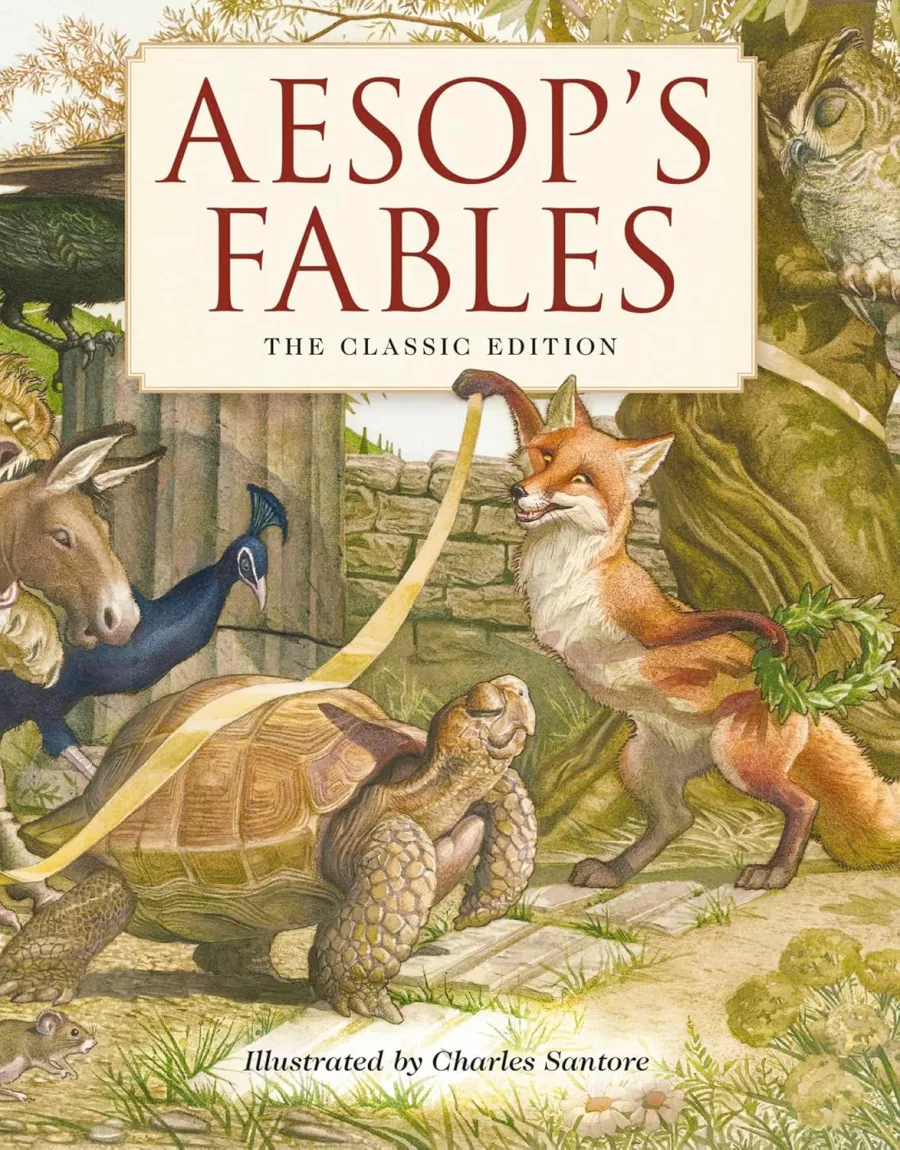
Aesop's Fables
Aesop, Charles Santore (Illustrator)
Hardcover
• 64 Pages
• USD 19.99
• English
• 9781604338102
No ratings yet
| Publisher | Applesauce Press |
|---|---|
| ISBN13 | 9781604338102 |
| ASIN/SKU | 1604338105 |
| Book Format | Hardcover |
| Language | English |
| Pages | 64 |
| List Price | USD 19.99 |
| Publishing Date | 25/09/2018 |
| Dimensions | 1 x 1 x 1 inches |
| Weight | 1.62 pounds |
| Book Code | BD00055501 |
Buy this Book
Amazon Stores
Ebook Stores
Other Stores
Discover Aesop's Fables by Aesop. This book is published by Applesauce Press in Hardcover format, ISBN 9781604338102, ASIN 1604338105, under Children's Books, Children's Trickster Tales Fiction, Children's Fox and Wolf Books.
Book Description
Cuddle up with your little one and share the wonder of Aesop's Fables with the most exquisitely illustrated edition—featuring breathtaking original artwork by acclaimed illustrator Charles Santore! Get ready for an adventurous bedtime story full of trickster deeds, moral lessons, and age old fables in this favorite childhood fairy tale anthology that is sure to delight and inspire.
Captivating the hearts and minds of kids and adults for generations, Aesop, a former Greek slave, developed simple and meaningful adventures featuring animals or insects to teach a moral standard or lesson for living. The most well known and well loved of Aesop's fables are included here:
The Hare and the Tortoise
The Lion and the Mouse
The Town Mouse and the Country Mouse
The Wolf in Sheep's Clothing
This Classic Edition:
Is great for children ages 4 - 8
Perfect for family read-alouds or story at bedtime
Lavish illustrations by renowned artist Charles Santore, the critically-acclaimed illustrator of multiple classic tales, including The Velveteen Rabbit, and The Classic Tale of Peter Rabbit, and The Night Before Christmas
Makes a great holiday, Advent, or Christmas gift
Charles Santore is best known for his luminous interpretations of classic children’s stories, including The Little Mermaid, Alice's Adventures in Wonderland, Snow White, and The Wizard of Oz.
Captivating the hearts and minds of kids and adults for generations, Aesop, a former Greek slave, developed simple and meaningful adventures featuring animals or insects to teach a moral standard or lesson for living. The most well known and well loved of Aesop's fables are included here:
The Hare and the Tortoise
The Lion and the Mouse
The Town Mouse and the Country Mouse
The Wolf in Sheep's Clothing
This Classic Edition:
Is great for children ages 4 - 8
Perfect for family read-alouds or story at bedtime
Lavish illustrations by renowned artist Charles Santore, the critically-acclaimed illustrator of multiple classic tales, including The Velveteen Rabbit, and The Classic Tale of Peter Rabbit, and The Night Before Christmas
Makes a great holiday, Advent, or Christmas gift
Charles Santore is best known for his luminous interpretations of classic children’s stories, including The Little Mermaid, Alice's Adventures in Wonderland, Snow White, and The Wizard of Oz.
Author Biography
Aesop (/ˈiːsɒp/ EE-sop; Ancient Greek: Αἴσωπος, Aisōpos; c. 620 - 564 BCE) was an Ancient Greek fabulist or story teller credited with a number of fables now collectively known as Aesop's Fables. Although his existence remains uncertain and no writings by him survive, numerous tales credited to him were gathered across the centuries and in many languages in a storytelling tradition that continues to this day. Many of the tales are characterized by animals and inanimate objects that speak, solve problems, and generally have human characteristics.
Scattered details of Aesop's life can be found in ancient sources, including Aristotle, Herodotus, and Plutarch. An ancient literary work called The Aesop Romance tells an episodic, probably highly fictional version of his life, including the traditional description of him as a strikingly ugly slave (δοῦλος) who by his cleverness acquires freedom and becomes an adviser to kings and city-states. Older spellings of his name have included Esop(e) and Isope. Depictions of Aesop in popular culture over the last 2500 years have included several works of art and his appearance as a character in numerous books, films, plays, and television programs.
Bio from Wikipedia, the free encyclopedia. Photo of statue by user:shakko (Own work) [CC BY-SA 3.0 (http://creativecommons.org/licenses/by-sa/3.0)], via Wikimedia Commons.
Scattered details of Aesop's life can be found in ancient sources, including Aristotle, Herodotus, and Plutarch. An ancient literary work called The Aesop Romance tells an episodic, probably highly fictional version of his life, including the traditional description of him as a strikingly ugly slave (δοῦλος) who by his cleverness acquires freedom and becomes an adviser to kings and city-states. Older spellings of his name have included Esop(e) and Isope. Depictions of Aesop in popular culture over the last 2500 years have included several works of art and his appearance as a character in numerous books, films, plays, and television programs.
Bio from Wikipedia, the free encyclopedia. Photo of statue by user:shakko (Own work) [CC BY-SA 3.0 (http://creativecommons.org/licenses/by-sa/3.0)], via Wikimedia Commons.
Editorial Reviews
Editorial Reviews will be added soon…
Book Summary
“Aesop’s Fables” is a collection of short moral stories told through animals, people, and everyday situations, and this edition is especially memorable because of Charles Santore’s rich, detailed illustrations. The book brings together some of the most famous fables ever told, such as “The Hare and the Tortoise,” “The Lion and the Mouse,” “The Boy Who Cried Wolf,” “The Town Mouse and the Country Mouse,” and “The Wolf in Sheep’s Clothing,” each one offering a simple lesson about behavior, wisdom, patience, honesty, or humility.
The stories are brief, but they stay powerful because they speak to basic human habits and mistakes. In “The Hare and the Tortoise,” the faster animal loses because of arrogance and carelessness, while the slow tortoise wins through persistence. In “The Lion and the Mouse,” a small creature proves that kindness can be returned in unexpected ways. In “The Boy Who Cried Wolf,” false alarms destroy trust, showing how lies can make real danger harder to believe. In “The Wolf in Sheep’s Clothing,” the danger of appearances is revealed, reminding readers that not everything gentle-looking is safe or honest. These and the other fables in the collection all work in a similar way: they tell a memorable little story and then leave behind a lesson that feels easy to understand but hard to forget.
What makes this edition stand out is the way the artwork deepens the experience. Santore’s illustrations give the fables a classic, almost timeless feel, making the animals and scenes look vivid, dramatic, and full of life. The images are not just decoration; they help create mood and make the moral tales feel more immersive for younger readers and for adults reading aloud. The visual style gives the book a storybook quality that matches the simplicity and charm of the fables themselves.
At its heart, the collection is about living wisely. It shows that pride can lead to failure, patience can bring victory, honesty matters, and power should not be used carelessly. The fables are short enough for children, but their lessons remain relevant for readers of any age because they describe situations that still happen in everyday life. That is why Aesop’s stories have lasted so long: they are simple on the surface, but they capture human nature in a way that still feels true.
The stories are brief, but they stay powerful because they speak to basic human habits and mistakes. In “The Hare and the Tortoise,” the faster animal loses because of arrogance and carelessness, while the slow tortoise wins through persistence. In “The Lion and the Mouse,” a small creature proves that kindness can be returned in unexpected ways. In “The Boy Who Cried Wolf,” false alarms destroy trust, showing how lies can make real danger harder to believe. In “The Wolf in Sheep’s Clothing,” the danger of appearances is revealed, reminding readers that not everything gentle-looking is safe or honest. These and the other fables in the collection all work in a similar way: they tell a memorable little story and then leave behind a lesson that feels easy to understand but hard to forget.
What makes this edition stand out is the way the artwork deepens the experience. Santore’s illustrations give the fables a classic, almost timeless feel, making the animals and scenes look vivid, dramatic, and full of life. The images are not just decoration; they help create mood and make the moral tales feel more immersive for younger readers and for adults reading aloud. The visual style gives the book a storybook quality that matches the simplicity and charm of the fables themselves.
At its heart, the collection is about living wisely. It shows that pride can lead to failure, patience can bring victory, honesty matters, and power should not be used carelessly. The fables are short enough for children, but their lessons remain relevant for readers of any age because they describe situations that still happen in everyday life. That is why Aesop’s stories have lasted so long: they are simple on the surface, but they capture human nature in a way that still feels true.
Sample Chapters
Sample Chapters will be added soon…
Reader Reviews
No reviews yet.
Aesop's Fables