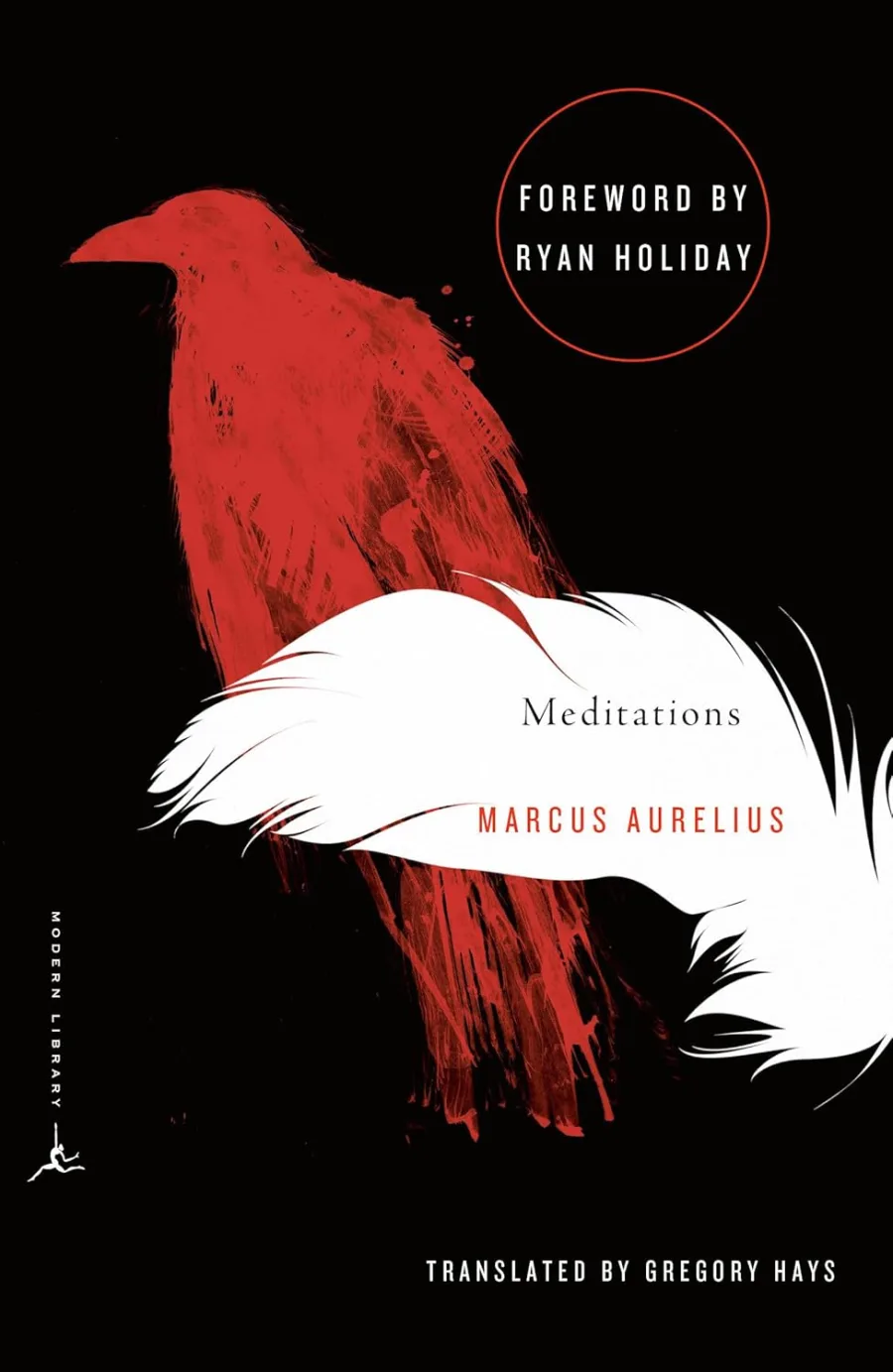
Meditations
Paperback
• 272 Pages
• USD 11.00
• English
• 9780812968255
No ratings yet
| Publisher | Modern Library |
|---|---|
| ISBN13 | 9780812968255 |
| ASIN/SKU | 0812968255 |
| Book Format | Paperback |
| Language | English |
| Pages | 272 |
| List Price | USD 11.00 |
| Publishing Date | 06/05/2003 |
| Dimensions | 5.16 x 0.59 x 7.99 inches |
| Weight | 6.2 ounces |
| Book Code | BD00055502 |
Buy this Book
Amazon Stores
Ebook Stores
Other Stores
Discover Meditations by Marcus Aurelius. This book is published by Modern Library in Paperback format, ISBN 9780812968255, ASIN 0812968255, under Self-Help, Philosophy, Rationalist Philosophy.
Book Description
NATIONAL BESTSELLER • Timeless insights into what it takes to lead a meaningful life—still profoundly relevant nearly two thousand years later.
Now featuring a brand-new foreword from Ryan Holiday, #1 New York Times bestselling author of The Obstacle Is the Way!
“Meditations offers a glimpse into [Marcus Aurelius’s] mind, his habits, and his approach to life. . . . I think any reader would find something useful to take away from it.”—James Clear, #1 New York Times bestselling author of Atomic Habits
“It is unbelievable to see how the emperor’s words have stood the test of time. . . . Read a page or two anytime you feel like the world is too much.”—Arnold Schwarzenegger, The Wall Street Journal
Your ability to control your thoughts—treat it with respect. It’s all that protects your mind from false perceptions—false to your nature, and that of all rational beings.
A series of spiritual exercises filled with wisdom, practical guidance, and profound understanding of human behavior, Marcus Aurelius’s Meditations remains one of the greatest works of spiritual and ethical reflection ever written. With bite-size insights and advice on everything from living in the world to coping with adversity and interacting with others, Meditations has become required reading not only for statesmen and philosophers alike, but also for generations of readers who responded to the straightforward intimacy of his style.
In Gregory Hays’s translation—the first in nearly four decades—Marcus’s thoughts speak with a new immediacy. In fresh and unencumbered English, Hays vividly conveys the spareness and compression of the original Greek text. Never before have Marcus’s insights been so directly and powerfully presented.
With an Introduction that outlines Marcus’s life and career, the essentials of Stoic doctrine, the style and construction of the Meditations, and the work’s ongoing influence, this edition makes it possible to fully rediscover the thoughts of one of the most enlightened and intelligent leaders of any era.
Now featuring a brand-new foreword from Ryan Holiday, #1 New York Times bestselling author of The Obstacle Is the Way!
“Meditations offers a glimpse into [Marcus Aurelius’s] mind, his habits, and his approach to life. . . . I think any reader would find something useful to take away from it.”—James Clear, #1 New York Times bestselling author of Atomic Habits
“It is unbelievable to see how the emperor’s words have stood the test of time. . . . Read a page or two anytime you feel like the world is too much.”—Arnold Schwarzenegger, The Wall Street Journal
Your ability to control your thoughts—treat it with respect. It’s all that protects your mind from false perceptions—false to your nature, and that of all rational beings.
A series of spiritual exercises filled with wisdom, practical guidance, and profound understanding of human behavior, Marcus Aurelius’s Meditations remains one of the greatest works of spiritual and ethical reflection ever written. With bite-size insights and advice on everything from living in the world to coping with adversity and interacting with others, Meditations has become required reading not only for statesmen and philosophers alike, but also for generations of readers who responded to the straightforward intimacy of his style.
In Gregory Hays’s translation—the first in nearly four decades—Marcus’s thoughts speak with a new immediacy. In fresh and unencumbered English, Hays vividly conveys the spareness and compression of the original Greek text. Never before have Marcus’s insights been so directly and powerfully presented.
With an Introduction that outlines Marcus’s life and career, the essentials of Stoic doctrine, the style and construction of the Meditations, and the work’s ongoing influence, this edition makes it possible to fully rediscover the thoughts of one of the most enlightened and intelligent leaders of any era.
Author Biography
Marcus Aurelius Antoninus was born to an upper-class Roman family in A.D. 121 and was later adopted by the future emperor Antoninus Pius, whom he succeeded in 161. His reign was marked by a successful campaign against Parthia, but was overshadowed in later years by plague, an abortive revolt in the eastern provinces, and the deaths of friends and family, including his co-emperor Lucius Verus. A student of philosophy from his earliest youth, he was especially influenced by the first-century Stoic thinker Epictetus. His later reputation rests on his Meditations, written during his later years and never meant for formal publication. He died in 180, while campaigning against the barbarian tribes on Rome’s northern frontier.
Editorial Reviews
“Here, for our age, is [Marcus’s] great work presented in its entirety, strongly introduced and freshly, elegantly translated.” —Robert Fagles
Book Summary
“Meditations” is not a conventional book with a plot, but a deeply personal collection of reflections written by the Roman emperor Marcus Aurelius for himself. In Gregory Hays’s translation, the writing feels especially clear and modern, which makes Marcus’s ancient thoughts on duty, self-control, and human life feel immediate and practical. The book reads like a private notebook of moral exercises, where a ruler tries to steady his mind, correct his thinking, and live in a way that is worthy of reason and nature.
At the center of the work is Stoic philosophy, the idea that a person cannot control everything that happens, but can always control how they respond. Marcus returns to this lesson again and again. He urges himself to stay calm in the face of difficulty, not to be ruled by anger, fear, vanity, or desire, and to remember that events themselves are not what disturb us as much as our judgments about them. If the mind is disciplined, then hardship loses some of its power. If a person chooses virtue, then outside events cannot fully damage the soul.
A major theme in the book is the smallness of the individual life compared with the vastness of time, nature, and the universe. Marcus constantly reflects on how brief life is and how quickly all people are forgotten. He does not present this as a reason for despair, but as a reason to live more carefully and honestly. Since life is short, there is no point in wasting it on resentment, performance, or chasing praise. The right response is to focus on what is just, useful, and in harmony with nature. This gives the book a serious but strangely comforting tone. Death is not denied, but accepted as part of the order of things.
Another powerful idea in Meditations is the importance of duty. Marcus was not writing as a detached philosopher in a quiet room, but as a man burdened with public responsibility, military conflict, political pressure, and the demands of ruling an empire. His reflections often circle back to the question of how to do one’s work well, whatever that work may be. He believes each person has a role in the larger structure of life, and the task is not to complain about that role, but to perform it with integrity. For him, being a good human being is inseparable from being useful to other people.
That leads to one of the most humane parts of the book: Marcus’s insistence that people are meant to work together. He repeatedly reminds himself not to resent others, even when they are rude, selfish, foolish, or cruel. Since people act out of ignorance, habit, or weakness, the proper response is patience rather than hatred. He compares human beings to different parts of one body, meant to cooperate rather than oppose one another. This makes the book more than self-improvement; it is also a lesson in social ethics. The goal is not merely inner peace, but living justly among others.
The book also emphasizes self-examination. Marcus is constantly checking his own thoughts, asking whether he is being fair, disciplined, and truthful. He does not flatter himself. He reminds himself that fame, wealth, and power are temporary and that character matters more than reputation. This self-scrutiny gives the work its honest tone. It does not sound like someone preaching from above. It sounds like someone struggling to follow his own advice, repeatedly returning to the same principles because he knows how difficult they are to live by.
What makes Gregory Hays’s translation so effective is the way it preserves the directness of Marcus’s voice. The language is plain and forceful, which suits the content perfectly. The result is a book that feels both ancient and modern, formal and intimate. Its short entries do not build into a story, but into a way of thinking. Over time, the reader sees a consistent effort to stay grounded, act well, and accept what cannot be changed.
“Meditations” is a book about living with discipline, humility, and courage in a world that is uncertain and temporary. Its message is that peace comes from mastering the mind, doing one’s duty, treating others fairly, and accepting the flow of nature without complaint. It remains powerful because it does not pretend life is easy. Instead, it offers a steady way to face life honestly.
At the center of the work is Stoic philosophy, the idea that a person cannot control everything that happens, but can always control how they respond. Marcus returns to this lesson again and again. He urges himself to stay calm in the face of difficulty, not to be ruled by anger, fear, vanity, or desire, and to remember that events themselves are not what disturb us as much as our judgments about them. If the mind is disciplined, then hardship loses some of its power. If a person chooses virtue, then outside events cannot fully damage the soul.
A major theme in the book is the smallness of the individual life compared with the vastness of time, nature, and the universe. Marcus constantly reflects on how brief life is and how quickly all people are forgotten. He does not present this as a reason for despair, but as a reason to live more carefully and honestly. Since life is short, there is no point in wasting it on resentment, performance, or chasing praise. The right response is to focus on what is just, useful, and in harmony with nature. This gives the book a serious but strangely comforting tone. Death is not denied, but accepted as part of the order of things.
Another powerful idea in Meditations is the importance of duty. Marcus was not writing as a detached philosopher in a quiet room, but as a man burdened with public responsibility, military conflict, political pressure, and the demands of ruling an empire. His reflections often circle back to the question of how to do one’s work well, whatever that work may be. He believes each person has a role in the larger structure of life, and the task is not to complain about that role, but to perform it with integrity. For him, being a good human being is inseparable from being useful to other people.
That leads to one of the most humane parts of the book: Marcus’s insistence that people are meant to work together. He repeatedly reminds himself not to resent others, even when they are rude, selfish, foolish, or cruel. Since people act out of ignorance, habit, or weakness, the proper response is patience rather than hatred. He compares human beings to different parts of one body, meant to cooperate rather than oppose one another. This makes the book more than self-improvement; it is also a lesson in social ethics. The goal is not merely inner peace, but living justly among others.
The book also emphasizes self-examination. Marcus is constantly checking his own thoughts, asking whether he is being fair, disciplined, and truthful. He does not flatter himself. He reminds himself that fame, wealth, and power are temporary and that character matters more than reputation. This self-scrutiny gives the work its honest tone. It does not sound like someone preaching from above. It sounds like someone struggling to follow his own advice, repeatedly returning to the same principles because he knows how difficult they are to live by.
What makes Gregory Hays’s translation so effective is the way it preserves the directness of Marcus’s voice. The language is plain and forceful, which suits the content perfectly. The result is a book that feels both ancient and modern, formal and intimate. Its short entries do not build into a story, but into a way of thinking. Over time, the reader sees a consistent effort to stay grounded, act well, and accept what cannot be changed.
“Meditations” is a book about living with discipline, humility, and courage in a world that is uncertain and temporary. Its message is that peace comes from mastering the mind, doing one’s duty, treating others fairly, and accepting the flow of nature without complaint. It remains powerful because it does not pretend life is easy. Instead, it offers a steady way to face life honestly.
Sample Chapters
Sample Chapters will be added soon…
Reader Reviews
No reviews yet.
Meditations