
Think and Grow Rich
Paperback
• 320 Pages
• USD 11.00
• English
• 9781585424337
No ratings yet
| Publisher | Tarcher |
|---|---|
| ISBN13 | 9781585424337 |
| ASIN/SKU | 1585424331 |
| Book Format | Paperback |
| Language | English |
| Pages | 320 |
| List Price | USD 11.00 |
| Publishing Date | 01/01/2005 |
| Dimensions | 5.04 x 0.91 x 7.09 inches |
| Weight | 9.2 ounces |
| Book Code | BD00055503 |
Buy this Book
Amazon Stores
Ebook Stores
Other Stores
Discover Think and Grow Rich by Napoleon Hill. This book is published by Tarcher in Paperback format, ISBN 9781585424337, ASIN 1585424331, under Business and Money, Accounting Specialties, Accounting Theory.
Book Description
The bestselling success book of all time—now revised and updated for the 21st century.
Think and Grow Rich has been called the “Granddaddy of All Motivational Literature.” It was the first book to boldly ask, “What makes a winner?” The man who asked and listened for the answer, Napoleon Hill, is now counted in the top ranks of the world's winners himself. The most famous of all teachers of success spent “a fortune and the better part of a lifetime of effort” to produce the “Law of Success” philosophy that forms the basis of his books and that is so powerfully summarized in this one.
In the original Think and Grow Rich, published in 1937, Hill draws on stories of Andrew Carnegie, Thomas Edison, Henry Ford, and other millionaires of his generation to illustrate his principles. In the updated version, Arthur R. Pell, Ph.D., a nationally known author, lecturer, and consultant in human resources management and an expert in applying Hill's thought, deftly interweaves anecdotes of how contemporary millionaires and billionaires, such as Bill Gates, Mary Kay Ash, Dave Thomas, and Sir John Templeton, achieved their wealth. Outmoded or arcane terminology and examples are faithfully refreshed to preclude any stumbling blocks to a new generation of readers.
Think and Grow Rich has been called the “Granddaddy of All Motivational Literature.” It was the first book to boldly ask, “What makes a winner?” The man who asked and listened for the answer, Napoleon Hill, is now counted in the top ranks of the world's winners himself. The most famous of all teachers of success spent “a fortune and the better part of a lifetime of effort” to produce the “Law of Success” philosophy that forms the basis of his books and that is so powerfully summarized in this one.
In the original Think and Grow Rich, published in 1937, Hill draws on stories of Andrew Carnegie, Thomas Edison, Henry Ford, and other millionaires of his generation to illustrate his principles. In the updated version, Arthur R. Pell, Ph.D., a nationally known author, lecturer, and consultant in human resources management and an expert in applying Hill's thought, deftly interweaves anecdotes of how contemporary millionaires and billionaires, such as Bill Gates, Mary Kay Ash, Dave Thomas, and Sir John Templeton, achieved their wealth. Outmoded or arcane terminology and examples are faithfully refreshed to preclude any stumbling blocks to a new generation of readers.
Author Biography
Napoleon Hill was born in Wise County, Virginia. He began his writing career at age 13 as a "mountain reporter" for small town newspapers and went on to become America's most beloved motivational author. His work stands as a monument to individual achievement and is the cornerstone of modern motivation. His most famous work, Think and Grow Rich, is one of the best-selling books of all time. Hill established the Foundation as a nonprofit educational institution whose mission is to perpetuate his philosophy of leadership, self-motivation, and individual achievement.
www.naphill.org
www.naphill.org
Editorial Reviews
"During the past twenty-five years I have been blessed with more good fortune than any individual deserves but I shudder to think where I'd be today, or what I'd be doing if I had not been exposed to Napoleon Hill's philosophy. It changed my life."
--Og Mandino, The Greatest Salesman in the World
--Og Mandino, The Greatest Salesman in the World
Book Summary
“Think and Grow Rich” by Napoleon Hill is one of the most famous self-help and personal success books ever written. First published in 1937, it is based on Hill’s study of many successful people of his time, including industrialists, inventors, business leaders, and entrepreneurs. The main message of the book is that success begins in the mind. Hill argues that wealth, achievement, and personal progress are not created by luck alone, but by clear desire, strong belief, disciplined thinking, planning, persistence, and the ability to work with others. Although the title focuses on becoming rich, the book’s ideas are also about developing the mindset needed to achieve any major goal in life.
The book begins with the idea that thoughts are powerful when they are joined with purpose and action. Hill believes that a person’s dominant thoughts shape their direction in life. If someone constantly thinks in terms of failure, fear, and limitation, they are more likely to act in ways that produce poor results. But if they fill their mind with a definite goal and believe they can achieve it, they begin to notice opportunities, make better decisions, and persist through difficulty. Hill does not suggest that thinking alone is enough. Rather, he says thought must be organized, emotionalized, and turned into practical action.
One of the central principles in the book is desire. Hill explains that success begins with a burning desire, not a vague wish. A person must know exactly what they want and be willing to give effort, time, and sacrifice to get it. He advises readers to define a clear financial or personal goal, decide what they will give in return, set a deadline, create a plan, write it down, and read it aloud daily. This practice is meant to make the goal deeply rooted in the mind. According to Hill, people who achieve great things are not casual dreamers; they are people who focus intensely on a specific aim.
Faith is another major idea in the book. Hill uses the word faith to mean belief in oneself, one’s goal, and one’s ability to succeed. He argues that repeated thoughts and affirmations can influence the subconscious mind and help build confidence. If a person repeatedly tells themselves they can succeed and connects that belief with emotion and action, they begin to develop a stronger mental attitude. Hill also warns that negative beliefs can work the same way. Fear, doubt, and self-criticism can become habits that weaken effort. For this reason, he encourages readers to train their minds deliberately.
Hill places great importance on autosuggestion, which is the process of influencing one’s own subconscious mind through repeated statements and visualization. He believes the subconscious mind accepts repeated ideas, especially when they are charged with emotion. By reading goals aloud and imagining success, a person can strengthen their motivation and direct their behavior. In modern terms, this resembles goal-setting, visualization, and positive self-talk. Hill presents it as a way to keep the mind focused and prevent discouragement from taking control.
Specialized knowledge is another key principle. Hill makes a clear difference between general knowledge and useful knowledge. Simply knowing many facts is not enough to become successful. Knowledge becomes power only when it is organized and applied toward a definite purpose. He encourages readers to learn from books, experience, experts, and other people. He also reminds readers that no one needs to know everything personally; successful people often succeed because they know how to find and use the knowledge of others.
The book also highlights imagination as a necessary part of achievement. Hill describes imagination as the workshop of the mind, where plans and ideas are created. He divides it into two types: synthetic imagination, which rearranges existing ideas into new combinations, and creative imagination, which produces original insights. Many businesses and inventions begin as ideas in someone’s imagination. But Hill stresses that ideas must be supported by planning and action. A good idea has little value if it is never developed.
Organized planning is one of the most practical parts of the book. Hill explains that desire must be turned into a clear plan. If one plan fails, the person should create another and keep trying. He says temporary defeat is not permanent failure unless a person accepts it as final. Hill also discusses leadership, cooperation, decision-making, and persistence as parts of successful planning. He believes that successful people make decisions quickly and change them slowly, while unsuccessful people often make decisions slowly and change them quickly because they are easily influenced by others.
Persistence is one of the strongest themes in *Think and Grow Rich*. Hill argues that most people fail not because they lack talent, but because they quit too soon. Every major achievement requires resistance, setbacks, criticism, and delays. Persistence is the habit of continuing despite these obstacles. Hill connects persistence with desire, self-discipline, and belief. A weak desire produces weak effort, but a strong desire helps a person keep going when success is not immediate.
Hill also introduces the idea of the mastermind group. This means a group of people who work together in harmony toward a common purpose or who support each other’s goals. He believes that when minds come together in a spirit of cooperation, they create energy, ideas, and encouragement that one person alone may not have. The mastermind principle is one of the book’s most influential ideas and is still used in business and personal development today.
The book also discusses the role of the subconscious mind, emotions, the brain, and what Hill calls the sixth sense. These sections reflect the language and beliefs of Hill’s time, mixing practical psychology with more spiritual or metaphysical ideas. He believes that people should feed their minds with positive emotions such as desire, faith, love, enthusiasm, and hope, while avoiding negative emotions such as fear, jealousy, hatred, and doubt. Whether readers accept all of Hill’s explanations or not, the practical message is clear: mental habits strongly influence behavior and results.
Toward the end, Hill focuses on fear, which he sees as one of the greatest enemies of success. He identifies common fears such as poverty, criticism, ill health, loss of love, old age, and death. These fears can stop people from taking action, making decisions, or believing in themselves. Hill encourages readers to examine their fears honestly and refuse to let them control their lives.
“Think and Grow Rich” teaches that success comes from a combination of clear goals, strong desire, belief, knowledge, planning, persistence, and positive association with others. Its style is motivational and sometimes old-fashioned, but its central lessons remain influential. The book’s main message is that people must first take control of their thoughts before they can take control of their future.
The book begins with the idea that thoughts are powerful when they are joined with purpose and action. Hill believes that a person’s dominant thoughts shape their direction in life. If someone constantly thinks in terms of failure, fear, and limitation, they are more likely to act in ways that produce poor results. But if they fill their mind with a definite goal and believe they can achieve it, they begin to notice opportunities, make better decisions, and persist through difficulty. Hill does not suggest that thinking alone is enough. Rather, he says thought must be organized, emotionalized, and turned into practical action.
One of the central principles in the book is desire. Hill explains that success begins with a burning desire, not a vague wish. A person must know exactly what they want and be willing to give effort, time, and sacrifice to get it. He advises readers to define a clear financial or personal goal, decide what they will give in return, set a deadline, create a plan, write it down, and read it aloud daily. This practice is meant to make the goal deeply rooted in the mind. According to Hill, people who achieve great things are not casual dreamers; they are people who focus intensely on a specific aim.
Faith is another major idea in the book. Hill uses the word faith to mean belief in oneself, one’s goal, and one’s ability to succeed. He argues that repeated thoughts and affirmations can influence the subconscious mind and help build confidence. If a person repeatedly tells themselves they can succeed and connects that belief with emotion and action, they begin to develop a stronger mental attitude. Hill also warns that negative beliefs can work the same way. Fear, doubt, and self-criticism can become habits that weaken effort. For this reason, he encourages readers to train their minds deliberately.
Hill places great importance on autosuggestion, which is the process of influencing one’s own subconscious mind through repeated statements and visualization. He believes the subconscious mind accepts repeated ideas, especially when they are charged with emotion. By reading goals aloud and imagining success, a person can strengthen their motivation and direct their behavior. In modern terms, this resembles goal-setting, visualization, and positive self-talk. Hill presents it as a way to keep the mind focused and prevent discouragement from taking control.
Specialized knowledge is another key principle. Hill makes a clear difference between general knowledge and useful knowledge. Simply knowing many facts is not enough to become successful. Knowledge becomes power only when it is organized and applied toward a definite purpose. He encourages readers to learn from books, experience, experts, and other people. He also reminds readers that no one needs to know everything personally; successful people often succeed because they know how to find and use the knowledge of others.
The book also highlights imagination as a necessary part of achievement. Hill describes imagination as the workshop of the mind, where plans and ideas are created. He divides it into two types: synthetic imagination, which rearranges existing ideas into new combinations, and creative imagination, which produces original insights. Many businesses and inventions begin as ideas in someone’s imagination. But Hill stresses that ideas must be supported by planning and action. A good idea has little value if it is never developed.
Organized planning is one of the most practical parts of the book. Hill explains that desire must be turned into a clear plan. If one plan fails, the person should create another and keep trying. He says temporary defeat is not permanent failure unless a person accepts it as final. Hill also discusses leadership, cooperation, decision-making, and persistence as parts of successful planning. He believes that successful people make decisions quickly and change them slowly, while unsuccessful people often make decisions slowly and change them quickly because they are easily influenced by others.
Persistence is one of the strongest themes in *Think and Grow Rich*. Hill argues that most people fail not because they lack talent, but because they quit too soon. Every major achievement requires resistance, setbacks, criticism, and delays. Persistence is the habit of continuing despite these obstacles. Hill connects persistence with desire, self-discipline, and belief. A weak desire produces weak effort, but a strong desire helps a person keep going when success is not immediate.
Hill also introduces the idea of the mastermind group. This means a group of people who work together in harmony toward a common purpose or who support each other’s goals. He believes that when minds come together in a spirit of cooperation, they create energy, ideas, and encouragement that one person alone may not have. The mastermind principle is one of the book’s most influential ideas and is still used in business and personal development today.
The book also discusses the role of the subconscious mind, emotions, the brain, and what Hill calls the sixth sense. These sections reflect the language and beliefs of Hill’s time, mixing practical psychology with more spiritual or metaphysical ideas. He believes that people should feed their minds with positive emotions such as desire, faith, love, enthusiasm, and hope, while avoiding negative emotions such as fear, jealousy, hatred, and doubt. Whether readers accept all of Hill’s explanations or not, the practical message is clear: mental habits strongly influence behavior and results.
Toward the end, Hill focuses on fear, which he sees as one of the greatest enemies of success. He identifies common fears such as poverty, criticism, ill health, loss of love, old age, and death. These fears can stop people from taking action, making decisions, or believing in themselves. Hill encourages readers to examine their fears honestly and refuse to let them control their lives.
“Think and Grow Rich” teaches that success comes from a combination of clear goals, strong desire, belief, knowledge, planning, persistence, and positive association with others. Its style is motivational and sometimes old-fashioned, but its central lessons remain influential. The book’s main message is that people must first take control of their thoughts before they can take control of their future.
Sample Chapters
Sample Chapters will be added soon…
Reader Reviews
No reviews yet.
Think and Grow Rich
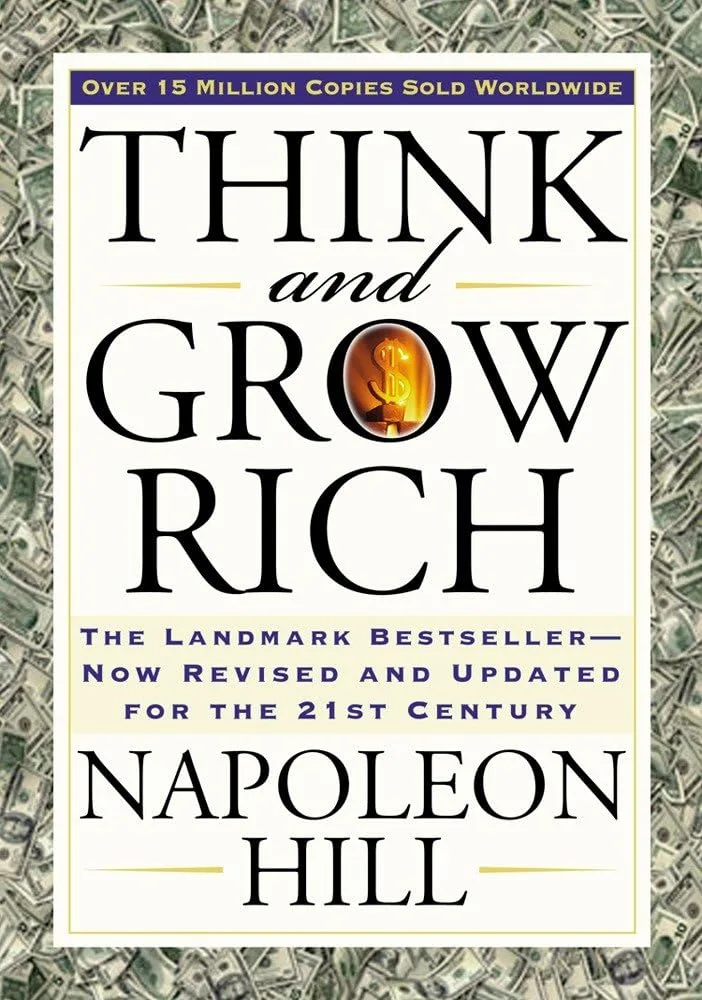
Download Cover Image
Do you want to download the full cover image for Think and Grow Rich?