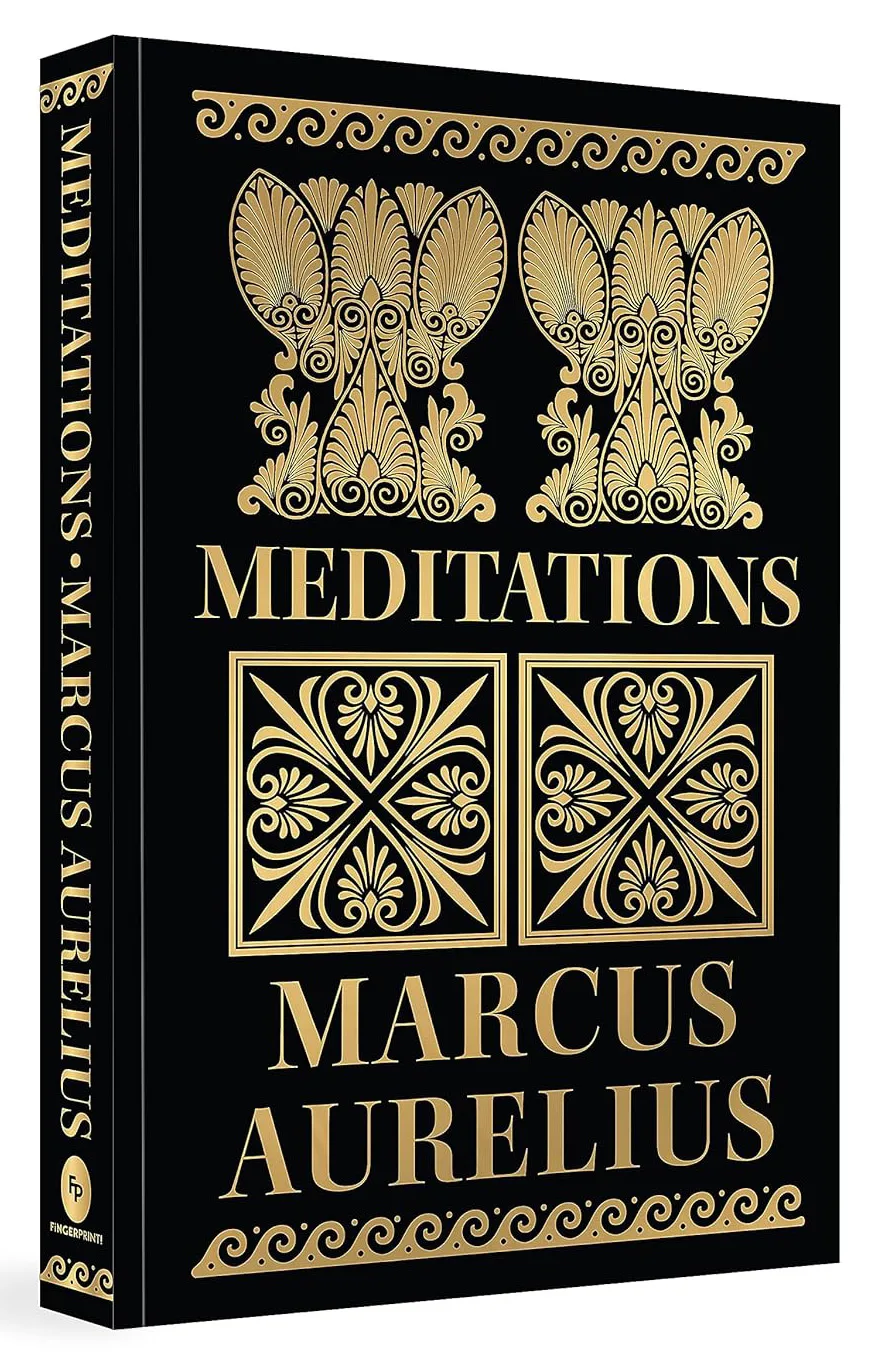
Meditations
Hardcover
• 304 Pages
• USD 14.99
• English
• 9789354407260
No ratings yet
| Publisher | Fingerprint |
|---|---|
| ISBN13 | 9789354407260 |
| ASIN/SKU | 9354407269 |
| Book Format | Hardcover |
| Language | English |
| Pages | 304 |
| List Price | USD 14.99 |
| Publishing Date | 15/02/2023 |
| Dimensions | 8.78 x 0.8 x 5.71 inches |
| Weight | 13.3 ounces |
| Book Code | BD00055504 |
Buy this Book
Amazon Stores
Ebook Stores
Other Stores
Discover Meditations by Aurelius Marcus. This book is published by Fingerprint in Hardcover format, ISBN 9789354407260, ASIN 9354407269, under Self-Help, Philosophy, Rationalist Philosophy.
Book Description
A classic of wisdom. A compass for the soul.
Step into the mind of a Roman emperor and Stoic sage. Meditations is more than just a philosophical text; it's a powerful guide to living with purpose, courage, and grace. Penned as private reflections, Marcus Aurelius’s words continue to echo across centuries, offering timeless insights into the human condition.
Whether you're facing everyday struggles or seeking deeper meaning, this enduring masterpiece speaks directly to the heart and mind, guiding you toward inner strength, clarity, and peace.
Why You’ll Love This Book
Timeless Wisdom, Everyday Relevance: Discover ancient Stoic principles that still resonate in today’s fast-paced world.
Resilience and Inner Peace: Learn how to stay grounded amidst chaos and cultivate calm through self-discipline and perspective.
Mindfulness and Self-Reflection: Explore the art of introspection and conscious living to create a life of balance and meaning.
A Lifelong Companion: Each passage offers fresh insights with every read, making it a trusted guide through life’s many seasons.
Ideal for Seekers and Thinkers: A must-read for anyone on the path of self-discovery, personal growth, or spiritual exploration.
Step into the mind of a Roman emperor and Stoic sage. Meditations is more than just a philosophical text; it's a powerful guide to living with purpose, courage, and grace. Penned as private reflections, Marcus Aurelius’s words continue to echo across centuries, offering timeless insights into the human condition.
Whether you're facing everyday struggles or seeking deeper meaning, this enduring masterpiece speaks directly to the heart and mind, guiding you toward inner strength, clarity, and peace.
Why You’ll Love This Book
Timeless Wisdom, Everyday Relevance: Discover ancient Stoic principles that still resonate in today’s fast-paced world.
Resilience and Inner Peace: Learn how to stay grounded amidst chaos and cultivate calm through self-discipline and perspective.
Mindfulness and Self-Reflection: Explore the art of introspection and conscious living to create a life of balance and meaning.
A Lifelong Companion: Each passage offers fresh insights with every read, making it a trusted guide through life’s many seasons.
Ideal for Seekers and Thinkers: A must-read for anyone on the path of self-discovery, personal growth, or spiritual exploration.
Author Biography
Marcus Aurelius Antoninus was born to an upper-class Roman family in A.D. 121 and was later adopted by the future emperor Antoninus Pius, whom he succeeded in 161. His reign was marked by a successful campaign against Parthia, but was overshadowed in later years by plague, an abortive revolt in the eastern provinces, and the deaths of friends and family, including his co-emperor Lucius Verus. A student of philosophy from his earliest youth, he was especially influenced by the first-century Stoic thinker Epictetus. His later reputation rests on his Meditations, written during his later years and never meant for formal publication. He died in 180, while campaigning against the barbarian tribes on Rome’s northern frontier.
Editorial Reviews
Editorial Reviews will be added soon…
Book Summary
“Meditations” by Marcus Aurelius is one of the most important works of Stoic philosophy and one of the most personal books ever written by a ruler. Marcus Aurelius was a Roman emperor, but this book was not written as a public speech or a guide for others. It was written as private notes to himself, mostly during military campaigns and difficult periods of his life. Because of this, the book feels honest, direct, and deeply human. It shows a powerful man reminding himself to stay calm, humble, disciplined, and fair in a world full of pressure, pain, ambition, and uncertainty.
The main idea of *Meditations* is that a person cannot control everything that happens in life, but they can control their own thoughts, actions, and character. Marcus constantly reminds himself that outside events are not fully in his power. People may insult him, betray him, disappoint him, or misunderstand him. Illness, death, loss, and bad luck may come at any time. But his response to these things belongs to him. If he chooses patience, reason, courage, and kindness, then no external event can truly damage his inner self. This is the heart of Stoicism: peace comes not from controlling the world, but from mastering oneself.
Marcus often reflects on the shortness of life. He reminds himself that every human being, no matter how rich, famous, beautiful, or powerful, will die. Emperors, soldiers, philosophers, and ordinary citizens all share the same end. This thought is not meant to make life feel meaningless. Instead, it is meant to make life clearer. Since life is brief, there is no time to waste on pride, anger, greed, jealousy, or empty praise. A person should focus on what is truly important: living honestly, doing their duty, helping others, and keeping their soul in good condition. Death, for Marcus, is part of nature, and fearing it too much only prevents people from living well.
Another major theme in the book is the importance of living according to nature. For Marcus, this means understanding that human beings are part of a larger universe governed by order, change, and reason. Everything that happens is part of this natural process. Seasons change, bodies grow old, people come and go, and nothing stays the same forever. Instead of fighting against reality, a wise person accepts it and works with it. Marcus tells himself to welcome whatever happens as part of the whole, even when it is unpleasant. This does not mean being passive or careless. It means doing what is right without complaining about things beyond one’s control.
Marcus also places great value on reason. He believes that the mind is the strongest part of a person when it is trained properly. Emotions like anger, fear, and desire can easily mislead us, but reason helps us see things clearly. Many of his notes are attempts to correct his own thinking. If someone insults him, he reminds himself that the insult only hurts if he chooses to treat it as harmful. If someone behaves badly, he reminds himself that they may be acting out of ignorance. If he feels tempted by luxury or fame, he reminds himself that these things are temporary and often empty. By changing the way he judges events, he changes the way he experiences them.
The book also teaches humility. Although Marcus was emperor of Rome, he repeatedly reminds himself that he is only a small part of the universe. His power, reputation, and body will all disappear. He warns himself not to become proud or cruel. He remembers the people who taught him good values, such as honesty, simplicity, self-control, and respect for others. He understands that leadership is not about personal glory, but about service. As emperor, his duty is to work for the common good, not to satisfy his own ego. This makes *Meditations* especially powerful because it shows a ruler trying to remain morally grounded despite having enormous power.
Kindness and tolerance are also central to Marcus’s thinking. He knows that people can be selfish, rude, dishonest, and foolish, but he tells himself to meet them with patience. Since human beings are made to live together, he believes we should not hate others, even when they do wrong. Instead, we should try to understand them, correct them if possible, and continue doing our own duty. He compares humanity to parts of one body, meant to cooperate rather than fight. This does not mean allowing injustice, but it does mean refusing to become bitter or hateful. For Marcus, another person’s wrongdoing should not make us abandon our own goodness.
A repeated message in *Meditations* is to focus on the present moment. Marcus warns himself not to be trapped by regret over the past or anxiety about the future. The past is gone, and the future is uncertain. The only thing a person truly has is the present action. If we do the right thing now, with honesty and attention, then we are living well. This simple idea gives the book much of its practical strength. Marcus is not interested in abstract philosophy alone. He wants philosophy to shape daily behavior: how to wake up, how to work, how to speak, how to handle pain, how to treat difficult people, and how to remain steady under pressure.
The tone of the book is serious but comforting. Marcus does not pretend that life is easy. He writes as someone who has seen war, sickness, betrayal, responsibility, and grief. Yet he continues to believe that peace is possible through discipline of the mind and devotion to virtue. He often sounds like a man encouraging himself not to fall into weakness, irritation, or despair. This makes the book relatable even centuries later. Readers can see that even an emperor struggled with the same inner problems that ordinary people face: impatience, fear, pride, sadness, distraction, and frustration.
In the end, “Meditations” is not a book about success in the worldly sense. It is a book about becoming a better human being. Marcus Aurelius teaches that the good life is not found in wealth, pleasure, fame, or control over others. It is found in wisdom, justice, courage, self-control, and acceptance of reality. The book’s lasting message is that we should stop wasting energy on what we cannot control and give our best effort to what we can control: our choices, our character, and our treatment of others. That is why *Meditations* remains powerful today. It speaks to anyone who wants to live with more calm, strength, and moral clarity in a difficult world.
The main idea of *Meditations* is that a person cannot control everything that happens in life, but they can control their own thoughts, actions, and character. Marcus constantly reminds himself that outside events are not fully in his power. People may insult him, betray him, disappoint him, or misunderstand him. Illness, death, loss, and bad luck may come at any time. But his response to these things belongs to him. If he chooses patience, reason, courage, and kindness, then no external event can truly damage his inner self. This is the heart of Stoicism: peace comes not from controlling the world, but from mastering oneself.
Marcus often reflects on the shortness of life. He reminds himself that every human being, no matter how rich, famous, beautiful, or powerful, will die. Emperors, soldiers, philosophers, and ordinary citizens all share the same end. This thought is not meant to make life feel meaningless. Instead, it is meant to make life clearer. Since life is brief, there is no time to waste on pride, anger, greed, jealousy, or empty praise. A person should focus on what is truly important: living honestly, doing their duty, helping others, and keeping their soul in good condition. Death, for Marcus, is part of nature, and fearing it too much only prevents people from living well.
Another major theme in the book is the importance of living according to nature. For Marcus, this means understanding that human beings are part of a larger universe governed by order, change, and reason. Everything that happens is part of this natural process. Seasons change, bodies grow old, people come and go, and nothing stays the same forever. Instead of fighting against reality, a wise person accepts it and works with it. Marcus tells himself to welcome whatever happens as part of the whole, even when it is unpleasant. This does not mean being passive or careless. It means doing what is right without complaining about things beyond one’s control.
Marcus also places great value on reason. He believes that the mind is the strongest part of a person when it is trained properly. Emotions like anger, fear, and desire can easily mislead us, but reason helps us see things clearly. Many of his notes are attempts to correct his own thinking. If someone insults him, he reminds himself that the insult only hurts if he chooses to treat it as harmful. If someone behaves badly, he reminds himself that they may be acting out of ignorance. If he feels tempted by luxury or fame, he reminds himself that these things are temporary and often empty. By changing the way he judges events, he changes the way he experiences them.
The book also teaches humility. Although Marcus was emperor of Rome, he repeatedly reminds himself that he is only a small part of the universe. His power, reputation, and body will all disappear. He warns himself not to become proud or cruel. He remembers the people who taught him good values, such as honesty, simplicity, self-control, and respect for others. He understands that leadership is not about personal glory, but about service. As emperor, his duty is to work for the common good, not to satisfy his own ego. This makes *Meditations* especially powerful because it shows a ruler trying to remain morally grounded despite having enormous power.
Kindness and tolerance are also central to Marcus’s thinking. He knows that people can be selfish, rude, dishonest, and foolish, but he tells himself to meet them with patience. Since human beings are made to live together, he believes we should not hate others, even when they do wrong. Instead, we should try to understand them, correct them if possible, and continue doing our own duty. He compares humanity to parts of one body, meant to cooperate rather than fight. This does not mean allowing injustice, but it does mean refusing to become bitter or hateful. For Marcus, another person’s wrongdoing should not make us abandon our own goodness.
A repeated message in *Meditations* is to focus on the present moment. Marcus warns himself not to be trapped by regret over the past or anxiety about the future. The past is gone, and the future is uncertain. The only thing a person truly has is the present action. If we do the right thing now, with honesty and attention, then we are living well. This simple idea gives the book much of its practical strength. Marcus is not interested in abstract philosophy alone. He wants philosophy to shape daily behavior: how to wake up, how to work, how to speak, how to handle pain, how to treat difficult people, and how to remain steady under pressure.
The tone of the book is serious but comforting. Marcus does not pretend that life is easy. He writes as someone who has seen war, sickness, betrayal, responsibility, and grief. Yet he continues to believe that peace is possible through discipline of the mind and devotion to virtue. He often sounds like a man encouraging himself not to fall into weakness, irritation, or despair. This makes the book relatable even centuries later. Readers can see that even an emperor struggled with the same inner problems that ordinary people face: impatience, fear, pride, sadness, distraction, and frustration.
In the end, “Meditations” is not a book about success in the worldly sense. It is a book about becoming a better human being. Marcus Aurelius teaches that the good life is not found in wealth, pleasure, fame, or control over others. It is found in wisdom, justice, courage, self-control, and acceptance of reality. The book’s lasting message is that we should stop wasting energy on what we cannot control and give our best effort to what we can control: our choices, our character, and our treatment of others. That is why *Meditations* remains powerful today. It speaks to anyone who wants to live with more calm, strength, and moral clarity in a difficult world.
Sample Chapters
Sample Chapters will be added soon…
Reader Reviews
No reviews yet.
Meditations