
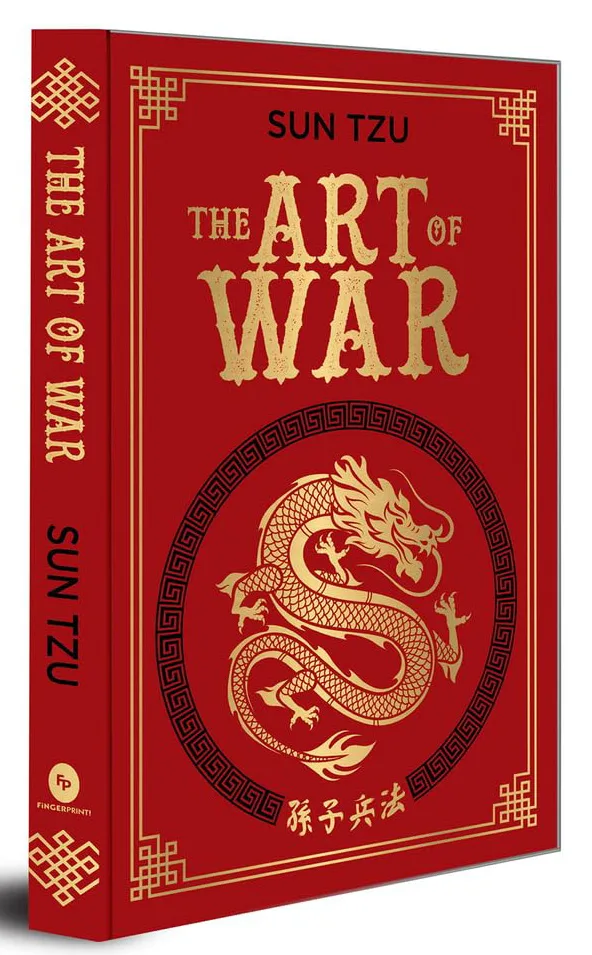
The Art of War (Deluxe Hardbound Edition)
Hardcover
• 232 Pages
• USD 16.99
• English
• 9789388369695
No ratings yet
| Publisher | Fingerprint |
|---|---|
| ISBN13 | 9789388369695 |
| ASIN/SKU | 9388369696 |
| Book Format | Hardcover |
| Language | English |
| Pages | 232 |
| List Price | USD 16.99 |
| Publishing Date | 01/12/2018 |
| Dimensions | 6 x 0.8 x 9 inches |
| Weight | 11.3 ounces |
| Book Code | BD00055513 |
Buy this Book
Amazon Stores
Ebook Stores
Other Stores
Discover The Art of War (Deluxe Hardbound Edition) by Sun Tzu. This book is published by Fingerprint in Hardcover format, ISBN 9789388369695, ASIN 9388369696, under Literature and Fiction, Chinese Literature, Ancient and Classical Literature.
Book Description
Master the invisible battlefield. Win with wisdom, not war.
A timeless masterpiece of strategy and insight, The Art of War by Sun Tzu is one of the most influential works ever written on leadership, warfare, and the psychology of conflict. Composed in ancient China around the 5th century BC, this legendary treatise goes beyond military tactics; it teaches how to lead, think, adapt, and triumph in any arena of life.
Whether you're navigating boardroom negotiations, competitive environments, or personal challenges, Sun Tzu’s principles remain as sharp and relevant today as they were thousands of years ago. His philosophy champions intellect over aggression, precision over chaos, and clarity over confusion.
Why You Should Read This Book
Think Strategically – Outsmart challenges with foresight and precision.
Lead with Clarity – Cultivate calm, control, and confidence.
Win Without Fighting – Use influence and timing over force.
Timeless Relevance – Ideal for business, leadership, and life.
Read by Leaders – A global classic for seekers of mastery.
A timeless masterpiece of strategy and insight, The Art of War by Sun Tzu is one of the most influential works ever written on leadership, warfare, and the psychology of conflict. Composed in ancient China around the 5th century BC, this legendary treatise goes beyond military tactics; it teaches how to lead, think, adapt, and triumph in any arena of life.
Whether you're navigating boardroom negotiations, competitive environments, or personal challenges, Sun Tzu’s principles remain as sharp and relevant today as they were thousands of years ago. His philosophy champions intellect over aggression, precision over chaos, and clarity over confusion.
Why You Should Read This Book
Think Strategically – Outsmart challenges with foresight and precision.
Lead with Clarity – Cultivate calm, control, and confidence.
Win Without Fighting – Use influence and timing over force.
Timeless Relevance – Ideal for business, leadership, and life.
Read by Leaders – A global classic for seekers of mastery.
Author Biography
Sun Tzu, a military general and strategist who lived in ancient China, is one of East Asia’s most important historical figures. Traditional historians believe that he lived between 544–496 B.C. Sun Tzu’s birth name was Sun Wu; the name he is well known with is an honorific that means “Master Sun.” He is most famous for writing The Art of War, a timeless classic and one of the most important works of Eastern literature.
Editorial Reviews
Editorial Reviews will be added soon…
Book Summary
“The Art of War” by Sun Tzu is a classic book on strategy, leadership, and winning conflicts with wisdom rather than brute force. Written as a short military treatise, it explains that the best victory is one achieved with the least cost, and ideally without direct battle at all.
At the heart of the book is the idea that war is serious, expensive, and risky, so it should be approached with careful planning. Sun Tzu teaches that a commander must think ahead, understand the situation fully, and judge whether fighting is even necessary. He presents war as something that must be managed with discipline, intelligence, and restraint, not with impulse or pride.
One of the most famous lessons in the book is that knowing yourself and knowing the enemy are essential to success. A good leader studies both strengths and weaknesses, prepares for different outcomes, and avoids blind confidence. Victory is not treated as luck; it comes from clear observation, patient calculation, and the ability to see patterns before others do.
Deception is another major principle. Sun Tzu argues that warfare depends on misleading the opponent, creating false impressions, and hiding one’s real intentions. A strong army may appear weak, and an approaching force may seem far away. This idea reflects the larger belief that strategic advantage often comes from shaping the enemy’s expectations before the fighting begins.
The book also stresses flexibility. Sun Tzu does not believe there is one fixed method for every battle. Instead, the wise commander adapts to changing terrain, enemy behavior, weather, timing, and morale. Like water, strategy must move around obstacles and take the shape of the situation. This makes the book feel practical rather than rigid, because it values adjustment over formula.
Another important theme is speed and efficiency. Sun Tzu strongly warns against long wars, sieges, and wasted effort because they drain resources and weaken both army and state. He prefers swift action, careful supply management, and use of the enemy’s resources whenever possible. A strong leader preserves energy, avoids unnecessary destruction, and seeks a result that leaves the state stronger, not exhausted.
The book also gives great importance to leadership and organization. A commander must be calm, disciplined, respected, and capable of making sound decisions under pressure. Sun Tzu suggests that armies are shaped by the quality of their leaders, and that confusion, poor planning, or lack of discipline can destroy even a large force. Good leadership is therefore not only about courage, but about order, judgment, and moral authority.
Another recurring idea is that the best strategy often avoids direct confrontation. Sun Tzu advises attacking the enemy’s plans, breaking alliances, and weakening support before fighting the army itself. In his view, the smartest victory is not the one that causes the most destruction, but the one that ends conflict quickly and decisively. This is why the book remains influential far beyond the battlefield, since its lessons apply to business, politics, sports, and everyday competition.
The final chapters also show how detailed and practical Sun Tzu’s thinking is. He discusses terrain, troop movement, encampment, intelligence, and the use of spies. These sections remind the reader that strategy is not abstract alone; it depends on facts, conditions, and constant observation. Success belongs to the leader who can read the situation clearly and act before the enemy can respond.
Overall, “The Art of War” is a concise guide to winning through intelligence, preparation, discipline, and adaptability. Its deeper message is that power is strongest when it is controlled, and that the highest skill is to defeat opposition with minimum harm. That is why the book has lasted for centuries: it teaches not just how to fight, but how to think.
At the heart of the book is the idea that war is serious, expensive, and risky, so it should be approached with careful planning. Sun Tzu teaches that a commander must think ahead, understand the situation fully, and judge whether fighting is even necessary. He presents war as something that must be managed with discipline, intelligence, and restraint, not with impulse or pride.
One of the most famous lessons in the book is that knowing yourself and knowing the enemy are essential to success. A good leader studies both strengths and weaknesses, prepares for different outcomes, and avoids blind confidence. Victory is not treated as luck; it comes from clear observation, patient calculation, and the ability to see patterns before others do.
Deception is another major principle. Sun Tzu argues that warfare depends on misleading the opponent, creating false impressions, and hiding one’s real intentions. A strong army may appear weak, and an approaching force may seem far away. This idea reflects the larger belief that strategic advantage often comes from shaping the enemy’s expectations before the fighting begins.
The book also stresses flexibility. Sun Tzu does not believe there is one fixed method for every battle. Instead, the wise commander adapts to changing terrain, enemy behavior, weather, timing, and morale. Like water, strategy must move around obstacles and take the shape of the situation. This makes the book feel practical rather than rigid, because it values adjustment over formula.
Another important theme is speed and efficiency. Sun Tzu strongly warns against long wars, sieges, and wasted effort because they drain resources and weaken both army and state. He prefers swift action, careful supply management, and use of the enemy’s resources whenever possible. A strong leader preserves energy, avoids unnecessary destruction, and seeks a result that leaves the state stronger, not exhausted.
The book also gives great importance to leadership and organization. A commander must be calm, disciplined, respected, and capable of making sound decisions under pressure. Sun Tzu suggests that armies are shaped by the quality of their leaders, and that confusion, poor planning, or lack of discipline can destroy even a large force. Good leadership is therefore not only about courage, but about order, judgment, and moral authority.
Another recurring idea is that the best strategy often avoids direct confrontation. Sun Tzu advises attacking the enemy’s plans, breaking alliances, and weakening support before fighting the army itself. In his view, the smartest victory is not the one that causes the most destruction, but the one that ends conflict quickly and decisively. This is why the book remains influential far beyond the battlefield, since its lessons apply to business, politics, sports, and everyday competition.
The final chapters also show how detailed and practical Sun Tzu’s thinking is. He discusses terrain, troop movement, encampment, intelligence, and the use of spies. These sections remind the reader that strategy is not abstract alone; it depends on facts, conditions, and constant observation. Success belongs to the leader who can read the situation clearly and act before the enemy can respond.
Overall, “The Art of War” is a concise guide to winning through intelligence, preparation, discipline, and adaptability. Its deeper message is that power is strongest when it is controlled, and that the highest skill is to defeat opposition with minimum harm. That is why the book has lasted for centuries: it teaches not just how to fight, but how to think.
Sample Chapters
Sample Chapters will be added soon…
Reader Reviews
No reviews yet.
The Art of War (Deluxe Hardbound Edition)
Download Cover Image
Do you want to download the full cover image for The Art of War (Deluxe Hardbound Edition)?