
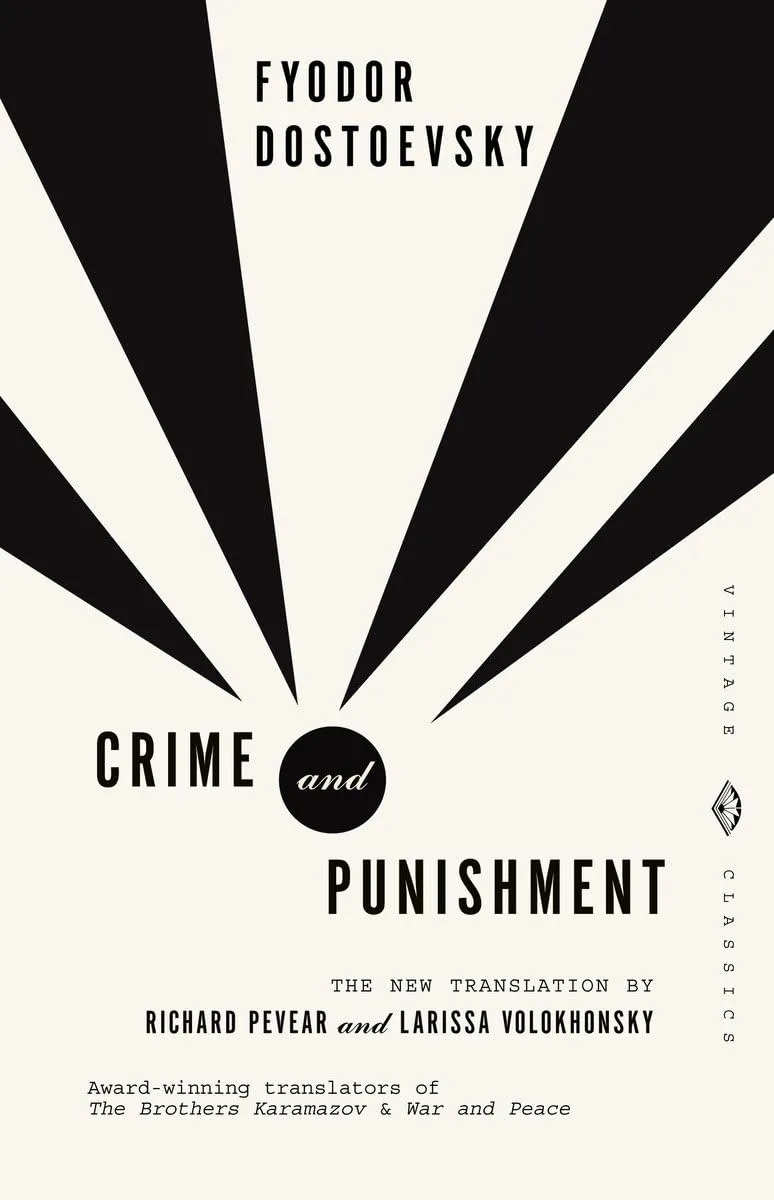
Crime and Punishment (Vintage Classics)
Paperback
• 565 Pages
• USD 19.00
• English
• 9780679734505
No ratings yet
| Publisher | Vintage |
|---|---|
| ISBN13 | 9780679734505 |
| ASIN/SKU | 0679734503 |
| Book Format | Paperback |
| Language | English |
| Pages | 565 |
| List Price | USD 19.00 |
| Publishing Date | 02/03/1993 |
| Dimensions | 5.15 x 1.1 x 7.95 inches |
| Weight | 2.31 pounds |
| Book Code | BD00055514 |
Buy this Book
Amazon Stores
Ebook Stores
Other Stores
Discover Crime and Punishment (Vintage Classics) by Fyodor Dostoevsky. This book is published by Vintage in Paperback format, ISBN 9780679734505, ASIN 0679734503, under Literature and Fiction, Russian and Soviet Literature, History and Criticism of Russian and Soviet Literature.
Book Description
Hailed by Washington Post Book World as “the best [translation] currently available" when it was first published, this second edition of Crime and Punishment has been updated in honor of the 200th anniversary of Dostoevsky’s birth. • ONE OF TIME MAGAZINE'S 100 BEST MYSTERY AND THRILLER BOOKS OF ALL TIME
With the same suppleness, energy, and range of voices that won their translation of The Brothers Karamazov the PEN/Book-of-the-Month Club Prize, Richard Pevear and Larissa Volokhonsky offer a brilliant translation of Crime and Punishment, Dostoevsky's astounding pyschological thriller, newly revised for his bicentenniel.
In Crime and Punishment, when Raskolnikov, an impoverished student living in the St. Petersburg of the tsars, commits an act of murder and theft, he sets into motion a story that is almost unequalled in world literature for its excruciating suspense, its atmospheric vividness, and its depth of characterization and vision. Dostoevsky’s drama of sin, guilt, and redemption transforms the sordid story of an old woman’s murder into the nineteenth century’s profoundest and most compelling philosophical novel.
With the same suppleness, energy, and range of voices that won their translation of The Brothers Karamazov the PEN/Book-of-the-Month Club Prize, Richard Pevear and Larissa Volokhonsky offer a brilliant translation of Crime and Punishment, Dostoevsky's astounding pyschological thriller, newly revised for his bicentenniel.
In Crime and Punishment, when Raskolnikov, an impoverished student living in the St. Petersburg of the tsars, commits an act of murder and theft, he sets into motion a story that is almost unequalled in world literature for its excruciating suspense, its atmospheric vividness, and its depth of characterization and vision. Dostoevsky’s drama of sin, guilt, and redemption transforms the sordid story of an old woman’s murder into the nineteenth century’s profoundest and most compelling philosophical novel.
Author Biography
Fyodor Mikhailovich Dostoyevsky (/ˌdɒstəˈjɛfski, ˌdʌs-/; Russian: Фёдор Миха́йлович Достое́вский; IPA: [ˈfʲɵdər mʲɪˈxajləvʲɪtɕ dəstɐˈjɛfskʲɪj]; 11 November 1821 – 9 February 1881), sometimes transliterated Dostoevsky, was a Russian novelist, short story writer, essayist, journalist and philosopher. Dostoyevsky's literary works explore human psychology in the troubled political, social, and spiritual atmosphere of 19th-century Russia. Many of his works are marked by a preoccupation with Christianity, explored through the prism of the individual confronted with life's hardships and beauty.
He began writing in his 20s, and his first novel, Poor Folk, was published in 1846 when he was 25. His major works include Crime and Punishment (1866), The Idiot (1869), Demons (1872) and The Brothers Karamazov (1880). His output consists of 11 novels, three novellas, 17 short novels and numerous other works. Many literary critics rate him as one of the greatest psychologists in world literature. His 1864 novella Notes from Underground is considered to be one of the first works of existentialist literature.
Born in Moscow in 1821, Dostoyevsky was introduced to literature at an early age through fairy tales and legends, and through books by Russian and foreign authors. His mother died in 1837, when he was 15, and around the same time he left school to enter the Nikolayev Military Engineering Institute. After graduating, he worked as an engineer and briefly enjoyed a lavish lifestyle, translating books to earn extra money. In the mid-1840s he wrote his first novel, Poor Folk, which gained him entry into St. Petersburg's literary circles.
In the following years, Dostoyevsky worked as a journalist, publishing and editing several magazines of his own and later A Writer's Diary, a collection of his writings. He began to travel around western Europe and developed a gambling addiction, which led to financial hardship. For a time, he had to beg for money, but he eventually became one of the most widely read and highly regarded Russian writers. His books have been translated into more than 170 languages. Dostoyevsky influenced a multitude of writers and philosophers, from Anton Chekhov and Ernest Hemingway to Friedrich Nietzsche and Jean-Paul Sartre.
Bio from Wikipedia, the free encyclopedia.
He began writing in his 20s, and his first novel, Poor Folk, was published in 1846 when he was 25. His major works include Crime and Punishment (1866), The Idiot (1869), Demons (1872) and The Brothers Karamazov (1880). His output consists of 11 novels, three novellas, 17 short novels and numerous other works. Many literary critics rate him as one of the greatest psychologists in world literature. His 1864 novella Notes from Underground is considered to be one of the first works of existentialist literature.
Born in Moscow in 1821, Dostoyevsky was introduced to literature at an early age through fairy tales and legends, and through books by Russian and foreign authors. His mother died in 1837, when he was 15, and around the same time he left school to enter the Nikolayev Military Engineering Institute. After graduating, he worked as an engineer and briefly enjoyed a lavish lifestyle, translating books to earn extra money. In the mid-1840s he wrote his first novel, Poor Folk, which gained him entry into St. Petersburg's literary circles.
In the following years, Dostoyevsky worked as a journalist, publishing and editing several magazines of his own and later A Writer's Diary, a collection of his writings. He began to travel around western Europe and developed a gambling addiction, which led to financial hardship. For a time, he had to beg for money, but he eventually became one of the most widely read and highly regarded Russian writers. His books have been translated into more than 170 languages. Dostoyevsky influenced a multitude of writers and philosophers, from Anton Chekhov and Ernest Hemingway to Friedrich Nietzsche and Jean-Paul Sartre.
Bio from Wikipedia, the free encyclopedia.
Editorial Reviews
“The best [translation of Crime and Punishment] currently available…. An especially faithful re-creation … with a coiled-spring kinetic energy…. Don’t miss it.” —The Washington Post Book World
“This fresh, new translation … provides a more exact, idiomatic, and contemporary rendition of the novel that brings Fyodor Dostoevsky’s tale achingly alive…. It succeeds beautifully.” —San Francisco Chronicle
“Reaches as close to Dostoevsky’ s Russian as is possible in English…. The original’s force and frightening immediacy is captured…. The Pevear and Volokhonsky translation will become the standard English version.” —Chicago Tribune
“This fresh, new translation … provides a more exact, idiomatic, and contemporary rendition of the novel that brings Fyodor Dostoevsky’s tale achingly alive…. It succeeds beautifully.” —San Francisco Chronicle
“Reaches as close to Dostoevsky’ s Russian as is possible in English…. The original’s force and frightening immediacy is captured…. The Pevear and Volokhonsky translation will become the standard English version.” —Chicago Tribune
Book Summary
Crime and Punishment by Fyodor Dostoevsky is a deep psychological novel about guilt, morality, suffering, pride, and the possibility of redemption. The story is set in St. Petersburg, Russia, and follows Rodion Romanovich Raskolnikov, a poor former student who lives in a cramped room and struggles with hunger, isolation, and hopelessness. Raskolnikov is intelligent but deeply troubled. He feels cut off from society and believes that ordinary moral rules may not apply to extraordinary people. This dangerous idea becomes the foundation for the crime that changes his life.
Raskolnikov develops a theory that some great individuals, such as historical leaders or reformers, have the right to break moral laws if their actions lead to a greater good. He convinces himself that killing a cruel old pawnbroker, Alyona Ivanovna, could be justified because she exploits desperate people and contributes nothing meaningful to the world. He imagines that her money could be used to help his family, support his education, and benefit others. But beneath these rational arguments are also pride, anger, and a desire to prove that he is superior to ordinary human weakness.
After much inner conflict, Raskolnikov murders the pawnbroker with an axe. The crime does not go as planned. Alyona’s innocent half-sister, Lizaveta, unexpectedly enters the room, and Raskolnikov kills her too in panic. This second murder destroys any illusion that his act was controlled or noble. He steals only a few items and leaves in confusion, barely escaping detection. Instead of feeling powerful or free, he is immediately overwhelmed by fear, sickness, and mental torment. The crime separates him even more from the world and from himself.
Much of the novel focuses on Raskolnikov’s psychological punishment. Although he has not been legally caught, his conscience begins to punish him almost immediately. He becomes feverish, paranoid, and unstable. He swings between arrogance and despair, wanting to confess one moment and defend his theory the next. He avoids people but also seeks them out, hoping for relief. Dostoevsky shows that punishment is not only something given by courts or prisons. It can begin inside the soul when a person violates their own humanity.
Raskolnikov’s family adds emotional pressure to his suffering. His mother, Pulcheria Alexandrovna, and sister, Dunya, love him deeply and have sacrificed for his future. Dunya is willing to marry the selfish and controlling Luzhin partly to help the family financially. Raskolnikov hates this idea because he sees it as another form of sacrifice and humiliation. His love for his mother and sister shows that he is not entirely cold, but his pride and guilt make it difficult for him to accept their affection. He wants to protect them, yet he also pushes them away.
Several important characters reflect different moral paths. Luzhin represents selfish respectability. He wants to marry Dunya because he believes a poor wife will be obedient and grateful. Svidrigailov, another disturbing figure, represents moral corruption and unchecked desire. He is drawn to Dunya and has a dark past, yet he is also capable of strange acts of generosity. Through these characters, Dostoevsky explores people who live without true moral grounding, showing how intelligence, wealth, or social status cannot replace conscience.
One of the most important people in Raskolnikov’s life is Sonia Marmeladova. Sonia is a poor young woman forced into prostitution to support her family, yet she remains spiritually pure, compassionate, and faithful. She suffers greatly, but unlike Raskolnikov, she does not use suffering as an excuse to reject morality. Sonia represents humility, love, and Christian forgiveness. When Raskolnikov confesses his crime to her, she does not abandon him. Instead, she urges him to accept responsibility, confess publicly, and seek redemption through suffering and truth.
The relationship between Raskolnikov and Sonia is central to the novel’s moral meaning. Sonia does not defeat his theory through argument alone. She offers him a different way of being human. Her life shows that even in humiliation and pain, a person can keep compassion and faith. Raskolnikov is drawn to her because she understands suffering without becoming proud or cruel. Through Sonia, he begins to see that his crime was not only a legal offense, but a spiritual separation from humanity. He killed not just two women, but also something within himself.
Another major figure is Porfiry Petrovich, the clever investigating magistrate. Porfiry suspects Raskolnikov but does not immediately arrest him. Instead, he engages him in tense conversations, using psychology more than force. Porfiry understands Raskolnikov’s pride and inner conflict. He gradually pushes him toward confession, suggesting that accepting guilt may be the only way for him to recover his life. Their conversations are among the most intense parts of the novel because they are battles of mind and conscience.
As the story moves forward, Raskolnikov becomes increasingly trapped. His theory collapses under the weight of reality. He realizes that he is not the extraordinary man he imagined himself to be. A truly great person, in his view, would not be destroyed by guilt, but he is. Yet this realization alone does not immediately make him repent. He still struggles with pride. He regrets his weakness more than the murder itself at first. Dostoevsky carefully shows that moral awakening is slow and painful.
Eventually, with Sonia’s support and Porfiry’s pressure, Raskolnikov confesses. He is sentenced to penal servitude in Siberia. Sonia follows him there, remaining loyal and patient. At first, even in prison, Raskolnikov remains emotionally distant and proud. But in the epilogue, he begins to change. He becomes ill, dreams of a world destroyed by people who each believe they alone possess the truth, and slowly awakens to love and humility. His redemption begins when he finally accepts Sonia’s love and opens himself to spiritual renewal.
“Crime and Punishment” is not simply a story about a murder. It is a profound exploration of what happens when a person tries to place intellect above conscience and pride above compassion. Dostoevsky shows that ideas have consequences, and that separating oneself from humanity leads to torment. The novel suggests that true freedom does not come from escaping moral law, but from accepting responsibility, suffering honestly, and returning to love. Through Raskolnikov’s fall and beginning of redemption, the book remains one of the most powerful studies of guilt and the human soul ever written.
Raskolnikov develops a theory that some great individuals, such as historical leaders or reformers, have the right to break moral laws if their actions lead to a greater good. He convinces himself that killing a cruel old pawnbroker, Alyona Ivanovna, could be justified because she exploits desperate people and contributes nothing meaningful to the world. He imagines that her money could be used to help his family, support his education, and benefit others. But beneath these rational arguments are also pride, anger, and a desire to prove that he is superior to ordinary human weakness.
After much inner conflict, Raskolnikov murders the pawnbroker with an axe. The crime does not go as planned. Alyona’s innocent half-sister, Lizaveta, unexpectedly enters the room, and Raskolnikov kills her too in panic. This second murder destroys any illusion that his act was controlled or noble. He steals only a few items and leaves in confusion, barely escaping detection. Instead of feeling powerful or free, he is immediately overwhelmed by fear, sickness, and mental torment. The crime separates him even more from the world and from himself.
Much of the novel focuses on Raskolnikov’s psychological punishment. Although he has not been legally caught, his conscience begins to punish him almost immediately. He becomes feverish, paranoid, and unstable. He swings between arrogance and despair, wanting to confess one moment and defend his theory the next. He avoids people but also seeks them out, hoping for relief. Dostoevsky shows that punishment is not only something given by courts or prisons. It can begin inside the soul when a person violates their own humanity.
Raskolnikov’s family adds emotional pressure to his suffering. His mother, Pulcheria Alexandrovna, and sister, Dunya, love him deeply and have sacrificed for his future. Dunya is willing to marry the selfish and controlling Luzhin partly to help the family financially. Raskolnikov hates this idea because he sees it as another form of sacrifice and humiliation. His love for his mother and sister shows that he is not entirely cold, but his pride and guilt make it difficult for him to accept their affection. He wants to protect them, yet he also pushes them away.
Several important characters reflect different moral paths. Luzhin represents selfish respectability. He wants to marry Dunya because he believes a poor wife will be obedient and grateful. Svidrigailov, another disturbing figure, represents moral corruption and unchecked desire. He is drawn to Dunya and has a dark past, yet he is also capable of strange acts of generosity. Through these characters, Dostoevsky explores people who live without true moral grounding, showing how intelligence, wealth, or social status cannot replace conscience.
One of the most important people in Raskolnikov’s life is Sonia Marmeladova. Sonia is a poor young woman forced into prostitution to support her family, yet she remains spiritually pure, compassionate, and faithful. She suffers greatly, but unlike Raskolnikov, she does not use suffering as an excuse to reject morality. Sonia represents humility, love, and Christian forgiveness. When Raskolnikov confesses his crime to her, she does not abandon him. Instead, she urges him to accept responsibility, confess publicly, and seek redemption through suffering and truth.
The relationship between Raskolnikov and Sonia is central to the novel’s moral meaning. Sonia does not defeat his theory through argument alone. She offers him a different way of being human. Her life shows that even in humiliation and pain, a person can keep compassion and faith. Raskolnikov is drawn to her because she understands suffering without becoming proud or cruel. Through Sonia, he begins to see that his crime was not only a legal offense, but a spiritual separation from humanity. He killed not just two women, but also something within himself.
Another major figure is Porfiry Petrovich, the clever investigating magistrate. Porfiry suspects Raskolnikov but does not immediately arrest him. Instead, he engages him in tense conversations, using psychology more than force. Porfiry understands Raskolnikov’s pride and inner conflict. He gradually pushes him toward confession, suggesting that accepting guilt may be the only way for him to recover his life. Their conversations are among the most intense parts of the novel because they are battles of mind and conscience.
As the story moves forward, Raskolnikov becomes increasingly trapped. His theory collapses under the weight of reality. He realizes that he is not the extraordinary man he imagined himself to be. A truly great person, in his view, would not be destroyed by guilt, but he is. Yet this realization alone does not immediately make him repent. He still struggles with pride. He regrets his weakness more than the murder itself at first. Dostoevsky carefully shows that moral awakening is slow and painful.
Eventually, with Sonia’s support and Porfiry’s pressure, Raskolnikov confesses. He is sentenced to penal servitude in Siberia. Sonia follows him there, remaining loyal and patient. At first, even in prison, Raskolnikov remains emotionally distant and proud. But in the epilogue, he begins to change. He becomes ill, dreams of a world destroyed by people who each believe they alone possess the truth, and slowly awakens to love and humility. His redemption begins when he finally accepts Sonia’s love and opens himself to spiritual renewal.
“Crime and Punishment” is not simply a story about a murder. It is a profound exploration of what happens when a person tries to place intellect above conscience and pride above compassion. Dostoevsky shows that ideas have consequences, and that separating oneself from humanity leads to torment. The novel suggests that true freedom does not come from escaping moral law, but from accepting responsibility, suffering honestly, and returning to love. Through Raskolnikov’s fall and beginning of redemption, the book remains one of the most powerful studies of guilt and the human soul ever written.
Sample Chapters
Sample Chapters will be added soon…
Reader Reviews
No reviews yet.
Crime and Punishment (Vintage Classics)
Download Cover Image
Do you want to download the full cover image for Crime and Punishment (Vintage Classics)?