
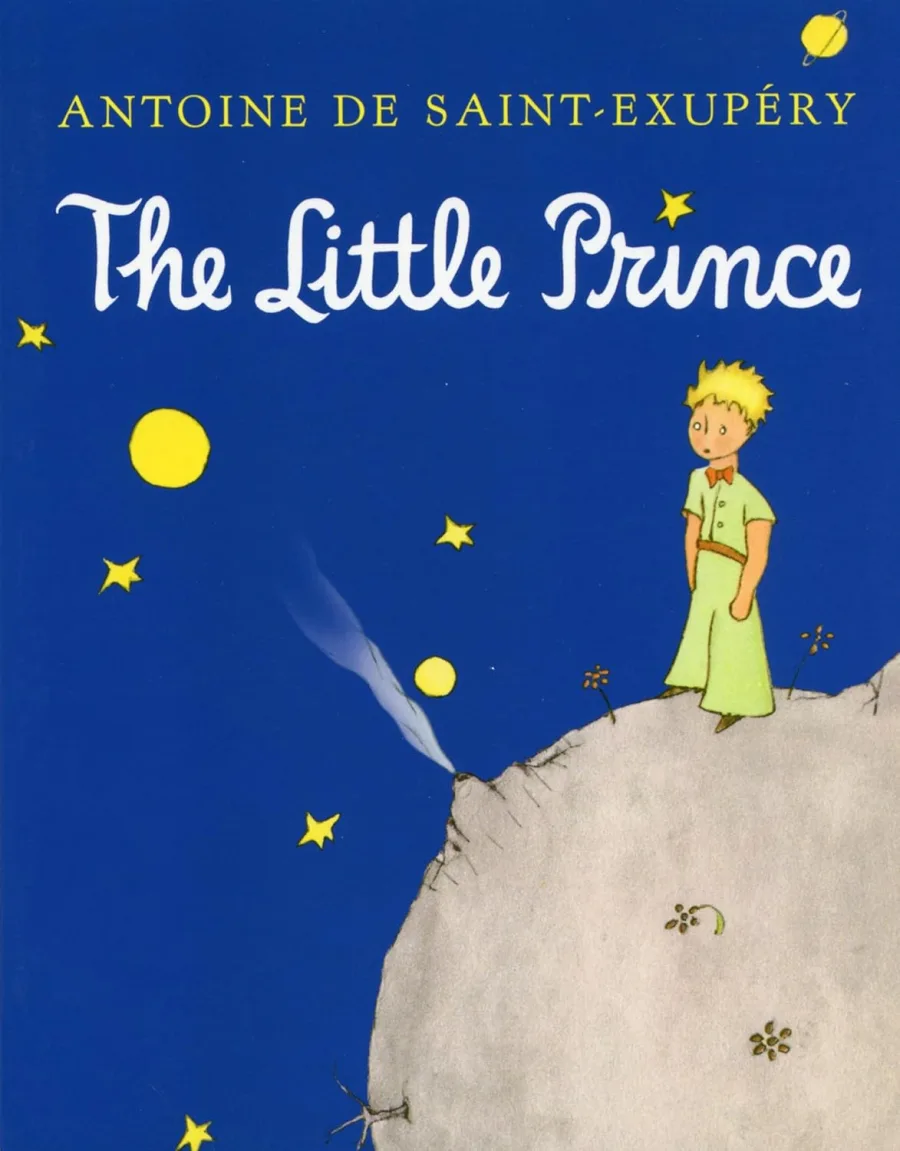
The Little Prince
Paperback
• 96 Pages
• USD 12.99
• English
• 9780156012195
No ratings yet
Teen & Young Adult
Teen & Young Adult Fiction about Values & Virtues
Teen & Young Adult Time Travel Fiction
| Publisher | Clarion Books |
|---|---|
| ISBN13 | 9780156012195 |
| ASIN/SKU | 0156012197 |
| Book Format | Paperback |
| Language | English |
| Pages | 96 |
| List Price | USD 12.99 |
| Publishing Date | 29/06/2000 |
| Dimensions | 8 x 5 x 0.31 inches |
| Weight | 7.4 ounces |
| Book Code | BD00055524 |
Buy this Book
Amazon Stores
Ebook Stores
Other Stores
Discover The Little Prince by Antoine de Saint-Exupéry. This book is published by Clarion Books in Paperback format, ISBN 9780156012195, ASIN 0156012197, under Teen and Young Adult, Teen and Young Adult Fiction about Values and Virtues, Teen and Young Adult Time Travel Fiction.
Book Description
OVER 140 MILLION COPIES SOLD
The beloved classic story about a young prince's travels through space―a profound philosophical tale about loneliness and loss, and love and friendship.
A pilot crashes in the Sahara Desert and encounters a strange young boy who calls himself the Little Prince. The Little Prince has traveled there from his home on a lonely, distant asteroid with a single rose. The story that follows is a beautiful and at times heartbreaking meditation on human nature and the wisdom of the heart.
The Little Prince is one of the best-selling and most translated books of all time, a classic fable universally cherished by children and adults alike, and Richard Howard's translation of the beloved classic beautifully reflects Saint-Exupéry's unique and gifted style, bringing the English text as close as possible to the French in language, style, and spirit.
This definitive English-language edition of The Little Prince will capture the hearts of readers of all ages.
The beloved classic story about a young prince's travels through space―a profound philosophical tale about loneliness and loss, and love and friendship.
A pilot crashes in the Sahara Desert and encounters a strange young boy who calls himself the Little Prince. The Little Prince has traveled there from his home on a lonely, distant asteroid with a single rose. The story that follows is a beautiful and at times heartbreaking meditation on human nature and the wisdom of the heart.
The Little Prince is one of the best-selling and most translated books of all time, a classic fable universally cherished by children and adults alike, and Richard Howard's translation of the beloved classic beautifully reflects Saint-Exupéry's unique and gifted style, bringing the English text as close as possible to the French in language, style, and spirit.
This definitive English-language edition of The Little Prince will capture the hearts of readers of all ages.
Author Biography
ANTOINE DE SAINT-EXUPÉRY, the "Winged Poet," was born in Lyon, France, in 1900. A pilot at twenty-six, he was a pioneer of commercial aviation and flew in the Spanish Civil War and World War II. His writings include The Little Prince, Wind, Sand and Stars, Night Flight, Southern Mail, and Airman's Odyssey. In 1944, while flying a reconnaissance mission for his French air squadron, he disappeared over the Mediterranean.
Editorial Reviews
Antoine de Saint-Exupéry first published The Little Prince in 1943, only a year before his Lockheed P-38 vanished over the Mediterranean during a reconnaissance mission. More than a half century later, this fable of love and loneliness has lost none of its power. The narrator is a downed pilot in the Sahara Desert, frantically trying to repair his wrecked plane. His efforts are interrupted one day by the apparition of a little, well, prince, who asks him to draw a sheep. "In the face of an overpowering mystery, you don't dare disobey," the narrator recalls. "Absurd as it seemed, a thousand miles from all inhabited regions and in danger of death, I took a scrap of paper and a pen out of my pocket." And so begins their dialogue, which stretches the narrator's imagination in all sorts of surprising, childlike directions.
The Little Prince describes his journey from planet to planet, each tiny world populated by a single adult. It's a wonderfully inventive sequence, which evokes not only the great fairy tales but also such monuments of postmodern whimsy as Italo Calvino's Invisible Cities. And despite his tone of gentle bemusement, Saint-Exupéry pulls off some fine satiric touches, too. There's the king, for example, who commands the Little Prince to function as a one-man (or one-boy) judiciary:
I have good reason to believe that there is an old rat living somewhere on my planet. I hear him at night. You could judge that old rat. From time to time you will condemn him to death. That way his life will depend on your justice. But you'll pardon him each time for economy's sake. There's only one rat.
The author pokes similar fun at a businessman, a geographer, and a lamplighter, all of whom signify some futile aspect of adult existence. Yet his tale is ultimately a tender one--a heartfelt exposition of sadness and solitude, which never turns into Peter Pan-style treacle. Such delicacy of tone can present real headaches for a translator, and in her 1943 translation, Katherine Woods sometimes wandered off the mark, giving the text a slightly wooden or didactic accent. Happily, Richard Howard (who did a fine nip-and-tuck job on Stendhal's The Charterhouse of Parma in 1999) has streamlined and simplified to wonderful effect. The result is a new and improved version of an indestructible classic, which also restores the original artwork to full color. "Trying to be witty," we're told at one point, "leads to lying, more or less." But Saint-Exupéry's drawings offer a handy rebuttal: they're fresh, funny, and like the book itself, rigorously truthful. --James Marcus.
The Little Prince describes his journey from planet to planet, each tiny world populated by a single adult. It's a wonderfully inventive sequence, which evokes not only the great fairy tales but also such monuments of postmodern whimsy as Italo Calvino's Invisible Cities. And despite his tone of gentle bemusement, Saint-Exupéry pulls off some fine satiric touches, too. There's the king, for example, who commands the Little Prince to function as a one-man (or one-boy) judiciary:
I have good reason to believe that there is an old rat living somewhere on my planet. I hear him at night. You could judge that old rat. From time to time you will condemn him to death. That way his life will depend on your justice. But you'll pardon him each time for economy's sake. There's only one rat.
The author pokes similar fun at a businessman, a geographer, and a lamplighter, all of whom signify some futile aspect of adult existence. Yet his tale is ultimately a tender one--a heartfelt exposition of sadness and solitude, which never turns into Peter Pan-style treacle. Such delicacy of tone can present real headaches for a translator, and in her 1943 translation, Katherine Woods sometimes wandered off the mark, giving the text a slightly wooden or didactic accent. Happily, Richard Howard (who did a fine nip-and-tuck job on Stendhal's The Charterhouse of Parma in 1999) has streamlined and simplified to wonderful effect. The result is a new and improved version of an indestructible classic, which also restores the original artwork to full color. "Trying to be witty," we're told at one point, "leads to lying, more or less." But Saint-Exupéry's drawings offer a handy rebuttal: they're fresh, funny, and like the book itself, rigorously truthful. --James Marcus.
Book Summary
“The Little Prince” by Antoine de Saint-Exupéry is a poetic and emotional story about innocence, love, loneliness, and the way adults often lose sight of what truly matters. It begins with an aviator who crashes his plane in the Sahara Desert and, while trying to repair it, meets a mysterious little boy known as the Little Prince. The prince asks him to draw a sheep, and this simple request opens the door to a deeper conversation about imagination, friendship, and the meaning of life. From the beginning, the story creates the feeling that the child sees the world more clearly than the grown-ups around him.
The Little Prince tells the aviator about his home planet, a tiny asteroid called B-612. On this small world, he lives alone with three volcanoes, a few seeds, and a beautiful rose. He spends his days cleaning the volcanoes, pulling out baobab sprouts before they can grow too large, and taking care of the rose. The rose is proud, delicate, and sometimes difficult, and the prince loves her deeply even though he does not fully understand her at first. Their relationship is one of the emotional centers of the book. The prince leaves his planet because he feels hurt and confused by the rose’s vanity and behavior, but later he realizes that her beauty and uniqueness come from the time and care he gave her.
After leaving his planet, the Little Prince travels to several other asteroids, each inhabited by a single adult. These encounters are satirical and revealing. He meets a king who rules over nothing, a conceited man who only wants admiration, a drunkard who drinks to forget shame, a businessman obsessed with counting and owning stars, a lamplighter trapped in endless duty, and a geographer who knows many facts but has never explored the world himself. Each of these characters represents a narrow or foolish way of living. Through them, Saint-Exupéry shows how adults can become trapped by pride, routine, status, or empty ideas, while missing the deeper meaning of life.
The prince is confused by these adults because they seem serious but act strangely. He expects wisdom, but instead finds obsession, vanity, and loneliness. These scenes are not just funny; they are also sad. They show a world where grown-ups care more about numbers, power, and appearance than about relationships or wonder. The prince begins to understand that adulthood often means forgetting how to see clearly. In contrast, the childlike way of looking at the world is not childish in a foolish sense, but innocent, honest, and alive to beauty.
When the Little Prince reaches Earth, he is initially disappointed because he does not immediately find the people he expected. Instead, he meets a snake in the desert, which speaks in mysterious and sometimes dark language. He also meets a flower that explains how lonely humans are, and later he discovers a rose garden full of flowers just like the one on his planet. This moment deeply saddens him, because he thought his rose was unique. But over time, the lesson becomes clear: what makes something special is not simply its appearance, but the love and attention invested in it.
The most important and touching part of the book comes when the prince meets a fox. The fox teaches him about “taming,” which means forming a bond and creating connection through time, patience, and trust. The fox explains that relationships are what make one person unique to another. Because of the time the prince spent with his rose, she became special to him among all roses in the world. This is one of the book’s most memorable messages: love creates meaning, and responsibility toward those we love gives life depth.
As the story moves toward the end, the Little Prince grows more thoughtful and more determined to return home. He misses his rose and understands that what he left behind was not ordinary after all. The snake offers him a way back, and the prince accepts that his body must be left behind for him to return to his planet. This ending is quiet and sorrowful, but also spiritual and mysterious. The prince comforts the aviator before leaving, telling him that if he looks at the stars, he will hear laughter and remember their friendship. The aviator is left heartbroken but changed, carrying the memory of the prince and his lessons.
At its core, "The Little Prince" is about learning to see with the heart rather than only with the eyes. It gently criticizes the dullness of adult life while honoring love, imagination, care, and friendship. Its story is simple, but its meaning is deep. It reminds readers that the most important things in life are often invisible, that relationships give value to the world, and that a person must never stop protecting their sense of wonder.
The Little Prince tells the aviator about his home planet, a tiny asteroid called B-612. On this small world, he lives alone with three volcanoes, a few seeds, and a beautiful rose. He spends his days cleaning the volcanoes, pulling out baobab sprouts before they can grow too large, and taking care of the rose. The rose is proud, delicate, and sometimes difficult, and the prince loves her deeply even though he does not fully understand her at first. Their relationship is one of the emotional centers of the book. The prince leaves his planet because he feels hurt and confused by the rose’s vanity and behavior, but later he realizes that her beauty and uniqueness come from the time and care he gave her.
After leaving his planet, the Little Prince travels to several other asteroids, each inhabited by a single adult. These encounters are satirical and revealing. He meets a king who rules over nothing, a conceited man who only wants admiration, a drunkard who drinks to forget shame, a businessman obsessed with counting and owning stars, a lamplighter trapped in endless duty, and a geographer who knows many facts but has never explored the world himself. Each of these characters represents a narrow or foolish way of living. Through them, Saint-Exupéry shows how adults can become trapped by pride, routine, status, or empty ideas, while missing the deeper meaning of life.
The prince is confused by these adults because they seem serious but act strangely. He expects wisdom, but instead finds obsession, vanity, and loneliness. These scenes are not just funny; they are also sad. They show a world where grown-ups care more about numbers, power, and appearance than about relationships or wonder. The prince begins to understand that adulthood often means forgetting how to see clearly. In contrast, the childlike way of looking at the world is not childish in a foolish sense, but innocent, honest, and alive to beauty.
When the Little Prince reaches Earth, he is initially disappointed because he does not immediately find the people he expected. Instead, he meets a snake in the desert, which speaks in mysterious and sometimes dark language. He also meets a flower that explains how lonely humans are, and later he discovers a rose garden full of flowers just like the one on his planet. This moment deeply saddens him, because he thought his rose was unique. But over time, the lesson becomes clear: what makes something special is not simply its appearance, but the love and attention invested in it.
The most important and touching part of the book comes when the prince meets a fox. The fox teaches him about “taming,” which means forming a bond and creating connection through time, patience, and trust. The fox explains that relationships are what make one person unique to another. Because of the time the prince spent with his rose, she became special to him among all roses in the world. This is one of the book’s most memorable messages: love creates meaning, and responsibility toward those we love gives life depth.
As the story moves toward the end, the Little Prince grows more thoughtful and more determined to return home. He misses his rose and understands that what he left behind was not ordinary after all. The snake offers him a way back, and the prince accepts that his body must be left behind for him to return to his planet. This ending is quiet and sorrowful, but also spiritual and mysterious. The prince comforts the aviator before leaving, telling him that if he looks at the stars, he will hear laughter and remember their friendship. The aviator is left heartbroken but changed, carrying the memory of the prince and his lessons.
At its core, "The Little Prince" is about learning to see with the heart rather than only with the eyes. It gently criticizes the dullness of adult life while honoring love, imagination, care, and friendship. Its story is simple, but its meaning is deep. It reminds readers that the most important things in life are often invisible, that relationships give value to the world, and that a person must never stop protecting their sense of wonder.
Sample Chapters
Sample Chapters will be added soon…
Reader Reviews
No reviews yet.
The Little Prince
Download Cover Image
Do you want to download the full cover image for The Little Prince?