
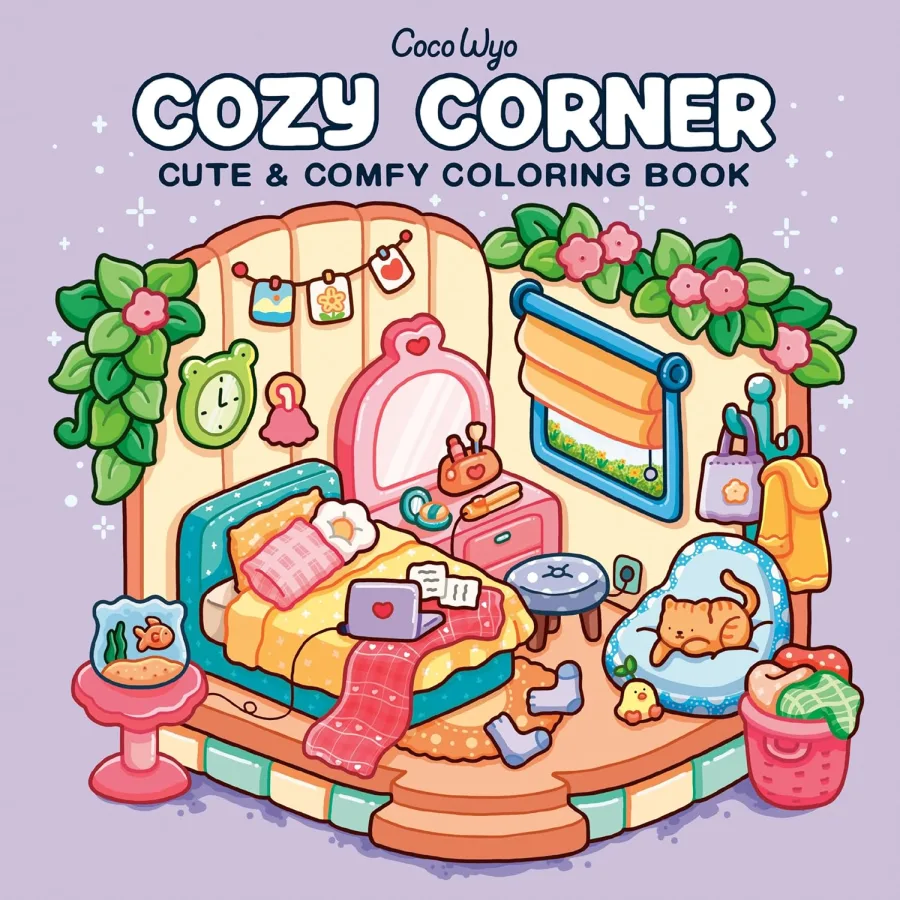
Cozy Corner: Coloring Book for Adults and Kids (Cozy Spaces Coloring)
Paperback
• 96 Pages
• USD 8.99
• English
• 9798217116867
No ratings yet
| Publisher | Random House Books for Young Readers |
|---|---|
| ISBN13 | 9798217116867 |
| ASIN/SKU | B0DSDN3M6D |
| Book Format | Paperback |
| Language | English |
| Pages | 96 |
| List Price | USD 8.99 |
| Publishing Date | 18/03/2025 |
| Dimensions | 8 x 0.37 x 8 inches |
| Weight | 8.8 ounces |
| Book Code | BD00055557 |
Buy this Book
Amazon Stores
Ebook Stores
Other Stores
Discover Cozy Corner: Coloring Book for Adults and Kids (Cozy Spaces Coloring) by Coco Wyo. This book is published by Random House Books for Young Readers in Paperback format, ISBN 9798217116867, ASIN B0DSDN3M6D, under Children's Books, Children's Coloring Books.
Book Description
Settle in to your very own cozy corner with these brand new coloring pages! This follow-up to Coco Wyo's beloved Little Corner promises a new colorful delight at every turn!
A delightful reading alcove, a heartwarming bakery, a well-loved kitchen, and more awaits you in this brand new coloring book! Relaxation can be found in every nook and cranny for your next coloring session with these cute and simple pages!
Cozy Corner has sweet and irresistible images for all ages of coloring fans!
This coloring book includes:
• 45 hand-drawn pages ready for your creativity
• Large, bold designs that are easy to color
• Convenient 8 x 8-inch size, perfect for relaxing anywhere
• Crisp, high-resolution illustrations that bring each page to life
A delightful reading alcove, a heartwarming bakery, a well-loved kitchen, and more awaits you in this brand new coloring book! Relaxation can be found in every nook and cranny for your next coloring session with these cute and simple pages!
Cozy Corner has sweet and irresistible images for all ages of coloring fans!
This coloring book includes:
• 45 hand-drawn pages ready for your creativity
• Large, bold designs that are easy to color
• Convenient 8 x 8-inch size, perfect for relaxing anywhere
• Crisp, high-resolution illustrations that bring each page to life
Author Biography
Hi there, we're Coco Wyo, a group of artists and coloring lovers with a simple dream: to create little cozy moments (and maybe a smile) through coloring books.
Life can get busy, and we all need a small pause to connect with ourselves and with others.
Each page is drawn with love, meant to warm the heart and sometimes spark a sweet memory.
So whenever things feel overwhelming, think of this as your cozy corner - a place to color, breathe and slow down for a bit.
Life can get busy, and we all need a small pause to connect with ourselves and with others.
Each page is drawn with love, meant to warm the heart and sometimes spark a sweet memory.
So whenever things feel overwhelming, think of this as your cozy corner - a place to color, breathe and slow down for a bit.
Editorial Reviews
Editorial Reviews will be added soon…
Book Summary
Cozy Corner: Coloring Book for Adults and Kids by Coco Wyo is not a traditional book with a narrative, characters, or a beginning-to-end storyline. Instead, it is an invitation to slow down, be creative, and turn ordinary moments of comfort into colorful personal experiences. Part of the Cozy Spaces Coloring collection, the book was published in 2025 and is designed for coloring enthusiasts from children to adults. It contains 45 hand-drawn illustrations featuring peaceful, charming spaces such as reading alcoves, bakeries, kitchens, and other inviting corners. The official publisher describes it as a book created for relaxation, with large, bold designs that are easy to color and an accessible 8-by-8-inch format.
The central idea behind Cozy Corner is wonderfully simple: comfort can be found in small spaces and ordinary moments. Rather than asking the reader to accomplish something complicated, the book encourages them to sit down with colored pencils, crayons, or markers and spend a little unhurried time making pictures their own. A comfortable reading nook, a warm bakery, a familiar kitchen, a table filled with little objects, or another charming corner becomes the starting point for imagination. The illustrations are deliberately simple and inviting, allowing the person coloring them to decide what the finished world should look like. In this sense, the book is less about producing perfect artwork and more about enjoying the process of creating it.
This emphasis on process is particularly important for understanding why Coco Wyo coloring books have become popular with both children and adults. The publisher describes Coco Wyo as a collective of independent artists whose goal is to encourage people to express emotions through color while creating books that entertain, comfort, inspire, and connect readers. The coloring experience is therefore presented as a form of creative expression rather than an exercise in artistic perfection. You do not need professional drawing skills to use the book. You simply need to choose colors and begin.
The book's 45 hand-drawn pages provide a wide variety of cozy scenes without making the coloring experience overwhelming. Each illustration has large, bold designs, which means that the individual areas are generally approachable even for beginners. The publisher specifically emphasizes that the pages are suitable for all ages of coloring fans. This makes Cozy Corner especially attractive to families who want a creative activity that children and adults can enjoy together. A child can color a page using bright, imaginative colors while an adult can approach the same kind of scene with softer or more detailed combinations.
The idea of a cozy corner gives the entire collection a consistent emotional atmosphere. A corner is usually a small part of a larger room or environment, but it can become deeply personal. It may be the place where someone reads, drinks tea, bakes, rests, studies, draws, listens to music, or simply sits quietly. Coco Wyo takes this familiar idea and turns it into a series of imaginary spaces that readers can inhabit through color. The illustrations provide the physical structure, while the colorist supplies much of the emotional character.
The reading alcove is a particularly natural example of this approach. A small space filled with books can suggest quiet, curiosity, and escape. Through color, a reader can make the bookshelves traditional or whimsical, the furniture warm or bright, the lighting sunny or mysterious. A page that begins as black-and-white line art can become an extension of the reader's own imagination. The result is not merely a colored picture but a personalized version of the cozy environment suggested by the illustration.
The bakery scenes offer a different kind of comfort. Food and baking are closely associated with warmth, home, celebration, and sensory pleasure. A bakery filled with breads, pastries, shelves, counters, or other small details gives the colorist numerous opportunities to experiment. Golden browns can suggest fresh bread, pinks and creams can make pastries look sweet, and brighter colors can turn an ordinary shop into a cheerful fantasy. The book does not dictate these choices. The colorist decides what kind of bakery exists on the page.
The kitchen illustrations similarly emphasize everyday comfort. Kitchens are familiar spaces, but they can also carry strong emotional associations. They are places where people prepare meals, gather with family, make tea or coffee, bake something special, or simply carry out the routines of daily life. By placing a kitchen inside a coloring book centered on cozy spaces, Coco Wyo transforms an ordinary domestic environment into a relaxing creative setting. The reader can decide whether the kitchen feels rustic, modern, colorful, seasonal, minimalist, or completely imaginary.
One of the most appealing aspects of Cozy Corner is its lack of pressure. Many creative activities can make people worry about whether their work is good enough. Drawing from scratch requires a blank page, which can be intimidating. Coloring is different. The outlines provide a structure, but the creative decisions remain open. The reader does not have to invent the composition, proportions, or perspective. Those elements have already been provided. Instead, the focus is on choosing colors, experimenting with combinations, adding personality, and enjoying the rhythm of filling spaces.
This makes the book particularly suitable for people searching for easy coloring books for adults, relaxing coloring books for beginners, cozy coloring pages, coloring books for stress relief, cute coloring books for kids and adults, or simple coloring books with bold lines. The publisher specifically describes the illustrations as cute and simple, with large designs that are easy to color. The book's appeal therefore does not depend on advanced coloring techniques. Someone who has never used an adult coloring book before can begin without feeling that they need to master complicated shading or intricate patterns.
At the same time, simplicity does not prevent experienced colorists from being creative. Large spaces can be filled with gradients, patterns, textures, highlights, shadows, or layered colors. A simple chair can become visually interesting through wood grain and lighting. A cup can be made to look ceramic, glass, or brightly decorated. A bookshelf can become a miniature rainbow of book covers. In other words, the bold line style creates a foundation that can be approached at different levels of complexity.
The 8-by-8-inch format is another practical part of the book's design. The compact square format makes the book relatively easy to hold and carry, allowing it to fit comfortably into a bag or onto a small table. This supports the larger philosophy of the book: relaxation does not have to require a special studio or elaborate setup. A person can take a few coloring supplies to a comfortable chair, a café, a bedroom, or another quiet place and create a small personal coloring session.
The physical design also contributes to the feeling that the book is approachable. The illustrations are described as crisp, high-resolution artwork, allowing the lines to remain clear as the reader works through each scene. The emphasis is on clarity rather than visual complexity. This matters because clean outlines help the colorist understand where one object ends and another begins, making the pages easier for younger children and beginning colorists.
Although Cozy Corner is marketed as a coloring book for adults and kids, its strongest audience may be the people who enjoy cozy aesthetics. The concept of coziness has become increasingly important in contemporary creative culture because it represents more than physical comfort. It suggests slowing down, creating a pleasant environment, appreciating small pleasures, and finding beauty in everyday routines. Coco Wyo's illustrations capture this feeling visually. Instead of grand landscapes or dramatic adventures, the reader is offered small interiors and familiar spaces where nothing urgent needs to happen.
That is precisely why the book can be relaxing. There is no plot to follow, no puzzle to solve, and no achievement that must be reached. The colorist can spend ten minutes on a page or return to it over several sessions. One illustration can be completed quickly, while another can become a longer creative project. The book accommodates different moods and levels of attention.
The relationship between color and emotion is also central to the Coco Wyo philosophy. The company explains that its books are intended to help people express emotions through colors. This gives the act of coloring a personal dimension. Two people can color exactly the same illustration and produce completely different results. One might use warm oranges, yellows, and reds to create a sunny, energetic room. Another might choose muted blues, greens, and purples to create a quiet evening atmosphere. Neither interpretation is more correct than the other.
For children, this openness can encourage imagination and confidence. A child does not have to color the world according to realistic rules. The sky can be pink, a chair can be purple, and a cat can have unusual markings. The book provides enough structure to make the activity accessible while leaving enough freedom for children to make creative decisions. For adults, the same freedom can provide a welcome break from environments where decisions are usually judged by practical outcomes.
The book can also function as a shared family activity. Because the recommended age range begins at seven and extends upward, Cozy Corner can be enjoyed by children, teenagers, parents, grandparents, and other family members. A family might choose the same page and compare their interpretations, or each person might work on a different illustration. The activity naturally creates opportunities for conversation without requiring anyone to force a conversation. People can simply sit together and color.
Its connection to Coco Wyo's broader Cozy Spaces Coloring series is also significant. Cozy Corner follows Little Corner and has been joined by related titles such as Comfy Corner. The recurring idea is that small spaces can become places of comfort and creativity. The series gives readers different variations on the same emotional theme, allowing fans of the style to explore additional cozy environments without abandoning the recognizable visual approach.
Importantly, Cozy Corner should not be approached as a book with a conventional “summary” in the same way as a novel or nonfiction work. There is no narrative argument to prove or character journey to complete. Its meaning comes from the experience it creates. The book invites the reader to pause, choose colors, concentrate on small details, and gradually transform an empty page into something personal. The finished illustration is almost secondary to the quiet attention required to create it.
That makes the book particularly relevant in a world filled with constant digital stimulation. Coloring offers a tactile activity that requires looking closely at one thing at a time. Instead of scrolling through dozens of images, the reader spends time creating one. Instead of consuming finished content, the reader participates in producing it. The simplicity of the activity can make it feel restorative precisely because it asks for a different kind of attention.
The ultimate message of Cozy Corner is therefore not expressed through words but through its entire format: comfort can be created, and creativity can begin with very little. You do not need to be an accomplished artist. You do not need expensive materials. You do not need a large amount of free time. You simply need a page, some colors, and the willingness to slow down for a while.
Overall, Cozy Corner: Coloring Book for Adults and Kids by Coco Wyo is a charming, accessible coloring experience centered on warm spaces, everyday pleasures, and imaginative relaxation. With 45 hand-drawn illustrations, bold and easy-to-color designs, a convenient square format, and scenes ranging from reading nooks to bakeries and kitchens, it is designed to make coloring feel approachable rather than demanding. Its real strength is the freedom it gives the reader: every page begins with Coco Wyo's lines but ends with the colorist's imagination.
For anyone searching for a cozy coloring book for adults and kids, relaxing coloring book for beginners, cute coloring book, stress-relief coloring activity, simple bold-line coloring book, family coloring activity, or easy coloring pages, Cozy Corner offers a particularly inviting choice. It turns small domestic spaces into little worlds of creativity and reminds readers that relaxation does not always require a major escape. Sometimes it can begin with a quiet chair, a handful of colors, and one cozy corner waiting to be filled.
The central idea behind Cozy Corner is wonderfully simple: comfort can be found in small spaces and ordinary moments. Rather than asking the reader to accomplish something complicated, the book encourages them to sit down with colored pencils, crayons, or markers and spend a little unhurried time making pictures their own. A comfortable reading nook, a warm bakery, a familiar kitchen, a table filled with little objects, or another charming corner becomes the starting point for imagination. The illustrations are deliberately simple and inviting, allowing the person coloring them to decide what the finished world should look like. In this sense, the book is less about producing perfect artwork and more about enjoying the process of creating it.
This emphasis on process is particularly important for understanding why Coco Wyo coloring books have become popular with both children and adults. The publisher describes Coco Wyo as a collective of independent artists whose goal is to encourage people to express emotions through color while creating books that entertain, comfort, inspire, and connect readers. The coloring experience is therefore presented as a form of creative expression rather than an exercise in artistic perfection. You do not need professional drawing skills to use the book. You simply need to choose colors and begin.
The book's 45 hand-drawn pages provide a wide variety of cozy scenes without making the coloring experience overwhelming. Each illustration has large, bold designs, which means that the individual areas are generally approachable even for beginners. The publisher specifically emphasizes that the pages are suitable for all ages of coloring fans. This makes Cozy Corner especially attractive to families who want a creative activity that children and adults can enjoy together. A child can color a page using bright, imaginative colors while an adult can approach the same kind of scene with softer or more detailed combinations.
The idea of a cozy corner gives the entire collection a consistent emotional atmosphere. A corner is usually a small part of a larger room or environment, but it can become deeply personal. It may be the place where someone reads, drinks tea, bakes, rests, studies, draws, listens to music, or simply sits quietly. Coco Wyo takes this familiar idea and turns it into a series of imaginary spaces that readers can inhabit through color. The illustrations provide the physical structure, while the colorist supplies much of the emotional character.
The reading alcove is a particularly natural example of this approach. A small space filled with books can suggest quiet, curiosity, and escape. Through color, a reader can make the bookshelves traditional or whimsical, the furniture warm or bright, the lighting sunny or mysterious. A page that begins as black-and-white line art can become an extension of the reader's own imagination. The result is not merely a colored picture but a personalized version of the cozy environment suggested by the illustration.
The bakery scenes offer a different kind of comfort. Food and baking are closely associated with warmth, home, celebration, and sensory pleasure. A bakery filled with breads, pastries, shelves, counters, or other small details gives the colorist numerous opportunities to experiment. Golden browns can suggest fresh bread, pinks and creams can make pastries look sweet, and brighter colors can turn an ordinary shop into a cheerful fantasy. The book does not dictate these choices. The colorist decides what kind of bakery exists on the page.
The kitchen illustrations similarly emphasize everyday comfort. Kitchens are familiar spaces, but they can also carry strong emotional associations. They are places where people prepare meals, gather with family, make tea or coffee, bake something special, or simply carry out the routines of daily life. By placing a kitchen inside a coloring book centered on cozy spaces, Coco Wyo transforms an ordinary domestic environment into a relaxing creative setting. The reader can decide whether the kitchen feels rustic, modern, colorful, seasonal, minimalist, or completely imaginary.
One of the most appealing aspects of Cozy Corner is its lack of pressure. Many creative activities can make people worry about whether their work is good enough. Drawing from scratch requires a blank page, which can be intimidating. Coloring is different. The outlines provide a structure, but the creative decisions remain open. The reader does not have to invent the composition, proportions, or perspective. Those elements have already been provided. Instead, the focus is on choosing colors, experimenting with combinations, adding personality, and enjoying the rhythm of filling spaces.
This makes the book particularly suitable for people searching for easy coloring books for adults, relaxing coloring books for beginners, cozy coloring pages, coloring books for stress relief, cute coloring books for kids and adults, or simple coloring books with bold lines. The publisher specifically describes the illustrations as cute and simple, with large designs that are easy to color. The book's appeal therefore does not depend on advanced coloring techniques. Someone who has never used an adult coloring book before can begin without feeling that they need to master complicated shading or intricate patterns.
At the same time, simplicity does not prevent experienced colorists from being creative. Large spaces can be filled with gradients, patterns, textures, highlights, shadows, or layered colors. A simple chair can become visually interesting through wood grain and lighting. A cup can be made to look ceramic, glass, or brightly decorated. A bookshelf can become a miniature rainbow of book covers. In other words, the bold line style creates a foundation that can be approached at different levels of complexity.
The 8-by-8-inch format is another practical part of the book's design. The compact square format makes the book relatively easy to hold and carry, allowing it to fit comfortably into a bag or onto a small table. This supports the larger philosophy of the book: relaxation does not have to require a special studio or elaborate setup. A person can take a few coloring supplies to a comfortable chair, a café, a bedroom, or another quiet place and create a small personal coloring session.
The physical design also contributes to the feeling that the book is approachable. The illustrations are described as crisp, high-resolution artwork, allowing the lines to remain clear as the reader works through each scene. The emphasis is on clarity rather than visual complexity. This matters because clean outlines help the colorist understand where one object ends and another begins, making the pages easier for younger children and beginning colorists.
Although Cozy Corner is marketed as a coloring book for adults and kids, its strongest audience may be the people who enjoy cozy aesthetics. The concept of coziness has become increasingly important in contemporary creative culture because it represents more than physical comfort. It suggests slowing down, creating a pleasant environment, appreciating small pleasures, and finding beauty in everyday routines. Coco Wyo's illustrations capture this feeling visually. Instead of grand landscapes or dramatic adventures, the reader is offered small interiors and familiar spaces where nothing urgent needs to happen.
That is precisely why the book can be relaxing. There is no plot to follow, no puzzle to solve, and no achievement that must be reached. The colorist can spend ten minutes on a page or return to it over several sessions. One illustration can be completed quickly, while another can become a longer creative project. The book accommodates different moods and levels of attention.
The relationship between color and emotion is also central to the Coco Wyo philosophy. The company explains that its books are intended to help people express emotions through colors. This gives the act of coloring a personal dimension. Two people can color exactly the same illustration and produce completely different results. One might use warm oranges, yellows, and reds to create a sunny, energetic room. Another might choose muted blues, greens, and purples to create a quiet evening atmosphere. Neither interpretation is more correct than the other.
For children, this openness can encourage imagination and confidence. A child does not have to color the world according to realistic rules. The sky can be pink, a chair can be purple, and a cat can have unusual markings. The book provides enough structure to make the activity accessible while leaving enough freedom for children to make creative decisions. For adults, the same freedom can provide a welcome break from environments where decisions are usually judged by practical outcomes.
The book can also function as a shared family activity. Because the recommended age range begins at seven and extends upward, Cozy Corner can be enjoyed by children, teenagers, parents, grandparents, and other family members. A family might choose the same page and compare their interpretations, or each person might work on a different illustration. The activity naturally creates opportunities for conversation without requiring anyone to force a conversation. People can simply sit together and color.
Its connection to Coco Wyo's broader Cozy Spaces Coloring series is also significant. Cozy Corner follows Little Corner and has been joined by related titles such as Comfy Corner. The recurring idea is that small spaces can become places of comfort and creativity. The series gives readers different variations on the same emotional theme, allowing fans of the style to explore additional cozy environments without abandoning the recognizable visual approach.
Importantly, Cozy Corner should not be approached as a book with a conventional “summary” in the same way as a novel or nonfiction work. There is no narrative argument to prove or character journey to complete. Its meaning comes from the experience it creates. The book invites the reader to pause, choose colors, concentrate on small details, and gradually transform an empty page into something personal. The finished illustration is almost secondary to the quiet attention required to create it.
That makes the book particularly relevant in a world filled with constant digital stimulation. Coloring offers a tactile activity that requires looking closely at one thing at a time. Instead of scrolling through dozens of images, the reader spends time creating one. Instead of consuming finished content, the reader participates in producing it. The simplicity of the activity can make it feel restorative precisely because it asks for a different kind of attention.
The ultimate message of Cozy Corner is therefore not expressed through words but through its entire format: comfort can be created, and creativity can begin with very little. You do not need to be an accomplished artist. You do not need expensive materials. You do not need a large amount of free time. You simply need a page, some colors, and the willingness to slow down for a while.
Overall, Cozy Corner: Coloring Book for Adults and Kids by Coco Wyo is a charming, accessible coloring experience centered on warm spaces, everyday pleasures, and imaginative relaxation. With 45 hand-drawn illustrations, bold and easy-to-color designs, a convenient square format, and scenes ranging from reading nooks to bakeries and kitchens, it is designed to make coloring feel approachable rather than demanding. Its real strength is the freedom it gives the reader: every page begins with Coco Wyo's lines but ends with the colorist's imagination.
For anyone searching for a cozy coloring book for adults and kids, relaxing coloring book for beginners, cute coloring book, stress-relief coloring activity, simple bold-line coloring book, family coloring activity, or easy coloring pages, Cozy Corner offers a particularly inviting choice. It turns small domestic spaces into little worlds of creativity and reminds readers that relaxation does not always require a major escape. Sometimes it can begin with a quiet chair, a handful of colors, and one cozy corner waiting to be filled.
Sample Chapters
Sample Chapters will be added soon…
Reader Reviews
No reviews yet.
Cozy Corner: Coloring Book for Adults and Kids (Cozy Spaces Coloring)
Download Cover Image
Do you want to download the full cover image for Cozy Corner: Coloring Book for Adults and Kids (Cozy Spaces Coloring)?