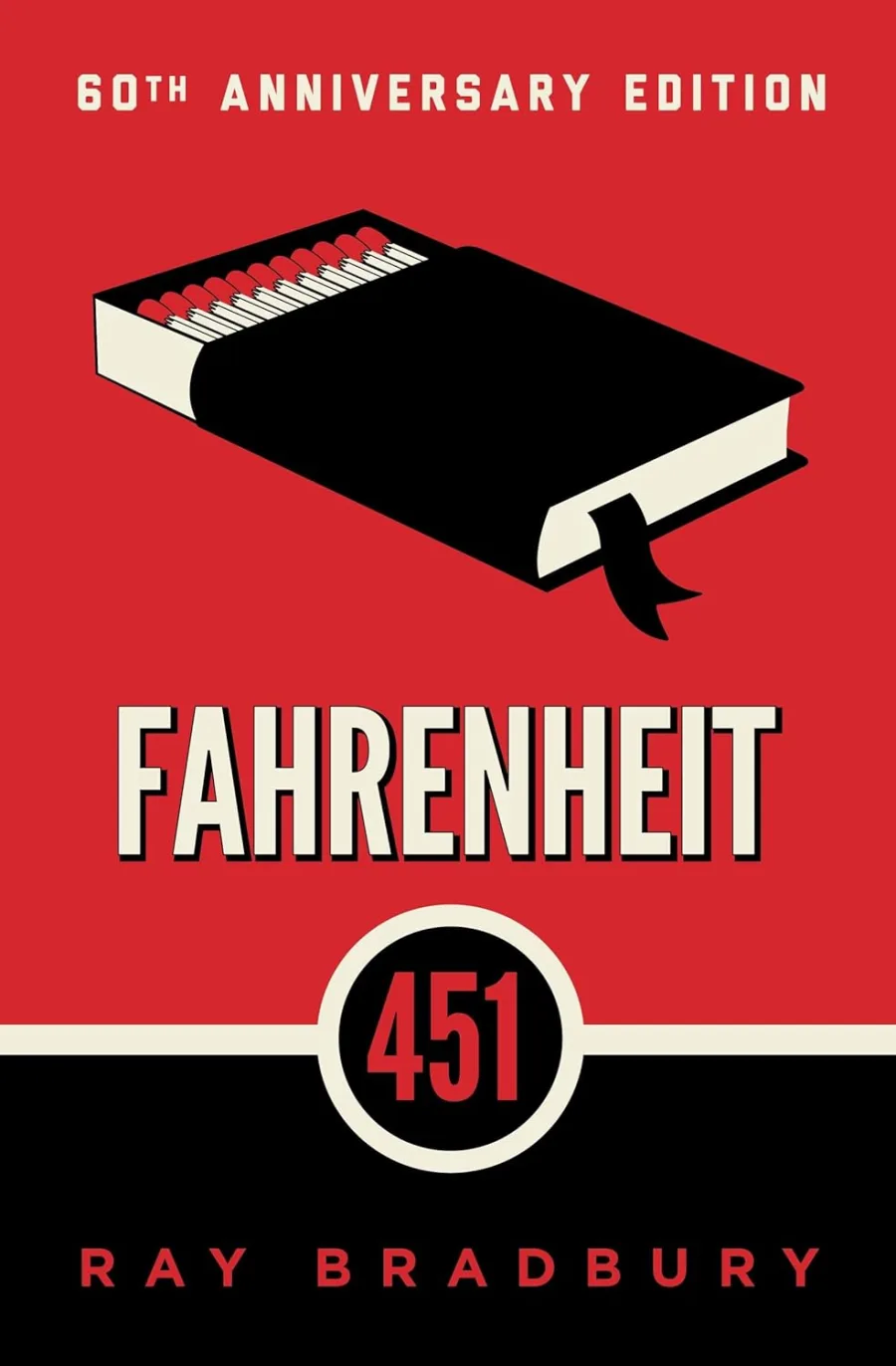
Fahrenheit 451
Paperback
• 249 Pages
• USD 17.00
• English
• 9781451673319
No ratings yet
| Publisher | Simon & Schuster |
|---|---|
| ISBN13 | 9781451673319 |
| ASIN/SKU | 1451673310 |
| Book Format | Paperback |
| Language | English |
| Pages | 249 |
| List Price | USD 17.00 |
| Publishing Date | 10/01/2012 |
| Dimensions | 5.5 x 0.8 x 8.44 inches |
| Weight | 2.31 pounds |
| Book Code | BD00055576 |
Buy this Book
Amazon Stores
Ebook Stores
Other Stores
Discover Fahrenheit 451 by Ray Bradbury. This book is published by Simon and Schuster in Paperback format, ISBN 9781451673319, ASIN 1451673310, under Literature and Fiction, Teen and Young Adult Classic Literature.
Book Description
Nearly seventy years after its original publication, Ray Bradbury’s internationally acclaimed novel Fahrenheit 451 stands as a classic of world literature set in a bleak, dystopian future. Today its message has grown more relevant than ever before.
Guy Montag is a fireman. His job is to destroy the most illegal of commodities, the printed book, along with the houses in which they are hidden. Montag never questions the destruction and ruin his actions produce, returning each day to his bland life and wife, Mildred, who spends all day with her television “family.” But when he meets an eccentric young neighbor, Clarisse, who introduces him to a past where people didn’t live in fear and to a present where one sees the world through the ideas in books instead of the mindless chatter of television, Montag begins to question everything he has ever known.
Guy Montag is a fireman. His job is to destroy the most illegal of commodities, the printed book, along with the houses in which they are hidden. Montag never questions the destruction and ruin his actions produce, returning each day to his bland life and wife, Mildred, who spends all day with her television “family.” But when he meets an eccentric young neighbor, Clarisse, who introduces him to a past where people didn’t live in fear and to a present where one sees the world through the ideas in books instead of the mindless chatter of television, Montag begins to question everything he has ever known.
Author Biography
In a career spanning more than seventy years, Ray Bradbury, who died on June 5, 2012, at the age of 91, inspired generations of readers to dream, think, and create. A prolific author of hundreds of short stories and close to fifty books, as well as numerous poems, essays, operas, plays, teleplays, and screenplays, Bradbury was one of the most celebrated writers of our time. His groundbreaking works include Fahrenheit 451, The Martian Chronicles, The Illustrated Man, Dandelion Wine, and Something Wicked This Way Comes. He wrote the screen play for John Huston's classic film adaptation of Moby Dick, and was nominated for an Academy Award. He adapted sixty-five of his stories for television's The Ray Bradbury Theater, and won an Emmy for his teleplay of The Halloween Tree. He was the recipient of the 2000 National Book Foundation Medal for Distinguished Contribution to American Letters, the 2004 National Medal of Arts, and the 2007 Pulitzer Prize Special Citation, among many honors.
Throughout his life, Bradbury liked to recount the story of meeting a carnival magician, Mr. Electrico, in 1932. At the end of his performance Electrico reached out to the twelve-year-old Bradbury, touched the boy with his sword, and commanded, "Live forever!" Bradbury later said, "I decided that was the greatest idea I had ever heard. I started writing every day. I never stopped."
Throughout his life, Bradbury liked to recount the story of meeting a carnival magician, Mr. Electrico, in 1932. At the end of his performance Electrico reached out to the twelve-year-old Bradbury, touched the boy with his sword, and commanded, "Live forever!" Bradbury later said, "I decided that was the greatest idea I had ever heard. I started writing every day. I never stopped."
Editorial Reviews
“Brilliant . . . Startling and ingenious . . . Mr. Bradbury’s account of this insane world, which bears many alarming resemblances to our own, is fascinating.” —Orville Prescott, The New York Times
“A masterpiece . . . A glorious American classic everyone should read: It’s life-changing if you read it as a teen, and still stunning when you reread it as an adult.” —Alice Hoffman, The Boston Globe
“The sheer lift and power of a truly original imagination exhilarates . . . His is a very great and unusual talent.” —Christopher Isherwood, Tomorrow
“One of this country’s most beloved writers . . . A great storyteller, sometimes even a mythmaker, a true American classic.” —Michael Dirda, The Washington Post
“A masterpiece . . . A glorious American classic everyone should read: It’s life-changing if you read it as a teen, and still stunning when you reread it as an adult.” —Alice Hoffman, The Boston Globe
“The sheer lift and power of a truly original imagination exhilarates . . . His is a very great and unusual talent.” —Christopher Isherwood, Tomorrow
“One of this country’s most beloved writers . . . A great storyteller, sometimes even a mythmaker, a true American classic.” —Michael Dirda, The Washington Post
Book Summary
Ray Bradbury’s classic dystopian novel, Fahrenheit 451, presents a chilling vision of a future where literature is outlawed, critical thought is dangerous, and the government employs heavily armed "firemen" to burn any books they find. Set in an unspecified American city, the narrative explores the devastating consequences of a culture that willingly traded its intellectual freedom for shallow entertainment and state-sponsored conformity. The temperature at which book paper catches fire—451 degrees Fahrenheit—serves as a constant reminder of the state’s absolute control over information. At the center of this grim reality is Guy Montag, a third-generation fireman who initially takes immense pride in his destructive profession, believing he is performing a vital civic duty by sanitizing society of conflicting ideas and emotional distress.
Montag’s unquestioning acceptance of his life is abruptly shattered when he meets his teenage neighbor, Clarisse McClellan. Unlike the rest of society, Clarisse is deeply observant, curious, and unafraid to ask probing questions. She introduces Montag to the forgotten beauties of the natural world and asks him a profound question: "Are you happy?" This innocent inquiry acts as a catalyst, plunging Montag into an existential crisis. He returns home to find his wife, Mildred, unconscious after overdosing on sleeping pills. After her stomach is casually pumped by emotionless technicians who treat suicide as a routine nightly occurrence, Mildred wakes up with no memory of the event, immediately returning to her mindless obsession with the interactive, wall-sized televisions that dominate their living room. The stark contrast between Clarisse’s vibrant humanity and Mildred’s hollow, technology-addicted existence forces Montag to recognize the profound emptiness of his own life.
The simmering discontent within Montag reaches a boiling point during a routine raid on a hidden library. Instead of fleeing, the elderly woman who owns the books chooses to burn alive with them, striking a match to her own kerosene-soaked home. Horrified and deeply moved by her sacrifice, Montag impulsively steals a book before the house is reduced to ash. This traumatic event breaks him completely. His resulting absence from work prompts a visit from his commanding officer, Captain Beatty. A highly intelligent and paradoxical figure, Beatty uses his vast knowledge of literature to explain why books were banned in the first place. He reveals that censorship did not start with a tyrannical government decree, but rather with the people themselves. Society voluntarily surrendered its literature because books contained uncomfortable truths, sparked arguments, and made people feel inferior. To maintain a state of perpetual, superficial happiness, the culture demanded that anything intellectually challenging be destroyed.
Despite Beatty’s intimidating lecture, Montag’s rebellion is fully ignited. He reveals a secret stash of stolen books to a terrified Mildred, desperately trying to read them to understand what society has lost. When Mildred rejects his efforts, prioritizing the safety of her mindless television "family," Montag realizes he needs a teacher. He seeks out Faber, an elderly, cowardly former English professor he had encountered years earlier. Initially hesitant, Faber eventually agrees to help Montag understand the value of literature, explaining that books provide quality of information, the leisure to digest it, and the freedom to act on what is learned. Together, they hatch a dangerous plan to print new books and plant them in the homes of firemen to discredit the profession. To aid Montag, Faber gives him a two-way radio earpiece so they can communicate secretly.
Montag’s newfound defiance culminates in a disastrous confrontation when he returns to the firehouse. The fire alarm sounds, and Beatty drives the fire truck directly to Montag’s own home. In a devastating betrayal, it is revealed that Mildred and her friends reported him to the authorities. Mildred flees the scene in a taxi without a word, leaving Montag to face the consequences. A triumphant Beatty forces Montag to burn his own house and books with a flamethrower. When Beatty discovers the secret earpiece and threatens to hunt down Faber, Montag snaps. Turning the flamethrower on his commanding officer, Montag burns Beatty alive, knocks out the other firemen, and destroys the terrifying Mechanical Hound—a lethal, robotic dog used to track fugitives.
Now a hunted fugitive, Montag makes a desperate run for his life. The authorities broadcast his pursuit on live television, turning his potential execution into a national entertainment spectacle. Following Faber’s instructions, Montag escapes by wading into a river, masking his scent and floating downstream away from the city into the untamed wilderness. He eventually follows abandoned railroad tracks and discovers a hidden encampment of wandering intellectuals, led by a man named Granger. These exiles, known as the "Book People," have committed themselves to memorizing entire works of literature, acting as living, breathing books to preserve human knowledge. Montag joins them, taking on the responsibility of memorizing the Book of Ecclesiastes. Just as he finds his place among them, enemy bombers fly overhead and annihilate the city in a sudden, blinding nuclear strike. In the aftermath of the total destruction, Montag and the Book People walk back toward the ruins, carrying the hope that humanity can finally learn from its past and rebuild a thoughtful world from the ashes.
Montag’s unquestioning acceptance of his life is abruptly shattered when he meets his teenage neighbor, Clarisse McClellan. Unlike the rest of society, Clarisse is deeply observant, curious, and unafraid to ask probing questions. She introduces Montag to the forgotten beauties of the natural world and asks him a profound question: "Are you happy?" This innocent inquiry acts as a catalyst, plunging Montag into an existential crisis. He returns home to find his wife, Mildred, unconscious after overdosing on sleeping pills. After her stomach is casually pumped by emotionless technicians who treat suicide as a routine nightly occurrence, Mildred wakes up with no memory of the event, immediately returning to her mindless obsession with the interactive, wall-sized televisions that dominate their living room. The stark contrast between Clarisse’s vibrant humanity and Mildred’s hollow, technology-addicted existence forces Montag to recognize the profound emptiness of his own life.
The simmering discontent within Montag reaches a boiling point during a routine raid on a hidden library. Instead of fleeing, the elderly woman who owns the books chooses to burn alive with them, striking a match to her own kerosene-soaked home. Horrified and deeply moved by her sacrifice, Montag impulsively steals a book before the house is reduced to ash. This traumatic event breaks him completely. His resulting absence from work prompts a visit from his commanding officer, Captain Beatty. A highly intelligent and paradoxical figure, Beatty uses his vast knowledge of literature to explain why books were banned in the first place. He reveals that censorship did not start with a tyrannical government decree, but rather with the people themselves. Society voluntarily surrendered its literature because books contained uncomfortable truths, sparked arguments, and made people feel inferior. To maintain a state of perpetual, superficial happiness, the culture demanded that anything intellectually challenging be destroyed.
Despite Beatty’s intimidating lecture, Montag’s rebellion is fully ignited. He reveals a secret stash of stolen books to a terrified Mildred, desperately trying to read them to understand what society has lost. When Mildred rejects his efforts, prioritizing the safety of her mindless television "family," Montag realizes he needs a teacher. He seeks out Faber, an elderly, cowardly former English professor he had encountered years earlier. Initially hesitant, Faber eventually agrees to help Montag understand the value of literature, explaining that books provide quality of information, the leisure to digest it, and the freedom to act on what is learned. Together, they hatch a dangerous plan to print new books and plant them in the homes of firemen to discredit the profession. To aid Montag, Faber gives him a two-way radio earpiece so they can communicate secretly.
Montag’s newfound defiance culminates in a disastrous confrontation when he returns to the firehouse. The fire alarm sounds, and Beatty drives the fire truck directly to Montag’s own home. In a devastating betrayal, it is revealed that Mildred and her friends reported him to the authorities. Mildred flees the scene in a taxi without a word, leaving Montag to face the consequences. A triumphant Beatty forces Montag to burn his own house and books with a flamethrower. When Beatty discovers the secret earpiece and threatens to hunt down Faber, Montag snaps. Turning the flamethrower on his commanding officer, Montag burns Beatty alive, knocks out the other firemen, and destroys the terrifying Mechanical Hound—a lethal, robotic dog used to track fugitives.
Now a hunted fugitive, Montag makes a desperate run for his life. The authorities broadcast his pursuit on live television, turning his potential execution into a national entertainment spectacle. Following Faber’s instructions, Montag escapes by wading into a river, masking his scent and floating downstream away from the city into the untamed wilderness. He eventually follows abandoned railroad tracks and discovers a hidden encampment of wandering intellectuals, led by a man named Granger. These exiles, known as the "Book People," have committed themselves to memorizing entire works of literature, acting as living, breathing books to preserve human knowledge. Montag joins them, taking on the responsibility of memorizing the Book of Ecclesiastes. Just as he finds his place among them, enemy bombers fly overhead and annihilate the city in a sudden, blinding nuclear strike. In the aftermath of the total destruction, Montag and the Book People walk back toward the ruins, carrying the hope that humanity can finally learn from its past and rebuild a thoughtful world from the ashes.
Sample Chapters
Sample Chapters will be added soon…
Reader Reviews
No reviews yet.
Fahrenheit 451