
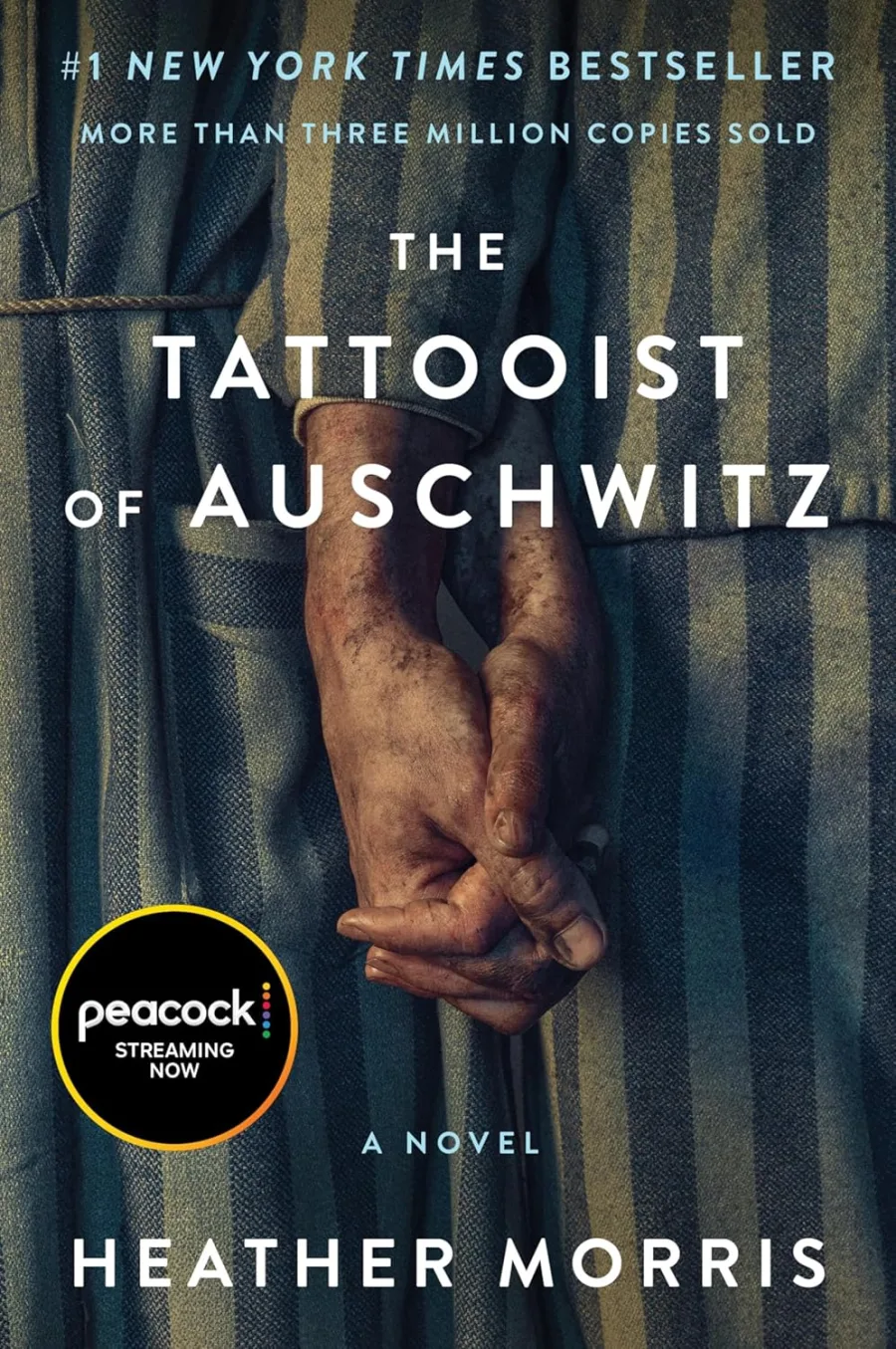
The Tattooist of Auschwitz
Paperback
• 288 Pages
• USD 17.99
• English
• 9780063413108
No ratings yet
| Publisher | Harper Paperbacks |
|---|---|
| ISBN13 | 9780063413108 |
| ASIN/SKU | 0063413108 |
| Book Format | Paperback |
| Language | English |
| Pages | 288 |
| List Price | USD 17.99 |
| Publishing Date | 30/04/2024 |
| Dimensions | 5 x 0.75 x 7.75 inches |
| Weight | 2.31 pounds |
| Book Code | BD00055582 |
Buy this Book
Amazon Stores
Ebook Stores
Other Stores
Discover The Tattooist of Auschwitz by Heather Morris. This book is published by Harper Paperbacks in Paperback format, ISBN 9780063413108, ASIN 0063413108, under Literature and Fiction, Jewish Literature and Fiction, Christian Historical Fiction.
Book Description
#1 New York Times Bestseller and #1 International Bestseller • Now a Peacock Original Series starring Harvey Keitel and Melanie Lynskey
This beautiful, illuminating tale of hope and courage is based on the powerful true story of Holocaust survivor and Auschwitz-Birkenau tattooist Ludwig (Lale) Sokolov―an unforgettable love story in the midst of atrocity.
“The Tattooist of Auschwitz is an extraordinary document, a story about the extremes of human behavior existing side by side: calculated brutality alongside impulsive and selfless acts of love. I find it hard to imagine anyone who would not be drawn in, confronted and moved. I would recommend it unreservedly to anyone, whether they’d read a hundred Holocaust stories or none.”―Graeme Simsion, internationally-bestselling author of The Rosie Project
In April 1942, Lale Sokolov, a Slovakian Jew, is forcibly transported to the concentration camps at Auschwitz-Birkenau. When his captors discover that he speaks several languages, he is put to work as a Tätowierer (the German word for tattooist), tasked with permanently marking his fellow prisoners.
Imprisoned for over two and a half years, Lale witnesses horrific atrocities and barbarism―but also incredible acts of bravery and compassion. Risking his own life, he uses his privileged position to exchange jewels and money from murdered Jews for food to keep his fellow prisoners alive.
One day in July 1942, Lale, prisoner 32407, comforts a trembling young woman waiting in line to have the number 34902 tattooed onto her arm. Her name is Gita, and in that first encounter, Lale vows to somehow survive the camp and marry her.
A vivid, harrowing, and ultimately hopeful re-creation of Lale Sokolov's experiences as the man who tattooed the arms of thousands of prisoners with what would become one of the most potent symbols of the Holocaust, The Tattooist of Auschwitz is an unforgettable work of historical fiction and a testament to the endurance of love and humanity under the darkest possible conditions.
This beautiful, illuminating tale of hope and courage is based on the powerful true story of Holocaust survivor and Auschwitz-Birkenau tattooist Ludwig (Lale) Sokolov―an unforgettable love story in the midst of atrocity.
“The Tattooist of Auschwitz is an extraordinary document, a story about the extremes of human behavior existing side by side: calculated brutality alongside impulsive and selfless acts of love. I find it hard to imagine anyone who would not be drawn in, confronted and moved. I would recommend it unreservedly to anyone, whether they’d read a hundred Holocaust stories or none.”―Graeme Simsion, internationally-bestselling author of The Rosie Project
In April 1942, Lale Sokolov, a Slovakian Jew, is forcibly transported to the concentration camps at Auschwitz-Birkenau. When his captors discover that he speaks several languages, he is put to work as a Tätowierer (the German word for tattooist), tasked with permanently marking his fellow prisoners.
Imprisoned for over two and a half years, Lale witnesses horrific atrocities and barbarism―but also incredible acts of bravery and compassion. Risking his own life, he uses his privileged position to exchange jewels and money from murdered Jews for food to keep his fellow prisoners alive.
One day in July 1942, Lale, prisoner 32407, comforts a trembling young woman waiting in line to have the number 34902 tattooed onto her arm. Her name is Gita, and in that first encounter, Lale vows to somehow survive the camp and marry her.
A vivid, harrowing, and ultimately hopeful re-creation of Lale Sokolov's experiences as the man who tattooed the arms of thousands of prisoners with what would become one of the most potent symbols of the Holocaust, The Tattooist of Auschwitz is an unforgettable work of historical fiction and a testament to the endurance of love and humanity under the darkest possible conditions.
Author Biography
Heather Morris is a native of New Zealand, now resident in Australia. For several years, while working in a large public hospital in Melbourne, she studied and wrote screenplays, one of which was optioned by an Academy Award-winning screenwriter in the US. In 2003, Heather was introduced to an elderly gentleman who ‘might just have a story worth telling’. The day she met Lale Sokolov changed both their lives. Their friendship grew and Lale embarked on a journey of self-scrutiny, entrusting the innermost details of his life during the Holocaust to her. Heather originally wrote Lale’s story as a screenplay – which ranked high in international competitions – before reshaping it into her debut novel, The Tattooist of Auschwitz.
Editorial Reviews
“To many, this book will be most appreciated for its powerful evocation of the everyday horrors of life as a prisoner in a concentration camp, while others will be heartened by the novel’s message of how true love can transcend even the most hellishly inhuman environments. This is a perfect novel for book clubs and readers of historical fiction.” - Publishers Weekly
“Like the Nobel Prize-winning author Elie Wiesel’s Night, Morris’ work takes us inside the day-to-day workings of the most notorious German death camp. Over the course of three years, Morris interviewed Lale, teasing out his memories and weaving them into her heart-rending narrative of a Jew whose unlikely forced occupation as a tattooist put him in a position to act with kindness and humanity in a place where both were nearly extinct.” - BookPage
“The Tattooist of Auschwitz is the story of hope and survival against incredible odds and the power of love.” - Popsugar
“Based on a true story, the wrenching yet riveting tale of Lale’s determination to survive the camp with Gita is a moving testament to the power of kindness, ingenuity, and hope.”
- People
“The Tattooist of Auschwitz is an extraordinary document. I find it hard to imagine anyone who would not be drawn in, confronted and moved. I would recommend it unreservedly to anyone, whether they’d read a hundred Holocaust stories or none.” - Graeme Simsion, internationally-bestselling author of The Rosie Project
“What an extraordinary and important book this is. We need as many memories of the Holocaust as we can retain, and this is a moving and ultimately uplifting story of love, loyalties and friendship amidst the horrors of war.” - International bestseller Jill Mansell
“As many interviews as I did with Holocaust survivors for the Shoah Foundation and as many devastating testimonies as I heard, I could not stop reading The Tattooist of Auschwitz—an extraordinary story of love so fierce it sustained people enduring the unimaginable. Read it, share it, remember it.” - Jenna Blum, New York Times and international bestselling author of Those Who Save Us and The Lost Family
“This is a powerful, gut-wrenching tale that is hard to shake off.” - Kirkus Reviews
“Although one might suspect that there’s far more to his past than is revealed here, much of Lale’s story’s complexity makes it onto the page. And even though it’s clear that Lale will survive, Morris imbues the novel with remarkable suspense.”
“Like the Nobel Prize-winning author Elie Wiesel’s Night, Morris’ work takes us inside the day-to-day workings of the most notorious German death camp. Over the course of three years, Morris interviewed Lale, teasing out his memories and weaving them into her heart-rending narrative of a Jew whose unlikely forced occupation as a tattooist put him in a position to act with kindness and humanity in a place where both were nearly extinct.” - BookPage
“The Tattooist of Auschwitz is the story of hope and survival against incredible odds and the power of love.” - Popsugar
“Based on a true story, the wrenching yet riveting tale of Lale’s determination to survive the camp with Gita is a moving testament to the power of kindness, ingenuity, and hope.”
- People
“The Tattooist of Auschwitz is an extraordinary document. I find it hard to imagine anyone who would not be drawn in, confronted and moved. I would recommend it unreservedly to anyone, whether they’d read a hundred Holocaust stories or none.” - Graeme Simsion, internationally-bestselling author of The Rosie Project
“What an extraordinary and important book this is. We need as many memories of the Holocaust as we can retain, and this is a moving and ultimately uplifting story of love, loyalties and friendship amidst the horrors of war.” - International bestseller Jill Mansell
“As many interviews as I did with Holocaust survivors for the Shoah Foundation and as many devastating testimonies as I heard, I could not stop reading The Tattooist of Auschwitz—an extraordinary story of love so fierce it sustained people enduring the unimaginable. Read it, share it, remember it.” - Jenna Blum, New York Times and international bestselling author of Those Who Save Us and The Lost Family
“This is a powerful, gut-wrenching tale that is hard to shake off.” - Kirkus Reviews
“Although one might suspect that there’s far more to his past than is revealed here, much of Lale’s story’s complexity makes it onto the page. And even though it’s clear that Lale will survive, Morris imbues the novel with remarkable suspense.”
Book Summary
“The Tattooist of Auschwitz” by Heather Morris is a deeply moving historical novel based on the true story of Lale Sokolov, a Slovakian Jew who survives Auschwitz by becoming the camp’s tattooist. The book follows his journey from the moment he is taken from his home in 1942 and transported in a cattle car to the concentration camp, where he has no idea what awaits him. Like thousands of other Jewish prisoners, he is stripped of his identity the moment he arrives. He is shaved, given a prisoner uniform, and tattooed with a number that replaces his name. From that point on, his life becomes a struggle to endure the unimaginable conditions of the camp and to hold on to his humanity in a place built to destroy it.
At Auschwitz, Lale’s life changes again when the Nazis discover that he speaks several languages. Because of this, he is assigned to work as the Tätowierer, the prisoner responsible for tattooing identification numbers onto incoming inmates. This job gives him a little more freedom and a slightly better chance of survival than most prisoners have, but it also places him in a morally difficult position. Every day he must mark people who are terrified, hungry, and often moments away from being sent into the worst parts of the camp system. The work is traumatic, and Lale never loses sight of the horror around him. At the same time, the position allows him limited access to food, money, and information, which he uses carefully to help other prisoners whenever he can. He trades with guards and other contacts, risking punishment to smuggle food and medicine to people who are starving or ill. This makes him not just a survivor, but someone who quietly resists the camp system through acts of compassion.
The novel’s emotional center is the love story between Lale and Gita, a young woman he meets while tattooing prisoners. When he first sees her, he is struck by her beauty and strength, and that moment changes him. Even in a place filled with death and cruelty, he feels a powerful hope that he can survive long enough to be with her. Their relationship grows through secret messages, brief encounters, and the help of others who are willing to take enormous risks for them. Because prisoners are strictly separated, their love is fragile and difficult to sustain, but it becomes a source of meaning for both of them. In the middle of atrocity, their connection offers proof that tenderness and hope can still exist. Lale’s promise to find Gita again and marry her gives him a reason to keep going, even when everything around him seems designed to erase life itself.
As the story unfolds, the reader sees how the camp works not only through visible violence but also through fear, hunger, exhaustion, and constant uncertainty. Prisoners disappear, are beaten, are worked to death, or are selected for killing without warning. Lale witnesses terrible things, and the novel does not soften the brutality of Auschwitz. Yet it also shows small human acts that matter deeply in such a place: sharing food, passing messages, remembering names, and choosing to care when the system demands indifference. These moments do not erase the horror, but they reveal how people survive by creating meaning where there should be none.
Lale’s role also brings him into contact with several different people, including guards and fellow inmates, and his intelligence helps him navigate dangerous relationships. He learns that survival in Auschwitz depends not only on luck but also on timing, observation, and the ability to understand human behavior. Still, the book never presents survival as simple or heroic. Lale must make compromises in order to live, and the weight of those choices stays with him. His survival is tied to guilt, responsibility, and the memory of those who did not survive. That moral complexity is one reason the story feels so powerful.
When the war nears its end, Lale and Gita are eventually separated by the chaos of the camp’s collapse and the movement of prisoners as the Nazis retreat. The final part of the novel follows Lale’s determination to find her again after liberation, and that search becomes its own act of faith. Their reunion and eventual life together form the hopeful center of the book’s ending. After surviving a place built on annihilation, they build a future, carry their memories forward, and choose love and life over despair.
Overall, “The Tattooist of Auschwitz” is a heartbreaking but hopeful novel about survival, love, and the refusal to surrender one’s humanity. It tells the story of one man’s extraordinary endurance, but it also honors the countless victims of the Holocaust whose lives were reduced to numbers. Through Lale and Gita’s story, the book shows that even in the darkest circumstances, people can still choose kindness, courage, and love.
At Auschwitz, Lale’s life changes again when the Nazis discover that he speaks several languages. Because of this, he is assigned to work as the Tätowierer, the prisoner responsible for tattooing identification numbers onto incoming inmates. This job gives him a little more freedom and a slightly better chance of survival than most prisoners have, but it also places him in a morally difficult position. Every day he must mark people who are terrified, hungry, and often moments away from being sent into the worst parts of the camp system. The work is traumatic, and Lale never loses sight of the horror around him. At the same time, the position allows him limited access to food, money, and information, which he uses carefully to help other prisoners whenever he can. He trades with guards and other contacts, risking punishment to smuggle food and medicine to people who are starving or ill. This makes him not just a survivor, but someone who quietly resists the camp system through acts of compassion.
The novel’s emotional center is the love story between Lale and Gita, a young woman he meets while tattooing prisoners. When he first sees her, he is struck by her beauty and strength, and that moment changes him. Even in a place filled with death and cruelty, he feels a powerful hope that he can survive long enough to be with her. Their relationship grows through secret messages, brief encounters, and the help of others who are willing to take enormous risks for them. Because prisoners are strictly separated, their love is fragile and difficult to sustain, but it becomes a source of meaning for both of them. In the middle of atrocity, their connection offers proof that tenderness and hope can still exist. Lale’s promise to find Gita again and marry her gives him a reason to keep going, even when everything around him seems designed to erase life itself.
As the story unfolds, the reader sees how the camp works not only through visible violence but also through fear, hunger, exhaustion, and constant uncertainty. Prisoners disappear, are beaten, are worked to death, or are selected for killing without warning. Lale witnesses terrible things, and the novel does not soften the brutality of Auschwitz. Yet it also shows small human acts that matter deeply in such a place: sharing food, passing messages, remembering names, and choosing to care when the system demands indifference. These moments do not erase the horror, but they reveal how people survive by creating meaning where there should be none.
Lale’s role also brings him into contact with several different people, including guards and fellow inmates, and his intelligence helps him navigate dangerous relationships. He learns that survival in Auschwitz depends not only on luck but also on timing, observation, and the ability to understand human behavior. Still, the book never presents survival as simple or heroic. Lale must make compromises in order to live, and the weight of those choices stays with him. His survival is tied to guilt, responsibility, and the memory of those who did not survive. That moral complexity is one reason the story feels so powerful.
When the war nears its end, Lale and Gita are eventually separated by the chaos of the camp’s collapse and the movement of prisoners as the Nazis retreat. The final part of the novel follows Lale’s determination to find her again after liberation, and that search becomes its own act of faith. Their reunion and eventual life together form the hopeful center of the book’s ending. After surviving a place built on annihilation, they build a future, carry their memories forward, and choose love and life over despair.
Overall, “The Tattooist of Auschwitz” is a heartbreaking but hopeful novel about survival, love, and the refusal to surrender one’s humanity. It tells the story of one man’s extraordinary endurance, but it also honors the countless victims of the Holocaust whose lives were reduced to numbers. Through Lale and Gita’s story, the book shows that even in the darkest circumstances, people can still choose kindness, courage, and love.
Sample Chapters
Sample Chapters will be added soon…
Reader Reviews
No reviews yet.
The Tattooist of Auschwitz
Download Cover Image
Do you want to download the full cover image for The Tattooist of Auschwitz?