
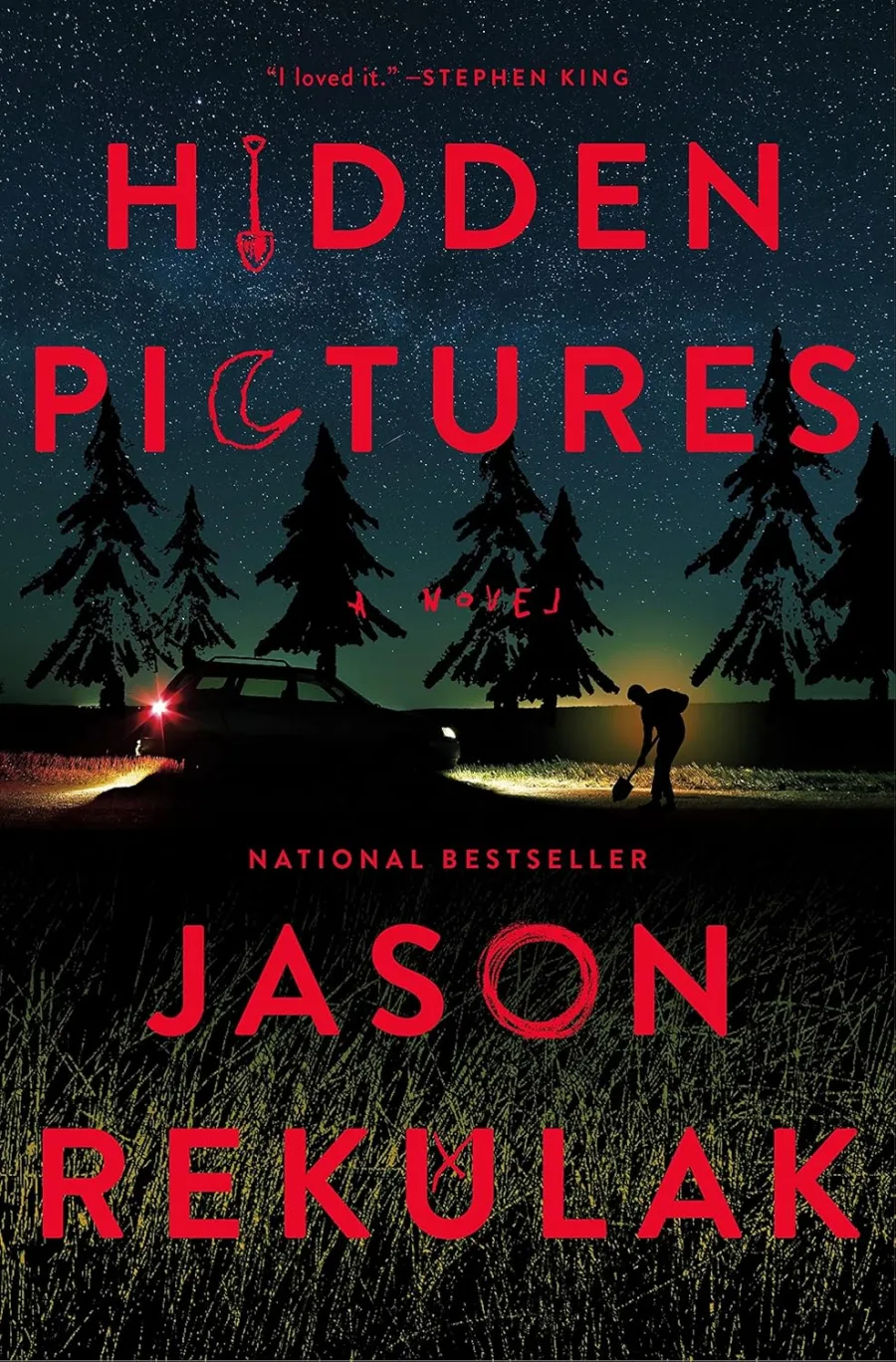
Hidden Pictures
Paperback
• 400 Pages
• USD 17.99
• English
• 9781250819352
No ratings yet
| Publisher | Flatiron Books |
|---|---|
| ISBN13 | 9781250819352 |
| ASIN/SKU | 1250819350 |
| Book Format | Paperback |
| Language | English |
| Pages | 400 |
| List Price | USD 17.99 |
| Publishing Date | 06/06/2023 |
| Dimensions | 5.3 x 1.15 x 8.2 inches |
| Weight | 2.31 pounds |
| Book Code | BD00055592 |
Buy this Book
Amazon Stores
Ebook Stores
Other Stores
Discover Hidden Pictures by Jason Rekulak. This book is published by Flatiron Books in Paperback format, ISBN 9781250819352, ASIN 1250819350, under Mystery, Thriller and Suspense, Ghost Thrillers, Horror Literature and Fiction.
Book Description
OVER 1 MILLION COPIES SOLD!
NEW YORK TIMES BESTSELLER · GOODREADS CHOICE AWARD WINNER
“I loved it." ―Stephen King
From Edgar Award-finalist Jason Rekulak comes a wildly inventive spin on the supernatural thriller, for fans of Stranger Things and Riley Sager, about a woman working as a nanny for a young boy with strange and disturbing secrets.
Mallory Quinn is fresh out of rehab when she takes a job as a babysitter for Ted and Caroline Maxwell. She is to look after their five-year-old son, Teddy.
Mallory immediately loves it. She has her own living space, goes out for nightly runs, and has the stability she craves. And she sincerely bonds with Teddy, a sweet, shy boy who is never without his sketchbook and pencil. His drawings are the usual fare: trees, rabbits, balloons. But one day, he draws something different: a man in a forest, dragging a woman’s lifeless body.
Then, Teddy’s artwork becomes increasingly sinister, and his stick figures quickly evolve into lifelike sketches well beyond the ability of any five-year-old. Mallory begins to wonder if these are glimpses of a long-unsolved murder, perhaps relayed by a supernatural force.
Knowing just how crazy it all sounds, Mallory nevertheless sets out to decipher the images and save Teddy before it’s too late.
NEW YORK TIMES BESTSELLER · GOODREADS CHOICE AWARD WINNER
“I loved it." ―Stephen King
From Edgar Award-finalist Jason Rekulak comes a wildly inventive spin on the supernatural thriller, for fans of Stranger Things and Riley Sager, about a woman working as a nanny for a young boy with strange and disturbing secrets.
Mallory Quinn is fresh out of rehab when she takes a job as a babysitter for Ted and Caroline Maxwell. She is to look after their five-year-old son, Teddy.
Mallory immediately loves it. She has her own living space, goes out for nightly runs, and has the stability she craves. And she sincerely bonds with Teddy, a sweet, shy boy who is never without his sketchbook and pencil. His drawings are the usual fare: trees, rabbits, balloons. But one day, he draws something different: a man in a forest, dragging a woman’s lifeless body.
Then, Teddy’s artwork becomes increasingly sinister, and his stick figures quickly evolve into lifelike sketches well beyond the ability of any five-year-old. Mallory begins to wonder if these are glimpses of a long-unsolved murder, perhaps relayed by a supernatural force.
Knowing just how crazy it all sounds, Mallory nevertheless sets out to decipher the images and save Teddy before it’s too late.
Author Biography
Jason Rekulak lives in Philadelphia with his wife and family. His novels include Hidden Pictures (winner of a Goodreads Choice Award), The Last One at the Wedding (winner of the ITW Award for Best Standalone Thriller), and The Impossible Fortress (an Edgar Award finalist). His books have been translated into more than forty languages.
Editorial Reviews
"It's almost enough to make a person believe in ghosts..." ―Kirkus Reviews
"The explosive third act gives this story a nail-biting ending sure to thrill. Paranormal perfection." ―Booklist
“Beautiful, terrifying, and surprisingly kind.”―CrimeReads
"I read Hidden Pictures and loved it. The language is straightforward, the surprises really surprise, and it has that hard-to-achieve propulsiveness that won't let you put it down. And the pictures are terrific!" ―Stephen King
“Whip-smart, creepy as hell, and masterfully plotted, Hidden Pictures is the best new thriller novel I’ve read in years. Destined to be a classic of the genre.” ―Ransom Riggs, bestselling author of Miss Peregrine’s Home for Peculiar Children
“Hidden Pictures is one of those rare gems that’s aware of the rules of the genre even as it breaks them and invents new ones. It’s a gas to read, full of wonderful new ideas, both literary and visual. This is one of those books you leave out long after finishing, just so your friends might see it and give you the chance to share it! Jason Rekulak is going to be telling us all stories for a good long while.” ―Scott Frank, Academy Award-nominated screenwriter and Emmy-winning director of The Queen’s Gambit
"For a few days, my life was completely hijacked by Jason Rekulak's Hidden Pictures, one of the best and most inventive ghost stories I've read in years. The damaged but still fighting Mallory Quinn stole my heart and her plunge into supernatural wonder gripped my imagination. It's a beautiful dark rush of a novel. I'm already excited to read it again." ―Joe Hill
“Hidden Pictures isn’t a ghost story, it’s a scalpel that slices into our smug sense of self-satisfaction so deeply it hits bone. A perfect summer thriller complete with vengeful spirits, class warfare, and it even has pictures. What more could you want?” ―Grady Hendrix, bestselling author of The Final Girl Support Group
"The explosive third act gives this story a nail-biting ending sure to thrill. Paranormal perfection." ―Booklist
“Beautiful, terrifying, and surprisingly kind.”―CrimeReads
"I read Hidden Pictures and loved it. The language is straightforward, the surprises really surprise, and it has that hard-to-achieve propulsiveness that won't let you put it down. And the pictures are terrific!" ―Stephen King
“Whip-smart, creepy as hell, and masterfully plotted, Hidden Pictures is the best new thriller novel I’ve read in years. Destined to be a classic of the genre.” ―Ransom Riggs, bestselling author of Miss Peregrine’s Home for Peculiar Children
“Hidden Pictures is one of those rare gems that’s aware of the rules of the genre even as it breaks them and invents new ones. It’s a gas to read, full of wonderful new ideas, both literary and visual. This is one of those books you leave out long after finishing, just so your friends might see it and give you the chance to share it! Jason Rekulak is going to be telling us all stories for a good long while.” ―Scott Frank, Academy Award-nominated screenwriter and Emmy-winning director of The Queen’s Gambit
"For a few days, my life was completely hijacked by Jason Rekulak's Hidden Pictures, one of the best and most inventive ghost stories I've read in years. The damaged but still fighting Mallory Quinn stole my heart and her plunge into supernatural wonder gripped my imagination. It's a beautiful dark rush of a novel. I'm already excited to read it again." ―Joe Hill
“Hidden Pictures isn’t a ghost story, it’s a scalpel that slices into our smug sense of self-satisfaction so deeply it hits bone. A perfect summer thriller complete with vengeful spirits, class warfare, and it even has pictures. What more could you want?” ―Grady Hendrix, bestselling author of The Final Girl Support Group
Book Summary
Hidden Pictures by Jason Rekulak is a suspenseful, emotional horror-thriller that blends the coziness of a nanny story with the creeping dread of a supernatural mystery, all centered around Mallory Quinn, a young woman trying to rebuild her life after addiction and relapse. Fresh out of rehab and determined to stay clean, Mallory is desperate for a fresh start, and she finds it when she lands a job as a live-in nanny for a seemingly perfect family, Ted and Caroline Maxwell, in a quiet, affluent New Jersey suburb. They have a five-year-old son named Teddy, a sweet and somewhat shy little boy, and Mallory’s main job is to care for him, walk him to the park, help with his routine, and keep him company during long days at home. The Maxwell household at first feels like a dream: a cozy carriage house for Mallory to live in, generous pay, clear rules about sobriety, and a picturesque neighborhood. Mallory, grateful and hopeful, throws herself into the job, slowly finding comfort in the daily rhythms of watching Teddy and learning the house’s quirks. She enjoys reading to him, playing games, and especially encouraging his love of drawing, which quickly becomes one of their favorite shared activities.
It’s through those drawings that the story tilts from gentle domestic drama into unsettling horror. At first, Teddy’s pictures are normal for a child his age: stick figures, houses, trees, animals, and goofy shapes. Mallory praises him and often hangs his art up, pleased to see his creativity flourishing. But then, little by little, his drawings begin to change. The figures become more detailed, more sophisticated, almost too advanced for a five-year-old. The content starts to get darker: a woman in the woods, bodies posed in strange positions, shadowy shapes that look like something watching from afar. Mallory notices that the quality of the art seems to leap forward overnight, as if another, more experienced hand has guided him. She begins to suspect that Teddy might have an imaginary friend—or something else—that is influencing him. Her concern deepens when Teddy talks about a woman named Anya, someone he insists is around and “shows” him what to draw. The Maxwells dismiss this as normal childhood imagination, but Mallory is troubled. Having lived through addiction, she trusts her instincts about danger, and something about Teddy’s pictures and his mentions of Anya feels wrong.
As Mallory quietly investigates, the house and neighborhood’s history start to surface. She learns, through local gossip and some digging, that decades ago, a woman disappeared under mysterious circumstances, and that this tragedy has never been fully resolved. The eerie drawings begin to line up with details from that old case: locations that match nearby woods, poses that resemble crime scene rumors, figures that look like a woman in distress. Mallory grows increasingly convinced that Teddy is somehow channeling this past tragedy, either through a supernatural presence or through some hidden influence in the house. At the same time, she is constantly aware of her own precarious position; as a recovering addict, she knows that if she sounds too paranoid or unstable, the Maxwells might think she’s relapsing or imagining things and fire her. This tension—between her rising fear and her need to appear sane and reliable—adds a strong psychological layer to the story, making the reader question, along with Mallory, whether what’s happening is real or a reflection of trauma and anxiety.
The book cleverly uses the idea of drawings as evidence that can’t easily be dismissed. Mallory physically sees the images change over time, and Jason Rekulak includes them as illustrations in the text, so in the story world, they become clues to be decoded. The more detailed and brutal they become, the more they resemble visual confessions or messages. Mallory starts to treat Teddy’s art like a map toward a hidden truth. She shares her worries only with a few people, including her sponsor and a friendly neighbor, but most of the time she is alone with her dread, walking through the house at night, feeling watched, hearing faint noises, and sensing that the pastoral safety of this suburban setting is a thin layer over something rotten. The Maxwells, meanwhile, remain complicated figures: they are not outright villains, but their insistence on normality and their subtle control over the household make it harder for Mallory to speak openly. At times, they seem to genuinely care; at other moments, their secrecy and selective honesty raise alarms. Mallory must decide how far she is willing to push and whom she can trust.
As the mystery deepens, Mallory’s past and present start to intersect. Her recovery journey is woven into the plot, showing how she has learned to question her own perceptions, to doubt herself, and to seek external validation, which complicates her efforts to act on her instincts. She knows that if she is wrong, she could lose everything—this job, her progress, her chance at a stable life. If she is right, though, then Teddy is in danger, and a decades-old crime may be crying out for resolution through him. The story becomes a race between her need to protect Teddy and the forces, both human and possibly supernatural, that want the truth to stay buried. Mallory’s determination hardens into courage, and despite her fear of being dismissed as “crazy” or “using again,” she starts piecing together the clues from Teddy’s drawings, local records, and strange occurrences in the house.
Eventually, her persistence leads her to uncover long-hidden secrets involving missing persons, possible cover-ups, and the dark history connected to the Maxwells’ property. The atmosphere grows increasingly tense as Mallory realizes that the threat may be closer than she imagined, not just an abstract ghost story but something that directly touches Teddy and the family she works for. The tension escalates into dangerous confrontations, where she is forced to choose between staying quiet to protect her own fragile stability and speaking up to save a child and address a terrible injustice. The horror elements—ghostly visions, sinister clues, the sense of being haunted—are balanced with grounded emotional stakes: Mallory’s desire to be a good caregiver, her fear of repeating past mistakes, and her deep-seated belief that children should be safe.
By the end of Hidden Pictures, the mystery of the drawings and the identity of Anya are resolved in a way that ties together the supernatural hints and the human cruelty lurking beneath the surface of the town’s history. Mallory faces real danger but also finds an unexpected inner strength, proving to herself that she is more than the worst things she has done and that her instincts to protect others are not just the fantasies of an unstable mind. The final revelations expose who was responsible for the long-ago tragedy and why it was never properly dealt with, and Teddy’s role as a conduit of that truth is both chilling and heartbreaking. The book leaves the reader with a sense that the past can cling to places and people until someone brave enough chooses to see and act, and it shows Mallory’s journey not only as a fight against an external haunting, but as a struggle to trust herself again. In the end, Hidden Pictures feels like a blend of ghost story, psychological thriller, and emotional character study, where the simple act of a child drawing pictures becomes the doorway to a long-buried nightmare and, ultimately, to justice and fragile hope.
It’s through those drawings that the story tilts from gentle domestic drama into unsettling horror. At first, Teddy’s pictures are normal for a child his age: stick figures, houses, trees, animals, and goofy shapes. Mallory praises him and often hangs his art up, pleased to see his creativity flourishing. But then, little by little, his drawings begin to change. The figures become more detailed, more sophisticated, almost too advanced for a five-year-old. The content starts to get darker: a woman in the woods, bodies posed in strange positions, shadowy shapes that look like something watching from afar. Mallory notices that the quality of the art seems to leap forward overnight, as if another, more experienced hand has guided him. She begins to suspect that Teddy might have an imaginary friend—or something else—that is influencing him. Her concern deepens when Teddy talks about a woman named Anya, someone he insists is around and “shows” him what to draw. The Maxwells dismiss this as normal childhood imagination, but Mallory is troubled. Having lived through addiction, she trusts her instincts about danger, and something about Teddy’s pictures and his mentions of Anya feels wrong.
As Mallory quietly investigates, the house and neighborhood’s history start to surface. She learns, through local gossip and some digging, that decades ago, a woman disappeared under mysterious circumstances, and that this tragedy has never been fully resolved. The eerie drawings begin to line up with details from that old case: locations that match nearby woods, poses that resemble crime scene rumors, figures that look like a woman in distress. Mallory grows increasingly convinced that Teddy is somehow channeling this past tragedy, either through a supernatural presence or through some hidden influence in the house. At the same time, she is constantly aware of her own precarious position; as a recovering addict, she knows that if she sounds too paranoid or unstable, the Maxwells might think she’s relapsing or imagining things and fire her. This tension—between her rising fear and her need to appear sane and reliable—adds a strong psychological layer to the story, making the reader question, along with Mallory, whether what’s happening is real or a reflection of trauma and anxiety.
The book cleverly uses the idea of drawings as evidence that can’t easily be dismissed. Mallory physically sees the images change over time, and Jason Rekulak includes them as illustrations in the text, so in the story world, they become clues to be decoded. The more detailed and brutal they become, the more they resemble visual confessions or messages. Mallory starts to treat Teddy’s art like a map toward a hidden truth. She shares her worries only with a few people, including her sponsor and a friendly neighbor, but most of the time she is alone with her dread, walking through the house at night, feeling watched, hearing faint noises, and sensing that the pastoral safety of this suburban setting is a thin layer over something rotten. The Maxwells, meanwhile, remain complicated figures: they are not outright villains, but their insistence on normality and their subtle control over the household make it harder for Mallory to speak openly. At times, they seem to genuinely care; at other moments, their secrecy and selective honesty raise alarms. Mallory must decide how far she is willing to push and whom she can trust.
As the mystery deepens, Mallory’s past and present start to intersect. Her recovery journey is woven into the plot, showing how she has learned to question her own perceptions, to doubt herself, and to seek external validation, which complicates her efforts to act on her instincts. She knows that if she is wrong, she could lose everything—this job, her progress, her chance at a stable life. If she is right, though, then Teddy is in danger, and a decades-old crime may be crying out for resolution through him. The story becomes a race between her need to protect Teddy and the forces, both human and possibly supernatural, that want the truth to stay buried. Mallory’s determination hardens into courage, and despite her fear of being dismissed as “crazy” or “using again,” she starts piecing together the clues from Teddy’s drawings, local records, and strange occurrences in the house.
Eventually, her persistence leads her to uncover long-hidden secrets involving missing persons, possible cover-ups, and the dark history connected to the Maxwells’ property. The atmosphere grows increasingly tense as Mallory realizes that the threat may be closer than she imagined, not just an abstract ghost story but something that directly touches Teddy and the family she works for. The tension escalates into dangerous confrontations, where she is forced to choose between staying quiet to protect her own fragile stability and speaking up to save a child and address a terrible injustice. The horror elements—ghostly visions, sinister clues, the sense of being haunted—are balanced with grounded emotional stakes: Mallory’s desire to be a good caregiver, her fear of repeating past mistakes, and her deep-seated belief that children should be safe.
By the end of Hidden Pictures, the mystery of the drawings and the identity of Anya are resolved in a way that ties together the supernatural hints and the human cruelty lurking beneath the surface of the town’s history. Mallory faces real danger but also finds an unexpected inner strength, proving to herself that she is more than the worst things she has done and that her instincts to protect others are not just the fantasies of an unstable mind. The final revelations expose who was responsible for the long-ago tragedy and why it was never properly dealt with, and Teddy’s role as a conduit of that truth is both chilling and heartbreaking. The book leaves the reader with a sense that the past can cling to places and people until someone brave enough chooses to see and act, and it shows Mallory’s journey not only as a fight against an external haunting, but as a struggle to trust herself again. In the end, Hidden Pictures feels like a blend of ghost story, psychological thriller, and emotional character study, where the simple act of a child drawing pictures becomes the doorway to a long-buried nightmare and, ultimately, to justice and fragile hope.
Sample Chapters
Sample Chapters will be added soon…
Reader Reviews
No reviews yet.
Hidden Pictures
Download Cover Image
Do you want to download the full cover image for Hidden Pictures?