
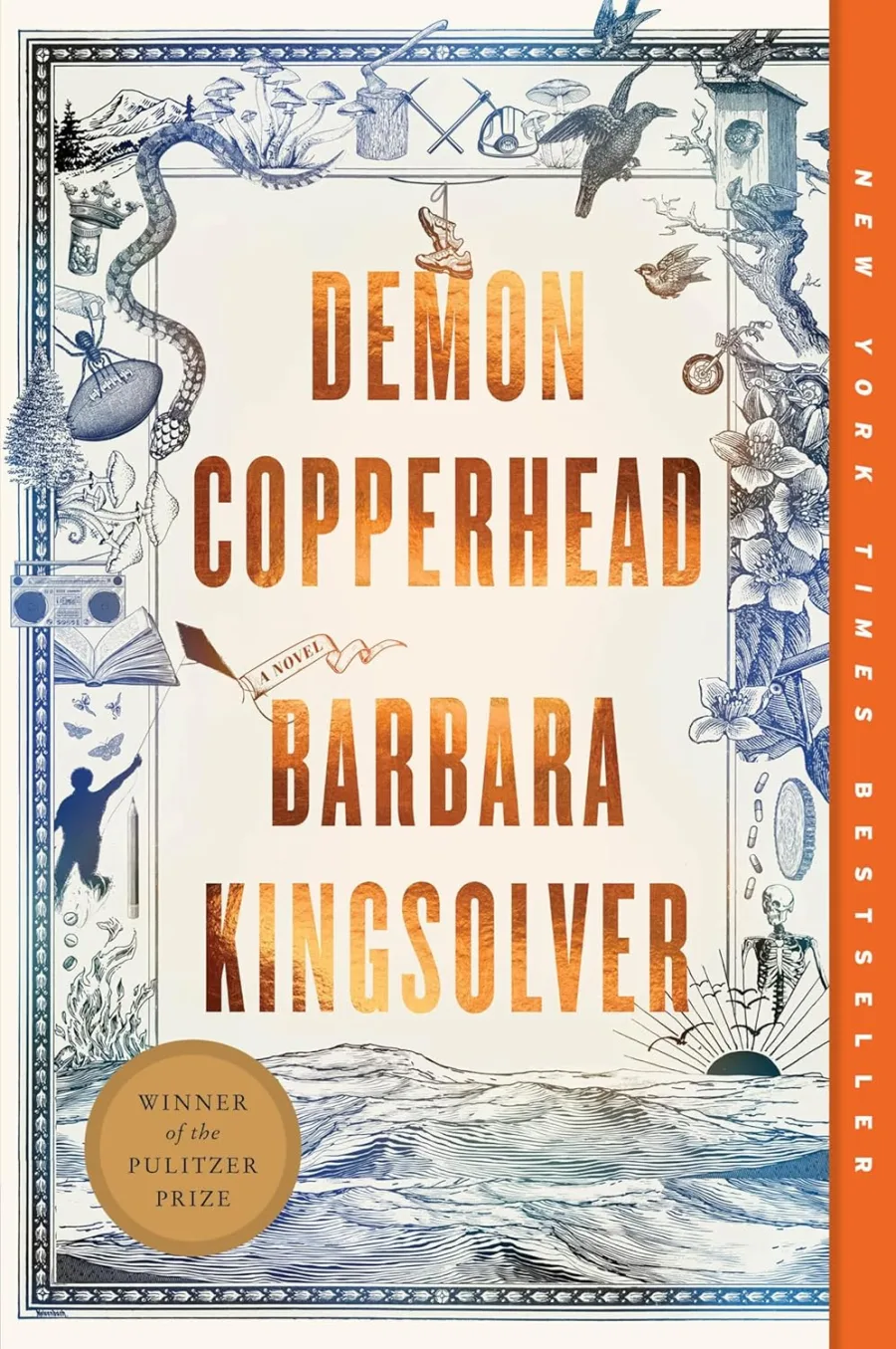
Demon Copperhead: A Pulitzer Prize Winner
Paperback
• 560 Pages
• USD 21.99
• English
• 9780063251984
No ratings yet
| Publisher | Harper Perennial |
|---|---|
| ISBN13 | 9780063251984 |
| ASIN/SKU | 0063251981 |
| Book Format | Paperback |
| Language | English |
| Pages | 560 |
| List Price | USD 21.99 |
| Publishing Date | 27/08/2024 |
| Dimensions | 5.25 x 1.25 x 8 inches |
| Weight | 1.25 pounds |
| Book Code | BD00055662 |
Buy this Book
Amazon Stores
Ebook Stores
Other Stores
Discover Demon Copperhead: A Pulitzer Prize Winner by Barbara Kingsolver. This book is published by Harper Perennial in Paperback format, ISBN 9780063251984, ASIN 0063251981, under Literature and Fiction, American Fiction Anthologies, Classic American Literature.
Book Description
WINNER OF THE PULITZER PRIZE • WINNER OF THE WOMEN'S PRIZE FOR FICTION
New York Times Readers’ Pick: Top 100 Books of the 21st Century • An Oprah’s Book Club Selection • An Instant New York Times Bestseller • An Instant Wall Street Journal Bestseller • A #1 Washington Post Bestseller • A New York Times "Ten Best Books of the Year"
"Demon is a voice for the ages—akin to Huck Finn or Holden Caulfield—only even more resilient.” —Beth Macy, author of Dopesick
"May be the best novel of [the year]. . . . Equal parts hilarious and heartbreaking, this is the story of an irrepressible boy nobody wants, but readers will love.” —Ron Charles, Washington Post
From the acclaimed author of The Poisonwood Bible and The Bean Trees and the recipient of the National Book Foundation's Medal for Distinguished Contribution to American Letters, a brilliant novel that enthralls, compels, and captures the heart as it evokes a young hero’s unforgettable journey to maturity
Set in the mountains of southern Appalachia, Demon Copperhead is the story of a boy born to a teenaged single mother in a single-wide trailer, with no assets beyond his dead father’s good looks and copper-colored hair, a caustic wit, and a fierce talent for survival. Relayed in his own unsparing voice, Demon braves the modern perils of foster care, child labor, derelict schools, athletic success, addiction, disastrous loves, and crushing losses. Through all of it, he reckons with his own invisibility in a popular culture where even the superheroes have abandoned rural people in favor of cities.
Many generations ago, Charles Dickens wrote David Copperfield from his experience as a survivor of institutional poverty and its damages to children in his society. Those problems have yet to be solved in ours. Dickens is not a prerequisite for readers of this novel, but he provided its inspiration. In transposing a Victorian epic novel to the contemporary American South, Barbara Kingsolver enlists Dickens’ anger and compassion, and above all, his faith in the transformative powers of a good story. Demon Copperhead speaks for a new generation of lost boys, and all those born into beautiful, cursed places they can’t imagine leaving behind.
New York Times Readers’ Pick: Top 100 Books of the 21st Century • An Oprah’s Book Club Selection • An Instant New York Times Bestseller • An Instant Wall Street Journal Bestseller • A #1 Washington Post Bestseller • A New York Times "Ten Best Books of the Year"
"Demon is a voice for the ages—akin to Huck Finn or Holden Caulfield—only even more resilient.” —Beth Macy, author of Dopesick
"May be the best novel of [the year]. . . . Equal parts hilarious and heartbreaking, this is the story of an irrepressible boy nobody wants, but readers will love.” —Ron Charles, Washington Post
From the acclaimed author of The Poisonwood Bible and The Bean Trees and the recipient of the National Book Foundation's Medal for Distinguished Contribution to American Letters, a brilliant novel that enthralls, compels, and captures the heart as it evokes a young hero’s unforgettable journey to maturity
Set in the mountains of southern Appalachia, Demon Copperhead is the story of a boy born to a teenaged single mother in a single-wide trailer, with no assets beyond his dead father’s good looks and copper-colored hair, a caustic wit, and a fierce talent for survival. Relayed in his own unsparing voice, Demon braves the modern perils of foster care, child labor, derelict schools, athletic success, addiction, disastrous loves, and crushing losses. Through all of it, he reckons with his own invisibility in a popular culture where even the superheroes have abandoned rural people in favor of cities.
Many generations ago, Charles Dickens wrote David Copperfield from his experience as a survivor of institutional poverty and its damages to children in his society. Those problems have yet to be solved in ours. Dickens is not a prerequisite for readers of this novel, but he provided its inspiration. In transposing a Victorian epic novel to the contemporary American South, Barbara Kingsolver enlists Dickens’ anger and compassion, and above all, his faith in the transformative powers of a good story. Demon Copperhead speaks for a new generation of lost boys, and all those born into beautiful, cursed places they can’t imagine leaving behind.
Author Biography
Barbara Kingsolver was born in 1955 and grew up in rural Kentucky. She earned degrees in biology from DePauw University and the University of Arizona, and has worked as a freelance writer and author since 1985. At various times she has lived in England, France, and the Canary Islands, and has worked in Europe, Africa, Asia, Mexico, and South America. She spent two decades in Tucson, Arizona, before moving to southwestern Virginia where she currently resides.
Her books, in order of publication, are: The Bean Trees (1988), Homeland (1989), Holding the Line: Women in the Great Arizona Mine Strike (1989), Animal Dreams (1990), Another America (1992), Pigs in Heaven (1993), High Tide in Tucson (1995), The Poisonwood Bible (1998), Prodigal Summer (2000), Small Wonder (2002), Last Stand: America's Virgin Lands, with photographer Annie Griffiths (2002), Animal, Vegetable, Miracle: A Year of Food Life (2007), The Lacuna (2009), Flight Behavior (2012), Unsheltered (2018), How To Fly (In 10,000 Easy Lessons) (2020), Demon Copperhead (2022), and coauthored with Lily Kingsolver, Coyote's Wild Home (2023). She served as editor for Best American Short Stories 2001.
Kingsolver was named one the most important writers of the 20th Century by Writers Digest, and in 2023 won a Pulitzer Prize for her novel Demon Copperhead. In 2000 she received the National Humanities Medal, our country's highest honor for service through the arts. Her books have been translated into more than thirty languages and have been adopted into the core curriculum in high schools and colleges throughout the nation. Critical acclaim for her work includes multiple awards from the American Booksellers Association and the American Library Association, a James Beard award, two-time Oprah Book Club selection, and the national book award of South Africa, among others. She was awarded Britain's prestigious Women's Prize for Fiction (formerly the Orange Prize) for both Demon Copperhead and The Lacuna, making Kingsolver the first author in the history of the prize to win it twice. In 2011, Kingsolver was awarded the Dayton Literary Peace Prize for the body of her work. She is a member of the American Academy of Arts and Letters.
She has two daughters, Camille (born in 1987) and Lily (1996). She and her husband, Steven Hopp, live on a farm in southern Appalachia where they raise an extensive vegetable garden and Icelandic sheep.
Her books, in order of publication, are: The Bean Trees (1988), Homeland (1989), Holding the Line: Women in the Great Arizona Mine Strike (1989), Animal Dreams (1990), Another America (1992), Pigs in Heaven (1993), High Tide in Tucson (1995), The Poisonwood Bible (1998), Prodigal Summer (2000), Small Wonder (2002), Last Stand: America's Virgin Lands, with photographer Annie Griffiths (2002), Animal, Vegetable, Miracle: A Year of Food Life (2007), The Lacuna (2009), Flight Behavior (2012), Unsheltered (2018), How To Fly (In 10,000 Easy Lessons) (2020), Demon Copperhead (2022), and coauthored with Lily Kingsolver, Coyote's Wild Home (2023). She served as editor for Best American Short Stories 2001.
Kingsolver was named one the most important writers of the 20th Century by Writers Digest, and in 2023 won a Pulitzer Prize for her novel Demon Copperhead. In 2000 she received the National Humanities Medal, our country's highest honor for service through the arts. Her books have been translated into more than thirty languages and have been adopted into the core curriculum in high schools and colleges throughout the nation. Critical acclaim for her work includes multiple awards from the American Booksellers Association and the American Library Association, a James Beard award, two-time Oprah Book Club selection, and the national book award of South Africa, among others. She was awarded Britain's prestigious Women's Prize for Fiction (formerly the Orange Prize) for both Demon Copperhead and The Lacuna, making Kingsolver the first author in the history of the prize to win it twice. In 2011, Kingsolver was awarded the Dayton Literary Peace Prize for the body of her work. She is a member of the American Academy of Arts and Letters.
She has two daughters, Camille (born in 1987) and Lily (1996). She and her husband, Steven Hopp, live on a farm in southern Appalachia where they raise an extensive vegetable garden and Icelandic sheep.
Editorial Reviews
“Absorbing….Readers see the yearning for love and wells of compassion hidden beneath Demon’s self-protective exterior…. Emotionally engaging is Demon’s fierce attachment to his home ground, a place where he is known and supported, tested to the breaking point as the opiate epidemic engulfs it…. An angry, powerful book seething with love and outrage for a community too often stereotyped or ignored.” - Kirkus Review (Starred Review)
“Kingsolver brings a notably different energy from her previous work to Demon Copperhead…through a tremendous narrative voice, one so sharp and fresh as to overwhelm the reader’s senses….Demon’s spirit comes through, and it is haunting. It’s the reason the pages keep turning….Kingsolver has made this story her own, and what a joy it is to slip into this world and inhabit it, even with all its challenges.” - BookPage
"The voice of Demon is so original. . . . Straight-talking, alert, witty and hard to deceive. In other words, a defiant retort to stereotypes about Appalachia. He’s mouthy and smart in a contemporary way, but he’s making the same call for attention and compassion Charles Dickens did more than a century and a half ago.” - USA Today
"A heartrending, probing and ultimately hopeful tale about a young boy’s journey from devastation to survival….It’s hard to ascertain which is more brilliant, Kingsolver’s skill in modernizing Dickens’ narrative or the voice she gives to the privations and adversities facing the land and people she so dearly loves.” - Atlanta Journal-Constitution
"Demon is a voice for the ages—akin to Huck Finn or Holden Caulfield—only even more resilient. I’m crazy about this book, which parses the epidemic in a beautiful and intimate new way. I think it’s her best.” - Beth Macy, author of Dopesick
“Kingsolver’s capacious, ingenious, wrenching, and funny survivor’s tale is a virtuoso present-day variation on Charles Dickens’ David Copperfield. . . . Kingsolver’s tour de force is a serpentine, hard-striking tale of profound dimension and resonance.” - Booklist (Starred Review)
"Kingsolver's new novel is her best in years. . . . The character of Damon is right up there with the best classic orphans of literatre. Believe me: you will root for this lost boy." - Pittsburgh Post-Gazette
“A riveting, epic tale…[Kingsolver’s] exquisite writing takes a wrenching story and makes it worthwhile… Kingsolver has given us a superb novel.” - Christian Science Monitor
“Kingsolver has made this story her own, and what a joy it is to slip into this world and inhabit it, even with all its challenges.” - BookPage
"This is storytelling at its best. The voice rings true and so do the incidents." - Stephen King
“Kingsolver brings a notably different energy from her previous work to Demon Copperhead…through a tremendous narrative voice, one so sharp and fresh as to overwhelm the reader’s senses….Demon’s spirit comes through, and it is haunting. It’s the reason the pages keep turning….Kingsolver has made this story her own, and what a joy it is to slip into this world and inhabit it, even with all its challenges.” - BookPage
"The voice of Demon is so original. . . . Straight-talking, alert, witty and hard to deceive. In other words, a defiant retort to stereotypes about Appalachia. He’s mouthy and smart in a contemporary way, but he’s making the same call for attention and compassion Charles Dickens did more than a century and a half ago.” - USA Today
"A heartrending, probing and ultimately hopeful tale about a young boy’s journey from devastation to survival….It’s hard to ascertain which is more brilliant, Kingsolver’s skill in modernizing Dickens’ narrative or the voice she gives to the privations and adversities facing the land and people she so dearly loves.” - Atlanta Journal-Constitution
"Demon is a voice for the ages—akin to Huck Finn or Holden Caulfield—only even more resilient. I’m crazy about this book, which parses the epidemic in a beautiful and intimate new way. I think it’s her best.” - Beth Macy, author of Dopesick
“Kingsolver’s capacious, ingenious, wrenching, and funny survivor’s tale is a virtuoso present-day variation on Charles Dickens’ David Copperfield. . . . Kingsolver’s tour de force is a serpentine, hard-striking tale of profound dimension and resonance.” - Booklist (Starred Review)
"Kingsolver's new novel is her best in years. . . . The character of Damon is right up there with the best classic orphans of literatre. Believe me: you will root for this lost boy." - Pittsburgh Post-Gazette
“A riveting, epic tale…[Kingsolver’s] exquisite writing takes a wrenching story and makes it worthwhile… Kingsolver has given us a superb novel.” - Christian Science Monitor
“Kingsolver has made this story her own, and what a joy it is to slip into this world and inhabit it, even with all its challenges.” - BookPage
"This is storytelling at its best. The voice rings true and so do the incidents." - Stephen King
Book Summary
Demon Copperhead by Barbara Kingsolver is a powerful, moving coming-of-age novel about a boy trying to survive poverty, neglect, addiction, and the failures of the systems meant to protect him. Set in the Appalachian mountains of Virginia, the story is narrated by Damon Fields, nicknamed Demon because of his red hair, sharp tongue, and fierce spirit. From the beginning, his life is shaped by hardship. He is born to a teenage mother who struggles with addiction, and his father dies before he is born. That means Demon enters the world with very little security, living in a trailer and depending on the unstable care of a mother who loves him but cannot always protect him. Even as a child, he is aware that he is growing up in a place where people are poor, overlooked, and often trapped by circumstances they cannot control.
The novel follows Demon through the different stages of his life, beginning with the small joys and comforts of childhood. His closest early friendship is with Matt Peggot, called Maggot, whose family offers one of the few stable and loving homes in Demon’s life. The Peggots become a kind of chosen family to him, giving him warmth, meals, and a sense that he matters. But this fragile stability is shattered when his mother begins a relationship with a violent, controlling man named Stoner. Stoner takes over the household, isolates Demon’s mother, and makes life at home unbearable. Demon watches helplessly as his mother sinks further into addiction and loses the strength to care for herself. This part of the novel shows how quickly a child’s world can collapse when love and safety are replaced by fear and addiction.
After his mother dies of an overdose, Demon is pulled deeper into the foster care system, and this becomes one of the novel’s most painful sections. The foster homes are not places of healing but places of exploitation, neglect, and cruelty. In one home, children are treated like laborers rather than human beings, made to work in miserable conditions and given little real care. Demon learns early that the system meant to help children often fails them, especially in poor rural areas where oversight is weak and abuse is easy to hide. These experiences harden him, but they also teach him how to observe people closely, how to survive by wit and endurance, and how to keep going even when adults cannot be trusted.
Eventually, Demon begins moving through a series of new environments, including school, sports, and work, each of which gives him brief chances at a better life. He shows promise as a football player and later draws the attention of Coach Winfield, who gives him a more stable home and some real support. Under the coach’s care, Demon begins to experience something closer to a family life again. He also grows into his intelligence and talent, especially in art and storytelling. One of the strengths of the novel is the way it refuses to reduce Demon to a victim. He is funny, observant, proud, angry, loving, and deeply human. Even when he makes bad choices, the novel keeps showing the reader the boy behind those choices, someone shaped by loss but not destroyed by it.
As Demon gets older, the novel turns more directly toward addiction, particularly the opioid crisis that has devastated many Appalachian communities. After a football injury leads to a prescription for painkillers, Demon gradually becomes dependent on opioids himself. What starts as medical treatment turns into another trap, and he falls into a cycle of pain, withdrawal, shame, and relapse. This part of the story is especially brutal because it shows how addiction can look from the inside: not like a single bad choice, but like a slow collapse caused by trauma, loneliness, and physical dependence. Demon’s relationship with Dori, a girl who is also struggling, becomes another painful example of how addiction can twist love into something unstable and self-destructive. Together, they drift further from the life either of them hoped for.
At the same time, the novel keeps pointing to the larger forces behind Demon’s suffering. Barbara Kingsolver links his individual story to the history of Appalachia itself, showing how poverty, labor exploitation, corporate neglect, and cultural stereotypes have shaped the region for generations. Demon is not just one unlucky boy; he is also part of a community that has long been treated as disposable. The book makes it clear that the opioid epidemic did not appear out of nowhere. It grew in the cracks left by unemployment, broken families, weak institutions, and a culture that often ignores rural suffering until it becomes a crisis.
Even so, Demon Copperhead is not a story of total despair. Over time, Demon begins to find his way back through art, connection, and recovery. His talent for drawing becomes a way to process what he has lived through, and it gives him a future beyond survival. He eventually enters treatment, rebuilds parts of his life, and starts to imagine himself not just as a boy who endured pain, but as someone who can tell his story and make meaning out of it. His bond with Angus, one of the few people who truly sees him, also gives the novel emotional hope. Their relationship grows over time into something tender and deeply rooted, offering Demon a glimpse of love that is not based on need or damage.
By the end, the novel becomes a story about resilience without romanticizing suffering. Demon does not escape untouched, and the losses in his life are real and lasting. But he also refuses to disappear. He learns that survival is not enough unless it leads to some kind of self-understanding and connection. Demon Copperhead is moving because it is both brutally honest and deeply compassionate. It tells the story of a boy who is dealt nearly every bad hand possible, yet still finds ways to keep his voice, his humor, and his humanity.
The novel follows Demon through the different stages of his life, beginning with the small joys and comforts of childhood. His closest early friendship is with Matt Peggot, called Maggot, whose family offers one of the few stable and loving homes in Demon’s life. The Peggots become a kind of chosen family to him, giving him warmth, meals, and a sense that he matters. But this fragile stability is shattered when his mother begins a relationship with a violent, controlling man named Stoner. Stoner takes over the household, isolates Demon’s mother, and makes life at home unbearable. Demon watches helplessly as his mother sinks further into addiction and loses the strength to care for herself. This part of the novel shows how quickly a child’s world can collapse when love and safety are replaced by fear and addiction.
After his mother dies of an overdose, Demon is pulled deeper into the foster care system, and this becomes one of the novel’s most painful sections. The foster homes are not places of healing but places of exploitation, neglect, and cruelty. In one home, children are treated like laborers rather than human beings, made to work in miserable conditions and given little real care. Demon learns early that the system meant to help children often fails them, especially in poor rural areas where oversight is weak and abuse is easy to hide. These experiences harden him, but they also teach him how to observe people closely, how to survive by wit and endurance, and how to keep going even when adults cannot be trusted.
Eventually, Demon begins moving through a series of new environments, including school, sports, and work, each of which gives him brief chances at a better life. He shows promise as a football player and later draws the attention of Coach Winfield, who gives him a more stable home and some real support. Under the coach’s care, Demon begins to experience something closer to a family life again. He also grows into his intelligence and talent, especially in art and storytelling. One of the strengths of the novel is the way it refuses to reduce Demon to a victim. He is funny, observant, proud, angry, loving, and deeply human. Even when he makes bad choices, the novel keeps showing the reader the boy behind those choices, someone shaped by loss but not destroyed by it.
As Demon gets older, the novel turns more directly toward addiction, particularly the opioid crisis that has devastated many Appalachian communities. After a football injury leads to a prescription for painkillers, Demon gradually becomes dependent on opioids himself. What starts as medical treatment turns into another trap, and he falls into a cycle of pain, withdrawal, shame, and relapse. This part of the story is especially brutal because it shows how addiction can look from the inside: not like a single bad choice, but like a slow collapse caused by trauma, loneliness, and physical dependence. Demon’s relationship with Dori, a girl who is also struggling, becomes another painful example of how addiction can twist love into something unstable and self-destructive. Together, they drift further from the life either of them hoped for.
At the same time, the novel keeps pointing to the larger forces behind Demon’s suffering. Barbara Kingsolver links his individual story to the history of Appalachia itself, showing how poverty, labor exploitation, corporate neglect, and cultural stereotypes have shaped the region for generations. Demon is not just one unlucky boy; he is also part of a community that has long been treated as disposable. The book makes it clear that the opioid epidemic did not appear out of nowhere. It grew in the cracks left by unemployment, broken families, weak institutions, and a culture that often ignores rural suffering until it becomes a crisis.
Even so, Demon Copperhead is not a story of total despair. Over time, Demon begins to find his way back through art, connection, and recovery. His talent for drawing becomes a way to process what he has lived through, and it gives him a future beyond survival. He eventually enters treatment, rebuilds parts of his life, and starts to imagine himself not just as a boy who endured pain, but as someone who can tell his story and make meaning out of it. His bond with Angus, one of the few people who truly sees him, also gives the novel emotional hope. Their relationship grows over time into something tender and deeply rooted, offering Demon a glimpse of love that is not based on need or damage.
By the end, the novel becomes a story about resilience without romanticizing suffering. Demon does not escape untouched, and the losses in his life are real and lasting. But he also refuses to disappear. He learns that survival is not enough unless it leads to some kind of self-understanding and connection. Demon Copperhead is moving because it is both brutally honest and deeply compassionate. It tells the story of a boy who is dealt nearly every bad hand possible, yet still finds ways to keep his voice, his humor, and his humanity.
Sample Chapters
Sample Chapters will be added soon…
Reader Reviews
No reviews yet.
Demon Copperhead: A Pulitzer Prize Winner
Download Cover Image
Do you want to download the full cover image for Demon Copperhead: A Pulitzer Prize Winner?