
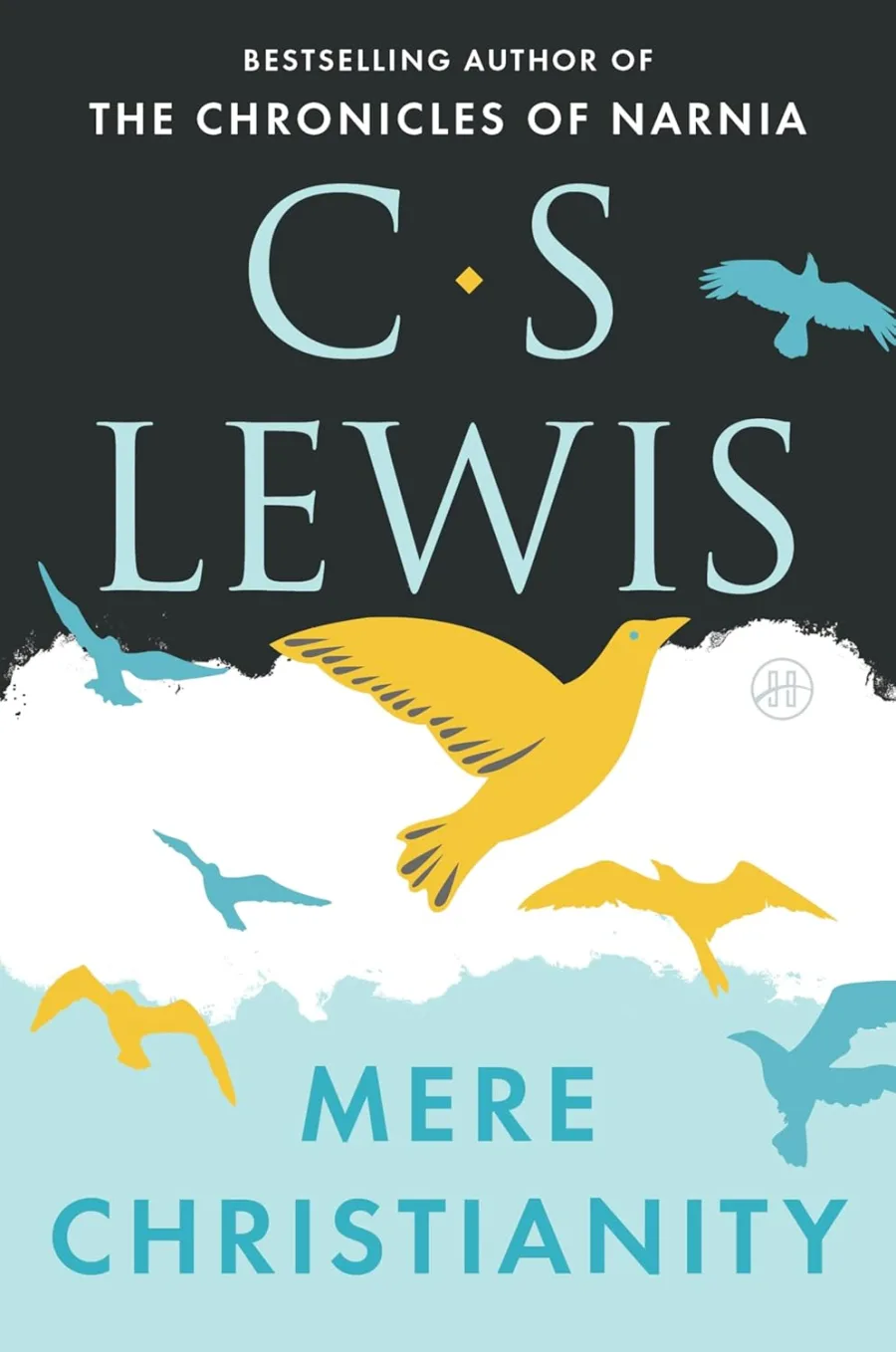
Mere Christianity
Paperback
• 227 Pages
• USD 17.99
• English
• 9780060652920
No ratings yet
| Publisher | HarperOne |
|---|---|
| ISBN13 | 9780060652920 |
| ASIN/SKU | 0060652926 |
| Book Format | Paperback |
| Language | English |
| Pages | 227 |
| List Price | USD 17.99 |
| Publishing Date | 06/02/2021 |
| Dimensions | 5.31 x 0.64 x 8 inches |
| Weight | 2.31 pounds |
| Book Code | BD00055722 |
Buy this Book
Amazon Stores
Ebook Stores
Other Stores
Discover Mere Christianity by C. S. Lewis. This book is published by HarperOne in Paperback format, ISBN 9780060652920, ASIN 0060652926, under Christian Books and Bibles, Christian Apologetics, Christian Personal Growth.
Book Description
"C.S. Lewis is the ideal persuader for the half-convinced, for the good man who would like to be a Christian but finds his intellect getting in the way." — Anthony Burgess, New York Times Book Review
Our moral consciousness and moral judgements are proof to the human race that a moral being exists—God.
Mere Christianity explores the core beliefs of Christianity by providing an unequaled opportunity for believers and nonbelievers alike to hear a powerful, rational case for the Christian faith. A brilliant collection, Mere Christianity remains strikingly fresh for the modern reader and at the same time confirms C. S. Lewis’s reputation as one of the leading writer and thinkers of our age.
Our moral consciousness and moral judgements are proof to the human race that a moral being exists—God.
Mere Christianity explores the core beliefs of Christianity by providing an unequaled opportunity for believers and nonbelievers alike to hear a powerful, rational case for the Christian faith. A brilliant collection, Mere Christianity remains strikingly fresh for the modern reader and at the same time confirms C. S. Lewis’s reputation as one of the leading writer and thinkers of our age.
Author Biography
Clive Staples Lewis (1898–1963) was one of the intellectual giants of the twentieth century and arguably one of the most influential writers of his day. He was a Fellow and Tutor in English Literature at Oxford University until 1954, when he was unanimously elected to the Chair of Medieval and Renaissance Literature at Cambridge University, a position he held until his retirement. He wrote more than thirty books, allowing him to reach a vast audience, and his works continue to attract thousands of new readers every year. His most distinguished and popular accomplishments include Out of the Silent Planet, The Great Divorce, The Screwtape Letters, and the universally acknowledged classics in The Chronicles of Narnia. To date, the Narnia books have sold over 100 million copies and have been transformed into three major motion pictures.
Editorial Reviews
“As we witness Lewis develop we find that these volumes are working as a kind of unconscious autobiography.” - Books & Culture
“C. S. Lewis understood, like few in the past century, just how deeply faith is both imaginative and rational.” - Christianity Today
“It is not surprising that Lewis’s time-proven views are still flourishing while most other mid-20th-century works are nearly neglected.” - Wall Street Journal
“Where would the Christian thinker be without Lewis? He is pivotal.” - Jan Karon, author of the bestselling series The Mitford Years
“C. S. Lewis understood, like few in the past century, just how deeply faith is both imaginative and rational.” - Christianity Today
“It is not surprising that Lewis’s time-proven views are still flourishing while most other mid-20th-century works are nearly neglected.” - Wall Street Journal
“Where would the Christian thinker be without Lewis? He is pivotal.” - Jan Karon, author of the bestselling series The Mitford Years
Book Summary
Mere Christianity by C. S. Lewis is one of the most influential introductions to Christian belief written in the twentieth century. Based on radio talks Lewis delivered during World War II and later revised into book form, Mere Christianity does not attempt to defend one particular Christian denomination. Instead, Lewis seeks to explain the basic beliefs shared by most Christians and to show why those beliefs can be intellectually and morally reasonable. The book is especially important for readers searching for a summary of Mere Christianity, C. S. Lewis's arguments for Christianity, the Christian view of morality, the meaning of faith, or an explanation of Lewis's famous argument for the existence of God. Written in remarkably clear and conversational language, the book moves from morality and reason to Christian doctrine, the person of Jesus Christ, human transformation, and the practical meaning of Christian faith.
Lewis begins with an observation that appears simple but has profound implications: human beings argue about right and wrong because they possess some understanding of a moral standard. When one person complains that another has behaved unfairly, the complaint usually assumes that fairness is something real. People do not merely say, “I personally dislike what you did.” They often say, in effect, “You should not have done that.” Lewis examines everyday arguments to suggest that beneath them lies what he calls the Law of Nature or moral law. This is not simply a description of how people actually behave, because human beings frequently violate it. Instead, it represents a standard of how people believe they ought to behave.
Lewis argues that different cultures may disagree about particular moral rules, but there are striking similarities in basic moral expectations. Courage, honesty, loyalty, fairness, generosity, and concern for others appear in many traditions, even though their precise expressions differ. He does not claim that every culture has identical morality. Rather, he argues that the widespread human awareness of obligation is difficult to explain if morality is nothing more than personal preference. For Lewis, the moral law points beyond individual human desires toward something objective.
The next question is whether this moral law is simply a human instinct. Lewis considers explanations based on instinct, social convention, and self-interest. He acknowledges that human beings possess instincts that push them in different directions. A person may have an instinct to protect a child and another instinct to protect himself from danger. But, Lewis argues, the moral law is what tells us which impulse should be followed in a particular situation. Therefore, morality cannot simply be identified with whichever instinct happens to be strongest. Social conditioning also cannot fully explain morality, because people can recognize that their society's expectations are wrong. Lewis consequently sees the moral law as evidence of something deeper than biology or social convention.
Lewis then moves toward a difficult conclusion: if there is an objective moral law, there may be a Moral Lawgiver behind it. He does not present this as a simple scientific proof of God. Instead, he gradually builds a philosophical case that the existence of objective moral obligation is more naturally explained if reality has a transcendent moral dimension. This argument leads Lewis to confront humanity's uncomfortable relationship with morality. People generally know that they should behave better than they actually do. The problem is therefore not simply discovering what is right but recognizing that we repeatedly fail to live according to what we know.
This leads into Lewis's discussion of human nature and sin. Christianity, he argues, offers a surprisingly realistic description of humanity. People are capable of extraordinary kindness and courage, yet they are also capable of selfishness, cruelty, dishonesty, pride, and betrayal. Even when people sincerely desire to do what is right, they often discover that their desires and habits pull them in another direction. Lewis compares this moral condition with knowing the right path while repeatedly choosing another. Christianity calls this fundamental disorder sin.
Lewis emphasizes that Christian teaching does not merely accuse people of breaking external rules. Sin represents a deeper separation from God and a distortion of human desire. People want to be masters of their own lives, deciding what is true and good according to themselves. Christianity, however, asks human beings to recognize that they are creatures rather than ultimate authorities. The Christian life therefore begins with humility: acknowledging that we need something beyond our own moral efforts.
Having established the problem, Lewis turns to Christian theology and asks what Christians mean when they speak about God. He explains the Christian doctrine of the Trinity as the belief that God is one Being who exists eternally as Father, Son, and Holy Spirit. Lewis uses illustrations to make an extraordinarily difficult theological concept more understandable, while acknowledging that every analogy has limitations. His larger point is that Christianity presents God not as an isolated force but as living, relational, and deeply personal.
The heart of the book arrives when Lewis considers Jesus Christ. If Jesus was merely a wise moral teacher, Christianity would be something very different from what it claims to be. Lewis famously argues that the Gospel accounts do not leave readers with the comfortable option of regarding Jesus simply as a great ethical teacher while ignoring His claims about Himself. Lewis presents the familiar alternatives that Jesus was either deliberately deceptive, sincerely but wrongly convinced about His identity, or genuinely who He claimed to be. The argument is designed to force readers to take the claims attributed to Jesus seriously.
Lewis's point is not that every difficult question about the historical Jesus is automatically solved by this argument. Rather, he wants readers to understand that Christianity makes a radical claim: Jesus is not merely someone who teaches people how to reach God; He is central to God's action toward humanity. The Christian message therefore revolves around Christ's death and resurrection and what those events mean for the human relationship with God.
Lewis then explains the Christian understanding of atonement. Humanity has fallen into a condition from which moral effort alone cannot rescue it. Christianity teaches that Christ's death accomplishes something for humanity that people cannot accomplish for themselves. Lewis explores several ways of understanding this mystery, using different images and explanations to communicate why Christians believe Christ's sacrifice brings reconciliation between God and humanity. He is careful to note that no single model completely captures the full meaning of Christ's work.
One of Lewis's most important themes is grace. Christianity is not, in his presentation, simply a system for becoming a morally better person through willpower. If Christianity merely meant trying harder to obey rules, it would not address humanity's deepest problem. The Christian message is that God acts first, offering forgiveness and new life through Christ. Human beings must respond with repentance and faith, but salvation ultimately depends upon God's grace rather than human moral achievement.
Lewis devotes considerable attention to the meaning of faith, because he believes people often misunderstand the word. Faith is not merely accepting an idea without evidence. In one sense, it involves trust: continuing to rely upon what one has good reason to believe even when emotions fluctuate. Lewis distinguishes intellectual belief from emotional certainty. A Christian may experience doubt, fear, or discouragement while still choosing to trust God. Faith therefore involves both the mind and the will.
The final section of Mere Christianity focuses on Christian transformation. Lewis describes Christianity as a process through which God changes people from the inside. The goal is not simply to make people behave better while remaining fundamentally self-centered. Instead, Christianity aims at a deeper transformation of character. Lewis uses the idea of becoming a “new man” or “new creature” to describe the Christian hope that God's life begins to reshape the believer.
This transformation requires confronting pride, which Lewis considers one of the greatest spiritual dangers. Pride is not merely excessive confidence. For Lewis, it is fundamentally the desire to place oneself above others and to derive identity from comparison. Pride can turn virtues into sources of arrogance and can even corrupt religious devotion. Humility, therefore, is not thinking that one has no value; it is freedom from constantly needing to establish one's superiority.
Lewis also explores Christian love, explaining that love is not primarily an emotional feeling. Christian love involves willing the good of another person. This distinction matters because people cannot command themselves to feel affectionate toward everyone. They can, however, choose to act with patience, generosity, forgiveness, and goodwill. In Lewis's understanding, loving behavior can gradually reshape emotional responses as well.
Another major idea is Lewis's distinction between Christianity and mere moralism. Christianity certainly demands moral behavior, but morality is not the whole of Christianity. A person can behave respectably while remaining deeply self-centered. The Christian objective is therefore not simply respectable conduct but surrender to God and transformation of the entire person. Lewis compares this transformation to God rebuilding a damaged house: God's work may initially feel disruptive because He intends to reconstruct the person at a much deeper level than expected.
Ultimately, the main message of Mere Christianity is that Christianity presents a coherent explanation of morality, human failure, God, Jesus Christ, forgiveness, faith, and transformation. Lewis begins with something accessible—the ordinary experience of arguing about right and wrong—and gradually leads readers toward the central claims of Christian faith. He does not pretend that Christianity eliminates mystery. Instead, he argues that mystery does not make belief irrational.
For readers looking for a Mere Christianity book summary or an explanation of C. S. Lewis's Christian philosophy, the book's enduring appeal lies in its combination of intellectual argument and ordinary human experience. Lewis speaks to questions that remain remarkably universal: Why do we know some things are wrong? Why do we fail to live according to our own standards? Is there a God behind the moral order? Who was Jesus? What does forgiveness mean? Can human beings genuinely change? His answer is that Christianity makes sense of these questions by presenting humanity as morally responsible yet deeply broken, and Christ as the means through which that broken relationship with God can be restored.
Mere Christianity ultimately invites readers not merely to understand Christianity as a collection of doctrines but to consider its central claim personally: that God has acted through Jesus Christ to reconcile humanity to Himself and that genuine Christian faith involves allowing that reality to transform the whole person. Its lasting power comes from Lewis's ability to make profound theological and philosophical ideas accessible without reducing them to simplistic answers. For believers, skeptics, and curious readers alike, the book remains a thoughtful introduction to the fundamental ideas of Christianity and one of C. S. Lewis's most enduring works.
Lewis begins with an observation that appears simple but has profound implications: human beings argue about right and wrong because they possess some understanding of a moral standard. When one person complains that another has behaved unfairly, the complaint usually assumes that fairness is something real. People do not merely say, “I personally dislike what you did.” They often say, in effect, “You should not have done that.” Lewis examines everyday arguments to suggest that beneath them lies what he calls the Law of Nature or moral law. This is not simply a description of how people actually behave, because human beings frequently violate it. Instead, it represents a standard of how people believe they ought to behave.
Lewis argues that different cultures may disagree about particular moral rules, but there are striking similarities in basic moral expectations. Courage, honesty, loyalty, fairness, generosity, and concern for others appear in many traditions, even though their precise expressions differ. He does not claim that every culture has identical morality. Rather, he argues that the widespread human awareness of obligation is difficult to explain if morality is nothing more than personal preference. For Lewis, the moral law points beyond individual human desires toward something objective.
The next question is whether this moral law is simply a human instinct. Lewis considers explanations based on instinct, social convention, and self-interest. He acknowledges that human beings possess instincts that push them in different directions. A person may have an instinct to protect a child and another instinct to protect himself from danger. But, Lewis argues, the moral law is what tells us which impulse should be followed in a particular situation. Therefore, morality cannot simply be identified with whichever instinct happens to be strongest. Social conditioning also cannot fully explain morality, because people can recognize that their society's expectations are wrong. Lewis consequently sees the moral law as evidence of something deeper than biology or social convention.
Lewis then moves toward a difficult conclusion: if there is an objective moral law, there may be a Moral Lawgiver behind it. He does not present this as a simple scientific proof of God. Instead, he gradually builds a philosophical case that the existence of objective moral obligation is more naturally explained if reality has a transcendent moral dimension. This argument leads Lewis to confront humanity's uncomfortable relationship with morality. People generally know that they should behave better than they actually do. The problem is therefore not simply discovering what is right but recognizing that we repeatedly fail to live according to what we know.
This leads into Lewis's discussion of human nature and sin. Christianity, he argues, offers a surprisingly realistic description of humanity. People are capable of extraordinary kindness and courage, yet they are also capable of selfishness, cruelty, dishonesty, pride, and betrayal. Even when people sincerely desire to do what is right, they often discover that their desires and habits pull them in another direction. Lewis compares this moral condition with knowing the right path while repeatedly choosing another. Christianity calls this fundamental disorder sin.
Lewis emphasizes that Christian teaching does not merely accuse people of breaking external rules. Sin represents a deeper separation from God and a distortion of human desire. People want to be masters of their own lives, deciding what is true and good according to themselves. Christianity, however, asks human beings to recognize that they are creatures rather than ultimate authorities. The Christian life therefore begins with humility: acknowledging that we need something beyond our own moral efforts.
Having established the problem, Lewis turns to Christian theology and asks what Christians mean when they speak about God. He explains the Christian doctrine of the Trinity as the belief that God is one Being who exists eternally as Father, Son, and Holy Spirit. Lewis uses illustrations to make an extraordinarily difficult theological concept more understandable, while acknowledging that every analogy has limitations. His larger point is that Christianity presents God not as an isolated force but as living, relational, and deeply personal.
The heart of the book arrives when Lewis considers Jesus Christ. If Jesus was merely a wise moral teacher, Christianity would be something very different from what it claims to be. Lewis famously argues that the Gospel accounts do not leave readers with the comfortable option of regarding Jesus simply as a great ethical teacher while ignoring His claims about Himself. Lewis presents the familiar alternatives that Jesus was either deliberately deceptive, sincerely but wrongly convinced about His identity, or genuinely who He claimed to be. The argument is designed to force readers to take the claims attributed to Jesus seriously.
Lewis's point is not that every difficult question about the historical Jesus is automatically solved by this argument. Rather, he wants readers to understand that Christianity makes a radical claim: Jesus is not merely someone who teaches people how to reach God; He is central to God's action toward humanity. The Christian message therefore revolves around Christ's death and resurrection and what those events mean for the human relationship with God.
Lewis then explains the Christian understanding of atonement. Humanity has fallen into a condition from which moral effort alone cannot rescue it. Christianity teaches that Christ's death accomplishes something for humanity that people cannot accomplish for themselves. Lewis explores several ways of understanding this mystery, using different images and explanations to communicate why Christians believe Christ's sacrifice brings reconciliation between God and humanity. He is careful to note that no single model completely captures the full meaning of Christ's work.
One of Lewis's most important themes is grace. Christianity is not, in his presentation, simply a system for becoming a morally better person through willpower. If Christianity merely meant trying harder to obey rules, it would not address humanity's deepest problem. The Christian message is that God acts first, offering forgiveness and new life through Christ. Human beings must respond with repentance and faith, but salvation ultimately depends upon God's grace rather than human moral achievement.
Lewis devotes considerable attention to the meaning of faith, because he believes people often misunderstand the word. Faith is not merely accepting an idea without evidence. In one sense, it involves trust: continuing to rely upon what one has good reason to believe even when emotions fluctuate. Lewis distinguishes intellectual belief from emotional certainty. A Christian may experience doubt, fear, or discouragement while still choosing to trust God. Faith therefore involves both the mind and the will.
The final section of Mere Christianity focuses on Christian transformation. Lewis describes Christianity as a process through which God changes people from the inside. The goal is not simply to make people behave better while remaining fundamentally self-centered. Instead, Christianity aims at a deeper transformation of character. Lewis uses the idea of becoming a “new man” or “new creature” to describe the Christian hope that God's life begins to reshape the believer.
This transformation requires confronting pride, which Lewis considers one of the greatest spiritual dangers. Pride is not merely excessive confidence. For Lewis, it is fundamentally the desire to place oneself above others and to derive identity from comparison. Pride can turn virtues into sources of arrogance and can even corrupt religious devotion. Humility, therefore, is not thinking that one has no value; it is freedom from constantly needing to establish one's superiority.
Lewis also explores Christian love, explaining that love is not primarily an emotional feeling. Christian love involves willing the good of another person. This distinction matters because people cannot command themselves to feel affectionate toward everyone. They can, however, choose to act with patience, generosity, forgiveness, and goodwill. In Lewis's understanding, loving behavior can gradually reshape emotional responses as well.
Another major idea is Lewis's distinction between Christianity and mere moralism. Christianity certainly demands moral behavior, but morality is not the whole of Christianity. A person can behave respectably while remaining deeply self-centered. The Christian objective is therefore not simply respectable conduct but surrender to God and transformation of the entire person. Lewis compares this transformation to God rebuilding a damaged house: God's work may initially feel disruptive because He intends to reconstruct the person at a much deeper level than expected.
Ultimately, the main message of Mere Christianity is that Christianity presents a coherent explanation of morality, human failure, God, Jesus Christ, forgiveness, faith, and transformation. Lewis begins with something accessible—the ordinary experience of arguing about right and wrong—and gradually leads readers toward the central claims of Christian faith. He does not pretend that Christianity eliminates mystery. Instead, he argues that mystery does not make belief irrational.
For readers looking for a Mere Christianity book summary or an explanation of C. S. Lewis's Christian philosophy, the book's enduring appeal lies in its combination of intellectual argument and ordinary human experience. Lewis speaks to questions that remain remarkably universal: Why do we know some things are wrong? Why do we fail to live according to our own standards? Is there a God behind the moral order? Who was Jesus? What does forgiveness mean? Can human beings genuinely change? His answer is that Christianity makes sense of these questions by presenting humanity as morally responsible yet deeply broken, and Christ as the means through which that broken relationship with God can be restored.
Mere Christianity ultimately invites readers not merely to understand Christianity as a collection of doctrines but to consider its central claim personally: that God has acted through Jesus Christ to reconcile humanity to Himself and that genuine Christian faith involves allowing that reality to transform the whole person. Its lasting power comes from Lewis's ability to make profound theological and philosophical ideas accessible without reducing them to simplistic answers. For believers, skeptics, and curious readers alike, the book remains a thoughtful introduction to the fundamental ideas of Christianity and one of C. S. Lewis's most enduring works.
Sample Chapters
Sample Chapters will be added soon…
Reader Reviews
No reviews yet.
Mere Christianity
Download Cover Image
Do you want to download the full cover image for Mere Christianity?