
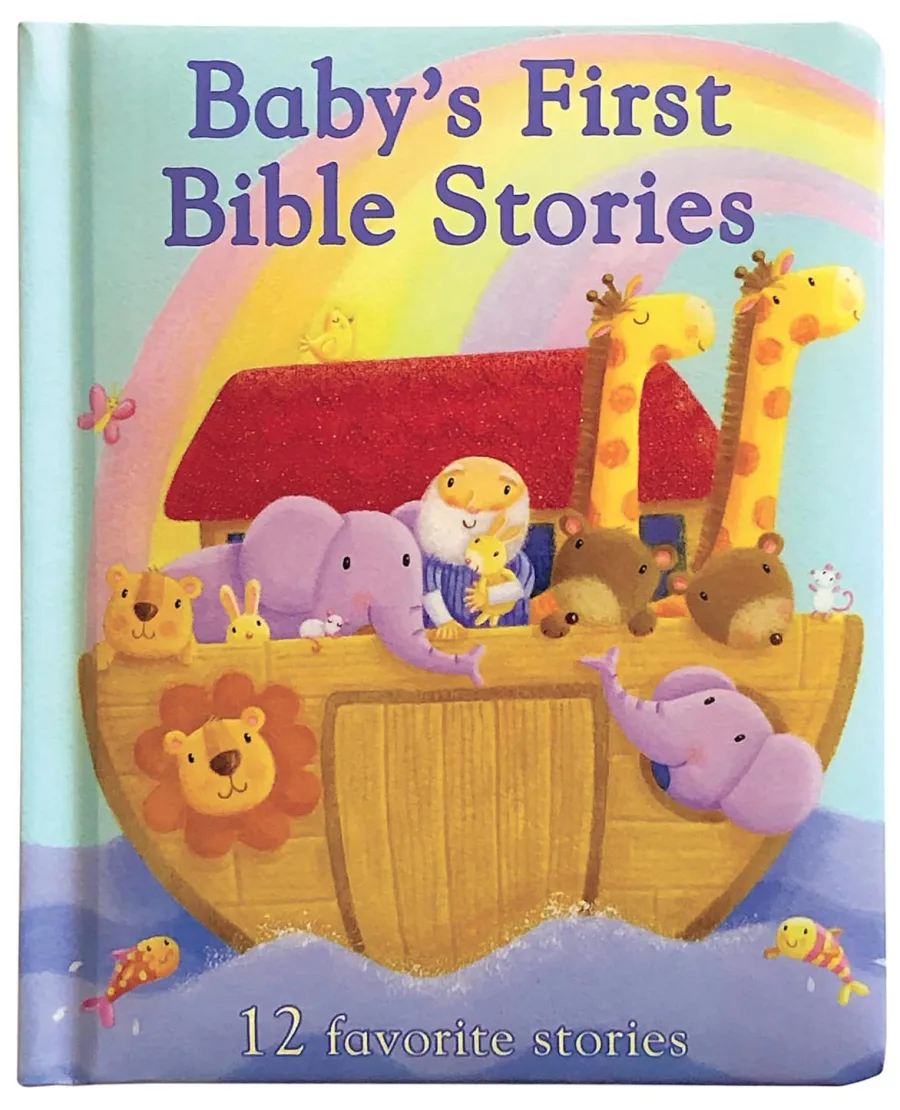
Baby's First Bible Stories Padded Board Book
Rachel Elliot, Caroline Williams (Illustrator)
Board Book
• 26 Pages
• USD 9.99
• English
• 9781680524239
No ratings yet
| Publisher | Cottage Door Press |
|---|---|
| ISBN13 | 9781680524239 |
| ASIN/SKU | 1680524232 |
| Book Format | Board Book |
| Language | English |
| Pages | 26 |
| List Price | USD 9.99 |
| Publishing Date | 24/09/2018 |
| Dimensions | 5.75 x 1.25 x 7.25 inches |
| Weight | 15.5 ounces |
| Book Code | BD00055725 |
Buy this Book
Amazon Stores
Ebook Stores
Other Stores
Discover Baby's First Bible Stories Padded Board Book by Rachel Elliot. This book is published by Cottage Door Press in Board Book format, ISBN 9781680524239, ASIN 1680524232, under Children's Books, Children's Christian Baptism Books, Children's First Communion Religion Books.
Book Description
Share Bible stories and the love of Christ with your little one in this collection of bright illustrations and sweet age-appropriate stories and prayers. Each story and prayer includes an interactive element to help children develop their own relationships with God. This sturdy padded board book is a wonderful introduction to faith for young boys and girls. Bible stories collection included: Creation, Noah’s Ark, Baby Moses, Daniel and the Lions, and more!
Includes 12 favorite stories from the Bible, retold in simple language which helps make it easy for toddlers to understand
Beautiful illustrations keep your child engaged, and sturdy, thick board pages are designed to withstand traditional wear and tear
Introduce Christian and religious beliefs to your little ones with prayers for any situation, and easy-to-read foundational Bible stories
This Bible for kids encourages curiosity and bonding between parents and children through prayer and religion
If looking for Christian gifts, this is great for baby showers, baptisms, birthdays, first communions, Easter basket stuffers, and Christmas
Includes 12 favorite stories from the Bible, retold in simple language which helps make it easy for toddlers to understand
Beautiful illustrations keep your child engaged, and sturdy, thick board pages are designed to withstand traditional wear and tear
Introduce Christian and religious beliefs to your little ones with prayers for any situation, and easy-to-read foundational Bible stories
This Bible for kids encourages curiosity and bonding between parents and children through prayer and religion
If looking for Christian gifts, this is great for baby showers, baptisms, birthdays, first communions, Easter basket stuffers, and Christmas
Author Biography
Author Biography will be added soon…
Editorial Reviews
Editorial Reviews will be added soon…
Book Summary
Baby's First Bible Stories by Rachel Elliot is a gentle Christian children's book created to introduce very young children to some of the best-known stories of the Bible. Published by Cottage Door Press in 2018, the book is a short, 26-page padded board book featuring twelve familiar Bible stories retold in simple, age-appropriate language. It is illustrated by Caroline Williams and combines brief storytelling with colorful artwork, prayers, and interactive elements intended to help parents and children experience the stories together. The book is designed particularly for babies, toddlers, and preschool-age children, making it less a traditional “Bible” in the complete sense and more a first introduction to Bible stories, Christian faith, prayer, and the idea of God's love.
The central purpose of Baby's First Bible Stories is not to provide detailed biblical explanations but to make foundational Christian stories approachable for a very young audience. Rachel Elliot takes stories that can be complicated, frightening, or difficult for toddlers to understand and reduces them to their most recognizable elements. The result is a collection that parents can easily read aloud during bedtime, quiet time, or family devotion. The stories are intentionally short, and the publisher describes them as simple retellings designed to help toddlers understand. Each story is also accompanied by a prayer, giving parents an opportunity to move naturally from storytelling into a simple conversation with God.
The book opens with Creation, introducing children to the biblical idea that God made the world. For an adult reader, the creation account contains enormous theological questions about existence, humanity, responsibility, and the nature of God. For a young child, however, the essential idea is much simpler: the world is God's creation, and the beautiful things children see around them are part of something God made. This provides a natural starting point for early Christian learning because children can connect the story with the world immediately around them—animals, plants, people, light, sky, and the natural environment. Rather than overwhelming children with theological vocabulary, the book uses the story to establish a basic sense of wonder and gratitude.
Another familiar story included in the collection is Noah's Ark. The biblical story of Noah involves judgment, obedience, a massive flood, survival, and God's covenant, but a toddler's version necessarily focuses on the most accessible elements. Noah, the animals, the ark, and the dramatic flood provide strong visual material for young children. The colorful illustrations are especially important here because animals and the ark give children something concrete to identify and discuss. Parents can use the story to talk about listening, trusting, caring for animals, and God's promises. The interactive approach also encourages children to participate rather than simply listen passively.
The story of Baby Moses introduces another important biblical theme: protection in the middle of danger. Moses' infancy occurs during a frightening period in which Hebrew children are threatened, but his mother places him in a basket and entrusts him to God's care. For very young children, the emotional heart of the story is the idea of a baby being protected and watched over. This makes the story particularly suitable for parents reading with infants because the subject itself—an endangered baby who is cared for—can be understood at an emotional level even when the historical details are simplified.
The collection also includes Daniel and the Lions, one of the Bible's most recognizable stories of courage and faith. Daniel is placed in a dangerous situation because of his faithfulness to God, yet he continues to trust God even when he is threatened. In a toddler-friendly retelling, the story becomes a memorable introduction to courage, trust, and prayer. The lions also provide an obvious visual and interactive element that can hold a young child's attention. Instead of attempting to explain every political and historical detail surrounding Daniel's experience, the book focuses on the reassuring idea that people can turn to God when they are afraid.
Other Old Testament stories help broaden the child's first exposure to biblical characters and themes. The collection is intentionally selective rather than comprehensive, giving families recognizable stories that can become familiar through repetition. This is important because Baby's First Bible Stories is designed for shared reading. The child is not expected to understand everything on the first reading. Parents can point to illustrations, ask simple questions, repeat character names, and return to favorite stories over time. The repetition helps turn Bible reading into a comforting family routine rather than an academic exercise.
One of the book's most distinctive features is the inclusion of prayers after the stories. According to the book's description, each story and prayer includes an interactive element intended to help children begin developing their own relationship with God. This approach changes the purpose of the book. It is not simply trying to teach children who Noah, Moses, or Daniel were. It encourages parents to model prayer and help children understand that Bible stories can connect to their own lives. A story about protection can lead to a prayer of thanks. A story about courage can lead to a simple request for bravery. A story about creation can lead to gratitude for the world around them.
The New Testament stories included in the book move the collection toward Jesus and the Christian message. Among the stories are accounts involving Jesus' ministry, including the feeding of the multitudes and the resurrection. This gives children their first introduction to Jesus as a central figure of Christian faith. The feeding story is especially accessible to young children because it involves food, sharing, a crowd, and a remarkable act of provision. It provides an opportunity to talk about generosity and caring for others while introducing the idea of Jesus' compassion.
The resurrection story provides the collection's concluding movement toward hope and new life. For a toddler, death is naturally a difficult and potentially confusing subject, so a simplified retelling necessarily avoids much of the complexity found in the biblical accounts. The book's overall approach is gentle and reassuring, seeking to introduce children to Christianity without exposing them to unnecessary detail or frightening imagery. This makes it appropriate as an early faith resource, although parents who want a more complete explanation of the crucifixion, resurrection, sin, salvation, and other central Christian doctrines will eventually need a more comprehensive children's Bible.
That limitation is important when evaluating Baby's First Bible Stories. The book is intentionally simplified, and some readers have noted that its retellings omit substantial biblical detail. One published reader review, for example, criticized the treatment of sin and the omission of the crucifixion, while another review described the stories as overly simplified and wished for more direct Scripture. These criticisms highlight a genuine distinction between a first Bible storybook and a children's Bible intended to teach the full biblical narrative. Rachel Elliot's book works best when understood as an introductory resource rather than a substitute for reading Scripture or a more doctrinally complete children's Bible.
The physical design is another major strength. The book is a padded board book with thick, sturdy pages, created specifically to withstand the handling that comes with books for babies and toddlers. It has 26 pages and is compact enough for little hands. The illustrations by Caroline Williams play an important role because very young children often respond to pictures before they can follow longer written narratives. Bright artwork gives parents natural opportunities to point, name objects, identify animals, and ask simple questions. This turns reading into an interactive experience rather than a one-way presentation.
The book also has an important parent-child bonding function. Bible reading for a baby is not primarily about independent comprehension. It is about voice, repetition, closeness, rhythm, pictures, and shared attention. A parent holding a child while reading a short story creates a ritual that can become associated with safety, affection, and faith. The prayers reinforce this pattern by allowing the parent and child to pause after each story and connect its message to everyday life. The book's publisher specifically presents it as a resource for developing children's relationships with God and encouraging bonding between parents and children.
For parents searching for the best first Bible book for a baby or toddler, Rachel Elliot's Baby's First Bible Stories is therefore best understood as an accessible starting point. It is particularly suitable for families looking for a sturdy Christian board book that can be incorporated into bedtime reading, family prayer, baptism gifts, baby showers, birthdays, Easter baskets, or early childhood faith routines. Retail listings specifically describe it as a gift option for occasions such as baby showers, baptisms, Christmas, and Easter.
Ultimately, Baby's First Bible Stories is about creating a child's first emotional and imaginative connection with the Bible. Its greatest strength is not theological depth but accessibility. The stories are short enough for young attention spans, the illustrations make biblical characters and events visually memorable, the board-book format is suitable for repeated handling, and the prayers encourage parents to connect stories with everyday faith. It introduces children to creation, Noah, Moses, Daniel, Jesus, the resurrection, and other foundational biblical themes while giving families a simple way to read and pray together.
In the end, Rachel Elliot's Baby's First Bible Stories works best as a child's first gentle step into Christian storytelling. It does not attempt to reproduce the entire Bible or explain every difficult theological concept. Instead, it creates a small collection of memorable stories through which parents can begin conversations about God, faith, courage, kindness, protection, gratitude, prayer, and love. For a baby or toddler, that simplicity can be valuable. The book's deeper purpose is to make Bible reading feel warm, familiar, and shared—to help a child associate stories about God with the loving presence of a parent. As children grow, they can move from these brief retellings toward fuller children's Bibles and eventually the biblical text itself. But as an early introduction to Bible stories for toddlers, a durable bedtime companion, and a Christian board book designed to encourage family bonding and prayer, Baby's First Bible Stories offers a gentle and accessible beginning.
The central purpose of Baby's First Bible Stories is not to provide detailed biblical explanations but to make foundational Christian stories approachable for a very young audience. Rachel Elliot takes stories that can be complicated, frightening, or difficult for toddlers to understand and reduces them to their most recognizable elements. The result is a collection that parents can easily read aloud during bedtime, quiet time, or family devotion. The stories are intentionally short, and the publisher describes them as simple retellings designed to help toddlers understand. Each story is also accompanied by a prayer, giving parents an opportunity to move naturally from storytelling into a simple conversation with God.
The book opens with Creation, introducing children to the biblical idea that God made the world. For an adult reader, the creation account contains enormous theological questions about existence, humanity, responsibility, and the nature of God. For a young child, however, the essential idea is much simpler: the world is God's creation, and the beautiful things children see around them are part of something God made. This provides a natural starting point for early Christian learning because children can connect the story with the world immediately around them—animals, plants, people, light, sky, and the natural environment. Rather than overwhelming children with theological vocabulary, the book uses the story to establish a basic sense of wonder and gratitude.
Another familiar story included in the collection is Noah's Ark. The biblical story of Noah involves judgment, obedience, a massive flood, survival, and God's covenant, but a toddler's version necessarily focuses on the most accessible elements. Noah, the animals, the ark, and the dramatic flood provide strong visual material for young children. The colorful illustrations are especially important here because animals and the ark give children something concrete to identify and discuss. Parents can use the story to talk about listening, trusting, caring for animals, and God's promises. The interactive approach also encourages children to participate rather than simply listen passively.
The story of Baby Moses introduces another important biblical theme: protection in the middle of danger. Moses' infancy occurs during a frightening period in which Hebrew children are threatened, but his mother places him in a basket and entrusts him to God's care. For very young children, the emotional heart of the story is the idea of a baby being protected and watched over. This makes the story particularly suitable for parents reading with infants because the subject itself—an endangered baby who is cared for—can be understood at an emotional level even when the historical details are simplified.
The collection also includes Daniel and the Lions, one of the Bible's most recognizable stories of courage and faith. Daniel is placed in a dangerous situation because of his faithfulness to God, yet he continues to trust God even when he is threatened. In a toddler-friendly retelling, the story becomes a memorable introduction to courage, trust, and prayer. The lions also provide an obvious visual and interactive element that can hold a young child's attention. Instead of attempting to explain every political and historical detail surrounding Daniel's experience, the book focuses on the reassuring idea that people can turn to God when they are afraid.
Other Old Testament stories help broaden the child's first exposure to biblical characters and themes. The collection is intentionally selective rather than comprehensive, giving families recognizable stories that can become familiar through repetition. This is important because Baby's First Bible Stories is designed for shared reading. The child is not expected to understand everything on the first reading. Parents can point to illustrations, ask simple questions, repeat character names, and return to favorite stories over time. The repetition helps turn Bible reading into a comforting family routine rather than an academic exercise.
One of the book's most distinctive features is the inclusion of prayers after the stories. According to the book's description, each story and prayer includes an interactive element intended to help children begin developing their own relationship with God. This approach changes the purpose of the book. It is not simply trying to teach children who Noah, Moses, or Daniel were. It encourages parents to model prayer and help children understand that Bible stories can connect to their own lives. A story about protection can lead to a prayer of thanks. A story about courage can lead to a simple request for bravery. A story about creation can lead to gratitude for the world around them.
The New Testament stories included in the book move the collection toward Jesus and the Christian message. Among the stories are accounts involving Jesus' ministry, including the feeding of the multitudes and the resurrection. This gives children their first introduction to Jesus as a central figure of Christian faith. The feeding story is especially accessible to young children because it involves food, sharing, a crowd, and a remarkable act of provision. It provides an opportunity to talk about generosity and caring for others while introducing the idea of Jesus' compassion.
The resurrection story provides the collection's concluding movement toward hope and new life. For a toddler, death is naturally a difficult and potentially confusing subject, so a simplified retelling necessarily avoids much of the complexity found in the biblical accounts. The book's overall approach is gentle and reassuring, seeking to introduce children to Christianity without exposing them to unnecessary detail or frightening imagery. This makes it appropriate as an early faith resource, although parents who want a more complete explanation of the crucifixion, resurrection, sin, salvation, and other central Christian doctrines will eventually need a more comprehensive children's Bible.
That limitation is important when evaluating Baby's First Bible Stories. The book is intentionally simplified, and some readers have noted that its retellings omit substantial biblical detail. One published reader review, for example, criticized the treatment of sin and the omission of the crucifixion, while another review described the stories as overly simplified and wished for more direct Scripture. These criticisms highlight a genuine distinction between a first Bible storybook and a children's Bible intended to teach the full biblical narrative. Rachel Elliot's book works best when understood as an introductory resource rather than a substitute for reading Scripture or a more doctrinally complete children's Bible.
The physical design is another major strength. The book is a padded board book with thick, sturdy pages, created specifically to withstand the handling that comes with books for babies and toddlers. It has 26 pages and is compact enough for little hands. The illustrations by Caroline Williams play an important role because very young children often respond to pictures before they can follow longer written narratives. Bright artwork gives parents natural opportunities to point, name objects, identify animals, and ask simple questions. This turns reading into an interactive experience rather than a one-way presentation.
The book also has an important parent-child bonding function. Bible reading for a baby is not primarily about independent comprehension. It is about voice, repetition, closeness, rhythm, pictures, and shared attention. A parent holding a child while reading a short story creates a ritual that can become associated with safety, affection, and faith. The prayers reinforce this pattern by allowing the parent and child to pause after each story and connect its message to everyday life. The book's publisher specifically presents it as a resource for developing children's relationships with God and encouraging bonding between parents and children.
For parents searching for the best first Bible book for a baby or toddler, Rachel Elliot's Baby's First Bible Stories is therefore best understood as an accessible starting point. It is particularly suitable for families looking for a sturdy Christian board book that can be incorporated into bedtime reading, family prayer, baptism gifts, baby showers, birthdays, Easter baskets, or early childhood faith routines. Retail listings specifically describe it as a gift option for occasions such as baby showers, baptisms, Christmas, and Easter.
Ultimately, Baby's First Bible Stories is about creating a child's first emotional and imaginative connection with the Bible. Its greatest strength is not theological depth but accessibility. The stories are short enough for young attention spans, the illustrations make biblical characters and events visually memorable, the board-book format is suitable for repeated handling, and the prayers encourage parents to connect stories with everyday faith. It introduces children to creation, Noah, Moses, Daniel, Jesus, the resurrection, and other foundational biblical themes while giving families a simple way to read and pray together.
In the end, Rachel Elliot's Baby's First Bible Stories works best as a child's first gentle step into Christian storytelling. It does not attempt to reproduce the entire Bible or explain every difficult theological concept. Instead, it creates a small collection of memorable stories through which parents can begin conversations about God, faith, courage, kindness, protection, gratitude, prayer, and love. For a baby or toddler, that simplicity can be valuable. The book's deeper purpose is to make Bible reading feel warm, familiar, and shared—to help a child associate stories about God with the loving presence of a parent. As children grow, they can move from these brief retellings toward fuller children's Bibles and eventually the biblical text itself. But as an early introduction to Bible stories for toddlers, a durable bedtime companion, and a Christian board book designed to encourage family bonding and prayer, Baby's First Bible Stories offers a gentle and accessible beginning.
Sample Chapters
Sample Chapters will be added soon…
Reader Reviews
No reviews yet.
Baby's First Bible Stories Padded Board Book
Download Cover Image
Do you want to download the full cover image for Baby's First Bible Stories Padded Board Book?