
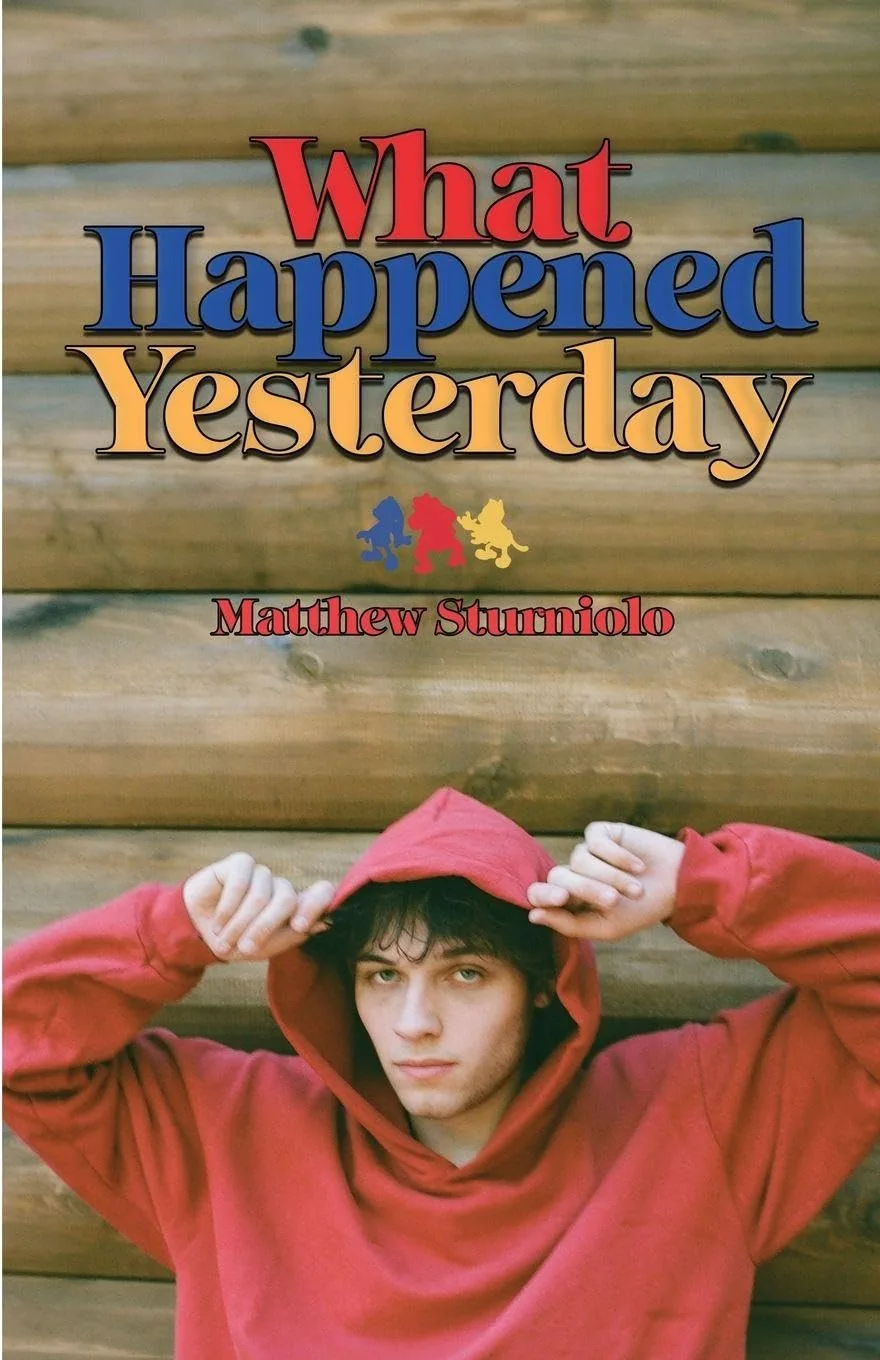
What Happened Yesterday
Paperback
• 242 Pages
• USD 21.99
• English
• 9781956464610
No ratings yet
| Publisher | Brightray Publishing |
|---|---|
| ISBN13 | 9781956464610 |
| ASIN/SKU | 1956464611 |
| Book Format | Paperback |
| Language | English |
| Pages | 242 |
| List Price | USD 21.99 |
| Publishing Date | 18/08/2026 |
| Dimensions | 5.5 x 0.51 x 8.5 inches |
| Weight | 10.1 ounces |
| Book Code | BD00055746 |
Buy this Book
Amazon Stores
Ebook Stores
Other Stores
Discover What Happened Yesterday by Matt Sturniolo. This book is published by Brightray Publishing in Paperback format, ISBN 9781956464610, ASIN 1956464611, under Health, Fitness and Dieting, Depression, Anxiety.
Book Description
Best known as one-third of the Sturniolo Triplets, YouTuber and social media personality Matt Sturniolo unpacks his complex past and makes his literary debut with What Happened Yesterday.
From simple yet meaningful milestones such as learning to drive, confusing moments in therapy, and navigating overnight virality, to the significant loss of his childhood home due to a house fire and the passing of his grandfather, Matt shares with dark humor, raw honesty, and his signature wit what no video could ever capture.
But this is not a sob story. It's a reminder that progress isn't always some huge life-changing moment. Sometimes, it's as small as standing in a grocery store line alone, or making it through an entire school day without running for the door.
As Matt's mom always told him: Yesterday's problems shouldn't affect today. Because what once felt like mistakes or painful experiences . . . is simply what happened yesterday.
From simple yet meaningful milestones such as learning to drive, confusing moments in therapy, and navigating overnight virality, to the significant loss of his childhood home due to a house fire and the passing of his grandfather, Matt shares with dark humor, raw honesty, and his signature wit what no video could ever capture.
But this is not a sob story. It's a reminder that progress isn't always some huge life-changing moment. Sometimes, it's as small as standing in a grocery store line alone, or making it through an entire school day without running for the door.
As Matt's mom always told him: Yesterday's problems shouldn't affect today. Because what once felt like mistakes or painful experiences . . . is simply what happened yesterday.
Author Biography
Author Biography will be added soon…
Editorial Reviews
Editorial Reviews will be added soon…
Book Summary
Matt Sturniolo’s What Happened Yesterday is a deeply personal memoir about anxiety, fear, grief, growth, family, fame, and the quiet process of learning to live with your own mind. Published in August 2026, the book is Sturniolo’s literary debut and offers something different from the polished image audiences usually see online. Best known as one-third of the Sturniolo Triplets, he uses the book to look behind the videos and social-media persona and talk honestly about experiences that cannot easily be captured on camera. The result is not presented as a traditional celebrity success story, but as an intimate account of the moments—both painful and ordinary—that shaped who he became.
At the center of the memoir is anxiety and the experience of feeling trapped inside your own thoughts. Sturniolo looks back at his younger self and the difficulties he experienced while growing up. The book explores panic, fear, social anxiety, overthinking, uncertainty, and the exhausting habit of mentally replaying situations. The available chapter material shows recurring concerns about an anxious mind, intrusive thoughts, panic attacks, avoidance, guilt, self-blame, and the desire for certainty. Rather than presenting these experiences as isolated incidents, Sturniolo shows how anxiety can influence ordinary parts of life, making school, conversations, public places, and everyday decisions feel much harder than they appear to other people.
One of the book’s most touching ideas is that progress is often invisible. People tend to imagine recovery as a dramatic transformation: one day the fear disappears, confidence arrives, and life becomes easy. Sturniolo offers a much more realistic picture. Progress can mean something as ordinary as standing alone in a grocery-store line, learning to drive, or completing a school day without feeling the need to escape. These moments may look insignificant to someone watching from the outside, but for a person struggling with anxiety, they can represent enormous victories. The book therefore asks readers to reconsider what improvement looks like. Sometimes getting better does not mean becoming fearless; it means being able to do something while the fear is still there.
Therapy becomes another important part of this journey. Sturniolo writes about therapy not as a magical solution but as a confusing, sometimes uncomfortable process of understanding himself. The memoir acknowledges that asking for help can be difficult, particularly when someone has spent years trying to manage distress privately. Through conversations about therapy, anxiety, and emotional struggles, the book encourages readers to see professional support as part of learning rather than as evidence of failure. Its broader message is that understanding what is happening inside you can be an important first step toward changing how you respond to it.
The memoir also explores the difference between yesterday, today, and tomorrow. Anxiety often pulls people backward into regret or forward into imagined disasters. A person may replay something embarrassing that happened years ago or spend hours predicting everything that could go wrong tomorrow. In that sense, the present becomes almost impossible to inhabit. Sturniolo's central philosophy is a gentle challenge to this cycle: yesterday has already happened, and tomorrow has not happened yet. What remains available is today. The book's title captures this idea, but it also has a more personal meaning for Sturniolo. In an interview, he explained that “What Happened Yesterday” can also be understood through the acronym WHY—the experiences described in the memoir form part of his explanation for who he is and why he became the person he is today.
The memoir does not avoid grief and loss. Among the significant experiences Sturniolo discusses are the loss of his childhood home in a house fire and the death of his grandfather. These experiences give the book emotional weight, but Sturniolo deliberately avoids turning the memoir into a simple tragedy narrative. The losses matter because they changed him, yet the book is ultimately interested in what people do with painful experiences after the immediate crisis has passed. Memories remain, but they do not have to dictate every future day.
Family, especially the relationship between Sturniolo and his brothers, provides another important foundation. Being one of the Sturniolo Triplets means that his identity has always been connected to two other people. The memoir explores the complicated experience of growing up as part of a trio while also trying to understand oneself as an individual. His family's presence gives the story warmth and context, while his mother's recurring advice becomes one of the book's guiding ideas: yesterday's problems should not control today. That message turns the title into something hopeful rather than merely nostalgic.
The book also addresses the extraordinary change that came with overnight virality and social-media fame. Sturniolo went from being an ordinary young person dealing with private struggles to becoming part of a highly visible online world. Fame may look exciting from the outside, but the memoir recognizes its psychological pressure. Millions of people can watch your videos while knowing almost nothing about what is happening inside your head. The contrast between a public identity and a private emotional life becomes an important part of the story.
What makes the memoir especially approachable is Sturniolo's use of humor alongside vulnerability. He does not present himself as someone who has solved every problem. Dark humor, wit, and ordinary observations prevent the difficult sections from becoming relentlessly heavy. This gives the book a conversational quality, as though the reader is hearing someone explain difficult experiences honestly without pretending to have perfect answers.
Ultimately, What Happened Yesterday is a book about learning from the past without continuing to live inside it. Its message is not that painful experiences can simply be forgotten. Instead, Sturniolo suggests that we can acknowledge what happened, understand how it shaped us, carry forward the lessons, and still allow ourselves to experience the present. His own description of the book emphasizes this idea: people, memories, losses, and difficult experiences become part of our stories, but we can continue moving forward even when the future is uncertain.
The book's greatest strength is its understanding of small victories. A person does not need to conquer the world to prove that they are healing. Sometimes healing is driving for the first time, entering a crowded place, asking for help, surviving a difficult day, or simply waking up and deciding that yesterday does not get to determine today. In that sense, What Happened Yesterday is both a memoir of Sturniolo's journey and a compassionate reminder to readers that their own progress may be happening in ways they have not yet learned to recognize.
At the center of the memoir is anxiety and the experience of feeling trapped inside your own thoughts. Sturniolo looks back at his younger self and the difficulties he experienced while growing up. The book explores panic, fear, social anxiety, overthinking, uncertainty, and the exhausting habit of mentally replaying situations. The available chapter material shows recurring concerns about an anxious mind, intrusive thoughts, panic attacks, avoidance, guilt, self-blame, and the desire for certainty. Rather than presenting these experiences as isolated incidents, Sturniolo shows how anxiety can influence ordinary parts of life, making school, conversations, public places, and everyday decisions feel much harder than they appear to other people.
One of the book’s most touching ideas is that progress is often invisible. People tend to imagine recovery as a dramatic transformation: one day the fear disappears, confidence arrives, and life becomes easy. Sturniolo offers a much more realistic picture. Progress can mean something as ordinary as standing alone in a grocery-store line, learning to drive, or completing a school day without feeling the need to escape. These moments may look insignificant to someone watching from the outside, but for a person struggling with anxiety, they can represent enormous victories. The book therefore asks readers to reconsider what improvement looks like. Sometimes getting better does not mean becoming fearless; it means being able to do something while the fear is still there.
Therapy becomes another important part of this journey. Sturniolo writes about therapy not as a magical solution but as a confusing, sometimes uncomfortable process of understanding himself. The memoir acknowledges that asking for help can be difficult, particularly when someone has spent years trying to manage distress privately. Through conversations about therapy, anxiety, and emotional struggles, the book encourages readers to see professional support as part of learning rather than as evidence of failure. Its broader message is that understanding what is happening inside you can be an important first step toward changing how you respond to it.
The memoir also explores the difference between yesterday, today, and tomorrow. Anxiety often pulls people backward into regret or forward into imagined disasters. A person may replay something embarrassing that happened years ago or spend hours predicting everything that could go wrong tomorrow. In that sense, the present becomes almost impossible to inhabit. Sturniolo's central philosophy is a gentle challenge to this cycle: yesterday has already happened, and tomorrow has not happened yet. What remains available is today. The book's title captures this idea, but it also has a more personal meaning for Sturniolo. In an interview, he explained that “What Happened Yesterday” can also be understood through the acronym WHY—the experiences described in the memoir form part of his explanation for who he is and why he became the person he is today.
The memoir does not avoid grief and loss. Among the significant experiences Sturniolo discusses are the loss of his childhood home in a house fire and the death of his grandfather. These experiences give the book emotional weight, but Sturniolo deliberately avoids turning the memoir into a simple tragedy narrative. The losses matter because they changed him, yet the book is ultimately interested in what people do with painful experiences after the immediate crisis has passed. Memories remain, but they do not have to dictate every future day.
Family, especially the relationship between Sturniolo and his brothers, provides another important foundation. Being one of the Sturniolo Triplets means that his identity has always been connected to two other people. The memoir explores the complicated experience of growing up as part of a trio while also trying to understand oneself as an individual. His family's presence gives the story warmth and context, while his mother's recurring advice becomes one of the book's guiding ideas: yesterday's problems should not control today. That message turns the title into something hopeful rather than merely nostalgic.
The book also addresses the extraordinary change that came with overnight virality and social-media fame. Sturniolo went from being an ordinary young person dealing with private struggles to becoming part of a highly visible online world. Fame may look exciting from the outside, but the memoir recognizes its psychological pressure. Millions of people can watch your videos while knowing almost nothing about what is happening inside your head. The contrast between a public identity and a private emotional life becomes an important part of the story.
What makes the memoir especially approachable is Sturniolo's use of humor alongside vulnerability. He does not present himself as someone who has solved every problem. Dark humor, wit, and ordinary observations prevent the difficult sections from becoming relentlessly heavy. This gives the book a conversational quality, as though the reader is hearing someone explain difficult experiences honestly without pretending to have perfect answers.
Ultimately, What Happened Yesterday is a book about learning from the past without continuing to live inside it. Its message is not that painful experiences can simply be forgotten. Instead, Sturniolo suggests that we can acknowledge what happened, understand how it shaped us, carry forward the lessons, and still allow ourselves to experience the present. His own description of the book emphasizes this idea: people, memories, losses, and difficult experiences become part of our stories, but we can continue moving forward even when the future is uncertain.
The book's greatest strength is its understanding of small victories. A person does not need to conquer the world to prove that they are healing. Sometimes healing is driving for the first time, entering a crowded place, asking for help, surviving a difficult day, or simply waking up and deciding that yesterday does not get to determine today. In that sense, What Happened Yesterday is both a memoir of Sturniolo's journey and a compassionate reminder to readers that their own progress may be happening in ways they have not yet learned to recognize.
Sample Chapters
Sample Chapters will be added soon…
Reader Reviews
No reviews yet.
What Happened Yesterday
Download Cover Image
Do you want to download the full cover image for What Happened Yesterday?