
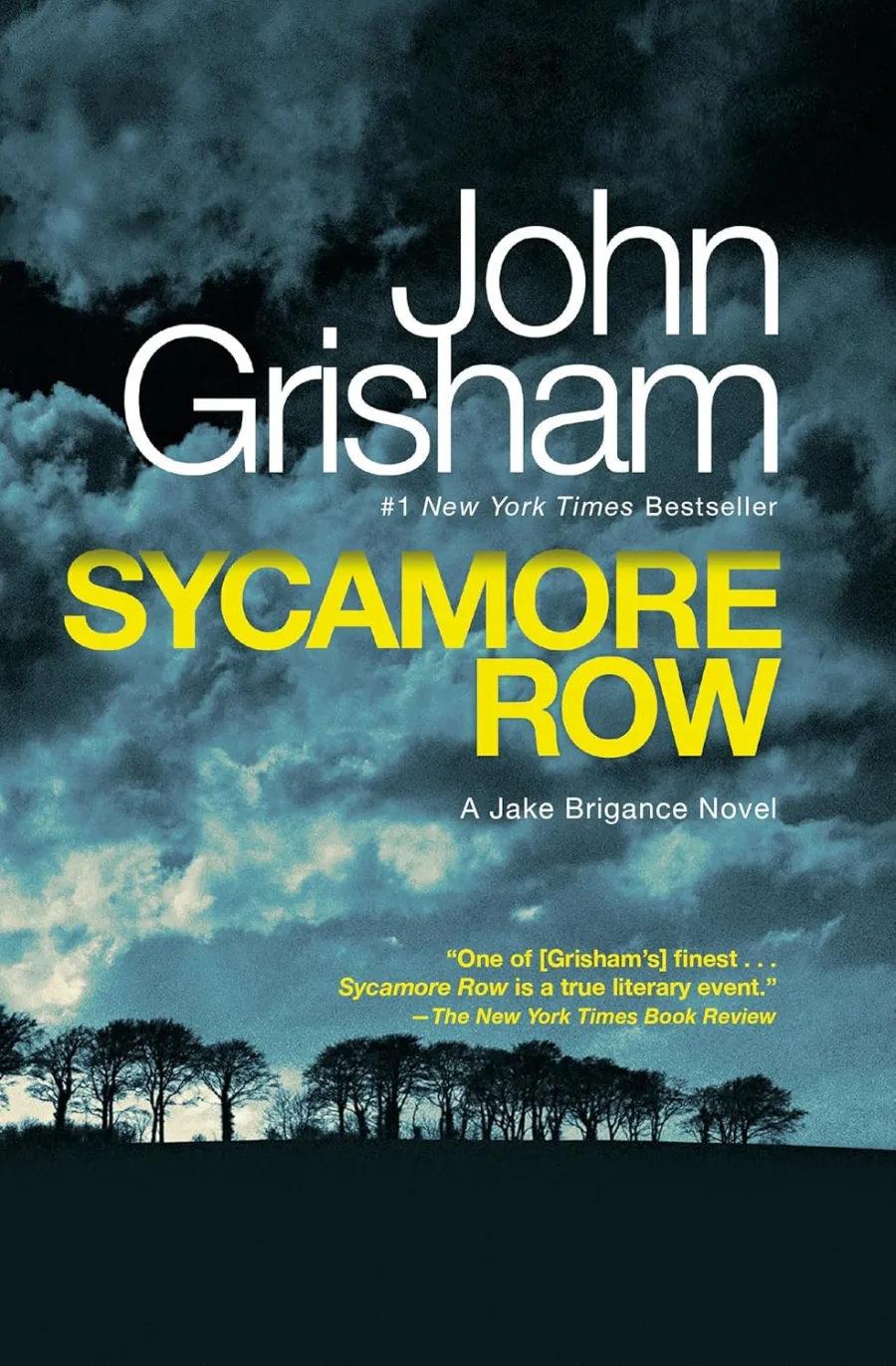
Sycamore Row: A Jake Brigance Novel
Paperback
• 464 Pages
• USD 18.00
• English
• 9780553393613
No ratings yet
| Publisher | Vintage |
|---|---|
| ISBN13 | 9780553393613 |
| ASIN/SKU | 0553393618 |
| Book Format | Paperback |
| Language | English |
| Pages | 464 |
| List Price | USD 18.00 |
| Publishing Date | 19/08/2014 |
| Dimensions | 5.2 x 1 x 8 inches |
| Weight | 11.9 ounces |
| Book Code | BD00055756 |
Buy this Book
Amazon Stores
Ebook Stores
Other Stores
Discover Sycamore Row: A Jake Brigance Novel by John Grisham. This book is published by Vintage in Paperback format, ISBN 9780553393613, ASIN 0553393618, under Mystery, Thriller and Suspense, Legal Thrillers, Political Thrillers.
Book Description
#1 NEW YORK TIMES BESTSELLER • John Grisham returns to the iconic setting of his first novel, A Time to Kill, as Jake Brigance finds himself embroiled in a controversial trial that exposes a tortured history of racial tension.
“Welcome back, Jake. . . . [Brigance] is one of the most fully developed and engaging characters in all of Grisham’s novels.”—USA Today
Seth Hubbard is a wealthy white man dying of lung cancer. He trusts no one. Before he hangs himself from a sycamore tree, Hubbard leaves a new, handwritten will. It is an act that drags his adult children, his black maid, and defense attorney Jake Brigance into a conflict as riveting and dramatic as the murder trial that made Brigance one of Ford County’s most notorious citizens, just three years earlier.
The second will raises many more questions than it answers. Why would Hubbard leave nearly all of his fortune to his maid? Had chemotherapy and painkillers affected his ability to think clearly? And what does it all have to do with a piece of land once known as Sycamore Row?
Look for all of John Grisham’s gripping Jake Brigance novels:
A Time to Kill
Sycamore Row
A Time for Mercy
“Welcome back, Jake. . . . [Brigance] is one of the most fully developed and engaging characters in all of Grisham’s novels.”—USA Today
Seth Hubbard is a wealthy white man dying of lung cancer. He trusts no one. Before he hangs himself from a sycamore tree, Hubbard leaves a new, handwritten will. It is an act that drags his adult children, his black maid, and defense attorney Jake Brigance into a conflict as riveting and dramatic as the murder trial that made Brigance one of Ford County’s most notorious citizens, just three years earlier.
The second will raises many more questions than it answers. Why would Hubbard leave nearly all of his fortune to his maid? Had chemotherapy and painkillers affected his ability to think clearly? And what does it all have to do with a piece of land once known as Sycamore Row?
Look for all of John Grisham’s gripping Jake Brigance novels:
A Time to Kill
Sycamore Row
A Time for Mercy
Author Biography
John Grisham is the author of numerous #1 bestsellers, including The Firm, A Time to Kill, The Rainmaker, The Innocent Man, The Whistler, The Boys from Biloxi, and many more. His books have been translated into nearly fifty languages. Grisham is a two-time winner of the Harper Lee Prize for Legal Fiction and was honored with the Library of Congress Creative Achievement Award for Fiction. Grisham serves on the board of directors of the Innocence Project and Centurion Ministries, two national organizations dedicated to exonerating those who have been wrongfully convicted. Much of his fiction explores deep-seated problems in our criminal justice system. He lives on a farm in central Virginia.
Editorial Reviews
“Powerful . . . immensely readable . . . the best of his books.”—The Washington Post
“One of [Grisham’s] finest . . . Sycamore Row is a true literary event.”—The New York Times Book Review
Praise for the novels of John Grisham
“John Grisham is about as good a storyteller as we’ve got in the United States these days.”—The New York Times Book Review
“In all of Grisham’s best books . . . the reader gets good company, a vigorous runaround and . . . a bit of a legal education.”—Janet Maslin, The New York Times
“Grisham’s books are smart, imaginative, and funny, populated by complex, interesting people.”—The Washington Post
“The law, by its nature, creates drama, and a new Grisham promises us an inside look at the dirty machineries of process and power, with plenty of entertainment.”—Los Angeles Times
“John Grisham owns the legal thriller.” —The Denver Post
“One of [Grisham’s] finest . . . Sycamore Row is a true literary event.”—The New York Times Book Review
Praise for the novels of John Grisham
“John Grisham is about as good a storyteller as we’ve got in the United States these days.”—The New York Times Book Review
“In all of Grisham’s best books . . . the reader gets good company, a vigorous runaround and . . . a bit of a legal education.”—Janet Maslin, The New York Times
“Grisham’s books are smart, imaginative, and funny, populated by complex, interesting people.”—The Washington Post
“The law, by its nature, creates drama, and a new Grisham promises us an inside look at the dirty machineries of process and power, with plenty of entertainment.”—Los Angeles Times
“John Grisham owns the legal thriller.” —The Denver Post
Book Summary
Sycamore Row by John Grisham is a legal thriller that returns to the small town of Clanton, Mississippi, and to lawyer Jake Brigance, several years after the explosive events of A Time to Kill. Jake is still living with the long shadow of that famous trial: he has some local fame, but not much money, his house was burned, and his career hasn’t taken off the way he hoped. Into this quiet, strained life comes a new case that once again forces the town to confront race, justice, and buried secrets. One Sunday, a white man named Seth Hubbard, a wealthy recluse dying of lung cancer, hangs himself from a sycamore tree. Shortly before his death, Seth mails a handwritten will to Jake Brigance, along with a letter insisting that Jake defend this will against any challenges. The will is shocking: Seth leaves almost all of his multi-million-dollar fortune not to his children or family, but to his Black housekeeper, Lettie Lang. He cancels an earlier, more traditional will, and offers no clear explanation for such a drastic change. This strange document, combined with the way Seth chose to die, immediately stirs anger, suspicion, and curiosity throughout Clanton.
Jake, surprised and wary, takes on the case. He barely knows Seth Hubbard and has never heard of Lettie Lang, but the letter from Seth makes it clear that he chose Jake for a reason, referencing Jake’s past courage in the Carl Lee Hailey trial. Jake realizes that the new will, called a holographic will because it is handwritten, will certainly be contested by Seth’s adult children, who expected to inherit his lumber empire and wealth. The children—Herschel and Ramona—are furious that their father cut them out and gave everything to a Black employee. They quickly hire powerful lawyers, intending to challenge the will as the product of confusion, manipulation, or mental instability. What follows is a tense legal battle centered on whether Seth was of sound mind when he wrote the will, whether Lettie unduly influenced him, and why he made such an unusual decision just days before his suicide.
As Jake prepares for trial, he starts investigating Seth’s life and Lettie’s background. Lettie is a hardworking woman with a troubled family. She has spent years cleaning Seth’s house, caring for him as his illness worsened, and doing her best to keep her own family afloat. Her husband is a drinker who has caused problems, and her children have made mistakes, but Lettie herself is steady, quiet, and deeply shocked by the will. She never asked for an inheritance and is initially uncomfortable with the attention and hostility it brings. Many white citizens of Clanton resent the idea that a Black housekeeper might suddenly become one of the richest people around, especially at their expense. Gossip and racial tension rise quickly. Some think Seth must have lost his mind; others suspect Lettie or imagine darker motives. Jake must not only defend the legal validity of the will but also protect Lettie from public scorn and the efforts to paint her as a manipulator or gold-digger.
The case draws in other familiar characters. Judge Reuben Atlee presides, mindful of how explosive race-related cases can become in this town. Jake’s friend and rival, attorney Lucien Wilbanks, though disbarred, still offers advice, especially on how to handle jury selection and small-town prejudice. The opposing lawyers are skilled and aggressive, using every possible angle to undermine Lettie’s claim, from questioning Seth’s mental state to poking at Lettie’s family problems. The courtroom scenes show careful strategy, sharp questioning, and the power of storytelling in front of a jury. Jake knows that logic and law alone won’t win; he must make the jurors feel that honoring Seth’s final wishes is the right and fair thing to do, even if it upends expectations about inheritance and race.
As the legal fight intensifies, another mystery runs beneath the surface: why did Seth Hubbard choose Lettie, and why did he choose Jake? Jake senses that the answer lies in the distant past, possibly connected to land, race, and old injustices in Ford County, where Clanton is located. Much of the story’s emotional weight comes from slowly uncovering this hidden history. Through research, old records, and the accounts of elderly witnesses, Jake and his team begin to piece together events dating back to the 1930s and 1940s, when racial violence and economic exploitation were common and often unpunished. A key part of this history involves the land owned by Seth—land that once belonged to a Black family and may have been taken through deception or coercion. As details emerge, it becomes clear that Seth’s decision to leave his fortune to Lettie is not random. It is tied to guilt, unresolved injustice, and a desire to make things right in the only way he can at the end of his life.
The trial forces the town to hear this painful history in open court. Old wounds are exposed: stories of lynching, intimidation, and the systematic stripping of Black families’ property. Jake presents evidence that connects Lettie’s family to past victims and shows that Seth may have profited from these wrongs, whether directly or through inheritance from his brother. In doing so, Jake reframes the case. It is not merely about a rich man’s strange will and angry children; it is about whether a long-standing injustice will finally be acknowledged and, in some way, repaired. The jurors are confronted not only with legal questions about testamentary capacity and undue influence, but also with moral questions about race, responsibility, and the meaning of justice across generations.
Lettie herself remains a powerful presence throughout the story. She is not portrayed as perfect; she has family issues and moments of doubt. But she carries herself with dignity despite public pressure, legal attacks, and the weight of knowing that her future—and her children’s future—hangs on the verdict. Her relationship with Jake grows from wary trust to deeper respect as she sees that he is truly committed to defending her, even when it is unpopular and potentially dangerous for his career. Jake, in turn, is reminded why he became a lawyer: not for money or prestige, but to fight for fairness in a system that often bends toward the powerful.
Ultimately, the jury must decide whether Seth’s final will stands. The outcome, delivered after emotional testimony and sharp argument, reflects both the evidence and the town’s struggle with its own conscience. When the reasons for Seth’s actions are fully revealed, they cast his suicide and his bequest in a different light. He was a flawed man, but his final act was an attempt to balance scales that had been unequal for decades. The resolution brings a measure of justice, though not without pain and controversy. Some characters gain wealth or vindication; others must accept loss and confront uncomfortable truths about their family and their town.
By the end of Sycamore Row, Jake Brigance has once again put himself at the center of a racially charged, morally complex case. He emerges still somewhat battered—financially and emotionally—but also strengthened in his sense of purpose. The town of Clanton is forced to look more honestly at its past, even if change comes slowly. The book, while full of legal twists and courtroom drama, is ultimately about memory, race, and the long reach of injustice. It shows how a single handwritten will, nailed to the branch of a sycamore tree by a dying man, can reopen old wounds, challenge deeply held prejudices, and offer a chance, however imperfect, for restitution and moral reckoning.
Jake, surprised and wary, takes on the case. He barely knows Seth Hubbard and has never heard of Lettie Lang, but the letter from Seth makes it clear that he chose Jake for a reason, referencing Jake’s past courage in the Carl Lee Hailey trial. Jake realizes that the new will, called a holographic will because it is handwritten, will certainly be contested by Seth’s adult children, who expected to inherit his lumber empire and wealth. The children—Herschel and Ramona—are furious that their father cut them out and gave everything to a Black employee. They quickly hire powerful lawyers, intending to challenge the will as the product of confusion, manipulation, or mental instability. What follows is a tense legal battle centered on whether Seth was of sound mind when he wrote the will, whether Lettie unduly influenced him, and why he made such an unusual decision just days before his suicide.
As Jake prepares for trial, he starts investigating Seth’s life and Lettie’s background. Lettie is a hardworking woman with a troubled family. She has spent years cleaning Seth’s house, caring for him as his illness worsened, and doing her best to keep her own family afloat. Her husband is a drinker who has caused problems, and her children have made mistakes, but Lettie herself is steady, quiet, and deeply shocked by the will. She never asked for an inheritance and is initially uncomfortable with the attention and hostility it brings. Many white citizens of Clanton resent the idea that a Black housekeeper might suddenly become one of the richest people around, especially at their expense. Gossip and racial tension rise quickly. Some think Seth must have lost his mind; others suspect Lettie or imagine darker motives. Jake must not only defend the legal validity of the will but also protect Lettie from public scorn and the efforts to paint her as a manipulator or gold-digger.
The case draws in other familiar characters. Judge Reuben Atlee presides, mindful of how explosive race-related cases can become in this town. Jake’s friend and rival, attorney Lucien Wilbanks, though disbarred, still offers advice, especially on how to handle jury selection and small-town prejudice. The opposing lawyers are skilled and aggressive, using every possible angle to undermine Lettie’s claim, from questioning Seth’s mental state to poking at Lettie’s family problems. The courtroom scenes show careful strategy, sharp questioning, and the power of storytelling in front of a jury. Jake knows that logic and law alone won’t win; he must make the jurors feel that honoring Seth’s final wishes is the right and fair thing to do, even if it upends expectations about inheritance and race.
As the legal fight intensifies, another mystery runs beneath the surface: why did Seth Hubbard choose Lettie, and why did he choose Jake? Jake senses that the answer lies in the distant past, possibly connected to land, race, and old injustices in Ford County, where Clanton is located. Much of the story’s emotional weight comes from slowly uncovering this hidden history. Through research, old records, and the accounts of elderly witnesses, Jake and his team begin to piece together events dating back to the 1930s and 1940s, when racial violence and economic exploitation were common and often unpunished. A key part of this history involves the land owned by Seth—land that once belonged to a Black family and may have been taken through deception or coercion. As details emerge, it becomes clear that Seth’s decision to leave his fortune to Lettie is not random. It is tied to guilt, unresolved injustice, and a desire to make things right in the only way he can at the end of his life.
The trial forces the town to hear this painful history in open court. Old wounds are exposed: stories of lynching, intimidation, and the systematic stripping of Black families’ property. Jake presents evidence that connects Lettie’s family to past victims and shows that Seth may have profited from these wrongs, whether directly or through inheritance from his brother. In doing so, Jake reframes the case. It is not merely about a rich man’s strange will and angry children; it is about whether a long-standing injustice will finally be acknowledged and, in some way, repaired. The jurors are confronted not only with legal questions about testamentary capacity and undue influence, but also with moral questions about race, responsibility, and the meaning of justice across generations.
Lettie herself remains a powerful presence throughout the story. She is not portrayed as perfect; she has family issues and moments of doubt. But she carries herself with dignity despite public pressure, legal attacks, and the weight of knowing that her future—and her children’s future—hangs on the verdict. Her relationship with Jake grows from wary trust to deeper respect as she sees that he is truly committed to defending her, even when it is unpopular and potentially dangerous for his career. Jake, in turn, is reminded why he became a lawyer: not for money or prestige, but to fight for fairness in a system that often bends toward the powerful.
Ultimately, the jury must decide whether Seth’s final will stands. The outcome, delivered after emotional testimony and sharp argument, reflects both the evidence and the town’s struggle with its own conscience. When the reasons for Seth’s actions are fully revealed, they cast his suicide and his bequest in a different light. He was a flawed man, but his final act was an attempt to balance scales that had been unequal for decades. The resolution brings a measure of justice, though not without pain and controversy. Some characters gain wealth or vindication; others must accept loss and confront uncomfortable truths about their family and their town.
By the end of Sycamore Row, Jake Brigance has once again put himself at the center of a racially charged, morally complex case. He emerges still somewhat battered—financially and emotionally—but also strengthened in his sense of purpose. The town of Clanton is forced to look more honestly at its past, even if change comes slowly. The book, while full of legal twists and courtroom drama, is ultimately about memory, race, and the long reach of injustice. It shows how a single handwritten will, nailed to the branch of a sycamore tree by a dying man, can reopen old wounds, challenge deeply held prejudices, and offer a chance, however imperfect, for restitution and moral reckoning.
Sample Chapters
Sample Chapters will be added soon…
Reader Reviews
No reviews yet.
Sycamore Row: A Jake Brigance Novel
Download Cover Image
Do you want to download the full cover image for Sycamore Row: A Jake Brigance Novel?