
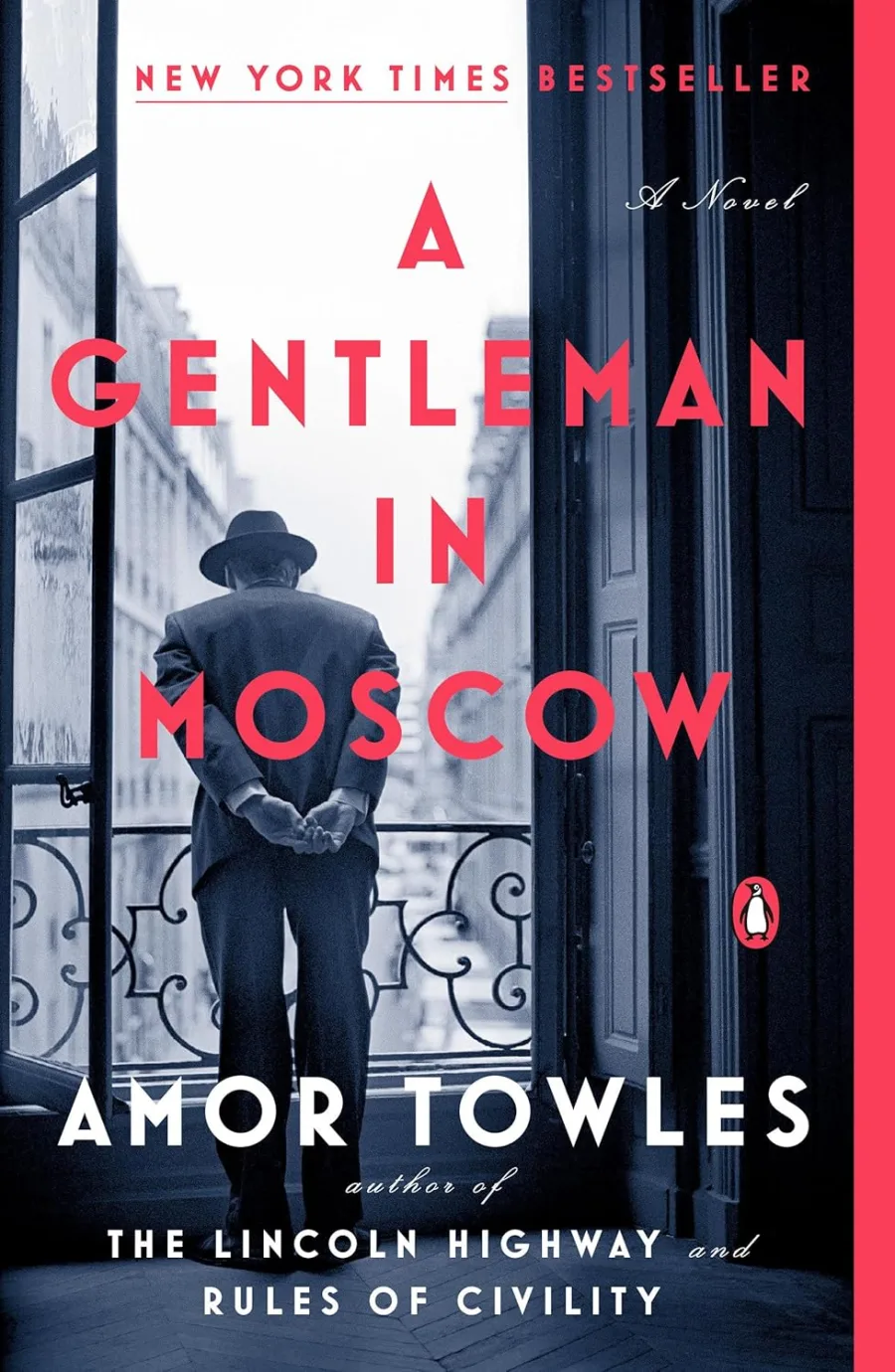
A Gentleman in Moscow: A Novel
Paperback
• 496 Pages
• USD 19.00
• English
• 9780143110439
No ratings yet
| Publisher | Penguin Books |
|---|---|
| ISBN13 | 9780143110439 |
| ASIN/SKU | 0143110438 |
| Book Format | Paperback |
| Language | English |
| Pages | 496 |
| List Price | USD 19.00 |
| Publishing Date | 26/03/2019 |
| Dimensions | 1.3 x 5.4 x 8.2 inches |
| Weight | 2.31 pounds |
| Book Code | BD00055759 |
Buy this Book
Amazon Stores
Ebook Stores
Other Stores
Discover A Gentleman in Moscow: A Novel by Amor Towles. This book is published by Penguin Books in Paperback format, ISBN 9780143110439, ASIN 0143110438, under Mystery, Thriller and Suspense, Historical Thrillers, Political Thrillers.
Book Description
The mega-bestseller with more than 2 million readers • A New York Times “Readers’ Choice: Best Books of the 21st Century” Pick
From the #1 New York Times-bestselling author of The Lincoln Highway and Table for Two, a beautifully transporting novel about a man who is ordered to spend the rest of his life inside a luxury hotel
In 1922, Count Alexander Rostov is deemed an unrepentant aristocrat by a Bolshevik tribunal, and is sentenced to house arrest in the Metropol, a grand hotel across the street from the Kremlin. Rostov, an indomitable man of erudition and wit, has never worked a day in his life, and must now live in an attic room while some of the most tumultuous decades in Russian history are unfolding outside the hotel’s doors. Unexpectedly, his reduced circumstances provide him entry into a much larger world of emotional discovery.
Brimming with humor, a glittering cast of characters, and one beautifully rendered scene after another, this singular novel casts a spell as it relates the count’s endeavor to gain a deeper understanding of what it means to be a man of purpose.
From the #1 New York Times-bestselling author of The Lincoln Highway and Table for Two, a beautifully transporting novel about a man who is ordered to spend the rest of his life inside a luxury hotel
In 1922, Count Alexander Rostov is deemed an unrepentant aristocrat by a Bolshevik tribunal, and is sentenced to house arrest in the Metropol, a grand hotel across the street from the Kremlin. Rostov, an indomitable man of erudition and wit, has never worked a day in his life, and must now live in an attic room while some of the most tumultuous decades in Russian history are unfolding outside the hotel’s doors. Unexpectedly, his reduced circumstances provide him entry into a much larger world of emotional discovery.
Brimming with humor, a glittering cast of characters, and one beautifully rendered scene after another, this singular novel casts a spell as it relates the count’s endeavor to gain a deeper understanding of what it means to be a man of purpose.
Author Biography
Amor Towles is the author of the New York Times bestsellers Rules of Civility, A Gentleman in Moscow, and The Lincoln Highway. The three novels have collectively sold millions of copies and have been translated into more than thirty-five languages. Towles lives in Manhattan with his wife and two children.
Editorial Reviews
A Kirkus Reviews Best Fiction Book of the Century
"The novel buzzes with the energy of numerous adventures, love affairs, [and] twists of fate."
—The Wall Street Journal
"If you're looking for a summer novel, this is it. Beautifully written, a story of a Russian aristocrat trapped in Moscow during the tumult of the 1930s. It brims with intelligence, erudition, and insight, an old-fashioned novel in the best sense of the term."
—Fareed Zakaria, "Global Public Square," CNN
“The book is like a salve. I think the world feels disordered right now. The count’s refinement and genteel nature are exactly what we’re longing for.”
—Ann Patchett
“How delightful that in an era as crude as ours this finely composed novel stretches out with old-World elegance.”
—The Washington Post
“[A] wonderful book at any time . . . [I]t brought home to me how people find ways to be happy, make connections, and make a difference to one another’s lives, even in the strangest, saddest and most restrictive circumstances.”
—Tana French, author of The Searcher
“Marvelous.”
—Chicago Tribune
“The novel buzzes with the energy of numerous adventures, love affairs, twists of fate and silly antics.”
—The Wall Street Journal
“A winning, stylish novel.”
—NPR.org
“Enjoyable, elegant.”
—Seattle Times
“The perfect book to curl up with while the world goes by outside your window.”
—Refinery29
“Who will save Rostov from the intrusions of state if not the seamstresses, chefs, bartenders and doormen? In the end, Towles’s greatest narrative effect is not the moments of wonder and synchronicity but the generous transformation of these peripheral workers, over the course of decades, into confidants, equals and, finally, friends. With them around, a life sentence in these gilded halls might make Rostov the luckiest man in Russia.”
—The New York Times Book Review
“This is an old fashioned sort of romance, filled with delicious detail. Save this precious book for times you really, really want to escape reality.”
—Louise Erdrich
“Towles gets good mileage from the considerable charm of his protagonist and the peculiar world he inhabits.”
—The New Yorker
“Irresistible . . . In his second elegant period piece, Towles continues to explore the question of how a person can lead an authentic life in a time when mere survival is a feat in itself . . . Towles’s tale, as lavishly filigreed as a Fabergé egg, gleams with nostalgia for the golden age of Tolstoy and Turgenev.”
—O, The Oprah Magazine
“‘The Grand Budapest Hotel’ and ‘Eloise’ meets all the Bond villains.”
—TheSkimm
"The novel buzzes with the energy of numerous adventures, love affairs, [and] twists of fate."
—The Wall Street Journal
"If you're looking for a summer novel, this is it. Beautifully written, a story of a Russian aristocrat trapped in Moscow during the tumult of the 1930s. It brims with intelligence, erudition, and insight, an old-fashioned novel in the best sense of the term."
—Fareed Zakaria, "Global Public Square," CNN
“The book is like a salve. I think the world feels disordered right now. The count’s refinement and genteel nature are exactly what we’re longing for.”
—Ann Patchett
“How delightful that in an era as crude as ours this finely composed novel stretches out with old-World elegance.”
—The Washington Post
“[A] wonderful book at any time . . . [I]t brought home to me how people find ways to be happy, make connections, and make a difference to one another’s lives, even in the strangest, saddest and most restrictive circumstances.”
—Tana French, author of The Searcher
“Marvelous.”
—Chicago Tribune
“The novel buzzes with the energy of numerous adventures, love affairs, twists of fate and silly antics.”
—The Wall Street Journal
“A winning, stylish novel.”
—NPR.org
“Enjoyable, elegant.”
—Seattle Times
“The perfect book to curl up with while the world goes by outside your window.”
—Refinery29
“Who will save Rostov from the intrusions of state if not the seamstresses, chefs, bartenders and doormen? In the end, Towles’s greatest narrative effect is not the moments of wonder and synchronicity but the generous transformation of these peripheral workers, over the course of decades, into confidants, equals and, finally, friends. With them around, a life sentence in these gilded halls might make Rostov the luckiest man in Russia.”
—The New York Times Book Review
“This is an old fashioned sort of romance, filled with delicious detail. Save this precious book for times you really, really want to escape reality.”
—Louise Erdrich
“Towles gets good mileage from the considerable charm of his protagonist and the peculiar world he inhabits.”
—The New Yorker
“Irresistible . . . In his second elegant period piece, Towles continues to explore the question of how a person can lead an authentic life in a time when mere survival is a feat in itself . . . Towles’s tale, as lavishly filigreed as a Fabergé egg, gleams with nostalgia for the golden age of Tolstoy and Turgenev.”
—O, The Oprah Magazine
“‘The Grand Budapest Hotel’ and ‘Eloise’ meets all the Bond villains.”
—TheSkimm
Book Summary
A Gentleman in Moscow is a sweeping, elegant novel about Count Alexander Rostov, a Russian aristocrat who is sentenced in 1922 to house arrest inside Moscow’s Metropol Hotel after the Bolshevik Revolution. Instead of being executed, he is confined to a tiny attic room, and the story follows his life there over the course of decades as the political world outside changes dramatically.
At the center of the novel is the Count’s remarkable ability to turn a narrow physical space into a full and meaningful life. Though he has lost his freedom, title, and former comfort, he keeps his dignity, wit, and sense of style, and gradually becomes deeply connected to the people who work and stay at the hotel. He learns how to adapt, how to endure, and how to find purpose in ordinary routines, friendships, and acts of kindness.
Early in his confinement, the Count meets Nina, a curious young girl who introduces him to hidden corners of the Metropol and opens his eyes to the richness of life within the hotel walls. Over time, these relationships become one of the novel’s strongest themes: the Count builds a chosen family among hotel staff, guests, and acquaintances. Later, he becomes especially tied to Sofia, Nina’s daughter, and takes on a paternal role in her life.
While the hotel remains his prison, it also becomes his refuge. The Metropol is portrayed as a small universe containing chefs, waiters, managers, artists, officials, and visitors from many layers of Soviet society. Through them, the novel shows how history affects individual lives, and how people keep going even under political pressure, scarcity, and fear. The Count watches Russia change from inside the hotel, witnessing decades of upheaval without ever leaving the building.
The novel is also about the idea that freedom is not only physical. Although Rostov cannot walk out of the Metropol, he continues to shape a life of intellect, grace, and emotional depth. He reads, reflects, makes meals, drinks, converses, and quietly resists bitterness. His character shows that a meaningful life can still be built under severe limitation, and that the human spirit can remain generous and curious even in confinement.
Toward its broader arc, the book moves through love, loss, friendship, and survival. The Count’s life is marked by changing seasons, changing governments, and changing relationships, yet the tone remains warm, philosophical, and often humorous. Amor Towles uses the setting of one hotel to tell a much larger story about time, memory, class, and personal resilience.
In simple terms, the novel is a portrait of a man who loses nearly everything except his character, and who discovers that dignity, companionship, and purpose can still flourish in the smallest of places.
At the center of the novel is the Count’s remarkable ability to turn a narrow physical space into a full and meaningful life. Though he has lost his freedom, title, and former comfort, he keeps his dignity, wit, and sense of style, and gradually becomes deeply connected to the people who work and stay at the hotel. He learns how to adapt, how to endure, and how to find purpose in ordinary routines, friendships, and acts of kindness.
Early in his confinement, the Count meets Nina, a curious young girl who introduces him to hidden corners of the Metropol and opens his eyes to the richness of life within the hotel walls. Over time, these relationships become one of the novel’s strongest themes: the Count builds a chosen family among hotel staff, guests, and acquaintances. Later, he becomes especially tied to Sofia, Nina’s daughter, and takes on a paternal role in her life.
While the hotel remains his prison, it also becomes his refuge. The Metropol is portrayed as a small universe containing chefs, waiters, managers, artists, officials, and visitors from many layers of Soviet society. Through them, the novel shows how history affects individual lives, and how people keep going even under political pressure, scarcity, and fear. The Count watches Russia change from inside the hotel, witnessing decades of upheaval without ever leaving the building.
The novel is also about the idea that freedom is not only physical. Although Rostov cannot walk out of the Metropol, he continues to shape a life of intellect, grace, and emotional depth. He reads, reflects, makes meals, drinks, converses, and quietly resists bitterness. His character shows that a meaningful life can still be built under severe limitation, and that the human spirit can remain generous and curious even in confinement.
Toward its broader arc, the book moves through love, loss, friendship, and survival. The Count’s life is marked by changing seasons, changing governments, and changing relationships, yet the tone remains warm, philosophical, and often humorous. Amor Towles uses the setting of one hotel to tell a much larger story about time, memory, class, and personal resilience.
In simple terms, the novel is a portrait of a man who loses nearly everything except his character, and who discovers that dignity, companionship, and purpose can still flourish in the smallest of places.
Sample Chapters
Sample Chapters will be added soon…
Reader Reviews
No reviews yet.
A Gentleman in Moscow: A Novel
Download Cover Image
Do you want to download the full cover image for A Gentleman in Moscow: A Novel?