
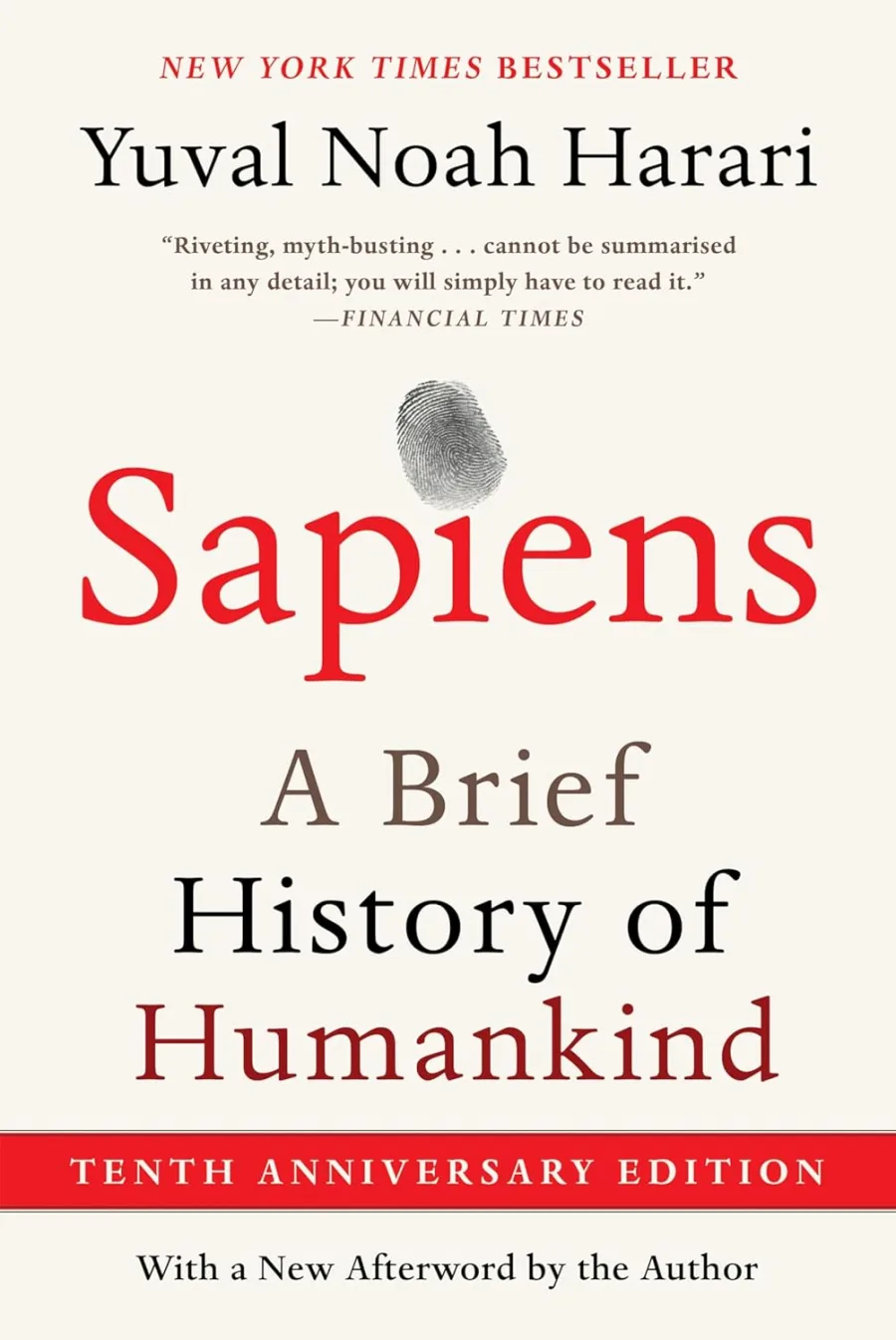
Sapiens: A Brief History of Humankind
Paperback
• 464 Pages
• USD 27.99
• English
• 9780063422001
No ratings yet
| Publisher | Harper Perennial |
|---|---|
| ISBN13 | 9780063422001 |
| ASIN/SKU | 006342200X |
| Book Format | Paperback |
| Language | English |
| Pages | 464 |
| List Price | USD 27.99 |
| Publishing Date | 04/02/2025 |
| Dimensions | 6 x 1.2 x 8.9 inches |
| Weight | 2.1 pounds |
| Book Code | BD00055788 |
Buy this Book
Amazon Stores
Ebook Stores
Other Stores
Discover Sapiens: A Brief History of Humankind by Yuval Noah Harari. This book is published by Harper Perennial in Paperback format, ISBN 9780063422001, ASIN 006342200X, under Science and Math, Physics of Time, Evolution.
Book Description
New York Times Readers’ Pick: Top 100 Books of the 21st Century
The tenth anniversary edition of the internationally bestselling phenomenon that cemented Yuval Noah Harari as one of the most prominent historians of our time—featuring a new afterword from the author.
One hundred thousand years ago, at least six human species inhabited the earth. Today there is just one. Us. Homo sapiens. How did our species succeed in the battle for dominance? Why did our foraging ancestors come together to create cities and kingdoms? How did we come to believe in gods, nations, and human rights; to trust money, books, and laws; and to be enslaved by bureaucracy, timetables, and consumerism? And what will our world be like in the millennia to come?
In Sapiens, Professor Yuval Noah Harari spans the whole of human history, from the very first humans to walk the earth to the radical—and sometimes devastating—breakthroughs of the Cognitive, Agricultural, and Scientific Revolutions. Drawing on insights from biology, anthropology, paleontology, and economics, and incorporating full-color illustrations throughout the text, he explores the origin of our species and how the currents of history have shaped our human societies, the animals and plants around us, and even our personalities. Can we ever free our behavior from the legacy of our ancestors? And what, if anything, can we do to influence the course of the centuries to come?
Bold, wide-ranging, and provocative, this work of big history integrates history and science to challenge everything we thought we knew about human evolution: our thoughts, our actions, our heritage…and our future.
This tenth anniversary edition is an invitation to explore the story of us: a brief history of humankind that challenges everything we thought we knew about being human.
The Three Great Revolutions: Discover how the Cognitive, Agricultural, and Scientific Revolutions shaped not just our societies and empires, but our very biology and psychology.
The Power of Shared Myths: Understand how Homo sapiens used its unique ability to believe in collective fictions—like gods, nations, money, and human rights—to cooperate by the millions and build civilizations.
An Animal of No Significance: Trace our journey from an unremarkable ape to the masters of the planet, and ask the question: Did we become happier along the way?
The Future of Sapiens: Look ahead to the radical new frontiers of the twenty-first century as we use biotechnology and artificial intelligence to upgrade ourselves into something entirely new.
The tenth anniversary edition of the internationally bestselling phenomenon that cemented Yuval Noah Harari as one of the most prominent historians of our time—featuring a new afterword from the author.
One hundred thousand years ago, at least six human species inhabited the earth. Today there is just one. Us. Homo sapiens. How did our species succeed in the battle for dominance? Why did our foraging ancestors come together to create cities and kingdoms? How did we come to believe in gods, nations, and human rights; to trust money, books, and laws; and to be enslaved by bureaucracy, timetables, and consumerism? And what will our world be like in the millennia to come?
In Sapiens, Professor Yuval Noah Harari spans the whole of human history, from the very first humans to walk the earth to the radical—and sometimes devastating—breakthroughs of the Cognitive, Agricultural, and Scientific Revolutions. Drawing on insights from biology, anthropology, paleontology, and economics, and incorporating full-color illustrations throughout the text, he explores the origin of our species and how the currents of history have shaped our human societies, the animals and plants around us, and even our personalities. Can we ever free our behavior from the legacy of our ancestors? And what, if anything, can we do to influence the course of the centuries to come?
Bold, wide-ranging, and provocative, this work of big history integrates history and science to challenge everything we thought we knew about human evolution: our thoughts, our actions, our heritage…and our future.
This tenth anniversary edition is an invitation to explore the story of us: a brief history of humankind that challenges everything we thought we knew about being human.
The Three Great Revolutions: Discover how the Cognitive, Agricultural, and Scientific Revolutions shaped not just our societies and empires, but our very biology and psychology.
The Power of Shared Myths: Understand how Homo sapiens used its unique ability to believe in collective fictions—like gods, nations, money, and human rights—to cooperate by the millions and build civilizations.
An Animal of No Significance: Trace our journey from an unremarkable ape to the masters of the planet, and ask the question: Did we become happier along the way?
The Future of Sapiens: Look ahead to the radical new frontiers of the twenty-first century as we use biotechnology and artificial intelligence to upgrade ourselves into something entirely new.
Author Biography
Prof. Yuval Noah Harari (born 1976) is a historian, philosopher and the bestselling author of 'Sapiens: A Brief History of Humankind' (2014); 'Homo Deus: A Brief History of Tomorrow' (2016); '21 Lessons for the 21st Century' (2018); the children's series 'Unstoppable Us' (launched in 2022); and 'Nexus: A Brief History of Information Networks from the Stone Age to AI' (2024). He is also the creator and co-writer of 'Sapiens: A Graphic History': a radical adaptation of 'Sapiens' into a graphic novel series (launched in 2020), which he published together with comics artists David Vandermeulen (co-writer) and Daniel Casanave (illustrator). These books have been translated into 65 languages, with 45 million copies sold, and have been recommended by Barack Obama, Bill Gates, Natalie Portman, Janelle Monáe, Chris Evans and many others. Harari has a PhD in History from the University of Oxford, is a Lecturer at the Hebrew University of Jerusalem's History department, and is a Distinguished Research Fellow at the University of Cambridge’s Centre for the Study of Existential Risk. Together with his husband, Itzik Yahav, Yuval Noah Harari is the co-founder of Sapienship: a social impact company that advocates for global collaboration, with projects in the realm of education and storytelling.
Editorial Reviews
“Sapiens tackles the biggest questions of history and of the modern world, and it is written in unforgettably vivid language.” - Jared Diamond, Pulitzer Prize-winning author of Guns, Germs, and Steel, Collapse, and The World until Yesterday
“In Sapiens, Harari delves deep into our history as a species to help us understand who we are and what made us this way. An engrossing read.” - Dan Ariely, New York Times Bestselling author of Predictably Irrational, The Upside of Irrationality, and The Honest Truth About Dishonesty
“The sort of book that sweeps the cobwebs out of your brain…. Harari…is an intellectual acrobat whose logical leaps will have you gasping with admiration.” - John Carey, Sunday Times (London)
“Harari’s account of how we conquered the Earth astonishes with its scope and imagination…. One of those rare books that lives up to the publisher’s blurb...brilliantly clear, witty and erudite.” - Ben Shepard, the Observer (London)
“Engaging and informative…. Extremely interesting.” - Guardian (London)
“Not only is Harari eloquent and humane, he is often wonderfully, mordantly funny” - The Independent (London)
“I would recommend this book to anyone interested in a fun, engaging look at early human history…you’ll have a hard time putting it down.” - Bill Gates
“Thank God someone finally wrote [this] exact book.” - Sebastian Junger
“The most idea-packed work of non-fiction I’ve read in years.” - Dick Meyer, www.abcactionnews.com
“Yuval Noah Harari’s full-throated review of our species may have been blurbed by Jared Diamond, but Harari’s conclusions are at once balder and less tendentious than that of his famous colleague.” - New York magazine
“Yuval Noah Harari is an emerging rock-star lecturer at the nexus of history and science. . . . Sapiens takes readers on a sweeping tour of the history of our species. . . . Harari’s formidable intellect sheds light on the biggest breakthroughs in the human story…important reading for serious-minded, self-reflective sapiens.” - Washington Post
“This was the most surprising and thought-provoking book I read this year.” - Atlantic.com
“In this sweeping look at the history of humans, Harari offers readers the chance to reconsider, well, everything, from a look at why Homo sapiens endured to a compelling discussion of how society organizes itself through fictions.” - Booklist Best Books of the Year
“[I]nteresting and provocative…It gives you a sense of perspective on how briefly we’ve been on this earth, how short things like agriculture and science have been around, and why it makes sense for us to not take them for granted.” - President Barack Obama
“Writing with wit and verve, Harari…attempts to explain how Homo sapiens came to be the dominant species on Earth as well as the sole representative of the human genus.… Provocative and entertaining.” - Publishers Weekly
“In Sapiens, Harari delves deep into our history as a species to help us understand who we are and what made us this way. An engrossing read.” - Dan Ariely, New York Times Bestselling author of Predictably Irrational, The Upside of Irrationality, and The Honest Truth About Dishonesty
“The sort of book that sweeps the cobwebs out of your brain…. Harari…is an intellectual acrobat whose logical leaps will have you gasping with admiration.” - John Carey, Sunday Times (London)
“Harari’s account of how we conquered the Earth astonishes with its scope and imagination…. One of those rare books that lives up to the publisher’s blurb...brilliantly clear, witty and erudite.” - Ben Shepard, the Observer (London)
“Engaging and informative…. Extremely interesting.” - Guardian (London)
“Not only is Harari eloquent and humane, he is often wonderfully, mordantly funny” - The Independent (London)
“I would recommend this book to anyone interested in a fun, engaging look at early human history…you’ll have a hard time putting it down.” - Bill Gates
“Thank God someone finally wrote [this] exact book.” - Sebastian Junger
“The most idea-packed work of non-fiction I’ve read in years.” - Dick Meyer, www.abcactionnews.com
“Yuval Noah Harari’s full-throated review of our species may have been blurbed by Jared Diamond, but Harari’s conclusions are at once balder and less tendentious than that of his famous colleague.” - New York magazine
“Yuval Noah Harari is an emerging rock-star lecturer at the nexus of history and science. . . . Sapiens takes readers on a sweeping tour of the history of our species. . . . Harari’s formidable intellect sheds light on the biggest breakthroughs in the human story…important reading for serious-minded, self-reflective sapiens.” - Washington Post
“This was the most surprising and thought-provoking book I read this year.” - Atlantic.com
“In this sweeping look at the history of humans, Harari offers readers the chance to reconsider, well, everything, from a look at why Homo sapiens endured to a compelling discussion of how society organizes itself through fictions.” - Booklist Best Books of the Year
“[I]nteresting and provocative…It gives you a sense of perspective on how briefly we’ve been on this earth, how short things like agriculture and science have been around, and why it makes sense for us to not take them for granted.” - President Barack Obama
“Writing with wit and verve, Harari…attempts to explain how Homo sapiens came to be the dominant species on Earth as well as the sole representative of the human genus.… Provocative and entertaining.” - Publishers Weekly
Book Summary
Sapiens: A Brief History of Humankind by Yuval Noah Harari offers a sweeping look at how Homo sapiens rose from a small, insignificant species to dominate the planet. The book begins by placing humans within the broader context of evolution, noting that for most of history, multiple human species coexisted on Earth. Harari explains that around seventy thousand years ago, something remarkable happened with our ancestors. This period, which he calls the Cognitive Revolution, marked the point when Homo sapiens developed the ability to create and share complex myths, stories, and ideas that allowed large groups to cooperate in ways no other species could match. These shared fictions, whether about gods, nations, or money, became the foundation for everything from tribes to modern societies.
From there, the narrative shifts to the Agricultural Revolution about twelve thousand years ago. Harari describes how early humans moved from foraging to farming, a change often celebrated as progress but presented here with clear drawbacks. While agriculture supported larger populations and permanent settlements, it also led to harder work, poorer diets, and new forms of inequality. People became tied to the land and their crops, creating cycles of labor and vulnerability to famine or disease that hunter-gatherers had largely avoided. The book highlights how this shift concentrated power in the hands of a few and set the stage for hierarchies that still shape our world today.
As societies grew, Harari explores how imagined orders helped unify people across vast distances. Concepts like money, religion, and empires allowed strangers to trust one another and trade or collaborate on a massive scale. He walks through the rise and fall of ancient empires, the spread of universal religions such as Christianity, Islam, and Buddhism, and the role of currency in creating common systems of value. These inventions, though not based in objective reality, proved incredibly effective at binding millions together under shared beliefs and rules. The book notes that these orders persist because they feel natural to those living within them, even when they rest on collective imagination rather than biological fact.
The later sections turn to the Scientific Revolution that began around five hundred years ago. Harari connects this era to the growth of capitalism, imperialism, and technological progress. He explains how Europeans began to value discovery and innovation in ways that fueled exploration, colonization, and industrial growth. The book examines how these forces reshaped the globe, often at great cost to indigenous populations and the environment. It also looks at the modern world’s reliance on credit, science, and consumer culture, showing how they drive constant expansion and change. Harari points out that while these developments have delivered longer lives and greater comfort for many, they have not necessarily increased human happiness.
Throughout the book, the focus remains on the tension between biology and culture. Harari argues that much of what we consider natural or inevitable in human behavior stems from these imagined constructs rather than hardwired instincts. He touches on topics like gender roles, social classes, and national identities, suggesting they are flexible products of history rather than fixed truths. The discussion of happiness stands out as particularly thoughtful, questioning whether modern comforts have truly made people more content or simply altered the sources of their discontent.
In its closing chapters, the book looks ahead to the future of our species. It considers possibilities like genetic engineering, artificial intelligence, and the potential end of Homo sapiens as we know it. Harari leaves readers with a sense that the stories we tell ourselves will continue to shape what comes next, for better or worse. The overall tone is clear and direct, blending big ideas with everyday examples to make complex history feel accessible. It encourages reflection on how the past influences the present without offering simple answers or predictions. The result is a thoughtful overview that connects ancient developments to the challenges of living in today’s interconnected world.
From there, the narrative shifts to the Agricultural Revolution about twelve thousand years ago. Harari describes how early humans moved from foraging to farming, a change often celebrated as progress but presented here with clear drawbacks. While agriculture supported larger populations and permanent settlements, it also led to harder work, poorer diets, and new forms of inequality. People became tied to the land and their crops, creating cycles of labor and vulnerability to famine or disease that hunter-gatherers had largely avoided. The book highlights how this shift concentrated power in the hands of a few and set the stage for hierarchies that still shape our world today.
As societies grew, Harari explores how imagined orders helped unify people across vast distances. Concepts like money, religion, and empires allowed strangers to trust one another and trade or collaborate on a massive scale. He walks through the rise and fall of ancient empires, the spread of universal religions such as Christianity, Islam, and Buddhism, and the role of currency in creating common systems of value. These inventions, though not based in objective reality, proved incredibly effective at binding millions together under shared beliefs and rules. The book notes that these orders persist because they feel natural to those living within them, even when they rest on collective imagination rather than biological fact.
The later sections turn to the Scientific Revolution that began around five hundred years ago. Harari connects this era to the growth of capitalism, imperialism, and technological progress. He explains how Europeans began to value discovery and innovation in ways that fueled exploration, colonization, and industrial growth. The book examines how these forces reshaped the globe, often at great cost to indigenous populations and the environment. It also looks at the modern world’s reliance on credit, science, and consumer culture, showing how they drive constant expansion and change. Harari points out that while these developments have delivered longer lives and greater comfort for many, they have not necessarily increased human happiness.
Throughout the book, the focus remains on the tension between biology and culture. Harari argues that much of what we consider natural or inevitable in human behavior stems from these imagined constructs rather than hardwired instincts. He touches on topics like gender roles, social classes, and national identities, suggesting they are flexible products of history rather than fixed truths. The discussion of happiness stands out as particularly thoughtful, questioning whether modern comforts have truly made people more content or simply altered the sources of their discontent.
In its closing chapters, the book looks ahead to the future of our species. It considers possibilities like genetic engineering, artificial intelligence, and the potential end of Homo sapiens as we know it. Harari leaves readers with a sense that the stories we tell ourselves will continue to shape what comes next, for better or worse. The overall tone is clear and direct, blending big ideas with everyday examples to make complex history feel accessible. It encourages reflection on how the past influences the present without offering simple answers or predictions. The result is a thoughtful overview that connects ancient developments to the challenges of living in today’s interconnected world.
Sample Chapters
Sample Chapters will be added soon…
Reader Reviews
No reviews yet.
Sapiens: A Brief History of Humankind
Download Cover Image
Do you want to download the full cover image for Sapiens: A Brief History of Humankind?