
Sunrise on the Reaping (The Hunger Games)
Paperback
• 400 Pages
• USD 17.99
• English
• 9781546171607
No ratings yet
| Publisher | Scholastic Press |
|---|---|
| ISBN13 | 9781546171607 |
| ASIN/SKU | 1546171606 |
| Book Format | Paperback |
| Language | English |
| Pages | 400 |
| List Price | USD 17.99 |
| Publishing Date | 04/08/2006 |
| Dimensions | 5.28 x 0.83 x 7.99 inches |
| Weight | 10.4 ounces |
| Book Code | BD00055801 |
Buy this Book
Amazon Stores
Ebook Stores
Other Stores
Discover Sunrise on the Reaping (The Hunger Games) by Suzanne Collins. This book is published by Scholastic Press in Paperback format, ISBN 9781546171607, ASIN 1546171606, under Teen and Young Adult, Teen and Young Adult Survival Stories, Teen and Young Adult Dystopian.
Book Description
The phenomenal fifth book in the Hunger Games series: Haymitch's story.
#1 USA Today Bestseller • #1 New York Times Bestseller • #1 Indie Bestseller • #1 Publishers Weekly Bestseller • A New York Times Editors' Choice
"A propulsive, brutal Hunger Games prequel is here. And it's great." The New York Times
When you've been set up to lose everything you love, what is there left to fight for?
As the day dawns on the fiftieth annual Hunger Games, fear grips the districts of Panem. This year, in honor of the Quarter Quell, twice as many tributes will be taken from their homes.
Back in District 12, Haymitch Abernathy is trying not to think too hard about his chances. All he cares about is making it through the day and being with the girl he loves.
When Haymitch's name is called, he can feel all his dreams break. He's torn from his family and his love, shuttled to the Capitol with the three other District 12 tributes: a young friend who's nearly a sister to him, a compulsive oddsmaker, and the most stuck-up girl in town. As the Games begin, Haymitch understands he's been set up to fail. But there's something in him that wants to fight . . . and have that fight reverberate far beyond the deadly arena.
#1 USA Today Bestseller • #1 New York Times Bestseller • #1 Indie Bestseller • #1 Publishers Weekly Bestseller • A New York Times Editors' Choice
"A propulsive, brutal Hunger Games prequel is here. And it's great." The New York Times
When you've been set up to lose everything you love, what is there left to fight for?
As the day dawns on the fiftieth annual Hunger Games, fear grips the districts of Panem. This year, in honor of the Quarter Quell, twice as many tributes will be taken from their homes.
Back in District 12, Haymitch Abernathy is trying not to think too hard about his chances. All he cares about is making it through the day and being with the girl he loves.
When Haymitch's name is called, he can feel all his dreams break. He's torn from his family and his love, shuttled to the Capitol with the three other District 12 tributes: a young friend who's nearly a sister to him, a compulsive oddsmaker, and the most stuck-up girl in town. As the Games begin, Haymitch understands he's been set up to fail. But there's something in him that wants to fight . . . and have that fight reverberate far beyond the deadly arena.
Author Biography
Suzanne Collins is the internationally bestselling author of the Hunger Games series, which includes the novels The Hunger Games, Catching Fire, Mockingjay, The Ballad of Songbirds and Snakes, and Sunrise on the Reaping. Together, the books have sold over 100 million copies and were the basis for five popular films. Her other books include the acclaimed Underland Chronicles series, which begins with Gregor the Overlander, and the picture book Year of the Jungle, illustrated by James Proimos. To date, her books have been published in fifty-five languages around the world.
Editorial Reviews
Praise for SUNRISE ON THE REAPING:
#1 USA Today Bestseller
#1 New York Times Bestseller
#1 Indie Bestseller
#1 Publishers Weekly Bestseller
A New York Times Editors' Choice
An Amazon Best Book of 2025
"A propulsive, brutal Hunger Games prequel is here. And it's great." The New York Times
"Yes, the new Hunger Games prequel is really that good. Everything Hunger Games fans could want and more." USA Today
"Collins is awfully good at what she does. It's a life-giving book." PEOPLE
"Like Margaret Atwood and George Orwell before her, Collins' novels have become part of the lexicon, an adjective - this is very Hunger Games - used to illustrate government overreach and authoritarianism. The Hunger Games series, including Sunrise on the Reaping, is a central part in the American dystopian literary canon." MSNBC
"[I]t's as if Collins is asking us to reflect on how much we really know of our history, and how much power we have in ensuring that our current truths have a place in the future." NPR
"Sunrise on the Reaping...succeeds in the near-impossible task of making a well-trod story feel as intimate and visceral as its predecessors." ELLE
"Genuinely outstanding." Paste
"Equal parts touching and deeply sad." Teen Vogue
★ "[A] brutal tale of compassion and rage, and a frank examination of propaganda and tragedy, that will satisfy longtime series fans and newcomers alike." Publishers Weekly, Starred Review
★ "Raw, shocking, and deeply bittersweet, Haymitch's backstory pulls the pieces of the Hunger Games universe together with ease....Collins has mentioned in past interviews that she would not return to this series unless she had something to say-and she has a lot to say." Booklist, Starred Review
★ "Required reading for fans of the original trilogy. A must-have." School Library Journal, Starred Review
#1 USA Today Bestseller
#1 New York Times Bestseller
#1 Indie Bestseller
#1 Publishers Weekly Bestseller
A New York Times Editors' Choice
An Amazon Best Book of 2025
"A propulsive, brutal Hunger Games prequel is here. And it's great." The New York Times
"Yes, the new Hunger Games prequel is really that good. Everything Hunger Games fans could want and more." USA Today
"Collins is awfully good at what she does. It's a life-giving book." PEOPLE
"Like Margaret Atwood and George Orwell before her, Collins' novels have become part of the lexicon, an adjective - this is very Hunger Games - used to illustrate government overreach and authoritarianism. The Hunger Games series, including Sunrise on the Reaping, is a central part in the American dystopian literary canon." MSNBC
"[I]t's as if Collins is asking us to reflect on how much we really know of our history, and how much power we have in ensuring that our current truths have a place in the future." NPR
"Sunrise on the Reaping...succeeds in the near-impossible task of making a well-trod story feel as intimate and visceral as its predecessors." ELLE
"Genuinely outstanding." Paste
"Equal parts touching and deeply sad." Teen Vogue
★ "[A] brutal tale of compassion and rage, and a frank examination of propaganda and tragedy, that will satisfy longtime series fans and newcomers alike." Publishers Weekly, Starred Review
★ "Raw, shocking, and deeply bittersweet, Haymitch's backstory pulls the pieces of the Hunger Games universe together with ease....Collins has mentioned in past interviews that she would not return to this series unless she had something to say-and she has a lot to say." Booklist, Starred Review
★ "Required reading for fans of the original trilogy. A must-have." School Library Journal, Starred Review
Book Summary
Sunrise on the Reaping by Suzanne Collins returns to the world of Panem more than twenty years after the original Hunger Games trilogy, but instead of continuing Katniss’s story, it goes back in time to explore the 50th Hunger Games—the Second Quarter Quell—and the brutal rise of Haymitch Abernathy. Set forty years before The Hunger Games, the novel shows Panem at a different, earlier stage: the Capitol is still tightening its grip after the war, the districts are deeply oppressed, and the Games are evolving into an ever more grotesque spectacle. At the center of it all is seventeen year old Haymitch from District 12, a boy who is clever, stubborn, and quietly defiant, long before he becomes the bitter, haunted mentor we know later.
The story opens in District 12, years before Katniss is born. Life in the Seam and town is still harsh: coal dust, hunger, and constant fear of Peacekeepers define daily existence. Haymitch is not yet the drunk we meet in The Hunger Games; he’s a sharp, observant teenager who understands how rigged the world is but hasn’t fully given up. He lives with the few people he cares about—family and friends who bring him scraps of joy in an otherwise bleak life. The announcement of the Quarter Quell twists everything. The Capitol reveals a special rule for the 50th Games: instead of the usual twenty four tributes, there will be twice as many. Forty eight children, two boys and two girls from each district, will be sent into the arena. This decision is framed as “punishment” and “reminder” of the districts’ rebellion decades earlier, but to Haymitch and the people of 12, it’s simply another act of cruelty.
Haymitch is reaped alongside another boy from his district, and two girls, all of them pushed from their rough but familiar lives into the nightmare of the Capitol. The journey to the Capitol gives us a fresh view of that city in its earlier, post war phase: the decadence is already there—bright colors, bizarre fashion, excess food—but it feels slightly less polished than in Katniss’s era, as if the system is still perfecting itself. Haymitch’s eyes become the lens through which we see the Capitol’s hypocrisy: the way announcers cheerfully treat slaughter as entertainment, the way stylists and trainers talk about tributes as if they’re characters in a game rather than living children. He hates it, but he also understands quickly that refusing to play along means dying even faster.
Training and pre Games preparation show Haymitch’s particular strength: his mind. He doesn’t have the brute physical power many careers do, but he is extremely good at reading people, spotting patterns, and thinking several steps ahead. He maps out which tributes are dangerous, which districts are likely to form alliances, and how the Capitol wants the narrative to go. Unlike many tributes, he doesn’t get dazzled by the food and luxury. He uses interviews and training sessions to gather information, to watch the Gamemakers, and to figure out what kind of arena they might create for a Quarter Quell with double the tributes. His defiance is quiet and often internal, but it’s there in the way he refuses to fully play the obedient role expected of him.
The arena itself is one of the most striking parts of the book. The 50th Games are designed to be bigger, crueler, and more twisted than anything that came before. The setting is lush and beautiful on the surface—wide landscapes, dangerous beauty, a place that could almost be mistaken for paradise—but it is crammed with deadly traps and engineered horrors. There are more tributes, more mutts, more shifting elements designed to keep everyone constantly off balance. The sheer number of children inside means chaos from the very beginning. Alliances are larger, betrayals are more frequent, and the Capitol’s cameras are everywhere, hungry for drama.
As the Games unfold, we see Haymitch’s survival strategy center on one key idea: figure out the Gamemakers.” He realizes that with forty eight tributes, the Capitol is not just tracking people, but also experimenting with how far they can push control. He studies the arena’s patterns—how the landscape changes, where food and water appear, when hazards strike—and slowly pieces together a larger design. His allies in the arena are not just other tributes, but moments of insight: recognizing that the terrain is not random, that the timing of disasters is deliberate, and that the Capitol needs to maintain a certain rhythm of deaths to keep the audience engaged. This intellectual battle between tribute and Gamemakers becomes the core tension of his arc.
The book doesn’t shy away from the brutality of the Games. Haymitch is forced to kill, to watch others die, and to make decisions that haunt him. Collins shows us the emotional weight of each choice: how guilt and survival intertwine, how killing in self defense still leaves scars. Haymitch’s growing trauma is written in the way he starts to flinch at certain sounds, how he distances himself from other tributes even as he fights alongside them, and how he talks to himself in his head to stay sane. We see glimpses of the mentor he will become—the cynicism, the sharp tongue, the refusal to sugarcoat anything—but here those traits are still forming, rooted in very fresh wounds.
At the same time, the narrative broadens to show how the 50th Games affect the wider world. In District 12, Haymitch’s family and friends watch the broadcast, forced to see their boy turned into a spectacle. In other districts, people see the Quarter Quell as a clear message: the Capitol will always escalate punishment whenever it senses dissent. There are small, quiet signs of growing unrest—muted anger, whispered conversations, the hint that some people are starting to question whether the system can last forever. The Capitol, meanwhile, treats the Games as a triumph: ratings, fashion, gossip, and celebration drown out the horror.
Haymitch’s eventual victory is both astonishing and terrible. When he finally realizes the arena’s full mechanism—how the Gamemakers control everything, and where their blind spots are—he uses that understanding in a risky, brilliant move that turns their own design against them. His win is not due to brute strength or luck; it’s a direct act of defiance against the Capitol’s sense of control. But the cost is enormous. By outsmarting the Gamemakers so publicly, he embarrasses them and exposes limitations in their power on live television. The Capitol does not forgive humiliation easily.
The aftermath of the Games is where Sunrise on the Reaping connects most deeply to what readers already know from The Hunger Games. Haymitch returns to District 12 as a victor, but what that means in practice is hollow and cruel. He gets the material rewards—a better house, money, access to the Capitol—but he is also forced into the role of pawn and symbol. The Capitol punishes him in quiet, relentless ways for what he did in the arena. People he loves pay the price. He learns that winning doesn’t free you; it cages you differently. This is the turning point where the boy who fought so cleverly in the arena begins to become the damaged, alcoholic mentor we meet years later—a man who knows exactly how rigged the system is and how little one person’s victory can change it.
Through Haymitch’s story, Collins deepens the world of Panem. We see earlier phases of the Games, the way Quarter Quells are used to manipulate both memory and fear, and how victors are weaponized against their own districts. We also see the seeds of rebellion being planted long before Katniss ever picks up a bow. Sunrise on the Reaping is ultimately about how one young man is broken into the sharp, scarred survivor we already think we know—and about how every “heroic” win in the Hunger Games hides a trail of grief, compromise, and quiet resistance.
The story opens in District 12, years before Katniss is born. Life in the Seam and town is still harsh: coal dust, hunger, and constant fear of Peacekeepers define daily existence. Haymitch is not yet the drunk we meet in The Hunger Games; he’s a sharp, observant teenager who understands how rigged the world is but hasn’t fully given up. He lives with the few people he cares about—family and friends who bring him scraps of joy in an otherwise bleak life. The announcement of the Quarter Quell twists everything. The Capitol reveals a special rule for the 50th Games: instead of the usual twenty four tributes, there will be twice as many. Forty eight children, two boys and two girls from each district, will be sent into the arena. This decision is framed as “punishment” and “reminder” of the districts’ rebellion decades earlier, but to Haymitch and the people of 12, it’s simply another act of cruelty.
Haymitch is reaped alongside another boy from his district, and two girls, all of them pushed from their rough but familiar lives into the nightmare of the Capitol. The journey to the Capitol gives us a fresh view of that city in its earlier, post war phase: the decadence is already there—bright colors, bizarre fashion, excess food—but it feels slightly less polished than in Katniss’s era, as if the system is still perfecting itself. Haymitch’s eyes become the lens through which we see the Capitol’s hypocrisy: the way announcers cheerfully treat slaughter as entertainment, the way stylists and trainers talk about tributes as if they’re characters in a game rather than living children. He hates it, but he also understands quickly that refusing to play along means dying even faster.
Training and pre Games preparation show Haymitch’s particular strength: his mind. He doesn’t have the brute physical power many careers do, but he is extremely good at reading people, spotting patterns, and thinking several steps ahead. He maps out which tributes are dangerous, which districts are likely to form alliances, and how the Capitol wants the narrative to go. Unlike many tributes, he doesn’t get dazzled by the food and luxury. He uses interviews and training sessions to gather information, to watch the Gamemakers, and to figure out what kind of arena they might create for a Quarter Quell with double the tributes. His defiance is quiet and often internal, but it’s there in the way he refuses to fully play the obedient role expected of him.
The arena itself is one of the most striking parts of the book. The 50th Games are designed to be bigger, crueler, and more twisted than anything that came before. The setting is lush and beautiful on the surface—wide landscapes, dangerous beauty, a place that could almost be mistaken for paradise—but it is crammed with deadly traps and engineered horrors. There are more tributes, more mutts, more shifting elements designed to keep everyone constantly off balance. The sheer number of children inside means chaos from the very beginning. Alliances are larger, betrayals are more frequent, and the Capitol’s cameras are everywhere, hungry for drama.
As the Games unfold, we see Haymitch’s survival strategy center on one key idea: figure out the Gamemakers.” He realizes that with forty eight tributes, the Capitol is not just tracking people, but also experimenting with how far they can push control. He studies the arena’s patterns—how the landscape changes, where food and water appear, when hazards strike—and slowly pieces together a larger design. His allies in the arena are not just other tributes, but moments of insight: recognizing that the terrain is not random, that the timing of disasters is deliberate, and that the Capitol needs to maintain a certain rhythm of deaths to keep the audience engaged. This intellectual battle between tribute and Gamemakers becomes the core tension of his arc.
The book doesn’t shy away from the brutality of the Games. Haymitch is forced to kill, to watch others die, and to make decisions that haunt him. Collins shows us the emotional weight of each choice: how guilt and survival intertwine, how killing in self defense still leaves scars. Haymitch’s growing trauma is written in the way he starts to flinch at certain sounds, how he distances himself from other tributes even as he fights alongside them, and how he talks to himself in his head to stay sane. We see glimpses of the mentor he will become—the cynicism, the sharp tongue, the refusal to sugarcoat anything—but here those traits are still forming, rooted in very fresh wounds.
At the same time, the narrative broadens to show how the 50th Games affect the wider world. In District 12, Haymitch’s family and friends watch the broadcast, forced to see their boy turned into a spectacle. In other districts, people see the Quarter Quell as a clear message: the Capitol will always escalate punishment whenever it senses dissent. There are small, quiet signs of growing unrest—muted anger, whispered conversations, the hint that some people are starting to question whether the system can last forever. The Capitol, meanwhile, treats the Games as a triumph: ratings, fashion, gossip, and celebration drown out the horror.
Haymitch’s eventual victory is both astonishing and terrible. When he finally realizes the arena’s full mechanism—how the Gamemakers control everything, and where their blind spots are—he uses that understanding in a risky, brilliant move that turns their own design against them. His win is not due to brute strength or luck; it’s a direct act of defiance against the Capitol’s sense of control. But the cost is enormous. By outsmarting the Gamemakers so publicly, he embarrasses them and exposes limitations in their power on live television. The Capitol does not forgive humiliation easily.
The aftermath of the Games is where Sunrise on the Reaping connects most deeply to what readers already know from The Hunger Games. Haymitch returns to District 12 as a victor, but what that means in practice is hollow and cruel. He gets the material rewards—a better house, money, access to the Capitol—but he is also forced into the role of pawn and symbol. The Capitol punishes him in quiet, relentless ways for what he did in the arena. People he loves pay the price. He learns that winning doesn’t free you; it cages you differently. This is the turning point where the boy who fought so cleverly in the arena begins to become the damaged, alcoholic mentor we meet years later—a man who knows exactly how rigged the system is and how little one person’s victory can change it.
Through Haymitch’s story, Collins deepens the world of Panem. We see earlier phases of the Games, the way Quarter Quells are used to manipulate both memory and fear, and how victors are weaponized against their own districts. We also see the seeds of rebellion being planted long before Katniss ever picks up a bow. Sunrise on the Reaping is ultimately about how one young man is broken into the sharp, scarred survivor we already think we know—and about how every “heroic” win in the Hunger Games hides a trail of grief, compromise, and quiet resistance.
Sample Chapters
Sample Chapters will be added soon…
Reader Reviews
No reviews yet.
Sunrise on the Reaping (The Hunger Games)
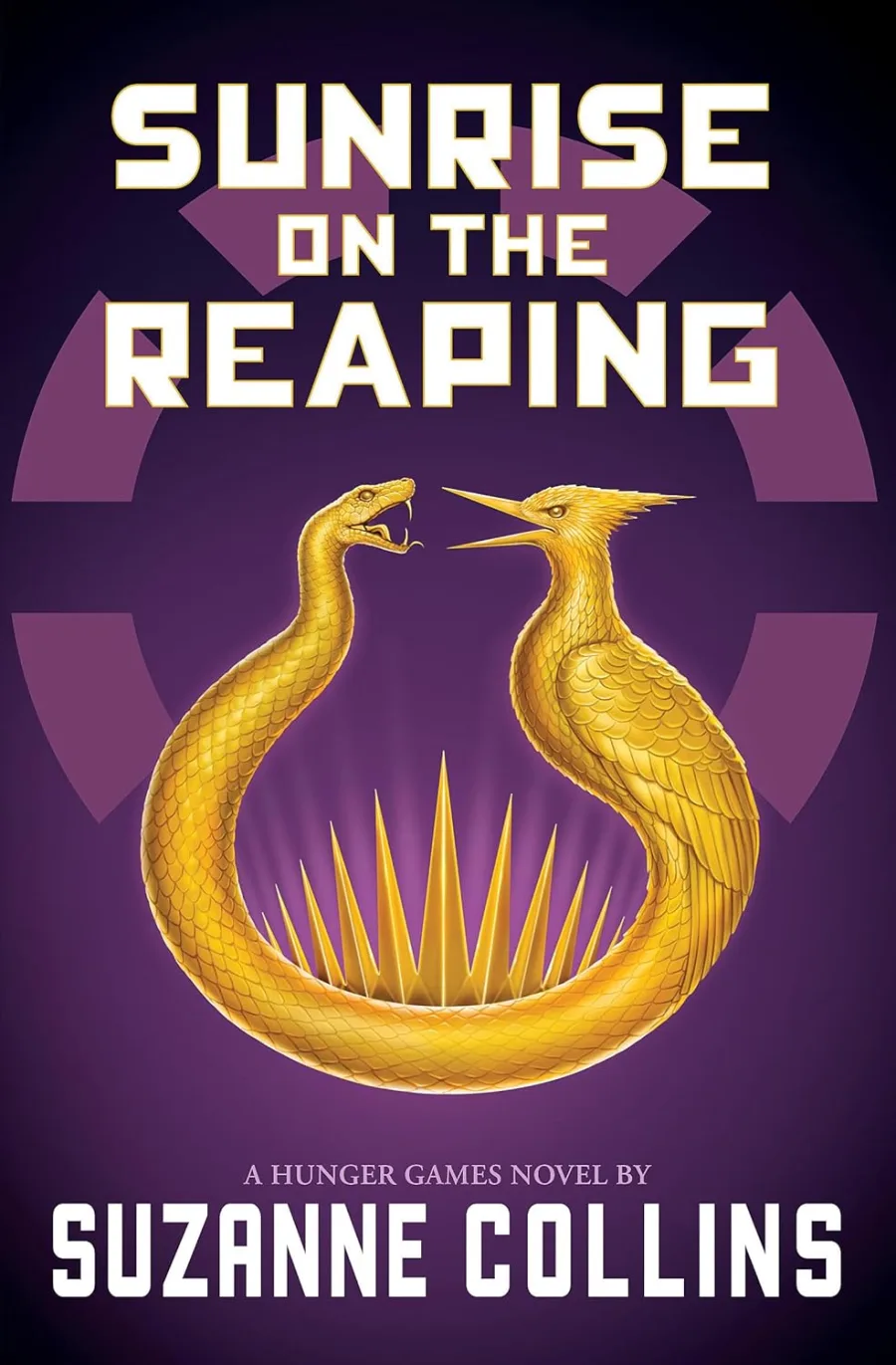
Download Cover Image
Do you want to download the full cover image for Sunrise on the Reaping (The Hunger Games)?