
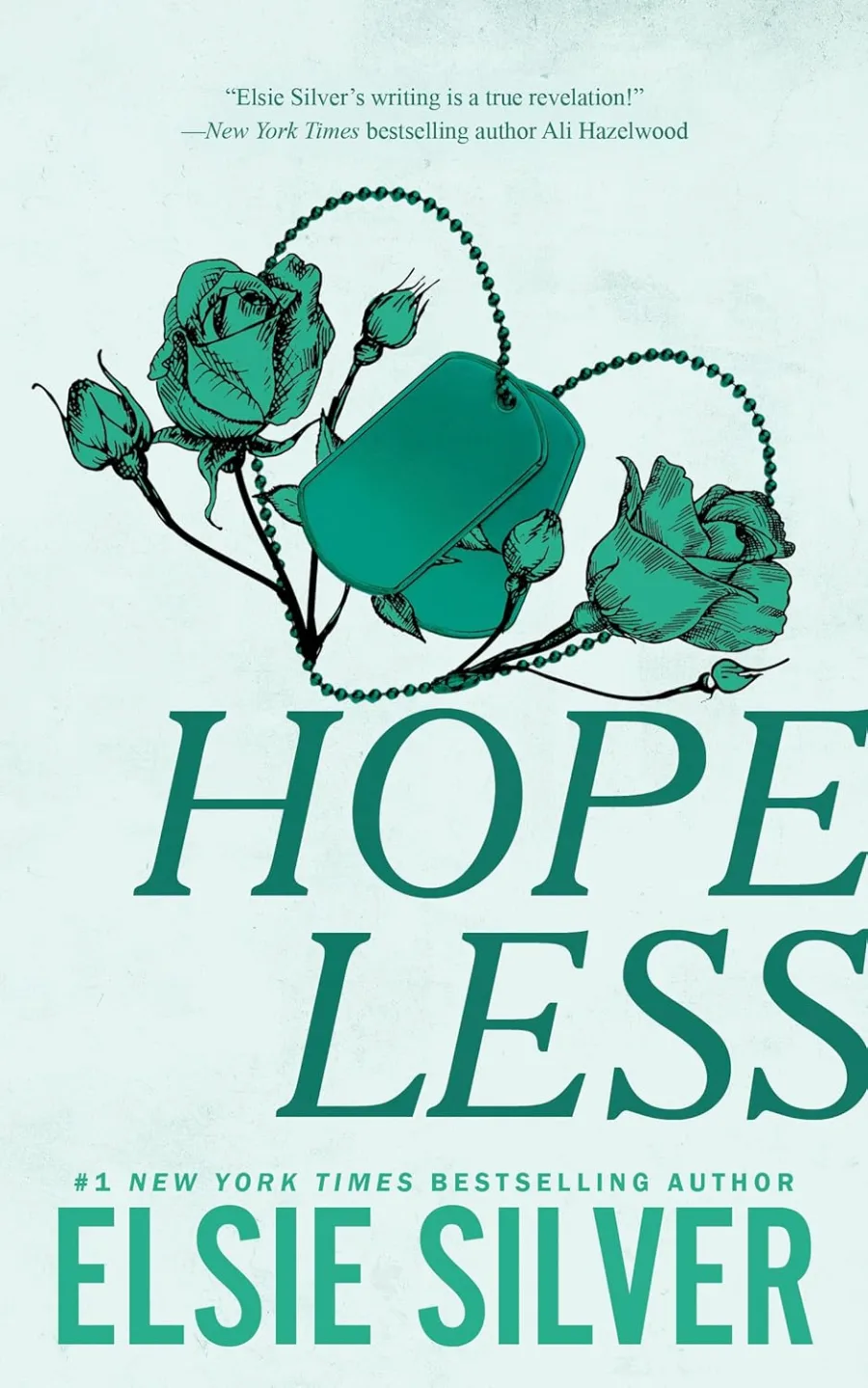
Hopeless (Chestnut Springs, 5)
Paperback
• 418 Pages
• USD 17.99
• English
• 9781728297040
No ratings yet
| Publisher | Bloom Books |
|---|---|
| ISBN13 | 9781728297040 |
| ASIN/SKU | 1728297044 |
| Book Format | Paperback |
| Language | English |
| Pages | 418 |
| List Price | USD 17.99 |
| Series Title | Chestnut Springs |
| Publishing Date | 30/01/2024 |
| Dimensions | 5 x 1.12 x 8 inches |
| Weight | 12 ounces |
| Book Code | BD00055804 |
Buy this Book
Amazon Stores
Ebook Stores
Other Stores
Discover Hopeless (Chestnut Springs, 5) by Elsie Silver. This book is published by Bloom Books in Paperback format, ISBN 9781728297040, ASIN 1728297044, under Romance, Western and Frontier Romance, Literature and Fiction.
Book Description
He doesn't believe that anyone holds her last name against her…so he offers her his.
Beau Eaton is the town prince, a handsome military hero with a tortured past. Bailey Jansen is the outcast bartender, a shy girl from the wrong side of the tracks. He's thirty-five and all man, and she's twenty-two and all…virgin.
He's also her fiancé. Correction: her fake fiancé.
It starts out as a bet, a point for Beau to prove. And it's a win-win: Beau gets a break from his concerned family's prying, and Bailey gets a chance to shed her family's reputation while she saves up to ditch this small town for good. All she has to do is wear his ring, follow his lead, and pretend she can't keep her hands off of him in public. Easy enough, right?
But it's what happens between them in private that blurs all those carefully drawn lines. It's what transpires behind closed doors that doesn't feel like pretending at all. This engagement was supposed to be for show. This agreement? It has an end date.
Beau once told Bailey he'd never fall in love. She's determined to make him change his mind.
Beau Eaton is the town prince, a handsome military hero with a tortured past. Bailey Jansen is the outcast bartender, a shy girl from the wrong side of the tracks. He's thirty-five and all man, and she's twenty-two and all…virgin.
He's also her fiancé. Correction: her fake fiancé.
It starts out as a bet, a point for Beau to prove. And it's a win-win: Beau gets a break from his concerned family's prying, and Bailey gets a chance to shed her family's reputation while she saves up to ditch this small town for good. All she has to do is wear his ring, follow his lead, and pretend she can't keep her hands off of him in public. Easy enough, right?
But it's what happens between them in private that blurs all those carefully drawn lines. It's what transpires behind closed doors that doesn't feel like pretending at all. This engagement was supposed to be for show. This agreement? It has an end date.
Beau once told Bailey he'd never fall in love. She's determined to make him change his mind.
Author Biography
Elsie Silver is a Canadian author of sassy, sexy, small town romance who loves a good book boyfriend and the strong heroines who bring them to their knees. She lives just outside of Vancouver, British Columbia with her husband, son, and three dogs and has been voraciously reading romance books since before she was probably supposed to.
She loves cooking and trying new foods, traveling, and spending time with her boys–especially outdoors. Elsie has also become a big fan of her quiet five am mornings, which is when most of her writing happens. It’s during this time that she can sip a cup of hot coffee and dream up a fictional world full of romantic stories to share with her readers.
She loves cooking and trying new foods, traveling, and spending time with her boys–especially outdoors. Elsie has also become a big fan of her quiet five am mornings, which is when most of her writing happens. It’s during this time that she can sip a cup of hot coffee and dream up a fictional world full of romantic stories to share with her readers.
Editorial Reviews
Editorial Reviews will be added soon…
Book Summary
Hopeless by Elsie Silver is a heartfelt, emotionally rich small-town romance set in her Chestnut Springs universe, and it focuses on a woman who’s running from a painful past and a man who’s convinced he’s too damaged to be anyone’s future. The story revolves around Aurora “Rory” Shields and Beau Eaton, two people who carry heavy emotional baggage, family complications, and deep-seated beliefs that love will only end in hurt. What makes the book feel so human is the way it shows them slowly, stubbornly learning that safety and belonging can be found in the most unexpected place: each other.
Rory arrives in Chestnut Springs tired of the life she’s been living and desperate for a reset. She’s spent years in survival mode, shaped by a history of instability, unreliable people, and having to rely mostly on herself. She’s independent, sharp, and capable—on the outside she looks like someone who can handle anything—but internally she lives with a constant fear of being abandoned or disappointed again. Coming to this little Alberta town feels like a chance to breathe. She takes a job and starts building something resembling a normal life, but she never really expects Chestnut Springs to become “home.” It’s just meant to be temporary, a stepping stone. Her only real plan is to keep her walls up, stay out of drama, and avoid getting attached.
Then there’s Beau Eaton, part of the tight-knit Eaton family that anchors the series. Beau is the kind of man people in town think they know: charming when he chooses to be, competent, steady, with that quiet cowboy vibe. But underneath, he’s deeply closed off. He carries trauma and guilt from his past, and it has convinced him that he’s better off alone, that letting someone close would just invite more pain—either for himself or for them. He’s the “emotionally unavailable” one, the guy who keeps his feelings locked away behind dry humor, distance, and the occasional bad decision. Beau has watched his brothers fall in love in earlier books, but he doesn’t believe that kind of happiness is meant for him. He prefers to stick to work, family obligations, and the familiar numbness of not really trying for more.
Rory and Beau collide almost immediately. Their first interactions are prickly, funny, and charged. She thinks he’s rude, infuriatingly guarded, and annoyingly good-looking. He thinks she’s trouble—too tempting, too direct, and someone who makes him feel things he’s spent years trying to avoid. The early dynamic between them is a classic slow burn: lots of banter, annoying attraction, and this underlying sense that they recognize something familiar in each other’s pain. Neither of them wants to admit it, though. They push and pull, exchange sharp comments, and pretend the spark isn’t there. At first glance, they look like oil and water. Underneath, they are two people who have just learned to hide their hurt in different ways.
The small-town setting plays a big role in forcing them together. Chestnut Springs is not a place where you can easily avoid someone; you see them at the diner, at the ranch, in the feed store, surrounded by mutual friends and family. The Eaton clan is present as a kind of warm, chaotic backdrop: brothers, partners, kids, and community all orbiting around Beau and slowly absorbing Rory into their circle. She, who never really had a stable, loving family, finds herself drawn into their traditions, teasing, and loyalty. It’s confusing and overwhelming for her. Love, attention, and genuine care are things she isn’t used to, and she doesn’t fully trust them at first. Beau, watching this, sees how fragile and brave she is beneath her tough exterior, and it chips away at his own protective shell.
As they spend more time together, Rory and Beau begin to drop their guards in small ways. They share late-night conversations where they reveal bits of their past. They argue about choices and what “being safe” really means. They show up for each other in quiet moments—a ride, a favor, a steady presence when things get hard. Through these interactions, their relationship slowly shifts from antagonistic to a complex mix of friendship, attraction, and reluctant emotional reliance. Beau notices Rory’s resilience and the way she refuses to let her past define her entire future, even when it has left scars. Rory sees Beau’s kindness beneath the gruffness, the way he is always trying to protect everyone else even while he refuses to protect himself emotionally.
The romance is a genuine slow burn. Both characters resist it for a long time because giving in means facing their deepest fears. Rory is terrified of needing someone; she’s convinced that dependence leads to disappointment. Beau is terrified of being needed; he believes he’s fundamentally a bad bet, that his trauma and hopelessness make him unfit for real love. So they dance around each other—flirting, fighting, occasionally crossing lines and then pulling back. When they finally do cross into physical intimacy, it’s intense, passionate, but also vulnerable. It’s not just about chemistry; it’s about two people who don’t know how to be fully themselves in front of anyone slowly realizing that they’re already more honest with each other than with anyone else.
At the core of Hopeless is the way each of them forces the other to confront their own lies. Beau challenges Rory’s belief that she’s destined to be alone or overlooked. He sees her clearly and refuses to let her diminish herself. Rory, in turn, challenges Beau’s belief that he is “hopeless.” She calls him out when he hides behind detachment, and she doesn’t accept his self-destructive narrative that he can’t be trusted with someone’s heart. Their conflicts are emotional more than external: they revolve around trust, commitment, and the question of whether two people with complicated pasts can build something stable together.
Family and community deepen these themes. The Eaton family’s presence shows Beau what love can look like when it’s messy but steady—how people can argue and still show up, how forgiveness and second chances are possible. Rory experiences this too, and it shakes her. She’s spent most of her life assuming that affection is conditional and temporary. In Chestnut Springs, she sees people who stick around, who care even when it’s inconvenient, and she begins to wonder if maybe she is allowed to want that for herself. The town, with its gossip, warmth, and daily rhythms, becomes a quiet character itself: a place where healing doesn’t happen through grand gestures, but through routines, familiarity, and small acts of kindness.
Of course, the story doesn’t move in a straight line. There are setbacks. Beau pulls away when he feels things getting too intense, retreating into old habits and emotional distance. Rory, stung by that, questions whether she was foolish to trust him and the town at all. Past trauma for both of them surfaces—old wounds, family issues, deeply rooted insecurities—and it threatens to derail what they’ve started to build. These rough patches feel real because they grow directly out of who they are, not from arbitrary misunderstandings. To move forward, they each have to make active choices: Beau must decide to stop hiding behind the idea that he’s unworthy, and Rory must decide to stop running at the first sign of hurt.
By the time the book reaches its emotional peak, Beau and Rory have both changed. Beau is still himself—quiet, intense, imperfect—but he’s no longer content to cling to the label “hopeless.” He accepts that his past shaped him, but it doesn’t have to define his future. Rory, still fiercely independent, finally allows the idea that being loved doesn’t make her weak or foolish. Instead, it gives her a foundation she never had before. Together, they choose to build a life in Chestnut Springs that’s rooted in honesty, support, and the understanding that love is not about fixing each other, but about standing together when things get hard.
Hopeless ultimately feels like a story about learning that “hopeless” is a lie people tell themselves when they’re scared. Through Beau and Rory’s journey, Elsie Silver shows how a shared sense of brokenness can either destroy people or bring them together—depending on whether they’re willing to risk being seen. The book is full of humor, longing, tenderness, and that satisfying emotional payoff that comes when two people who never believed they deserved a happy ending finally let themselves want one, and then fight for it.
Rory arrives in Chestnut Springs tired of the life she’s been living and desperate for a reset. She’s spent years in survival mode, shaped by a history of instability, unreliable people, and having to rely mostly on herself. She’s independent, sharp, and capable—on the outside she looks like someone who can handle anything—but internally she lives with a constant fear of being abandoned or disappointed again. Coming to this little Alberta town feels like a chance to breathe. She takes a job and starts building something resembling a normal life, but she never really expects Chestnut Springs to become “home.” It’s just meant to be temporary, a stepping stone. Her only real plan is to keep her walls up, stay out of drama, and avoid getting attached.
Then there’s Beau Eaton, part of the tight-knit Eaton family that anchors the series. Beau is the kind of man people in town think they know: charming when he chooses to be, competent, steady, with that quiet cowboy vibe. But underneath, he’s deeply closed off. He carries trauma and guilt from his past, and it has convinced him that he’s better off alone, that letting someone close would just invite more pain—either for himself or for them. He’s the “emotionally unavailable” one, the guy who keeps his feelings locked away behind dry humor, distance, and the occasional bad decision. Beau has watched his brothers fall in love in earlier books, but he doesn’t believe that kind of happiness is meant for him. He prefers to stick to work, family obligations, and the familiar numbness of not really trying for more.
Rory and Beau collide almost immediately. Their first interactions are prickly, funny, and charged. She thinks he’s rude, infuriatingly guarded, and annoyingly good-looking. He thinks she’s trouble—too tempting, too direct, and someone who makes him feel things he’s spent years trying to avoid. The early dynamic between them is a classic slow burn: lots of banter, annoying attraction, and this underlying sense that they recognize something familiar in each other’s pain. Neither of them wants to admit it, though. They push and pull, exchange sharp comments, and pretend the spark isn’t there. At first glance, they look like oil and water. Underneath, they are two people who have just learned to hide their hurt in different ways.
The small-town setting plays a big role in forcing them together. Chestnut Springs is not a place where you can easily avoid someone; you see them at the diner, at the ranch, in the feed store, surrounded by mutual friends and family. The Eaton clan is present as a kind of warm, chaotic backdrop: brothers, partners, kids, and community all orbiting around Beau and slowly absorbing Rory into their circle. She, who never really had a stable, loving family, finds herself drawn into their traditions, teasing, and loyalty. It’s confusing and overwhelming for her. Love, attention, and genuine care are things she isn’t used to, and she doesn’t fully trust them at first. Beau, watching this, sees how fragile and brave she is beneath her tough exterior, and it chips away at his own protective shell.
As they spend more time together, Rory and Beau begin to drop their guards in small ways. They share late-night conversations where they reveal bits of their past. They argue about choices and what “being safe” really means. They show up for each other in quiet moments—a ride, a favor, a steady presence when things get hard. Through these interactions, their relationship slowly shifts from antagonistic to a complex mix of friendship, attraction, and reluctant emotional reliance. Beau notices Rory’s resilience and the way she refuses to let her past define her entire future, even when it has left scars. Rory sees Beau’s kindness beneath the gruffness, the way he is always trying to protect everyone else even while he refuses to protect himself emotionally.
The romance is a genuine slow burn. Both characters resist it for a long time because giving in means facing their deepest fears. Rory is terrified of needing someone; she’s convinced that dependence leads to disappointment. Beau is terrified of being needed; he believes he’s fundamentally a bad bet, that his trauma and hopelessness make him unfit for real love. So they dance around each other—flirting, fighting, occasionally crossing lines and then pulling back. When they finally do cross into physical intimacy, it’s intense, passionate, but also vulnerable. It’s not just about chemistry; it’s about two people who don’t know how to be fully themselves in front of anyone slowly realizing that they’re already more honest with each other than with anyone else.
At the core of Hopeless is the way each of them forces the other to confront their own lies. Beau challenges Rory’s belief that she’s destined to be alone or overlooked. He sees her clearly and refuses to let her diminish herself. Rory, in turn, challenges Beau’s belief that he is “hopeless.” She calls him out when he hides behind detachment, and she doesn’t accept his self-destructive narrative that he can’t be trusted with someone’s heart. Their conflicts are emotional more than external: they revolve around trust, commitment, and the question of whether two people with complicated pasts can build something stable together.
Family and community deepen these themes. The Eaton family’s presence shows Beau what love can look like when it’s messy but steady—how people can argue and still show up, how forgiveness and second chances are possible. Rory experiences this too, and it shakes her. She’s spent most of her life assuming that affection is conditional and temporary. In Chestnut Springs, she sees people who stick around, who care even when it’s inconvenient, and she begins to wonder if maybe she is allowed to want that for herself. The town, with its gossip, warmth, and daily rhythms, becomes a quiet character itself: a place where healing doesn’t happen through grand gestures, but through routines, familiarity, and small acts of kindness.
Of course, the story doesn’t move in a straight line. There are setbacks. Beau pulls away when he feels things getting too intense, retreating into old habits and emotional distance. Rory, stung by that, questions whether she was foolish to trust him and the town at all. Past trauma for both of them surfaces—old wounds, family issues, deeply rooted insecurities—and it threatens to derail what they’ve started to build. These rough patches feel real because they grow directly out of who they are, not from arbitrary misunderstandings. To move forward, they each have to make active choices: Beau must decide to stop hiding behind the idea that he’s unworthy, and Rory must decide to stop running at the first sign of hurt.
By the time the book reaches its emotional peak, Beau and Rory have both changed. Beau is still himself—quiet, intense, imperfect—but he’s no longer content to cling to the label “hopeless.” He accepts that his past shaped him, but it doesn’t have to define his future. Rory, still fiercely independent, finally allows the idea that being loved doesn’t make her weak or foolish. Instead, it gives her a foundation she never had before. Together, they choose to build a life in Chestnut Springs that’s rooted in honesty, support, and the understanding that love is not about fixing each other, but about standing together when things get hard.
Hopeless ultimately feels like a story about learning that “hopeless” is a lie people tell themselves when they’re scared. Through Beau and Rory’s journey, Elsie Silver shows how a shared sense of brokenness can either destroy people or bring them together—depending on whether they’re willing to risk being seen. The book is full of humor, longing, tenderness, and that satisfying emotional payoff that comes when two people who never believed they deserved a happy ending finally let themselves want one, and then fight for it.
Sample Chapters
Sample Chapters will be added soon…
Reader Reviews
No reviews yet.
Hopeless (Chestnut Springs, 5)
Download Cover Image
Do you want to download the full cover image for Hopeless (Chestnut Springs, 5)?