
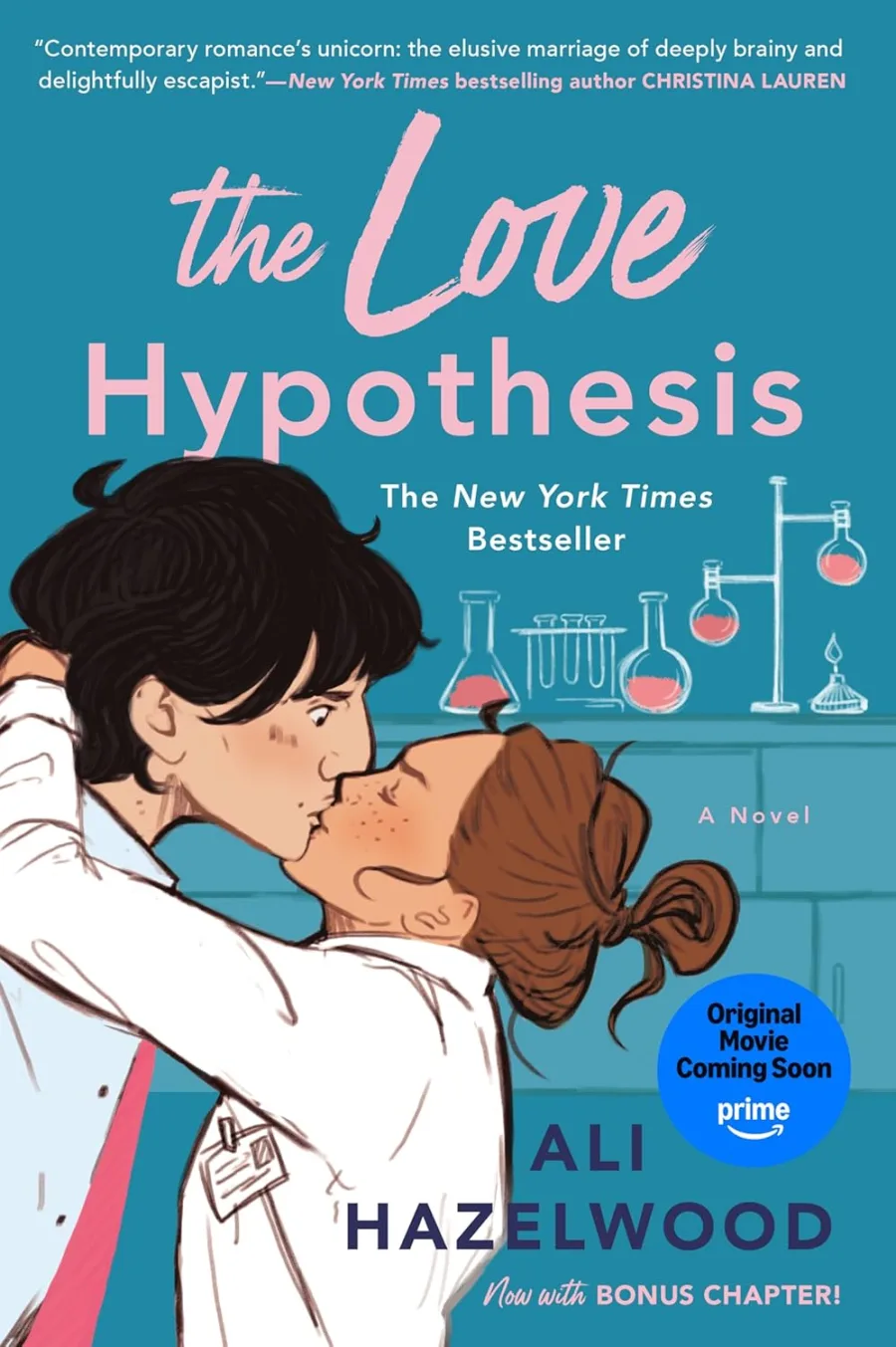
The Love Hypothesis
Paperback
• 400 Pages
• USD 16.00
• English
• 9780593336823
No ratings yet
| Publisher | Berkley |
|---|---|
| ISBN13 | 9780593336823 |
| ASIN/SKU | 0593336828 |
| Book Format | Paperback |
| Language | English |
| Pages | 400 |
| List Price | USD 16.00 |
| Publishing Date | 14/09/2021 |
| Dimensions | 5.46 x 0.84 x 8.21 inches |
| Weight | 12 ounces |
| Book Code | BD00055815 |
Buy this Book
Amazon Stores
Ebook Stores
Other Stores
Discover The Love Hypothesis by Ali Hazelwood. This book is published by Berkley in Paperback format, ISBN 9780593336823, ASIN 0593336828, under Romance, Workplace Romance, Romantic Comedy.
Book Description
The Instant New York Times Bestseller and TikTok Sensation!
When a fake relationship between scientists meets the irresistible force of attraction, it throws one woman's carefully calculated theories on love into chaos.
As a third-year Ph.D. candidate, Olive Smith doesn't believe in lasting romantic relationships—but her best friend does, and that's what got her into this situation. Convincing Anh that Olive is dating and well on her way to a happily ever after was always going to take more than hand-wavy Jedi mind tricks: Scientists require proof. So, like any self-respecting biologist, Olive panics and kisses the first man she sees.
That man is none other than Adam Carlsen, a young hotshot professor—and well-known ass. Which is why Olive is positively floored when Stanford's reigning lab tyrant agrees to keep her charade a secret and be her fake boyfriend. But when a big science conference goes haywire, putting Olive's career on the Bunsen burner, Adam surprises her again with his unyielding support and even more unyielding...six-pack abs.
Suddenly their little experiment feels dangerously close to combustion. And Olive discovers that the only thing more complicated than a hypothesis on love is putting her own heart under the microscope.
New Movie Coming Soon from Amazon MGM Studios
When a fake relationship between scientists meets the irresistible force of attraction, it throws one woman's carefully calculated theories on love into chaos.
As a third-year Ph.D. candidate, Olive Smith doesn't believe in lasting romantic relationships—but her best friend does, and that's what got her into this situation. Convincing Anh that Olive is dating and well on her way to a happily ever after was always going to take more than hand-wavy Jedi mind tricks: Scientists require proof. So, like any self-respecting biologist, Olive panics and kisses the first man she sees.
That man is none other than Adam Carlsen, a young hotshot professor—and well-known ass. Which is why Olive is positively floored when Stanford's reigning lab tyrant agrees to keep her charade a secret and be her fake boyfriend. But when a big science conference goes haywire, putting Olive's career on the Bunsen burner, Adam surprises her again with his unyielding support and even more unyielding...six-pack abs.
Suddenly their little experiment feels dangerously close to combustion. And Olive discovers that the only thing more complicated than a hypothesis on love is putting her own heart under the microscope.
New Movie Coming Soon from Amazon MGM Studios
Author Biography
Ali Hazelwood is the #1 New York Times bestselling author of Love, Theoretically and The Love Hypothesis, as well as a writer of peer-reviewed articles about brain science, in which no one makes out and the ever after is not always happy. Originally from Italy, she lived in Germany and Japan before moving to the US to pursue a PhD in neuroscience. When Ali is not at work, she can be found crocheting, eating cake pops, or watching sci-fi movies with her three feline overlords (and her slightly-less-feline husband).
Editorial Reviews
An Indie Next Pick!
"A literary breakthrough…The Love Hypothesis is a self-assured debut, and we hypothesize it's just the first bit of greatness we'll see from an author who somehow has the audacity to be both an academic powerhouse and divinely talented novelist."—Entertainment Weekly
“Contemporary romance's unicorn: the elusive marriage of deeply brainy and delightfully escapist...The Love Hypothesis has wild commercial appeal but the quieter secret is that there is a specific audience, made up of all of the Olives in the world, who have deeply, ardently waited for this exact book.”—Christina Lauren, New York Times bestselling author
“Funny, sexy and smart, Ali Hazelwood did a terrific job with The Love Hypothesis.”—Mariana Zapata, New York Times bestselling author
“This tackles one of my favorite tropes—Grumpy meets Sunshine—in a fun and utterly endearing way...I loved the nods towards fandom and romance novels, and I couldn't put it down. Highly recommended!”—Jessica Clare, New York Times bestselling author
"Pure slow-burning gold with lots of chemistry."—Popsugar
"A beautifully written romantic comedy with a heroine you will instantly fall in love with, The Love Hypothesis is destined to earn a place on your keeper shelf."—Elizabeth Everett, author of A Lady's Formula for Love
"Smart, witty dialog and a diverse cast of likable secondary characters...A realistic, amusing novel that readers won’t be able to put down."—Library Journal, starred review
"Hilarious and heartwarming, The Love Hypothesis is romantic comedy at its best...a perfect amalgamation of sex and science, sure to appeal to readers of Christina Lauren or Abby Jimenez."—Shelf Awareness
"With whip-smart and endearing characters, snappy prose, and a quirky take on a favorite trope, Hazelwood convincingly navigates the fraught shoals of academia...This smart, sexy contemporary should delight a wide swath of romance lovers."—Publishers Weekly
"A literary breakthrough…The Love Hypothesis is a self-assured debut, and we hypothesize it's just the first bit of greatness we'll see from an author who somehow has the audacity to be both an academic powerhouse and divinely talented novelist."—Entertainment Weekly
“Contemporary romance's unicorn: the elusive marriage of deeply brainy and delightfully escapist...The Love Hypothesis has wild commercial appeal but the quieter secret is that there is a specific audience, made up of all of the Olives in the world, who have deeply, ardently waited for this exact book.”—Christina Lauren, New York Times bestselling author
“Funny, sexy and smart, Ali Hazelwood did a terrific job with The Love Hypothesis.”—Mariana Zapata, New York Times bestselling author
“This tackles one of my favorite tropes—Grumpy meets Sunshine—in a fun and utterly endearing way...I loved the nods towards fandom and romance novels, and I couldn't put it down. Highly recommended!”—Jessica Clare, New York Times bestselling author
"Pure slow-burning gold with lots of chemistry."—Popsugar
"A beautifully written romantic comedy with a heroine you will instantly fall in love with, The Love Hypothesis is destined to earn a place on your keeper shelf."—Elizabeth Everett, author of A Lady's Formula for Love
"Smart, witty dialog and a diverse cast of likable secondary characters...A realistic, amusing novel that readers won’t be able to put down."—Library Journal, starred review
"Hilarious and heartwarming, The Love Hypothesis is romantic comedy at its best...a perfect amalgamation of sex and science, sure to appeal to readers of Christina Lauren or Abby Jimenez."—Shelf Awareness
"With whip-smart and endearing characters, snappy prose, and a quirky take on a favorite trope, Hazelwood convincingly navigates the fraught shoals of academia...This smart, sexy contemporary should delight a wide swath of romance lovers."—Publishers Weekly
Book Summary
The Love Hypothesis by Ali Hazelwood is a charming, funny, and emotionally warm contemporary romance set in the world of academia, following a fake-dating situation that slowly turns very real. The story centers on Olive Smith, a PhD candidate in biology at Stanford, who is smart, driven, and passionate about science but deeply uncertain about her own future and worth. Olive doesn’t come from privilege or a clear path; she’s quietly battling imposter syndrome, financial stress, and the intense pressure of trying to succeed in a competitive research environment. She’s kind, socially awkward, and often blurts out whatever comes into her head, which makes her endearing but also prone to messy situations. Her life revolves around her research on pancreatic cancer and the tight circle of friends she’s made in grad school, especially her best friend Anh.
The whole plot kicks off with a lie Olive tells to protect Anh’s happiness. Anh has a crush on a guy Olive briefly dated, and she refuses to pursue him because she believes Olive still has feelings for him. Olive, wanting Anh to stop holding back, insists that she has moved on and is seeing someone else. It’s a harmless lie meant to reassure Anh, but when she suddenly appears in the lab and demands proof, Olive panics. In a moment of pure desperation, she grabs the nearest man and kisses him. That man happens to be Dr. Adam Carlsen, a notoriously intimidating young professor in her department, known across campus as brilliant, brutally honest, and emotionally distant. Adam has a reputation for destroying students’ confidence with his harsh feedback, and Olive herself has always thought of him as the terrifying, grumpy rock star of the biology department.
Instead of freaking out, Adam plays along. He doesn’t shout, doesn’t embarrass her; instead, he calmly listens to her explanation and then agrees to pretend to be her boyfriend for a while, on the condition that it will help them both. Olive needs the fake relationship to convince Anh to date the guy she likes, and Adam has a practical reason of his own: the university thinks he’s planning to leave, and his funding is under scrutiny. Being seen as settled and happy, with personal roots, will help show he’s committed to staying. Their arrangement is professional on the surface—scheduled coffee dates, public appearances holding hands, careful displays of affection—but underneath, both of them are quietly thrown off balance. Olive can’t believe that the campus’s scariest professor is willing to help her, and Adam, who doesn’t usually tolerate nonsense, finds himself unexpectedly amused and drawn to her awkward honesty.
As Olive and Adam spend more time together, they begin to genuinely get to know each other, layer by layer. Olive sees a different side of him: a man who supports his students fiercely, who hates institutional unfairness, and who is far more thoughtful than his reputation suggests. He is still blunt and intense, but he listens when she talks about her research and takes her work seriously in a way that many people don’t. He cares about the science and seems to believe in her potential, which is something Olive desperately needs. For Adam, Olive is like a sudden source of light. She’s funny without meaning to be, dedicated, stubborn, and refreshingly straightforward. She doesn’t fawn over him or treat him like a myth; she treats him like a slightly grumpy human being, and that makes it easier for him to relax. Their fake dates start to feel like real companionship—sharing meals, talking about lab drama, joking about their roles, and gradually lowering their defenses.
Meanwhile, Olive’s life in the lab is full of pressure. She is wrestling with the reality that her groundbreaking research ideas may not fit neatly into the career paths available to her. There’s a tension between doing research she believes in and the practical constraints of funding, mentorship, and academic politics. She worries about whether she’s good enough, whether she can build a career in science, and whether her sacrifices will be worth it. Her mentors and peers, including her supportive friends Anh and Malcolm, provide a backdrop of friendship and chaos. They are protective and curious, and their interactions bring humor and warmth to the story. Olive does her best to keep the fake relationship secret from them at first, which leads to even more awkward situations and half-truths.
The emotional core of the book lies in how Olive gradually realizes that her feelings for Adam are no longer pretend. The more he shows up for her—attending seminars she’s nervous about, standing by her side in awkward social situations, treating her opinions seriously—the more she feels genuinely cared for. She begins to see that the “grumpy professor” exterior hides someone capable of deep loyalty and quiet kindness. At the same time, Adam’s feelings shift from convenience to something much more personal. He’s clearly drawn to her, though Olive struggles to believe it because of her own insecurities. She assumes he could never really want her when he has so many options and is so admired in their field. This mismatch between how they see themselves and each other creates a lot of emotional tension and slow-burning longing.
The fake-dating trope is used not just for romantic fun, but also to explore themes of trust and vulnerability. Both Olive and Adam are cautious with their hearts for different reasons. Olive has been let down before and often feels invisible, especially in a world that values glossy confidence. Adam has seen the worst of academia—the manipulation, the broken promises, the exploitation of younger scientists—and he’s wary of letting people close. As they navigate their pretend relationship, they also navigate a series of professional situations: conferences, presentations, committee decisions, and networking events. These scenes show the real stresses of graduate life and scientific careers, including sexism, power imbalances, and the way young researchers can be taken advantage of.
A major turning point comes when Olive faces a serious ethical and professional dilemma involving a senior male researcher she once trusted. He undermines her, threatens her career, and puts her in a position where speaking up could ruin everything she’s worked for. This situation forces Olive to confront how much power older academics hold and how easily they can harm junior scientists. Adam’s reaction to this conflict becomes a crucial moment that reveals his character and his feelings for her. He is furious on her behalf and refuses to let her be silenced or dismissed. His support shows Olive that she is not alone, and it also makes it impossible to pretend that their connection is just a convenient arrangement.
Throughout all of this, the book stays funny and gentle. Olive’s inner monologue is full of self-deprecating humor and nerdy references. She and Adam share silly moments—jokes about scientific clichés, awkwardly staged kisses for show, and misunderstandings that are rooted in their inability to believe they are truly lovable. The banter between them is sharp but kind, and the physical attraction slowly ramps up as they both struggle with pretending in public and trying not to act on their real feelings in private. Their chemistry feels natural and earned, built on mutual respect and the slow realization that they genuinely like each other as people.
By the end of The Love Hypothesis, Olive has grown significantly. She finds more confidence in her research, becomes braver in standing up for herself, and allows herself to believe she deserves good things—not just professionally, but also emotionally. Adam, too, opens up in ways he never expected, showing vulnerability and making it clear that he values Olive not just as a brilliant scientist, but as the person he wants to build a life with. The fake relationship that started as a desperate lie to help a friend transforms into a deeply real partnership rooted in trust, support, and shared passion for science. The book closes with a sense of hope and balance, suggesting that love and career do not have to be mutually exclusive, and that two flawed, earnest people can find something extraordinary together in the middle of lab benches, grant applications, and crowded lecture halls.
The whole plot kicks off with a lie Olive tells to protect Anh’s happiness. Anh has a crush on a guy Olive briefly dated, and she refuses to pursue him because she believes Olive still has feelings for him. Olive, wanting Anh to stop holding back, insists that she has moved on and is seeing someone else. It’s a harmless lie meant to reassure Anh, but when she suddenly appears in the lab and demands proof, Olive panics. In a moment of pure desperation, she grabs the nearest man and kisses him. That man happens to be Dr. Adam Carlsen, a notoriously intimidating young professor in her department, known across campus as brilliant, brutally honest, and emotionally distant. Adam has a reputation for destroying students’ confidence with his harsh feedback, and Olive herself has always thought of him as the terrifying, grumpy rock star of the biology department.
Instead of freaking out, Adam plays along. He doesn’t shout, doesn’t embarrass her; instead, he calmly listens to her explanation and then agrees to pretend to be her boyfriend for a while, on the condition that it will help them both. Olive needs the fake relationship to convince Anh to date the guy she likes, and Adam has a practical reason of his own: the university thinks he’s planning to leave, and his funding is under scrutiny. Being seen as settled and happy, with personal roots, will help show he’s committed to staying. Their arrangement is professional on the surface—scheduled coffee dates, public appearances holding hands, careful displays of affection—but underneath, both of them are quietly thrown off balance. Olive can’t believe that the campus’s scariest professor is willing to help her, and Adam, who doesn’t usually tolerate nonsense, finds himself unexpectedly amused and drawn to her awkward honesty.
As Olive and Adam spend more time together, they begin to genuinely get to know each other, layer by layer. Olive sees a different side of him: a man who supports his students fiercely, who hates institutional unfairness, and who is far more thoughtful than his reputation suggests. He is still blunt and intense, but he listens when she talks about her research and takes her work seriously in a way that many people don’t. He cares about the science and seems to believe in her potential, which is something Olive desperately needs. For Adam, Olive is like a sudden source of light. She’s funny without meaning to be, dedicated, stubborn, and refreshingly straightforward. She doesn’t fawn over him or treat him like a myth; she treats him like a slightly grumpy human being, and that makes it easier for him to relax. Their fake dates start to feel like real companionship—sharing meals, talking about lab drama, joking about their roles, and gradually lowering their defenses.
Meanwhile, Olive’s life in the lab is full of pressure. She is wrestling with the reality that her groundbreaking research ideas may not fit neatly into the career paths available to her. There’s a tension between doing research she believes in and the practical constraints of funding, mentorship, and academic politics. She worries about whether she’s good enough, whether she can build a career in science, and whether her sacrifices will be worth it. Her mentors and peers, including her supportive friends Anh and Malcolm, provide a backdrop of friendship and chaos. They are protective and curious, and their interactions bring humor and warmth to the story. Olive does her best to keep the fake relationship secret from them at first, which leads to even more awkward situations and half-truths.
The emotional core of the book lies in how Olive gradually realizes that her feelings for Adam are no longer pretend. The more he shows up for her—attending seminars she’s nervous about, standing by her side in awkward social situations, treating her opinions seriously—the more she feels genuinely cared for. She begins to see that the “grumpy professor” exterior hides someone capable of deep loyalty and quiet kindness. At the same time, Adam’s feelings shift from convenience to something much more personal. He’s clearly drawn to her, though Olive struggles to believe it because of her own insecurities. She assumes he could never really want her when he has so many options and is so admired in their field. This mismatch between how they see themselves and each other creates a lot of emotional tension and slow-burning longing.
The fake-dating trope is used not just for romantic fun, but also to explore themes of trust and vulnerability. Both Olive and Adam are cautious with their hearts for different reasons. Olive has been let down before and often feels invisible, especially in a world that values glossy confidence. Adam has seen the worst of academia—the manipulation, the broken promises, the exploitation of younger scientists—and he’s wary of letting people close. As they navigate their pretend relationship, they also navigate a series of professional situations: conferences, presentations, committee decisions, and networking events. These scenes show the real stresses of graduate life and scientific careers, including sexism, power imbalances, and the way young researchers can be taken advantage of.
A major turning point comes when Olive faces a serious ethical and professional dilemma involving a senior male researcher she once trusted. He undermines her, threatens her career, and puts her in a position where speaking up could ruin everything she’s worked for. This situation forces Olive to confront how much power older academics hold and how easily they can harm junior scientists. Adam’s reaction to this conflict becomes a crucial moment that reveals his character and his feelings for her. He is furious on her behalf and refuses to let her be silenced or dismissed. His support shows Olive that she is not alone, and it also makes it impossible to pretend that their connection is just a convenient arrangement.
Throughout all of this, the book stays funny and gentle. Olive’s inner monologue is full of self-deprecating humor and nerdy references. She and Adam share silly moments—jokes about scientific clichés, awkwardly staged kisses for show, and misunderstandings that are rooted in their inability to believe they are truly lovable. The banter between them is sharp but kind, and the physical attraction slowly ramps up as they both struggle with pretending in public and trying not to act on their real feelings in private. Their chemistry feels natural and earned, built on mutual respect and the slow realization that they genuinely like each other as people.
By the end of The Love Hypothesis, Olive has grown significantly. She finds more confidence in her research, becomes braver in standing up for herself, and allows herself to believe she deserves good things—not just professionally, but also emotionally. Adam, too, opens up in ways he never expected, showing vulnerability and making it clear that he values Olive not just as a brilliant scientist, but as the person he wants to build a life with. The fake relationship that started as a desperate lie to help a friend transforms into a deeply real partnership rooted in trust, support, and shared passion for science. The book closes with a sense of hope and balance, suggesting that love and career do not have to be mutually exclusive, and that two flawed, earnest people can find something extraordinary together in the middle of lab benches, grant applications, and crowded lecture halls.
Sample Chapters
Sample Chapters will be added soon…
Reader Reviews
No reviews yet.
The Love Hypothesis
Download Cover Image
Do you want to download the full cover image for The Love Hypothesis?