
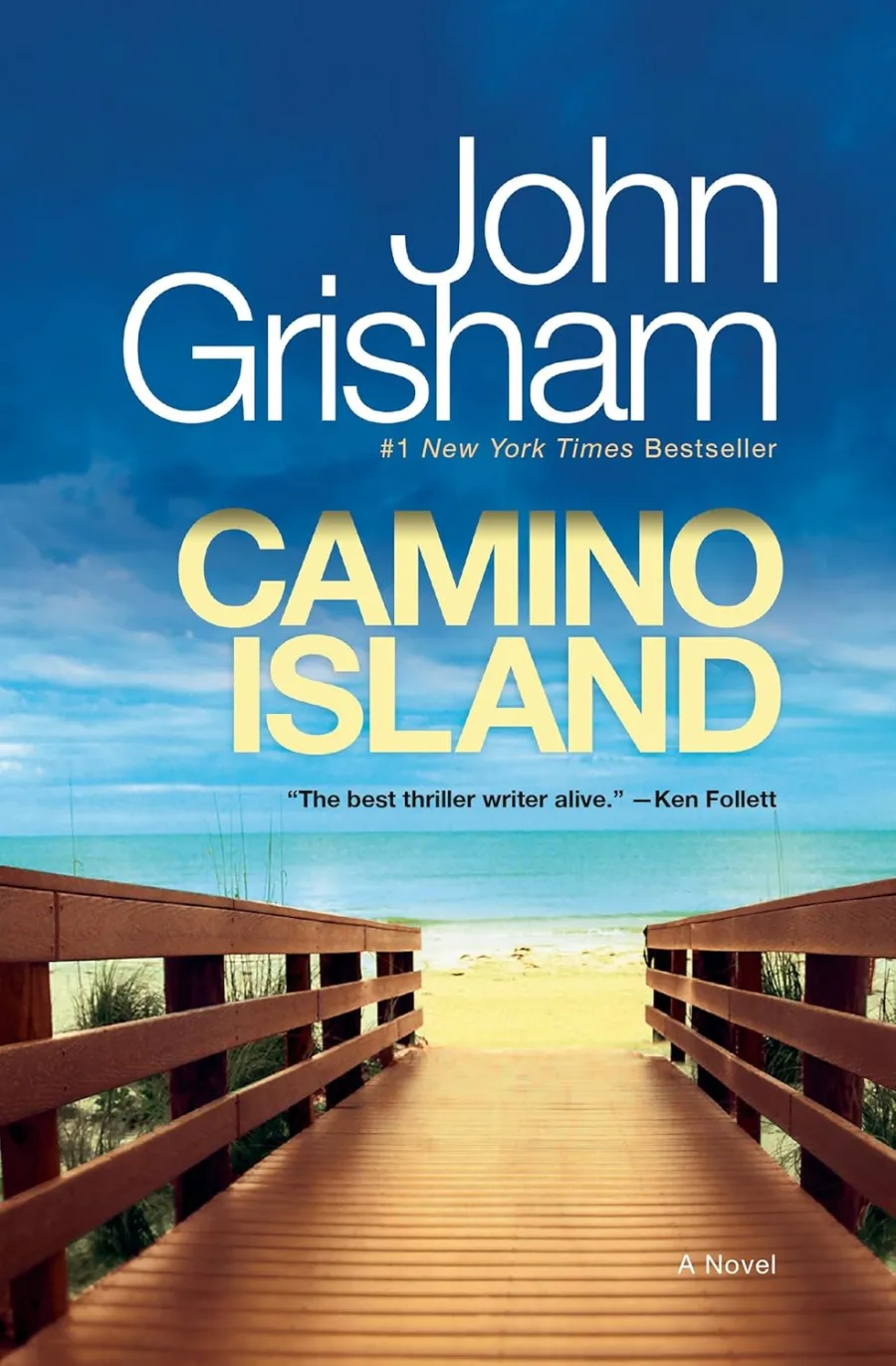
Camino Island: A Novel
Paperback
• 304 Pages
• USD 18.00
• English
• 9781524797140
No ratings yet
| Publisher | Vintage |
|---|---|
| ISBN13 | 9781524797140 |
| ASIN/SKU | 1524797146 |
| Book Format | Paperback |
| Language | English |
| Pages | 304 |
| List Price | USD 18.00 |
| Publishing Date | 06/03/2018 |
| Dimensions | 5.3 x 0.6 x 8 inches |
| Weight | 8.8 ounces |
| Book Code | BD00055856 |
Buy this Book
Amazon Stores
Ebook Stores
Other Stores
Discover Camino Island: A Novel by John Grisham. This book is published by Vintage in Paperback format, ISBN 9781524797140, ASIN 1524797146, under Mystery, Thriller and Suspense, Legal Thrillers, Science Fiction Crime and Mystery.
Book Description
#1 NEW YORK TIMES BESTSELLER • Soak up the sun—and the intrigue—with the first novel in John Grisham’s beloved Camino series.
“A happy lark [that] provides the pleasure of a leisurely jaunt periodically jolted into high gear, just for the fun and speed of it.”—The New York Times Book Review
A gang of thieves stage a daring heist from a secure vault deep below Princeton University’s Firestone Library. Their loot is priceless, but Princeton has insured it for twenty-five million dollars.
Bruce Cable owns a popular bookstore in the sleepy resort town of Santa Rosa on Camino Island in Florida. He makes his real money, though, as a prominent dealer in rare books. Very few people know that he occasionally dabbles in the black market of stolen books and manuscripts.
Mercer Mann is a young novelist with a severe case of writer’s block who has recently been laid off from her teaching position. She is approached by an elegant, mysterious woman working for an even more mysterious company. A generous offer of money convinces Mercer to go undercover and infiltrate Bruce Cable’s circle of literary friends, ideally getting close enough to him to learn his secrets.
But eventually Mercer learns far too much, and there’s trouble in paradise as only John Grisham can deliver it.
Look for all of John Grisham’s rollicking Camino novels:
Camino Island
Camino Winds
Camino Ghosts
“A happy lark [that] provides the pleasure of a leisurely jaunt periodically jolted into high gear, just for the fun and speed of it.”—The New York Times Book Review
A gang of thieves stage a daring heist from a secure vault deep below Princeton University’s Firestone Library. Their loot is priceless, but Princeton has insured it for twenty-five million dollars.
Bruce Cable owns a popular bookstore in the sleepy resort town of Santa Rosa on Camino Island in Florida. He makes his real money, though, as a prominent dealer in rare books. Very few people know that he occasionally dabbles in the black market of stolen books and manuscripts.
Mercer Mann is a young novelist with a severe case of writer’s block who has recently been laid off from her teaching position. She is approached by an elegant, mysterious woman working for an even more mysterious company. A generous offer of money convinces Mercer to go undercover and infiltrate Bruce Cable’s circle of literary friends, ideally getting close enough to him to learn his secrets.
But eventually Mercer learns far too much, and there’s trouble in paradise as only John Grisham can deliver it.
Look for all of John Grisham’s rollicking Camino novels:
Camino Island
Camino Winds
Camino Ghosts
Author Biography
John Grisham is the author of numerous #1 bestsellers, including The Firm, A Time to Kill, The Rainmaker, The Innocent Man, The Whistler, The Boys from Biloxi, and many more. His books have been translated into nearly fifty languages. Grisham is a two-time winner of the Harper Lee Prize for Legal Fiction and was honored with the Library of Congress Creative Achievement Award for Fiction. Grisham serves on the board of directors of the Innocence Project and Centurion Ministries, two national organizations dedicated to exonerating those who have been wrongfully convicted. Much of his fiction explores deep-seated problems in our criminal justice system. He lives on a farm in central Virginia.
Editorial Reviews
“A delightfully lighthearted caper . . . [a] fast-moving, entertaining tale.”—Pittsburgh Post-Gazette
“A happy lark [that] provides the pleasure of a leisurely jaunt periodically jolted into high gear, just for the fun and speed of it.”—The New York Times Book Review
“Sheer catnip . . . [Grisham] reveals an amiable, sardonic edge here that makes Camino Island a most agreeable summer destination.”—USA Today
“Fans will thrill with the classic chase and satisfying ending; and book lovers will wallow in ecstasy.”—The Florida Times-Union
“Grisham weaves an engaging story, with enough plot twists and hints of danger and past secrets to keep the reader involved. And for aspiring writers, he includes tidbits about publishing and book selling that provide the kind of insider’s feel that only an established author might know.”—St. Louis Post-Dispatch
“Grisham twists the expected into a set of cascading surprises that fooled and entertained this reader just as he does in his legal thrillers.”—Winston-Salem Journal
“A happy lark [that] provides the pleasure of a leisurely jaunt periodically jolted into high gear, just for the fun and speed of it.”—The New York Times Book Review
“Sheer catnip . . . [Grisham] reveals an amiable, sardonic edge here that makes Camino Island a most agreeable summer destination.”—USA Today
“Fans will thrill with the classic chase and satisfying ending; and book lovers will wallow in ecstasy.”—The Florida Times-Union
“Grisham weaves an engaging story, with enough plot twists and hints of danger and past secrets to keep the reader involved. And for aspiring writers, he includes tidbits about publishing and book selling that provide the kind of insider’s feel that only an established author might know.”—St. Louis Post-Dispatch
“Grisham twists the expected into a set of cascading surprises that fooled and entertained this reader just as he does in his legal thrillers.”—Winston-Salem Journal
Book Summary
Camino Island by John Grisham is a light, fast-paced literary caper that blends book-world gossip, art theft, and a bit of amateur sleuthing. The story begins with a daring heist at Princeton University, where a small group of thieves steal F. Scott Fitzgerald’s priceless original manuscripts. The robbery is carefully planned and executed, but almost immediately things start to unravel. One of the thieves is killed, others are arrested, and the manuscripts vanish into the shadowy rare-book underground. The authorities, the FBI, and a powerful insurance company are desperate to recover these irreplaceable treasures, not just for the money but for the cultural value they hold. The insurance company, believing that official channels may be too slow and too obvious, decides to try a quieter, more creative approach. That decision eventually leads them to a small island off the coast of Florida and to a man named Bruce Cable.
Bruce Cable owns Bay Books, a charming independent bookstore on Camino Island, a fictional spot that feels like a mix of coastal resort, sleepy town, and secret refuge for writers. On the surface, Bruce is the perfect local celebrity: he hosts readings and signings, champions authors, knows everyone, and runs a thriving store even in the age of Amazon. He is charismatic, stylish, and just a little flamboyant, married to an art dealer, and known for hosting lively parties for the island’s community of writers. But Bruce has a less visible side. He is also rumored to be involved in the rare-book trade in ways that are not entirely legal. Over the years, he has quietly bought and sold valuable first editions, letters, and manuscripts that might not have the cleanest provenance. The insurance company suspects that the stolen Fitzgerald manuscripts may have passed through, or be resting in, Bruce’s orbit. They cannot prove it, and they cannot simply raid his store, so they decide to send in someone who can get close to him without raising suspicion.
That someone is Mercer Mann, a young novelist whose promising career has stalled. Mercer published a well-regarded debut novel years ago but has since struggled with writer’s block, grief over her past, and money problems. She is working an unsatisfying teaching job and carrying student debt when a mysterious woman from the insurance company approaches her with an offer. They know Mercer spent childhood summers on Camino Island and that she knows the area well. They also know she is a writer—someone who could plausibly be drawn into Bruce Cable’s social circle. They propose a deal: if Mercer agrees to move back to the island for a few months, pretend she is working on a new novel, and quietly investigate Bruce to find out if he has the Fitzgerald manuscripts, they will pay off her debts and give her enough money to get back on her feet. Mercer is uneasy about spying, but the financial temptation and the pull of returning to the island of her youth finally sway her.
When Mercer arrives on Camino Island, the book shifts into a gentler, more atmospheric mode. We see the island through her eyes: the beaches, the summer crowds, the tourist shops, and, most importantly, the small group of eccentric writers who live there year-round. Bruce is at the center of it all, a kind of unofficial king of the local literary scene. He flirts, flatters, and charms; he praises Mercer’s old book and nudges her to write again. He invites her to dinners and parties where authors drink too much, gossip about agents and publishers, and complain about reviews and sales. Grisham clearly enjoys this side of the story: there is a lot of insider talk about the publishing industry, bestselling trends, and the precarious lives of midlist writers. Mercer finds herself drawn into this world, half as an infiltrator and half as someone who genuinely enjoys it. She feels both guilty about her secret mission and excited to be treated again as a “real writer” instead of a burned-out teacher.
As she gets closer to Bruce, Mercer slowly tries to learn more about his rare-book dealings. She explores parts of the bookstore not open to the public, hears stories about his impressive private collection, and notices security measures that suggest something of great value might be hidden there. Bruce, for his part, is not stupid. He suspects people might be interested in his activities, and Grisham keeps their relationship layered: is Bruce genuinely fond of Mercer, or does he see her as yet another piece in his game? The tension is subtle rather than violent. There are no bloody confrontations; instead, the suspense arises from whether Mercer will discover the truth, whether Bruce will catch on to her spying, and what she will do with what she learns. Mercer is not a professional agent. She hesitates, makes mistakes, and wonders if she is in over her head, especially as she starts to like Bruce and appreciate what he has built on the island.
In the background, the stolen manuscripts remain a ticking clock. The insurance company wants results, and Mercer keeps feeding them small updates. The official investigation is moving too, occasionally intersecting with her efforts. There is always the risk that if Bruce does have the manuscripts and realizes he is being watched, he might move them or sell them to someone even more secretive. Grisham uses the Fitzgerald material to remind the reader that this is not just about money; these are pieces of literary history, and losing them would be a cultural tragedy. At the same time, Bruce’s perspective complicates things a little. He sees himself as a kind of guardian of rare books, someone who genuinely loves literature, even as he skirts the law. The novel plays with that ambiguity: Bruce is not a simple villain, but neither is he an innocent book lover.
Mercer’s personal arc becomes as important as the crime plot. Being back on Camino Island stirs memories of her childhood and her late grandmother, who had a house there. She reconnects with the place, finds a rhythm to her days, and, somewhat unexpectedly, starts writing again. The act of spying and pretending to work on a book slowly leads her to genuinely work on a book. She begins to rediscover her voice, her confidence, and the creative spark that had gone missing. This dual track—her mission and her recovery as a writer—gives the story emotional weight. The question shifts from just “Will the manuscripts be recovered?” to “What kind of person does Mercer want to be?” If she succeeds and exposes Bruce, she might destroy a man who, despite his crimes, has given a lot to the literary community and helped her regain her footing. If she fails or walks away, she betrays the deal she made and leaves the manuscripts lost.
Eventually, Mercer uncovers enough to confirm that Bruce has ties to the stolen Fitzgerald work, and the pieces of the heist fall into place. The resolution unfolds with legal pressure, deals, and discreet maneuvers rather than shootouts or dramatic arrests. Grisham keeps it in the realm of clever negotiation, quiet leverage, and behind-the-scenes agreements. The manuscripts’ fate is resolved in a way that feels plausible for a story about wealthy collectors and institutions eager to avoid scandal. Mercer, having played her role, must live with the moral compromises she made and the relationships she formed under false pretenses. Yet she also emerges changed: financially freer, creatively revived, and more honest about what she wants from her life and career.
Camino Island is less about complex legal strategies and more about the intersection of crime, books, and identity. It reads like a summer novel, with breezy scenes of bookstores, beaches, and writers behaving badly, wrapped around a central art-theft mystery. Through Bruce Cable and Mercer Mann, Grisham explores how far people will go for rare, beautiful objects and how the literary world, for all its talk of art and ideals, is still deeply entangled with money, ego, and power. In the end, the book leaves you with the feeling of having spent time in a slightly shady, very bookish little world where the stakes are high but the violence is mostly offstage, and where even a morally messy adventure can push someone toward a more authentic version of themselves.
Bruce Cable owns Bay Books, a charming independent bookstore on Camino Island, a fictional spot that feels like a mix of coastal resort, sleepy town, and secret refuge for writers. On the surface, Bruce is the perfect local celebrity: he hosts readings and signings, champions authors, knows everyone, and runs a thriving store even in the age of Amazon. He is charismatic, stylish, and just a little flamboyant, married to an art dealer, and known for hosting lively parties for the island’s community of writers. But Bruce has a less visible side. He is also rumored to be involved in the rare-book trade in ways that are not entirely legal. Over the years, he has quietly bought and sold valuable first editions, letters, and manuscripts that might not have the cleanest provenance. The insurance company suspects that the stolen Fitzgerald manuscripts may have passed through, or be resting in, Bruce’s orbit. They cannot prove it, and they cannot simply raid his store, so they decide to send in someone who can get close to him without raising suspicion.
That someone is Mercer Mann, a young novelist whose promising career has stalled. Mercer published a well-regarded debut novel years ago but has since struggled with writer’s block, grief over her past, and money problems. She is working an unsatisfying teaching job and carrying student debt when a mysterious woman from the insurance company approaches her with an offer. They know Mercer spent childhood summers on Camino Island and that she knows the area well. They also know she is a writer—someone who could plausibly be drawn into Bruce Cable’s social circle. They propose a deal: if Mercer agrees to move back to the island for a few months, pretend she is working on a new novel, and quietly investigate Bruce to find out if he has the Fitzgerald manuscripts, they will pay off her debts and give her enough money to get back on her feet. Mercer is uneasy about spying, but the financial temptation and the pull of returning to the island of her youth finally sway her.
When Mercer arrives on Camino Island, the book shifts into a gentler, more atmospheric mode. We see the island through her eyes: the beaches, the summer crowds, the tourist shops, and, most importantly, the small group of eccentric writers who live there year-round. Bruce is at the center of it all, a kind of unofficial king of the local literary scene. He flirts, flatters, and charms; he praises Mercer’s old book and nudges her to write again. He invites her to dinners and parties where authors drink too much, gossip about agents and publishers, and complain about reviews and sales. Grisham clearly enjoys this side of the story: there is a lot of insider talk about the publishing industry, bestselling trends, and the precarious lives of midlist writers. Mercer finds herself drawn into this world, half as an infiltrator and half as someone who genuinely enjoys it. She feels both guilty about her secret mission and excited to be treated again as a “real writer” instead of a burned-out teacher.
As she gets closer to Bruce, Mercer slowly tries to learn more about his rare-book dealings. She explores parts of the bookstore not open to the public, hears stories about his impressive private collection, and notices security measures that suggest something of great value might be hidden there. Bruce, for his part, is not stupid. He suspects people might be interested in his activities, and Grisham keeps their relationship layered: is Bruce genuinely fond of Mercer, or does he see her as yet another piece in his game? The tension is subtle rather than violent. There are no bloody confrontations; instead, the suspense arises from whether Mercer will discover the truth, whether Bruce will catch on to her spying, and what she will do with what she learns. Mercer is not a professional agent. She hesitates, makes mistakes, and wonders if she is in over her head, especially as she starts to like Bruce and appreciate what he has built on the island.
In the background, the stolen manuscripts remain a ticking clock. The insurance company wants results, and Mercer keeps feeding them small updates. The official investigation is moving too, occasionally intersecting with her efforts. There is always the risk that if Bruce does have the manuscripts and realizes he is being watched, he might move them or sell them to someone even more secretive. Grisham uses the Fitzgerald material to remind the reader that this is not just about money; these are pieces of literary history, and losing them would be a cultural tragedy. At the same time, Bruce’s perspective complicates things a little. He sees himself as a kind of guardian of rare books, someone who genuinely loves literature, even as he skirts the law. The novel plays with that ambiguity: Bruce is not a simple villain, but neither is he an innocent book lover.
Mercer’s personal arc becomes as important as the crime plot. Being back on Camino Island stirs memories of her childhood and her late grandmother, who had a house there. She reconnects with the place, finds a rhythm to her days, and, somewhat unexpectedly, starts writing again. The act of spying and pretending to work on a book slowly leads her to genuinely work on a book. She begins to rediscover her voice, her confidence, and the creative spark that had gone missing. This dual track—her mission and her recovery as a writer—gives the story emotional weight. The question shifts from just “Will the manuscripts be recovered?” to “What kind of person does Mercer want to be?” If she succeeds and exposes Bruce, she might destroy a man who, despite his crimes, has given a lot to the literary community and helped her regain her footing. If she fails or walks away, she betrays the deal she made and leaves the manuscripts lost.
Eventually, Mercer uncovers enough to confirm that Bruce has ties to the stolen Fitzgerald work, and the pieces of the heist fall into place. The resolution unfolds with legal pressure, deals, and discreet maneuvers rather than shootouts or dramatic arrests. Grisham keeps it in the realm of clever negotiation, quiet leverage, and behind-the-scenes agreements. The manuscripts’ fate is resolved in a way that feels plausible for a story about wealthy collectors and institutions eager to avoid scandal. Mercer, having played her role, must live with the moral compromises she made and the relationships she formed under false pretenses. Yet she also emerges changed: financially freer, creatively revived, and more honest about what she wants from her life and career.
Camino Island is less about complex legal strategies and more about the intersection of crime, books, and identity. It reads like a summer novel, with breezy scenes of bookstores, beaches, and writers behaving badly, wrapped around a central art-theft mystery. Through Bruce Cable and Mercer Mann, Grisham explores how far people will go for rare, beautiful objects and how the literary world, for all its talk of art and ideals, is still deeply entangled with money, ego, and power. In the end, the book leaves you with the feeling of having spent time in a slightly shady, very bookish little world where the stakes are high but the violence is mostly offstage, and where even a morally messy adventure can push someone toward a more authentic version of themselves.
Sample Chapters
Sample Chapters will be added soon…
Reader Reviews
No reviews yet.
Camino Island: A Novel
Download Cover Image
Do you want to download the full cover image for Camino Island: A Novel?