
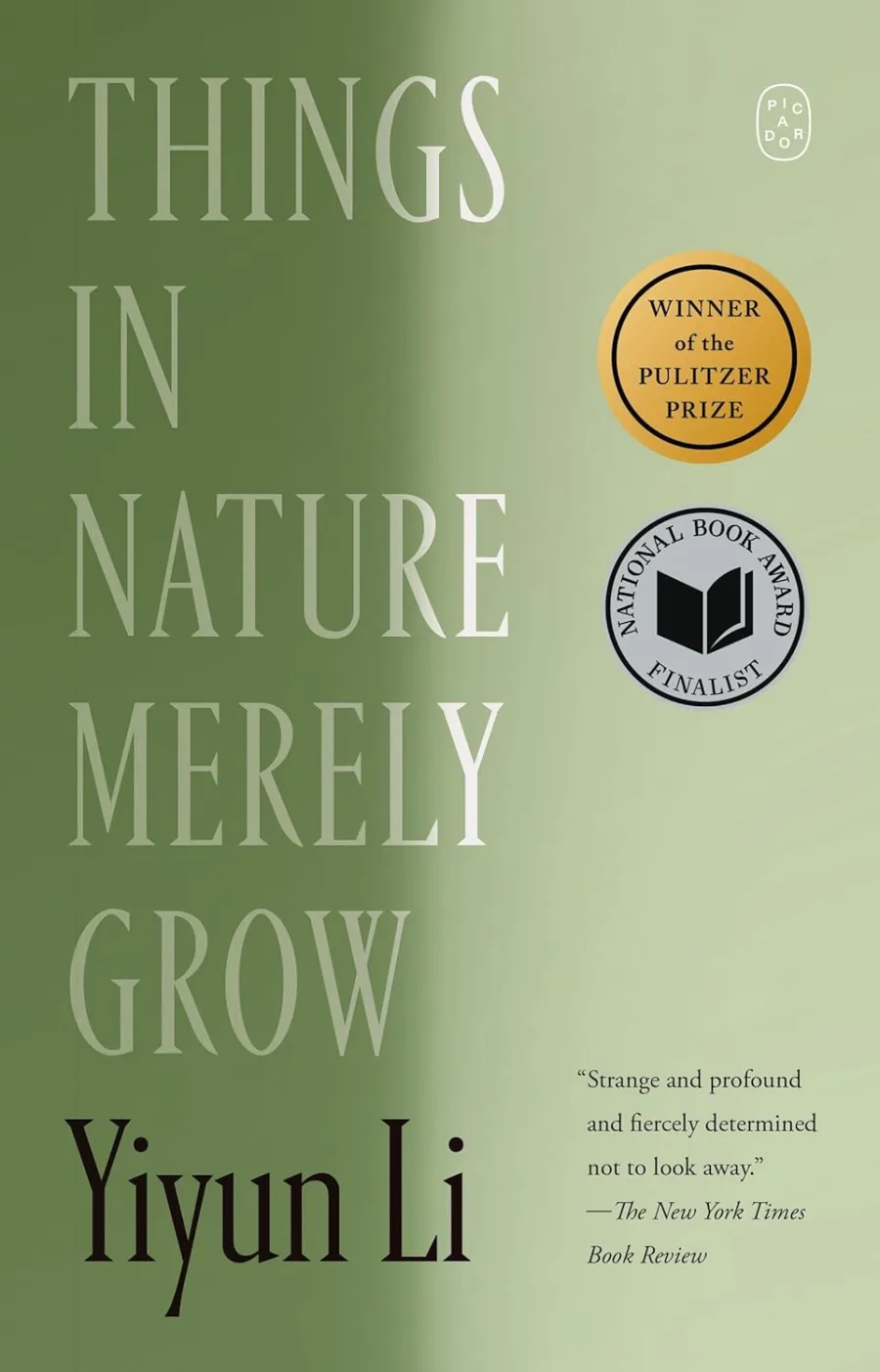
Things in Nature Merely Grow
Paperback
• 192 Pages
• USD 17.99
• English
• 9781250437976
No ratings yet
| Publisher | Picador |
|---|---|
| ISBN13 | 9781250437976 |
| ASIN/SKU | 1250437970 |
| Book Format | Paperback |
| Language | English |
| Pages | 192 |
| List Price | USD 17.99 |
| Publishing Date | 19/05/2026 |
| Dimensions | 5.35 x 0.45 x 8.25 inches |
| Weight | 1 pounds |
| Book Code | BD00055889 |
Buy this Book
Amazon Stores
Ebook Stores
Other Stores
Discover Things in Nature Merely Grow by Yiyun Li. This book is published by Picador in Paperback format, ISBN 9781250437976, ASIN 1250437970, under Literature and Fiction, Grief and Bereavement, Essays.
Book Description
WINNER OF THE PULITZER PRIZE FOR MEMOIR/AUTOBIOGRAPHY
FINALIST FOR THE NATIONAL BOOK AWARD FOR NONFICTION
Winner of the Andrew Carnegie Medal for Excellence in Nonfiction
Finalist for the PEN/Jean Stein Book Award
Long-listed for the National Book Critics Circle Award for Autobiography
One of the New York Times Notable Books of the Year
Yiyun Li’s remarkable, defiant work of radical acceptance as she considers the loss of her son James.
“There is no good way to say this,” Yiyun Li writes at the beginning of this book.
“There is no good way to state these facts, which must be acknowledged . . . My husband and I had two children and lost them both: Vincent in 2017, at sixteen, James in 2024, at nineteen. Both chose suicide, and both died not far from home.”
There is no good way to say this―because words fall short. It takes only an instant for death to become fact, “a single point in a time line.” Living now on this single point, Li turns to thinking and reasoning and searching for words that might hold a place for James. Li does what she can: doing “things that work,” including not just writing but gardening, reading Camus and Wittgenstein, learning the piano, and living thinkingly alongside death.
This is a book for James, but it is not a book about grieving or mourning. As Li writes, “The verb that does not die is ‘to be.’ Vincent was and is and will always be Vincent. James was and is and will always be James. We were and are and will always be their parents. There is no now and then, now and later; only now and now and now and now.” Things in Nature Merely Grow is a testament to Li’s indomitable spirit.
FINALIST FOR THE NATIONAL BOOK AWARD FOR NONFICTION
Winner of the Andrew Carnegie Medal for Excellence in Nonfiction
Finalist for the PEN/Jean Stein Book Award
Long-listed for the National Book Critics Circle Award for Autobiography
One of the New York Times Notable Books of the Year
Yiyun Li’s remarkable, defiant work of radical acceptance as she considers the loss of her son James.
“There is no good way to say this,” Yiyun Li writes at the beginning of this book.
“There is no good way to state these facts, which must be acknowledged . . . My husband and I had two children and lost them both: Vincent in 2017, at sixteen, James in 2024, at nineteen. Both chose suicide, and both died not far from home.”
There is no good way to say this―because words fall short. It takes only an instant for death to become fact, “a single point in a time line.” Living now on this single point, Li turns to thinking and reasoning and searching for words that might hold a place for James. Li does what she can: doing “things that work,” including not just writing but gardening, reading Camus and Wittgenstein, learning the piano, and living thinkingly alongside death.
This is a book for James, but it is not a book about grieving or mourning. As Li writes, “The verb that does not die is ‘to be.’ Vincent was and is and will always be Vincent. James was and is and will always be James. We were and are and will always be their parents. There is no now and then, now and later; only now and now and now and now.” Things in Nature Merely Grow is a testament to Li’s indomitable spirit.
Author Biography
Yiyun Li is the author of several works of fiction―Wednesday’s Child; The Book of Goose; Must I Go; Where Reasons End; Kinder Than Solitude; Gold Boy, Emerald Girl; The Vagrants; and A
Thousand Years of Good Prayers―and the memoirs Things in Nature Merely Grow and Dear Friend, from My Life I Write to You in Your Life. She is the recipient of many awards, including a Pulitzer Prize, a PEN/Faulkner Award, a PEN/Malamud Award, a PEN/Hemingway Award, a PEN/Jean Stein Book Award, a MacArthur Fellowship, and a Windham–Campbell Prize, and was a finalist for the National Book Award. Her work has appeared in The New Yorker, A Public Space, The Best American Short Stories, and The PEN/O. Henry Prize Stories, among other
publications. She teaches at Princeton University and lives in Princeton, New Jersey.
Thousand Years of Good Prayers―and the memoirs Things in Nature Merely Grow and Dear Friend, from My Life I Write to You in Your Life. She is the recipient of many awards, including a Pulitzer Prize, a PEN/Faulkner Award, a PEN/Malamud Award, a PEN/Hemingway Award, a PEN/Jean Stein Book Award, a MacArthur Fellowship, and a Windham–Campbell Prize, and was a finalist for the National Book Award. Her work has appeared in The New Yorker, A Public Space, The Best American Short Stories, and The PEN/O. Henry Prize Stories, among other
publications. She teaches at Princeton University and lives in Princeton, New Jersey.
Editorial Reviews
“A writer’s deeply moving and revelatory account of losing her younger son to suicide a little more than six years after her older son died in the same manner, an austere and defiant memoir of acceptance that focuses on facts, language and the persistence of life.”
―2026 Pulitzer Prize Judges’ Citation
“A memoir unlike others, strange and profound and fiercely determined not to look away.”
―The New York Times (Best Books of the Year So Far)
“A work of genius.”
―Medaya Ocher, Los Angeles Review of Books (Best Books of the Year)
“To be in Li’s head is a rare privilege―she is a writer of elegance and clarity and is a deeply interesting thinker. And the book, surprisingly, is not sad. It is moving and even funny in places as she writes about her wonderful friends, a few awful strangers, but most of all her extraordinary sons. You may find yourself transformed after reading it. I did.”
―Barrie Hardymon, NPR
“By refusing to dwell on the maudlin, Li captures an even more difficult emotional truth: how to accept and live with unimaginable tragedy.”
―Jen Lennon, The AV Club
“Transcendent . . . In sparing prose that cuts deeply, Li examines the relationship between language and loss, honoring the sons who she carries with her, always.”
―Annabel Gutterman, Time (Best Books of the Year So Far)
“A meditative, unflinching exploration of loss . . . Li writes beautifully and honestly about this very thing, about how a person continues through the ‘now and now and now and now’ of life after tragedy.”
―Isle McElroy, New York (Best Books of the Year So Far)
“In direct and unsparing reflections, Li confronts not only the loss of her children but the limits of language, as she tries to convey anguish that defies description.”
―Alexandra Alter, The New York Times
“An ethereal memorial . . . Li quietly guides us through the devastation of living, and mothering, after death . . . She delivers an extraordinarily intellectual undertaking that transforms the motherhood memoir, always a fraught genre . . . A mother, she writes, cannot keep a child alive. In writing like Li’s, however, even absent children can live on.”
―Courtney Tenz, The Washington Post
“A tribute to radical acceptance and the lasting power of memory.”
―Clare Mulroy, USA Today
“Unbearably poignant . . . Vital and tenderly written.”
―Michael Magras, Shelf Awareness
“[Things in Nature Merely Grow] stuns with its lucidity . . . What is most striking about Li’s book [is] not her grief, but her ability to move beyond guilt to understand ‘that a mother could do all things humanly possible and sensible for a child but still could not keep him alive.’”
―Vikas Turakhia, The Minnesota Star Tribune
“[Li] is a master of words, a master of making ideas flow flawlessly from thought to paper . . . No matter where you stand on grief―whether you’re entirely free of it, drowning in it, or somewhere in between―I suggest letting Yiyun Li’s words wash over you, for in this tribute you may just find something in whi
―2026 Pulitzer Prize Judges’ Citation
“A memoir unlike others, strange and profound and fiercely determined not to look away.”
―The New York Times (Best Books of the Year So Far)
“A work of genius.”
―Medaya Ocher, Los Angeles Review of Books (Best Books of the Year)
“To be in Li’s head is a rare privilege―she is a writer of elegance and clarity and is a deeply interesting thinker. And the book, surprisingly, is not sad. It is moving and even funny in places as she writes about her wonderful friends, a few awful strangers, but most of all her extraordinary sons. You may find yourself transformed after reading it. I did.”
―Barrie Hardymon, NPR
“By refusing to dwell on the maudlin, Li captures an even more difficult emotional truth: how to accept and live with unimaginable tragedy.”
―Jen Lennon, The AV Club
“Transcendent . . . In sparing prose that cuts deeply, Li examines the relationship between language and loss, honoring the sons who she carries with her, always.”
―Annabel Gutterman, Time (Best Books of the Year So Far)
“A meditative, unflinching exploration of loss . . . Li writes beautifully and honestly about this very thing, about how a person continues through the ‘now and now and now and now’ of life after tragedy.”
―Isle McElroy, New York (Best Books of the Year So Far)
“In direct and unsparing reflections, Li confronts not only the loss of her children but the limits of language, as she tries to convey anguish that defies description.”
―Alexandra Alter, The New York Times
“An ethereal memorial . . . Li quietly guides us through the devastation of living, and mothering, after death . . . She delivers an extraordinarily intellectual undertaking that transforms the motherhood memoir, always a fraught genre . . . A mother, she writes, cannot keep a child alive. In writing like Li’s, however, even absent children can live on.”
―Courtney Tenz, The Washington Post
“A tribute to radical acceptance and the lasting power of memory.”
―Clare Mulroy, USA Today
“Unbearably poignant . . . Vital and tenderly written.”
―Michael Magras, Shelf Awareness
“[Things in Nature Merely Grow] stuns with its lucidity . . . What is most striking about Li’s book [is] not her grief, but her ability to move beyond guilt to understand ‘that a mother could do all things humanly possible and sensible for a child but still could not keep him alive.’”
―Vikas Turakhia, The Minnesota Star Tribune
“[Li] is a master of words, a master of making ideas flow flawlessly from thought to paper . . . No matter where you stand on grief―whether you’re entirely free of it, drowning in it, or somewhere in between―I suggest letting Yiyun Li’s words wash over you, for in this tribute you may just find something in whi
Book Summary
Things in Nature Merely Grow by Yiyun Li is a quiet, unflinching memoir that records the author’s life after losing both of her sons to suicide. Yiyun Li begins with a plain statement of fact: she and her husband had two children, and both chose to end their lives—Vincent in 2017 at sixteen and James in 2024 at nineteen. The book is dedicated to James, the younger son, and it deliberately avoids turning his story into a narrative of healing or redemption. Li makes it clear from the start that she is writing from a place of radical acceptance rather than seeking comfort or offering inspiration. She tells readers who want transformation or easy lessons to stop reading, because those things are not what this book provides.
The memoir centers on the practical reality of continuing to live after such losses. Li describes her days with the same steady attention she gives to her sons’ lives. She takes piano lessons, tends her garden, reads, and writes, not as acts of coping or renewal but simply as things one does because they are possible. She notes that nature does not pause for grief; grass and trees keep growing regardless of what happens to people. This observation gives the book its title and its central image. Life moves forward in the same way, and Li chooses to move with it through ordinary routines and clear thinking.
James is portrayed as a young man of extraordinary intellect and few words. He mastered several languages, studied linguistics at Princeton, and spent his final year of high school reading Ludwig Wittgenstein. Li respects his preference for silence and precision, so she writes about him through facts rather than imagined scenes or emotional reconstruction. She explains that she cannot conjure him the way she once tried to imagine conversations with Vincent in her earlier novel Where Reasons End. Instead, she stays close to what can be known and stated directly. This approach keeps the book from feeling like a conventional grief memoir and turns it into something closer to a record of living inside an unchangeable reality.
Li also reflects on her own earlier struggles with suicidal thoughts and on the difficult relationship she had with her mother. These personal details are presented without drama, as part of the larger picture of how she has learned to live with what cannot be solved. She writes that suffering becomes part of one’s being over time and that one can learn to suffer better without resisting it at every turn. The tone remains logical and measured even when the subject is most painful. She quotes friends’ emails and notes the small comforts that come from people who can name the situation plainly.
The book does not follow a traditional arc. There is no movement toward closure or acceptance in the usual sense. Li describes her existence as a state of “now and now and now,” where each day is met as it arrives. Writing itself becomes a way to create a small distance from the abyss while also settling more firmly into it. She returns again and again to the idea that there is no real salvation from one’s own life, only approximations offered by books, language, and steady attention to what is real.
In the end, Things in Nature Merely Grow offers a portrait of endurance that refuses sentimentality. Li shows how a person can keep living—eating, working, practicing an instrument, tending plants—without pretending that the loss has been transformed into something meaningful. The memoir stands as a clear-eyed account of two deaths and the life that continues beside them, written with the same precision and restraint that James himself seemed to value. It leaves readers with the simple, stubborn fact that things in nature merely grow, and so, in their own way, do the people left behind.
The memoir centers on the practical reality of continuing to live after such losses. Li describes her days with the same steady attention she gives to her sons’ lives. She takes piano lessons, tends her garden, reads, and writes, not as acts of coping or renewal but simply as things one does because they are possible. She notes that nature does not pause for grief; grass and trees keep growing regardless of what happens to people. This observation gives the book its title and its central image. Life moves forward in the same way, and Li chooses to move with it through ordinary routines and clear thinking.
James is portrayed as a young man of extraordinary intellect and few words. He mastered several languages, studied linguistics at Princeton, and spent his final year of high school reading Ludwig Wittgenstein. Li respects his preference for silence and precision, so she writes about him through facts rather than imagined scenes or emotional reconstruction. She explains that she cannot conjure him the way she once tried to imagine conversations with Vincent in her earlier novel Where Reasons End. Instead, she stays close to what can be known and stated directly. This approach keeps the book from feeling like a conventional grief memoir and turns it into something closer to a record of living inside an unchangeable reality.
Li also reflects on her own earlier struggles with suicidal thoughts and on the difficult relationship she had with her mother. These personal details are presented without drama, as part of the larger picture of how she has learned to live with what cannot be solved. She writes that suffering becomes part of one’s being over time and that one can learn to suffer better without resisting it at every turn. The tone remains logical and measured even when the subject is most painful. She quotes friends’ emails and notes the small comforts that come from people who can name the situation plainly.
The book does not follow a traditional arc. There is no movement toward closure or acceptance in the usual sense. Li describes her existence as a state of “now and now and now,” where each day is met as it arrives. Writing itself becomes a way to create a small distance from the abyss while also settling more firmly into it. She returns again and again to the idea that there is no real salvation from one’s own life, only approximations offered by books, language, and steady attention to what is real.
In the end, Things in Nature Merely Grow offers a portrait of endurance that refuses sentimentality. Li shows how a person can keep living—eating, working, practicing an instrument, tending plants—without pretending that the loss has been transformed into something meaningful. The memoir stands as a clear-eyed account of two deaths and the life that continues beside them, written with the same precision and restraint that James himself seemed to value. It leaves readers with the simple, stubborn fact that things in nature merely grow, and so, in their own way, do the people left behind.
Sample Chapters
Sample Chapters will be added soon…
Reader Reviews
No reviews yet.
Things in Nature Merely Grow
Download Cover Image
Do you want to download the full cover image for Things in Nature Merely Grow?