
The Manbook: A Point-by-Point Guide to Sucking It Up and Getting the Job Done
Hardcover
• 256 Pages
• USD 32.00
• English
• 9780063434080
No ratings yet
| Publisher | Broadside Books |
|---|---|
| ISBN13 | 9780063434080 |
| ASIN/SKU | 0063434083 |
| Book Format | Hardcover |
| Language | English |
| Pages | 256 |
| List Price | USD 32.00 |
| Publishing Date | 14/04/2026 |
| Dimensions | 10 x 2 x 2.7 inches |
| Weight | 13.6 ounces |
| Book Code | BD00055890 |
Buy this Book
Amazon Stores
Ebook Stores
Other Stores
Discover The Manbook: A Point-by-Point Guide to Sucking It Up and Getting the Job Done by Nick Freitas. This book is published by Broadside Books in Hardcover format, ISBN 9780063434080, ASIN 0063434083, under Self-Help, Stress Management Self-Help, Self-Esteem.
Book Description
A NEW YORK TIMES BESTSELLER
You’re not the man you want to be. Because none of us are. It's a quest, not a destination.
Whether you're young and still learning or seasoned but always trying to improve, this book is a list of hard lessons learned through marriage, fatherhood, war, business and politics all in the quest to be a good man.
Retired Green Beret, husband, father, and Virginia legislator Nick Freitas has spent a lifetime in demanding roles. He has thought deeply about the standards every man needs to meet (and, like all of us, knows the challenge of consistently measuring up). In this book, he shares straightforward, concrete advice on over fifty masculine skills, including:
How to win an argument fairly
How to plan the perfect date
How to win a fight
How to prepare a steak
How to pit a car
The answer to the crisis of masculinity is not docility or weakness, but men who are both strong and honorable. Freitas shares his experiences and lessons learned along the way. With a signature blend of humor and hard-earned wisdom, Freitas gives you the actionable knowledge to get things done and be the man your wife, children and country needs.
You’re not the man you want to be. Because none of us are. It's a quest, not a destination.
Whether you're young and still learning or seasoned but always trying to improve, this book is a list of hard lessons learned through marriage, fatherhood, war, business and politics all in the quest to be a good man.
Retired Green Beret, husband, father, and Virginia legislator Nick Freitas has spent a lifetime in demanding roles. He has thought deeply about the standards every man needs to meet (and, like all of us, knows the challenge of consistently measuring up). In this book, he shares straightforward, concrete advice on over fifty masculine skills, including:
How to win an argument fairly
How to plan the perfect date
How to win a fight
How to prepare a steak
How to pit a car
The answer to the crisis of masculinity is not docility or weakness, but men who are both strong and honorable. Freitas shares his experiences and lessons learned along the way. With a signature blend of humor and hard-earned wisdom, Freitas gives you the actionable knowledge to get things done and be the man your wife, children and country needs.
Author Biography
Nick Freitas has been married to his high school sweetheart, Tina, since 1999. Immediately following high school Nick joined the Army and served with the 82nd Airborne Division and 25th Light Infantry Division as an Infantryman. After September 11th Nick volunteered for US Army Special Forces (Green Berets) and eventually served 2 tours in Iraq as a Special Forces Weapons SGT and Special Forces Intelligence SGT. In 2015, he was elected to the Virginia House of Delegates and currently serves on the Finance, Courts of Justice, Public Safety and Education committees. Nick and Tina have three children and live in Culpepper, Virginia.
Editorial Reviews
“Nick Freitas is the kind of man you’re grateful to call a friend—steadfast in faith, strong in character, forged in combat, and unafraid to speak truth. He embodies the modern-day warrior who leads through service, humility, and conviction. In The Manbook, Nick gives men a bold and timely road map to become who God designed them to be: capable, courageous, disciplined, honorable, and grounded in biblical masculinity. In a culture starving for real leadership, this book is a gift and powerful call for men to rise, take responsibility, and lead their families and communities with strength and purpose.” — Chad Robichaux, USMC Force Recon veteran, Pro MMA Champion, Founder of the Mighty Oaks Foundation, and bestselling author of Silent Horizons
“The Manbook is likely the most practical book on masculinity I’ve encountered. Nick delivers no fluff and no frills, only hard-hitting, ancient wisdom resurrected in modern language. Read this book, apply the wisdom, and be better for it.” — John Lovell, 2nd Ranger Battalion veteran, and bestselling author of The Warrior Poet Way
“The Manbook is a tour de force—practical, gripping, and impossible to put down. Nick Freitas integrates faith, professional expertise, and practical experience to offer a blueprint for combating the crisis of masculinity. Read it—and pass it on! Our country desperately needs this book.” — Kevin D. Roberts, President, The Heritage Foundation
“Nearly every societal ill that plagues this nation could be solved with a greater supply of strong, godly men. The problem is, every successive generation has seen fewer fathers teaching their sons how to fill that role. With The Manbook, Nick Freitas is stepping into the gap. From arguing effectively with your spouse to building a legacy and defending your faith, he offers not therapy-speak or ideological scolding, but practical wisdom, hard-earned lessons, and a moral framework that treats young men as capable of responsibility, courage, and growth. In a society that has left countless young men adrift, this book is a reminder that meaningful, honorable masculinity is still needed and within reach.” — Megan Basham, Culture Reporter for The Daily Wire, and New York Times bestselling author of Shepherds For Sale
“The Manbook is likely the most practical book on masculinity I’ve encountered. Nick delivers no fluff and no frills, only hard-hitting, ancient wisdom resurrected in modern language. Read this book, apply the wisdom, and be better for it.” — John Lovell, 2nd Ranger Battalion veteran, and bestselling author of The Warrior Poet Way
“The Manbook is a tour de force—practical, gripping, and impossible to put down. Nick Freitas integrates faith, professional expertise, and practical experience to offer a blueprint for combating the crisis of masculinity. Read it—and pass it on! Our country desperately needs this book.” — Kevin D. Roberts, President, The Heritage Foundation
“Nearly every societal ill that plagues this nation could be solved with a greater supply of strong, godly men. The problem is, every successive generation has seen fewer fathers teaching their sons how to fill that role. With The Manbook, Nick Freitas is stepping into the gap. From arguing effectively with your spouse to building a legacy and defending your faith, he offers not therapy-speak or ideological scolding, but practical wisdom, hard-earned lessons, and a moral framework that treats young men as capable of responsibility, courage, and growth. In a society that has left countless young men adrift, this book is a reminder that meaningful, honorable masculinity is still needed and within reach.” — Megan Basham, Culture Reporter for The Daily Wire, and New York Times bestselling author of Shepherds For Sale
Book Summary
The Manbook by Nick Freitas is a direct, conversational guide to masculinity, responsibility, and personal character. The book is written in a straightforward and often practical style, aimed especially at men who may feel confused by modern messages about what it means to be strong, good, and useful. Rather than presenting masculinity as dominance or aggression, Freitas argues that being a man is primarily about duty, discipline, and service to others. The book is built around the idea that real manhood is not something proven by image, status, or toughness alone, but by consistent actions, moral courage, and the willingness to take responsibility for one’s life.
At its core, the book tries to answer a question many people struggle with today: what does healthy masculinity actually look like? Freitas responds by rejecting both shallow stereotypes and the idea that masculinity itself is something negative. He believes that many boys and men have grown up without clear guidance, role models, or expectations, and that this absence has left them vulnerable to confusion, passivity, and resentment. According to him, society often criticizes men either for being too harsh or for failing to lead, while offering very little constructive advice about how to build strong character. The book is his attempt to fill that gap with a set of principles grounded in self-control, honor, loyalty, and accountability.
One of the strongest messages throughout the book is that a man should not see himself as the center of the world. Freitas argues that maturity begins when a person stops asking only what he wants and starts asking what is required of him. This means learning to protect, provide, and contribute, especially to family and community. He places a heavy emphasis on responsibility, suggesting that men become stronger and more fulfilled when they commit themselves to something beyond personal comfort. In his view, purpose does not come from endlessly chasing pleasure, attention, or validation. It comes from taking ownership of one’s role in life and doing difficult things even when no one is watching.
Freitas also spends time discussing discipline, which he treats as a foundation for freedom rather than a restriction on it. He argues that many people misunderstand freedom as simply being able to do whatever they feel like in the moment. In reality, he says, a person without self-control becomes a slave to impulse, distraction, and weakness. Whether the issue is physical fitness, work ethic, finances, relationships, or emotional reactions, the book repeatedly insists that self-mastery matters. A man who cannot control his temper, his habits, or his desires will eventually create damage in his own life and in the lives of the people who depend on him. Discipline, in this sense, is not about harshness for its own sake but about becoming reliable and steady.
Another major theme in The Manbook is courage, though Freitas presents courage in a broad way. It is not just about physical bravery or dramatic acts. It also means telling the truth, standing by principles, accepting consequences, and doing what is right when it is inconvenient or unpopular. He suggests that too many people avoid hard conversations, hard work, or hard decisions because they want comfort more than growth. For Freitas, courage is closely linked to integrity. A man should try to become someone whose private conduct matches his public image. Character is shown most clearly not in moments of performance, but in quiet choices made consistently over time.
The book also reflects on relationships, especially the role of men within families. Freitas emphasizes being dependable as a husband, father, son, or friend, and he returns often to the idea that leadership in the home is not about control but about example. He argues that a man should earn respect through sacrifice, competence, and love, not demand it through intimidation. This part of the book stresses that strength should make others safer, not smaller. He wants men to be emotionally grounded, capable of affection, and willing to bear burdens rather than run from them. At the same time, he does not frame vulnerability as endless emotional display. Instead, he seems to value honest self-awareness combined with the ability to remain steady in difficult times.
Freitas also addresses the cultural confusion surrounding masculinity in modern society. He argues that boys are often given mixed signals: they are told to be confident, but not too assertive; strong, but not threatening; emotionally open, but not unstable. In his view, the result is not balance but uncertainty. He believes many institutions have become better at criticizing men than at forming them. The book pushes back against the idea that traditionally masculine traits such as competitiveness, protectiveness, and physical courage are automatically harmful. Freitas argues that these traits can be deeply positive when guided by virtue. Without moral direction, strength can become destructive, but without strength, virtue may remain passive and ineffective.
A practical tone runs through much of the book. Freitas does not just talk in abstract ideals; he often ties his ideas to habits, choices, and daily conduct. The message is that being a man is not about claiming a title but about building a pattern of behavior. This includes showing up on time, keeping one’s word, taking care of one’s body, working hard, learning from failure, and refusing to blame others for every setback. He seems especially critical of victim mentality, not because hardship is unreal, but because he believes people become stronger when they focus on what they can control rather than what they cannot. Personal responsibility, in his view, is empowering because it restores agency.
At the same time, the book’s style is unapologetically opinionated. Freitas writes with confidence and conviction, and readers may agree with some parts more than others. His perspective is rooted in traditional values and a belief that modern culture often undermines the development of strong men. Some readers may find his approach refreshing and clarifying, especially if they are looking for direct advice and moral structure. Others may see parts of the argument as too rigid or too tied to conventional gender roles. Still, even for those who do not accept every conclusion, the book clearly aims to start a serious conversation about character, meaning, and what responsible adulthood should look like.
Overall, The Manbook is less about proving masculinity and more about defining it through service, discipline, courage, and accountability. It argues that manhood is not a performance and not a set of slogans, but a lifelong practice of becoming someone others can trust. Freitas presents masculinity as something valuable when it is disciplined by virtue and directed toward the good of others. The book’s central message is simple but demanding: a man should strive to be useful, honest, self-controlled, and strong enough to carry responsibility well. In that sense, the book is really about character first, and masculinity as the form that character takes when lived out with purpose and conviction.
At its core, the book tries to answer a question many people struggle with today: what does healthy masculinity actually look like? Freitas responds by rejecting both shallow stereotypes and the idea that masculinity itself is something negative. He believes that many boys and men have grown up without clear guidance, role models, or expectations, and that this absence has left them vulnerable to confusion, passivity, and resentment. According to him, society often criticizes men either for being too harsh or for failing to lead, while offering very little constructive advice about how to build strong character. The book is his attempt to fill that gap with a set of principles grounded in self-control, honor, loyalty, and accountability.
One of the strongest messages throughout the book is that a man should not see himself as the center of the world. Freitas argues that maturity begins when a person stops asking only what he wants and starts asking what is required of him. This means learning to protect, provide, and contribute, especially to family and community. He places a heavy emphasis on responsibility, suggesting that men become stronger and more fulfilled when they commit themselves to something beyond personal comfort. In his view, purpose does not come from endlessly chasing pleasure, attention, or validation. It comes from taking ownership of one’s role in life and doing difficult things even when no one is watching.
Freitas also spends time discussing discipline, which he treats as a foundation for freedom rather than a restriction on it. He argues that many people misunderstand freedom as simply being able to do whatever they feel like in the moment. In reality, he says, a person without self-control becomes a slave to impulse, distraction, and weakness. Whether the issue is physical fitness, work ethic, finances, relationships, or emotional reactions, the book repeatedly insists that self-mastery matters. A man who cannot control his temper, his habits, or his desires will eventually create damage in his own life and in the lives of the people who depend on him. Discipline, in this sense, is not about harshness for its own sake but about becoming reliable and steady.
Another major theme in The Manbook is courage, though Freitas presents courage in a broad way. It is not just about physical bravery or dramatic acts. It also means telling the truth, standing by principles, accepting consequences, and doing what is right when it is inconvenient or unpopular. He suggests that too many people avoid hard conversations, hard work, or hard decisions because they want comfort more than growth. For Freitas, courage is closely linked to integrity. A man should try to become someone whose private conduct matches his public image. Character is shown most clearly not in moments of performance, but in quiet choices made consistently over time.
The book also reflects on relationships, especially the role of men within families. Freitas emphasizes being dependable as a husband, father, son, or friend, and he returns often to the idea that leadership in the home is not about control but about example. He argues that a man should earn respect through sacrifice, competence, and love, not demand it through intimidation. This part of the book stresses that strength should make others safer, not smaller. He wants men to be emotionally grounded, capable of affection, and willing to bear burdens rather than run from them. At the same time, he does not frame vulnerability as endless emotional display. Instead, he seems to value honest self-awareness combined with the ability to remain steady in difficult times.
Freitas also addresses the cultural confusion surrounding masculinity in modern society. He argues that boys are often given mixed signals: they are told to be confident, but not too assertive; strong, but not threatening; emotionally open, but not unstable. In his view, the result is not balance but uncertainty. He believes many institutions have become better at criticizing men than at forming them. The book pushes back against the idea that traditionally masculine traits such as competitiveness, protectiveness, and physical courage are automatically harmful. Freitas argues that these traits can be deeply positive when guided by virtue. Without moral direction, strength can become destructive, but without strength, virtue may remain passive and ineffective.
A practical tone runs through much of the book. Freitas does not just talk in abstract ideals; he often ties his ideas to habits, choices, and daily conduct. The message is that being a man is not about claiming a title but about building a pattern of behavior. This includes showing up on time, keeping one’s word, taking care of one’s body, working hard, learning from failure, and refusing to blame others for every setback. He seems especially critical of victim mentality, not because hardship is unreal, but because he believes people become stronger when they focus on what they can control rather than what they cannot. Personal responsibility, in his view, is empowering because it restores agency.
At the same time, the book’s style is unapologetically opinionated. Freitas writes with confidence and conviction, and readers may agree with some parts more than others. His perspective is rooted in traditional values and a belief that modern culture often undermines the development of strong men. Some readers may find his approach refreshing and clarifying, especially if they are looking for direct advice and moral structure. Others may see parts of the argument as too rigid or too tied to conventional gender roles. Still, even for those who do not accept every conclusion, the book clearly aims to start a serious conversation about character, meaning, and what responsible adulthood should look like.
Overall, The Manbook is less about proving masculinity and more about defining it through service, discipline, courage, and accountability. It argues that manhood is not a performance and not a set of slogans, but a lifelong practice of becoming someone others can trust. Freitas presents masculinity as something valuable when it is disciplined by virtue and directed toward the good of others. The book’s central message is simple but demanding: a man should strive to be useful, honest, self-controlled, and strong enough to carry responsibility well. In that sense, the book is really about character first, and masculinity as the form that character takes when lived out with purpose and conviction.
Sample Chapters
Sample Chapters will be added soon…
Reader Reviews
No reviews yet.
The Manbook: A Point-by-Point Guide to Sucking It Up and Getting the Job Done
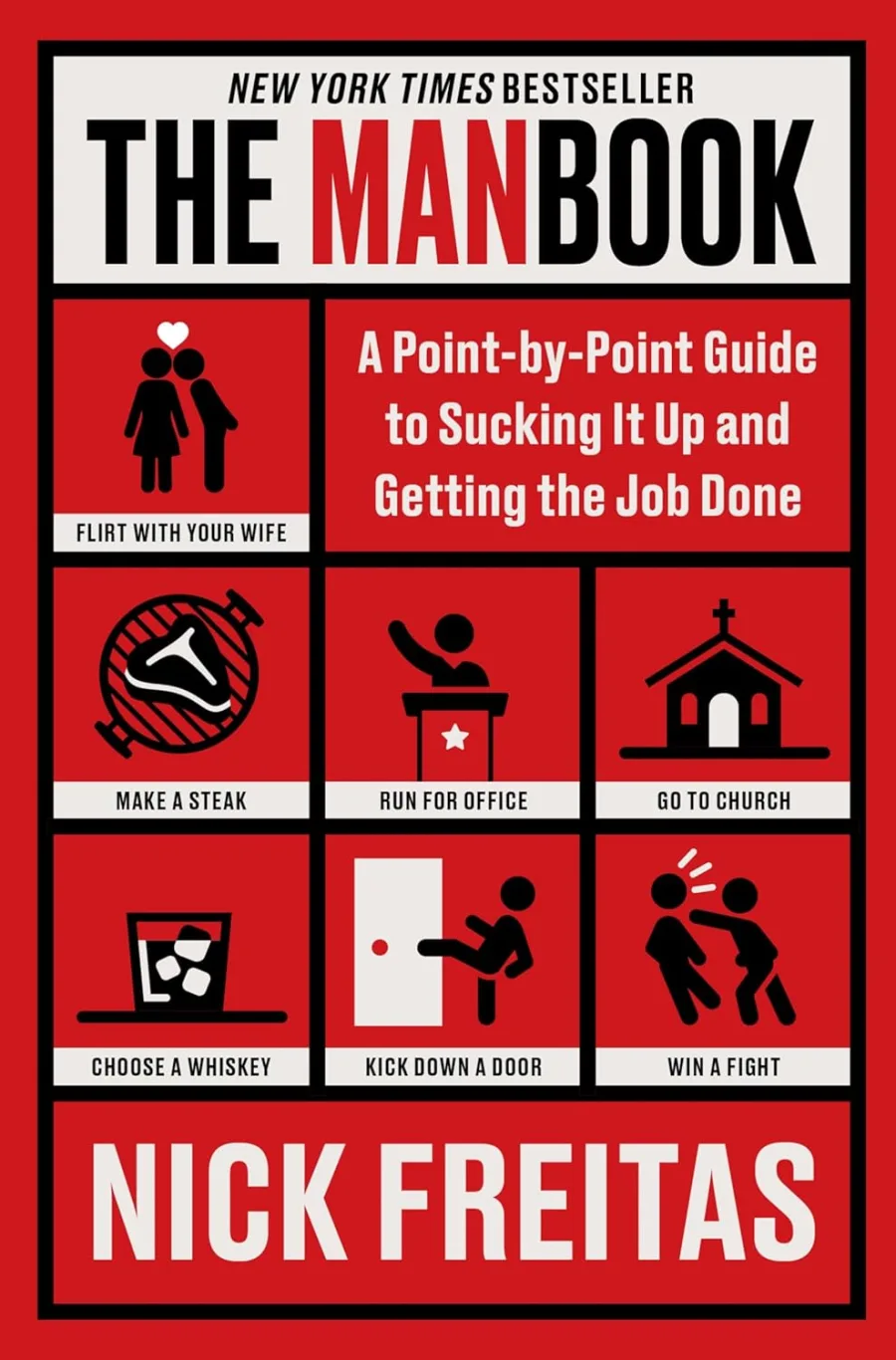
Download Cover Image
Do you want to download the full cover image for The Manbook: A Point-by-Point Guide to Sucking It Up and Getting the Job Done?