
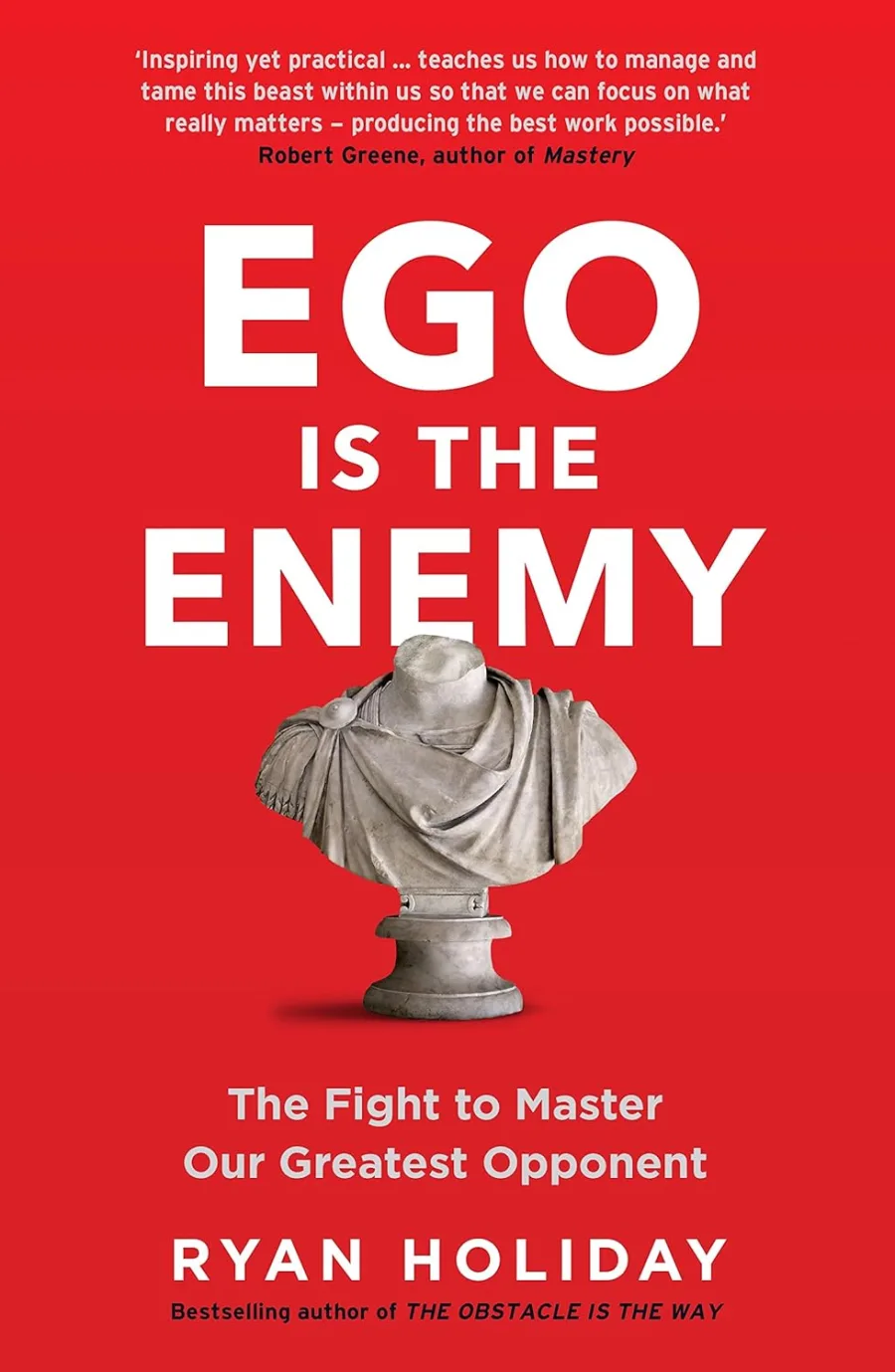
Ego is the Enemy: The Fight to Master Our Greatest Opponent (The Way, the Enemy and the Key)
eBook
• 254 Pages
• USD 8.99
• English
• 9781782832836
No ratings yet
| Publisher | Profile Books |
|---|---|
| ISBN13 | 9781782832836 |
| ASIN/SKU | B01AWUTMB0 |
| Book Format | eBook |
| Language | English |
| Pages | 254 |
| List Price | USD 8.99 |
| Publishing Date | 07/07/2016 |
| Book Code | BD00055893 |
Buy this Book
Amazon Stores
Ebook Stores
Other Stores
Discover Ego is the Enemy: The Fight to Master Our Greatest Opponent (The Way, the Enemy and the Key) by Ryan Holiday. This book is published by Profile Books in eBook format, ISBN 9781782832836, ASIN B01AWUTMB0, under Business and Money, Motivational Business Management, Business Motivation and Self-Improvement.
Book Description
A powerful meditation on the nature and dangers of ego, from the author of the #1 New York Times bestseller Stillness is the Key, and Obstacle is the Way - over 1 million copies sold
'Re-read it each year. It's that important' Derek Sivers, author of Anything You Want
'Ryan Holiday is one of his generation's finest thinkers' Steven Pressfield, author of The War of Art
'This is a book I want every athlete, aspiring leader, entrepreneur, thinker and doer to read' George Raveling, Nike's Director of International Basketball
'Inspiring yet practical' Robert Greene, author of The 48 Laws of Power
It's wrecked the careers of promising young geniuses. It's evaporated great fortunes and run companies into the ground. It's made adversity unbearable and turned struggle into shame. Every great philosopher has warned against it, in our most lasting stories and countless works of art, in all culture and all ages. Its name? Ego, and it is the enemy - of ambition, of success and of resilience.
In Ego is the Enemy, Ryan Holiday shows us how and why ego is such a powerful internal opponent to be guarded against at all stages of our careers and lives, and that we can only create our best work when we identify, acknowledge and disarm its dangers. Drawing on an array of inspiring characters and narratives from literature, philosophy and history, the book explores the nature and dangers of ego to illustrate how you can be humble in your aspirations, gracious in your success and resilient in your failures.
The result is an inspiring and timely reminder that humility and confidence are our greatest friends when confronting the challenges of a culture that tends to fan the flames of ego, a book full of themes and life lessons that will resonate, uplift and inspire.
'Re-read it each year. It's that important' Derek Sivers, author of Anything You Want
'Ryan Holiday is one of his generation's finest thinkers' Steven Pressfield, author of The War of Art
'This is a book I want every athlete, aspiring leader, entrepreneur, thinker and doer to read' George Raveling, Nike's Director of International Basketball
'Inspiring yet practical' Robert Greene, author of The 48 Laws of Power
It's wrecked the careers of promising young geniuses. It's evaporated great fortunes and run companies into the ground. It's made adversity unbearable and turned struggle into shame. Every great philosopher has warned against it, in our most lasting stories and countless works of art, in all culture and all ages. Its name? Ego, and it is the enemy - of ambition, of success and of resilience.
In Ego is the Enemy, Ryan Holiday shows us how and why ego is such a powerful internal opponent to be guarded against at all stages of our careers and lives, and that we can only create our best work when we identify, acknowledge and disarm its dangers. Drawing on an array of inspiring characters and narratives from literature, philosophy and history, the book explores the nature and dangers of ego to illustrate how you can be humble in your aspirations, gracious in your success and resilient in your failures.
The result is an inspiring and timely reminder that humility and confidence are our greatest friends when confronting the challenges of a culture that tends to fan the flames of ego, a book full of themes and life lessons that will resonate, uplift and inspire.
Author Biography
Ryan Holiday is one of the world’s bestselling living philosophers. His books, including The Obstacle Is the Way, Ego Is the Enemy, The Daily Stoic, and the #1 New York Times bestseller Stillness Is the Key, appear in more than forty languages and have sold over 10 million copies. He lives outside Austin with his wife and two boys ... and a small herd of cows and donkeys and goats. His bookstore, The Painted Porch, sits on historic Main Street in Bastrop, Texas.
Editorial Reviews
Editorial Reviews will be added soon…
Book Summary
Ryan Holiday’s Ego Is the Enemy is a thoughtful and practical book about one of the biggest obstacles to success, growth, and peace of mind: our own ego. In the book, Holiday does not use the word “ego” in a technical psychological sense. Instead, he uses it to describe an unhealthy belief in our own importance, a constant need to be recognized, and a tendency to let pride distort the way we see ourselves and the world. His central argument is simple but powerful: many of the problems people face in ambition, achievement, and failure are made worse by ego. It can make us overconfident when we are rising, careless when we are succeeding, and broken when we are struggling. The book is a warning, but also a guide to living with more humility, discipline, and self-awareness.
The structure of the book follows the broad stages of life and work: aspiration, success, and failure. Holiday explains that ego is dangerous at every stage, not just when people become rich or famous. At the beginning of a journey, ego can tempt a person to talk too much, imagine greatness without earning it, and confuse wanting to be important with doing important work. Many people love the image of success before they love the process required to achieve it. They want attention, admiration, and the feeling of being special, but they resist the quiet discipline, repetition, and patience that real mastery demands. Holiday argues that this kind of ego creates a fantasy life where people become attached to what they want others to think of them, instead of staying focused on learning and improving.
One of the strongest messages in the book is the importance of being a student. Holiday repeatedly suggests that people grow faster when they stay teachable, curious, and grounded. Ego hates this position because ego wants to already be seen as brilliant, talented, or superior. But true development usually requires accepting how much we do not know. Holiday uses examples from history, politics, sports, literature, and business to show that many remarkable people achieved greatness not by announcing themselves loudly, but by working quietly, learning constantly, and resisting the urge to make everything about themselves. He praises those who let their actions speak louder than their identity, and he warns against confusing confidence with arrogance.
As the book moves into the stage of success, the argument becomes even sharper. Holiday says that achievement often feeds ego in subtle ways. A person who has accomplished something real may begin to believe the rules no longer apply to them. Praise, status, and power can create a false sense of invincibility. Instead of staying disciplined, they become careless. Instead of listening, they become defensive. Instead of continuing to work, they become obsessed with protecting their image. According to Holiday, this is where many people begin to decline. Their downfall does not come because talent disappears, but because ego makes them unable to adapt, collaborate, or see their own weaknesses. Success becomes dangerous when it turns into self-importance.
Holiday also emphasizes that ego affects relationships, not just personal ambition. A person consumed by ego wants credit, control, and validation. This can damage teams, friendships, leadership, and creative partnerships. It becomes hard to listen genuinely, to share responsibility, or to admit mistakes. In professional life, ego often creates conflict where humility could have created progress. In personal life, it can isolate people and prevent honest connection. Holiday’s view is that strong character is not built by always proving yourself to others, but by becoming secure enough not to need constant proof. Real strength includes restraint, perspective, and the ability to put the mission or the work above one’s personal pride.
The final part of the book deals with failure, and this is where Holiday’s Stoic influence becomes especially clear. He argues that failure is inevitable in some form, but ego makes failure much harder to survive. When identity is built around being admired, being right, or being exceptional, any setback can feel unbearable. Ego turns disappointment into humiliation. It pushes people toward denial, blame, bitterness, or self-pity. But humility allows a person to learn, recover, and begin again. Holiday does not suggest that failure is easy or pleasant. Rather, he insists that it becomes more useful when we stop treating it as an insult to our identity and start seeing it as part of reality. A setback can teach patience, perspective, and resilience, but only if ego does not block the lesson.
Throughout the book, Holiday supports his ideas with many short examples from famous historical figures, athletes, generals, writers, and entrepreneurs. Some are praised for their humility and discipline, while others are shown as cautionary examples of pride leading to collapse. These stories give the book energy and variety, though the larger point always comes back to the same truth: ego clouds judgment. It makes people think they are more complete than they are, more deserving than they are, and more in control than they really are. By contrast, humility keeps people open, flexible, and grounded in reality. Holiday presents humility not as weakness or low self-esteem, but as a clear-eyed understanding of one’s place in the world.
Another important idea in the book is that the cure for ego is not thinking less of yourself in a negative way, but thinking of yourself less often. Holiday encourages attention to the work itself rather than to personal image. He admires people who are devoted to purpose, craft, and service rather than recognition. This shift in focus can be freeing. When people stop needing every action to confirm their importance, they often become calmer, more productive, and more effective. Their energy is no longer wasted on comparison, posturing, or protecting a fragile sense of self. Instead, they can invest it in effort, learning, and contribution.
What makes Ego Is the Enemy appealing is that it speaks to a very modern problem in a direct and timeless way. In a world shaped by self-promotion, personal branding, and constant performance, Holiday’s message feels especially relevant. He reminds readers that outward success can hide inward instability, and that the desire to look important can quietly ruin the chance to become truly good at something. The book does not ask people to become passive or unambitious. In fact, it assumes that ambition can be healthy. The real challenge is to pursue excellence without letting self-importance take over.
Overall, Ego Is the Enemy is a clear and memorable book about the value of humility in every stage of life. Its message is not flashy, but it is deeply practical. Ryan Holiday argues that if people want to do meaningful work, handle success wisely, and survive failure with dignity, they must learn to keep ego in check. The book encourages a life built on discipline, honesty, self-control, and devotion to something larger than personal image. In the end, it suggests that the greatest obstacle is often not the world outside us, but the voice inside us that wants to be worshipped instead of improved.
The structure of the book follows the broad stages of life and work: aspiration, success, and failure. Holiday explains that ego is dangerous at every stage, not just when people become rich or famous. At the beginning of a journey, ego can tempt a person to talk too much, imagine greatness without earning it, and confuse wanting to be important with doing important work. Many people love the image of success before they love the process required to achieve it. They want attention, admiration, and the feeling of being special, but they resist the quiet discipline, repetition, and patience that real mastery demands. Holiday argues that this kind of ego creates a fantasy life where people become attached to what they want others to think of them, instead of staying focused on learning and improving.
One of the strongest messages in the book is the importance of being a student. Holiday repeatedly suggests that people grow faster when they stay teachable, curious, and grounded. Ego hates this position because ego wants to already be seen as brilliant, talented, or superior. But true development usually requires accepting how much we do not know. Holiday uses examples from history, politics, sports, literature, and business to show that many remarkable people achieved greatness not by announcing themselves loudly, but by working quietly, learning constantly, and resisting the urge to make everything about themselves. He praises those who let their actions speak louder than their identity, and he warns against confusing confidence with arrogance.
As the book moves into the stage of success, the argument becomes even sharper. Holiday says that achievement often feeds ego in subtle ways. A person who has accomplished something real may begin to believe the rules no longer apply to them. Praise, status, and power can create a false sense of invincibility. Instead of staying disciplined, they become careless. Instead of listening, they become defensive. Instead of continuing to work, they become obsessed with protecting their image. According to Holiday, this is where many people begin to decline. Their downfall does not come because talent disappears, but because ego makes them unable to adapt, collaborate, or see their own weaknesses. Success becomes dangerous when it turns into self-importance.
Holiday also emphasizes that ego affects relationships, not just personal ambition. A person consumed by ego wants credit, control, and validation. This can damage teams, friendships, leadership, and creative partnerships. It becomes hard to listen genuinely, to share responsibility, or to admit mistakes. In professional life, ego often creates conflict where humility could have created progress. In personal life, it can isolate people and prevent honest connection. Holiday’s view is that strong character is not built by always proving yourself to others, but by becoming secure enough not to need constant proof. Real strength includes restraint, perspective, and the ability to put the mission or the work above one’s personal pride.
The final part of the book deals with failure, and this is where Holiday’s Stoic influence becomes especially clear. He argues that failure is inevitable in some form, but ego makes failure much harder to survive. When identity is built around being admired, being right, or being exceptional, any setback can feel unbearable. Ego turns disappointment into humiliation. It pushes people toward denial, blame, bitterness, or self-pity. But humility allows a person to learn, recover, and begin again. Holiday does not suggest that failure is easy or pleasant. Rather, he insists that it becomes more useful when we stop treating it as an insult to our identity and start seeing it as part of reality. A setback can teach patience, perspective, and resilience, but only if ego does not block the lesson.
Throughout the book, Holiday supports his ideas with many short examples from famous historical figures, athletes, generals, writers, and entrepreneurs. Some are praised for their humility and discipline, while others are shown as cautionary examples of pride leading to collapse. These stories give the book energy and variety, though the larger point always comes back to the same truth: ego clouds judgment. It makes people think they are more complete than they are, more deserving than they are, and more in control than they really are. By contrast, humility keeps people open, flexible, and grounded in reality. Holiday presents humility not as weakness or low self-esteem, but as a clear-eyed understanding of one’s place in the world.
Another important idea in the book is that the cure for ego is not thinking less of yourself in a negative way, but thinking of yourself less often. Holiday encourages attention to the work itself rather than to personal image. He admires people who are devoted to purpose, craft, and service rather than recognition. This shift in focus can be freeing. When people stop needing every action to confirm their importance, they often become calmer, more productive, and more effective. Their energy is no longer wasted on comparison, posturing, or protecting a fragile sense of self. Instead, they can invest it in effort, learning, and contribution.
What makes Ego Is the Enemy appealing is that it speaks to a very modern problem in a direct and timeless way. In a world shaped by self-promotion, personal branding, and constant performance, Holiday’s message feels especially relevant. He reminds readers that outward success can hide inward instability, and that the desire to look important can quietly ruin the chance to become truly good at something. The book does not ask people to become passive or unambitious. In fact, it assumes that ambition can be healthy. The real challenge is to pursue excellence without letting self-importance take over.
Overall, Ego Is the Enemy is a clear and memorable book about the value of humility in every stage of life. Its message is not flashy, but it is deeply practical. Ryan Holiday argues that if people want to do meaningful work, handle success wisely, and survive failure with dignity, they must learn to keep ego in check. The book encourages a life built on discipline, honesty, self-control, and devotion to something larger than personal image. In the end, it suggests that the greatest obstacle is often not the world outside us, but the voice inside us that wants to be worshipped instead of improved.
Sample Chapters
It’s wrecked the career of promising young geniuses.
It’s evaporated great fortunes and run companies into the ground.
It’s made adversity unbearable and turned struggle into shame.
It derails ambition, turns success into poison, and makes failure the most bitter taste of all.
Its name? Ego.
Ego is the enemy—of what you want to achieve, of what you have, and what you’re struggling to overcome.
It’s an internal opponent warned against by every great philosopher, in our most lasting stories and countless works of art, in every culture, in every age.
In the pages of this book, we fight to destroy it before it destroys us.
It’s evaporated great fortunes and run companies into the ground.
It’s made adversity unbearable and turned struggle into shame.
It derails ambition, turns success into poison, and makes failure the most bitter taste of all.
Its name? Ego.
Ego is the enemy—of what you want to achieve, of what you have, and what you’re struggling to overcome.
It’s an internal opponent warned against by every great philosopher, in our most lasting stories and countless works of art, in every culture, in every age.
In the pages of this book, we fight to destroy it before it destroys us.
Reader Reviews
No reviews yet.
Ego is the Enemy: The Fight to Master Our Greatest Opponent (The Way, the Enemy and the Key)
Download Cover Image
Do you want to download the full cover image for Ego is the Enemy: The Fight to Master Our Greatest Opponent (The Way, the Enemy and the Key)?