
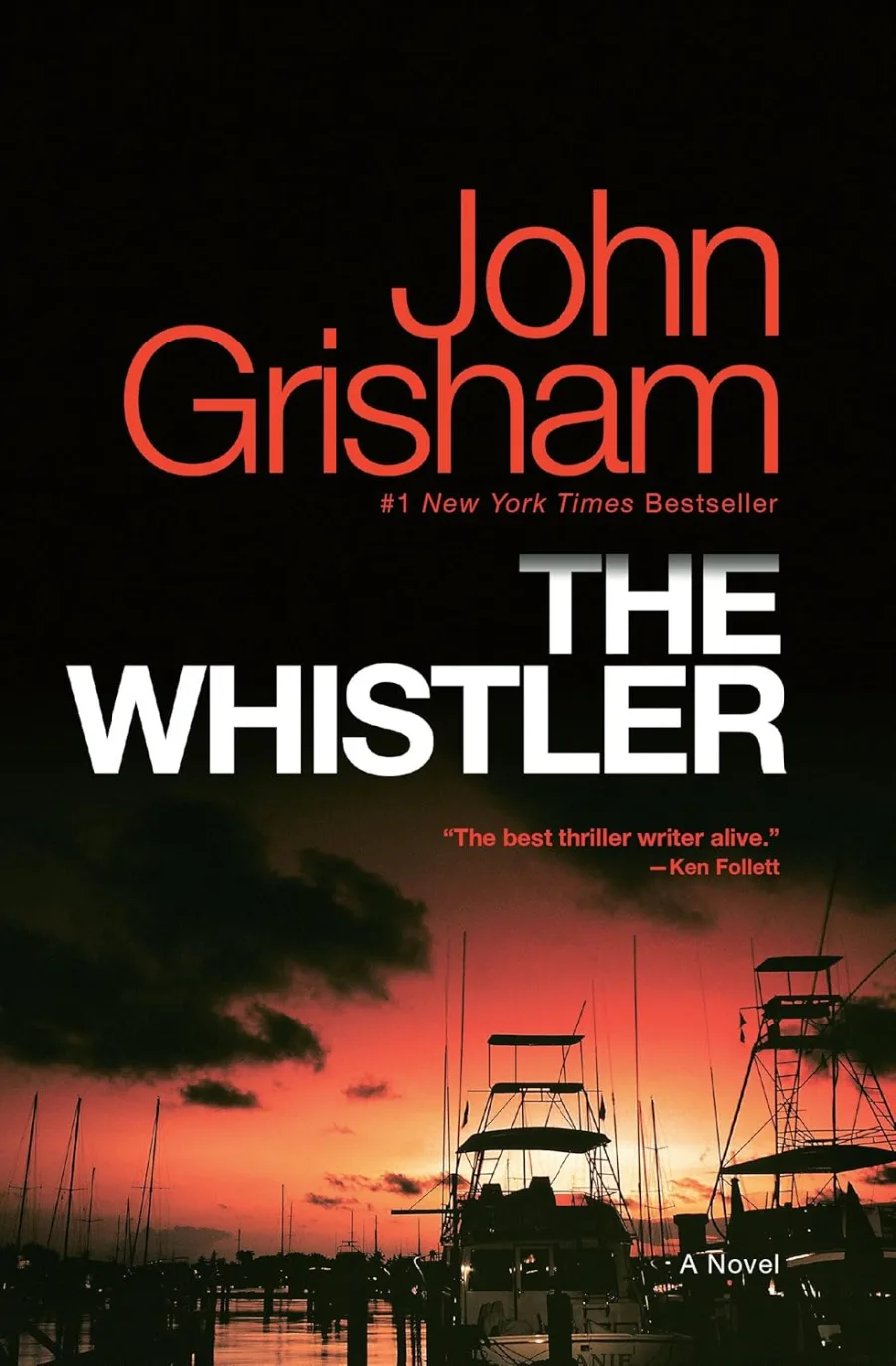
The Whistler: A Novel
Paperback
• 384 Pages
• USD 20.00
• English
• 9781101967676
No ratings yet
| Publisher | Vintage |
|---|---|
| ISBN13 | 9781101967676 |
| ASIN/SKU | 1101967676 |
| Book Format | Paperback |
| Language | English |
| Pages | 384 |
| List Price | USD 20.00 |
| Publishing Date | 11/07/2017 |
| Dimensions | 5.2 x 0.77 x 8 inches |
| Weight | 12 ounces |
| Book Code | BD00055911 |
Buy this Book
Amazon Stores
Ebook Stores
Other Stores
Discover The Whistler: A Novel by John Grisham. This book is published by Vintage in Paperback format, ISBN 9781101967676, ASIN 1101967676, under Mystery, Thriller and Suspense, Legal Thrillers, Political Thrillers.
Book Description
#1 NEW YORK TIMES BESTSELLER • A high-stakes thrill ride through the darkest corners of the Sunshine State, from the author hailed as “the best thriller writer alive” by Ken Follett
“Riveting . . . an elaborate conspiracy.”—The New York Times Book Review
We expect our judges to be honest and wise. Their integrity is the bedrock of the entire judicial system. We trust them to ensure fair trials, to protect the rights of all litigants, to punish those who do wrong, and to oversee the flow of justice. But what happens when a judge bends the law or takes a bribe?
Lacy Stoltz is an investigator for the Florida Board on Judicial Conduct. It is her job to respond to complaints dealing with judicial misconduct. After nine years with the Board, she knows that most problems are caused by incompetence, not corruption.
But a corruption case eventually crosses her desk. A previously disbarred lawyer is back in business, and he claims to know of a Florida judge who has stolen more money than all other crooked judges combined. And not just crooked judges in Florida. All judges, from all states, and throughout United States history. And now he wants to put a stop to it. His only client is a person who knows the truth and wants to blow the whistle and collect millions under Florida law. When the case is assigned to Lacy, she immediately suspects that this one could be dangerous.
Dangerous is one thing. Deadly is something else.
“Riveting . . . an elaborate conspiracy.”—The New York Times Book Review
We expect our judges to be honest and wise. Their integrity is the bedrock of the entire judicial system. We trust them to ensure fair trials, to protect the rights of all litigants, to punish those who do wrong, and to oversee the flow of justice. But what happens when a judge bends the law or takes a bribe?
Lacy Stoltz is an investigator for the Florida Board on Judicial Conduct. It is her job to respond to complaints dealing with judicial misconduct. After nine years with the Board, she knows that most problems are caused by incompetence, not corruption.
But a corruption case eventually crosses her desk. A previously disbarred lawyer is back in business, and he claims to know of a Florida judge who has stolen more money than all other crooked judges combined. And not just crooked judges in Florida. All judges, from all states, and throughout United States history. And now he wants to put a stop to it. His only client is a person who knows the truth and wants to blow the whistle and collect millions under Florida law. When the case is assigned to Lacy, she immediately suspects that this one could be dangerous.
Dangerous is one thing. Deadly is something else.
Author Biography
John Grisham is the author of more than fifty consecutive #1 bestsellers, which have been translated into nearly fifty languages. His recent books include The Boys From Biloxi, The Judge's List, Sooley, and his third Jake Brigance novel, A Time for Mercy, which is being developed by HBO as a limited series.
Grisham is a two-time winner of the Harper Lee Prize for Legal Fiction and was honored with the Library of Congress Creative Achievement Award for Fiction.
When he's not writing, Grisham serves on the board of directors of the Innocence Project and of Centurion Ministries, two national organizations dedicated to exonerating those who have been wrongfully convicted. Much of his fiction explores deep-seated problems in our criminal justice system.
John lives on a farm in central Virginia.
Grisham is a two-time winner of the Harper Lee Prize for Legal Fiction and was honored with the Library of Congress Creative Achievement Award for Fiction.
When he's not writing, Grisham serves on the board of directors of the Innocence Project and of Centurion Ministries, two national organizations dedicated to exonerating those who have been wrongfully convicted. Much of his fiction explores deep-seated problems in our criminal justice system.
John lives on a farm in central Virginia.
Editorial Reviews
“Riveting . . . finely drawn . . . The Whistler centers on an elaborate conspiracy involving an Indian reservation, an organized crime syndicate and a crooked judge skimming a small fortune from the tribal casino’s monthly haul.”—The New York Times Book Review
“A main character who’s a seriously appealing woman . . . a whistle-blower who secretly calls attention to corruption . . . a strong and frightening sense of place . . . Grisham’s on his game.”—Janet Maslin, The New York Times
“A fascinating look at judicial corruption . . . an entirely convincing story and one of Grisham’s best. I can’t think of another major American novelist since Sinclair Lewis who has so effectively targeted social and political ills in our society. In Grisham’s case, it is time at least to recognize that at his best he is not simply the author of entertaining legal thrillers but an important novelistic critic of our society. In more than 30 novels, he has often used his exceptional storytelling skills to take a hard look at injustice and corruption in the legal world and in our society as a whole.”—Patrick Anderson, The Washington Post
“Grisham’s latest involves the rich and powerful and an abuse of the justice system. Grisham novels are crowd-pleasers because he knows how to satisfy readers who want to see injustice crushed, and justice truly prevails for those who cannot buy influence.”—Associated Press
“Grisham has become an institution. For more than 25 years now he’s been our guide to the byways and backwaters of our legal system, superb in particular at ferreting out its vulnerabilities and dramatizing their abuse in gripping style. He excels at describing injustice and corruption. Grisham’s legal knowledge is impressive, and his ability to convey it unparalleled in popular fiction.”—USA Today
“A main character who’s a seriously appealing woman . . . a whistle-blower who secretly calls attention to corruption . . . a strong and frightening sense of place . . . Grisham’s on his game.”—Janet Maslin, The New York Times
“A fascinating look at judicial corruption . . . an entirely convincing story and one of Grisham’s best. I can’t think of another major American novelist since Sinclair Lewis who has so effectively targeted social and political ills in our society. In Grisham’s case, it is time at least to recognize that at his best he is not simply the author of entertaining legal thrillers but an important novelistic critic of our society. In more than 30 novels, he has often used his exceptional storytelling skills to take a hard look at injustice and corruption in the legal world and in our society as a whole.”—Patrick Anderson, The Washington Post
“Grisham’s latest involves the rich and powerful and an abuse of the justice system. Grisham novels are crowd-pleasers because he knows how to satisfy readers who want to see injustice crushed, and justice truly prevails for those who cannot buy influence.”—Associated Press
“Grisham has become an institution. For more than 25 years now he’s been our guide to the byways and backwaters of our legal system, superb in particular at ferreting out its vulnerabilities and dramatizing their abuse in gripping style. He excels at describing injustice and corruption. Grisham’s legal knowledge is impressive, and his ability to convey it unparalleled in popular fiction.”—USA Today
Book Summary
John Grisham’s The Whistler is a legal thriller that explores corruption, greed, and the hidden ways power can manipulate justice. The novel centers on a judicial corruption investigation, which already sets it apart from many courtroom dramas because the problem is not simply a criminal on trial, but the possibility that the system itself has been compromised. Grisham builds the story around the idea that when a judge becomes corrupt, the damage spreads far beyond a single case. A dishonest judge can ruin lives, distort the law, and protect criminal networks while appearing respectable from the outside. This makes the stakes of the novel feel especially high from the beginning.
The story follows Lacy Stoltz, an investigator for the Florida Board on Judicial Conduct. Her job is not glamorous, and most of the complaints she handles involve minor ethical issues, personal misconduct, or behavior that falls short of criminal scandal. She is used to dull paperwork, cautious investigations, and cases that rarely become dramatic. That changes when a man named Greg Myers approaches the board with an explosive allegation. He claims to represent a whistleblower who has information about a Florida judge who has been secretly receiving enormous sums of money through a criminal operation connected to a Native American casino. At first, the accusation seems almost unbelievable because the scale of the corruption is so massive. If true, it would mean that a judge has not simply bent the rules, but has become part of a deeply organized scheme involving land deals, extortion, and murder.
As Lacy and her colleague Hugo Hatch begin to look into the claim, they discover that the case is far more dangerous than anything they have handled before. The whistleblower, whose real identity is protected at first, is deeply entangled in the events being described and has strong reasons to fear for their life. The judge at the center of the allegations, Claudia McDover, appears polished, successful, and untouchable in public, but beneath that surface lies a disturbing picture of calculated corruption. The money she is accused of taking comes from a criminal conspiracy built around a casino on Native American land, and the operation is controlled not just through fraud but through intimidation and violence. As the investigation moves forward, Grisham reveals how illegal wealth can penetrate legitimate institutions and how difficult it becomes to challenge such power once it is embedded.
One of the most important aspects of the novel is its portrayal of institutional vulnerability. Lacy works inside a system designed to oversee judges, but even that system seems small and almost powerless when faced with corruption of this scale. She is intelligent, cautious, and professional, but she is not a superhero. Grisham presents her as an ordinary person trying to do her job in increasingly extraordinary circumstances. This helps ground the novel. The danger feels more real because Lacy does not move through the story with total control. She is constantly aware that the people she is investigating may be watching her, threatening witnesses, or eliminating problems before they can surface. The tension grows from the fact that the truth is dangerous not only because it is shocking, but because those who benefit from it are willing to kill to protect it.
The legal and procedural side of the novel is classic Grisham. He is interested not just in dramatic confrontations, but in the slow accumulation of evidence, the negotiation between agencies, and the practical difficulty of building a case that can survive scrutiny. Much of the suspense comes from documents, interviews, hidden financial arrangements, and the question of how to move from suspicion to proof. Grisham has always been skilled at making bureaucracy and legal process feel suspenseful, and The Whistler continues that strength. Instead of rushing into a dramatic courtroom trial, the novel spends much of its energy showing how corruption is uncovered piece by piece. This gives the story a grounded, procedural rhythm that makes the eventual dangers feel earned.
The whistleblower figure also adds emotional and moral complexity to the novel. This person is not presented as a pure hero standing outside the corruption. Instead, they are someone who has lived close to it, benefited from it in some ways, and now wants protection while exposing the truth. This creates ambiguity about motive. Is the whistleblower acting out of conscience, fear, revenge, or survival? Grisham does not make this entirely simple, and that uncertainty adds depth to the narrative. It also reflects one of the novel’s broader ideas: in systems shaped by greed, very few people remain fully clean. Even those who come forward may do so only after becoming entangled in wrongdoing themselves.
Violence enters the story in a measured but effective way. Grisham is not writing pure action fiction, but he understands that corruption on this level cannot remain abstract. As Lacy gets closer to the truth, the threat becomes more personal. People connected to the investigation are placed in danger, and the novel makes clear that the criminal network surrounding the judge is ruthless. This shift gives the book momentum, moving it from a slow legal inquiry into a more urgent thriller. Still, the violence never completely overwhelms the legal core of the novel. The story remains focused on justice, evidence, and exposure, even as the risks intensify.
Another key theme in The Whistler is the corrupting power of money. The judge’s greed is not portrayed as a momentary lapse or a small ethical failure. It is part of a larger worldview in which status, luxury, and power matter more than law or conscience. Grisham uses this case to show how wealth gained through illegal means can reshape institutions, relationships, and moral judgment. Once people begin profiting from corruption, they start justifying it, protecting it, and normalizing it. The tragedy is not only that crimes are committed, but that legal authority itself becomes a tool in those crimes. A judge is supposed to represent fairness and restraint, so when that role is corrupted, the betrayal feels profound.
Lacy’s character gives the novel its moral center. She is not flawless, but she is steady, thoughtful, and committed to the truth. What makes her compelling is her persistence. She keeps going even when the investigation becomes overwhelming and personally dangerous. Her determination reflects one of Grisham’s recurring beliefs: that institutions fail less completely when ordinary, conscientious people choose not to give up. Lacy may not be powerful in the traditional sense, but her refusal to look away gives the story its emotional force.
By the end of the novel, the investigation leads to revelations that confirm just how extensive the corruption has been. The climax is satisfying because it exposes a network, not just an individual act. Yet the ending also carries a certain realism. Even when wrongdoing is uncovered, the damage it has caused cannot be fully undone. Grisham does not pretend that justice is simple or complete. Instead, he shows it as difficult, partial, and dependent on courage from people willing to challenge entrenched power.
Overall, The Whistler is an engaging and sharply constructed legal thriller about what happens when the guardians of the law become part of criminal enterprise. John Grisham combines legal detail, moral tension, and steady suspense to tell a story about judicial corruption that feels both entertaining and unsettling. The novel is ultimately about more than a single crooked judge. It is about the fragility of trust in public institutions and the cost of restoring truth when lies have been protected by wealth, fear, and authority.
The story follows Lacy Stoltz, an investigator for the Florida Board on Judicial Conduct. Her job is not glamorous, and most of the complaints she handles involve minor ethical issues, personal misconduct, or behavior that falls short of criminal scandal. She is used to dull paperwork, cautious investigations, and cases that rarely become dramatic. That changes when a man named Greg Myers approaches the board with an explosive allegation. He claims to represent a whistleblower who has information about a Florida judge who has been secretly receiving enormous sums of money through a criminal operation connected to a Native American casino. At first, the accusation seems almost unbelievable because the scale of the corruption is so massive. If true, it would mean that a judge has not simply bent the rules, but has become part of a deeply organized scheme involving land deals, extortion, and murder.
As Lacy and her colleague Hugo Hatch begin to look into the claim, they discover that the case is far more dangerous than anything they have handled before. The whistleblower, whose real identity is protected at first, is deeply entangled in the events being described and has strong reasons to fear for their life. The judge at the center of the allegations, Claudia McDover, appears polished, successful, and untouchable in public, but beneath that surface lies a disturbing picture of calculated corruption. The money she is accused of taking comes from a criminal conspiracy built around a casino on Native American land, and the operation is controlled not just through fraud but through intimidation and violence. As the investigation moves forward, Grisham reveals how illegal wealth can penetrate legitimate institutions and how difficult it becomes to challenge such power once it is embedded.
One of the most important aspects of the novel is its portrayal of institutional vulnerability. Lacy works inside a system designed to oversee judges, but even that system seems small and almost powerless when faced with corruption of this scale. She is intelligent, cautious, and professional, but she is not a superhero. Grisham presents her as an ordinary person trying to do her job in increasingly extraordinary circumstances. This helps ground the novel. The danger feels more real because Lacy does not move through the story with total control. She is constantly aware that the people she is investigating may be watching her, threatening witnesses, or eliminating problems before they can surface. The tension grows from the fact that the truth is dangerous not only because it is shocking, but because those who benefit from it are willing to kill to protect it.
The legal and procedural side of the novel is classic Grisham. He is interested not just in dramatic confrontations, but in the slow accumulation of evidence, the negotiation between agencies, and the practical difficulty of building a case that can survive scrutiny. Much of the suspense comes from documents, interviews, hidden financial arrangements, and the question of how to move from suspicion to proof. Grisham has always been skilled at making bureaucracy and legal process feel suspenseful, and The Whistler continues that strength. Instead of rushing into a dramatic courtroom trial, the novel spends much of its energy showing how corruption is uncovered piece by piece. This gives the story a grounded, procedural rhythm that makes the eventual dangers feel earned.
The whistleblower figure also adds emotional and moral complexity to the novel. This person is not presented as a pure hero standing outside the corruption. Instead, they are someone who has lived close to it, benefited from it in some ways, and now wants protection while exposing the truth. This creates ambiguity about motive. Is the whistleblower acting out of conscience, fear, revenge, or survival? Grisham does not make this entirely simple, and that uncertainty adds depth to the narrative. It also reflects one of the novel’s broader ideas: in systems shaped by greed, very few people remain fully clean. Even those who come forward may do so only after becoming entangled in wrongdoing themselves.
Violence enters the story in a measured but effective way. Grisham is not writing pure action fiction, but he understands that corruption on this level cannot remain abstract. As Lacy gets closer to the truth, the threat becomes more personal. People connected to the investigation are placed in danger, and the novel makes clear that the criminal network surrounding the judge is ruthless. This shift gives the book momentum, moving it from a slow legal inquiry into a more urgent thriller. Still, the violence never completely overwhelms the legal core of the novel. The story remains focused on justice, evidence, and exposure, even as the risks intensify.
Another key theme in The Whistler is the corrupting power of money. The judge’s greed is not portrayed as a momentary lapse or a small ethical failure. It is part of a larger worldview in which status, luxury, and power matter more than law or conscience. Grisham uses this case to show how wealth gained through illegal means can reshape institutions, relationships, and moral judgment. Once people begin profiting from corruption, they start justifying it, protecting it, and normalizing it. The tragedy is not only that crimes are committed, but that legal authority itself becomes a tool in those crimes. A judge is supposed to represent fairness and restraint, so when that role is corrupted, the betrayal feels profound.
Lacy’s character gives the novel its moral center. She is not flawless, but she is steady, thoughtful, and committed to the truth. What makes her compelling is her persistence. She keeps going even when the investigation becomes overwhelming and personally dangerous. Her determination reflects one of Grisham’s recurring beliefs: that institutions fail less completely when ordinary, conscientious people choose not to give up. Lacy may not be powerful in the traditional sense, but her refusal to look away gives the story its emotional force.
By the end of the novel, the investigation leads to revelations that confirm just how extensive the corruption has been. The climax is satisfying because it exposes a network, not just an individual act. Yet the ending also carries a certain realism. Even when wrongdoing is uncovered, the damage it has caused cannot be fully undone. Grisham does not pretend that justice is simple or complete. Instead, he shows it as difficult, partial, and dependent on courage from people willing to challenge entrenched power.
Overall, The Whistler is an engaging and sharply constructed legal thriller about what happens when the guardians of the law become part of criminal enterprise. John Grisham combines legal detail, moral tension, and steady suspense to tell a story about judicial corruption that feels both entertaining and unsettling. The novel is ultimately about more than a single crooked judge. It is about the fragility of trust in public institutions and the cost of restoring truth when lies have been protected by wealth, fear, and authority.
Sample Chapters
Sample Chapters will be added soon…
Reader Reviews
No reviews yet.
The Whistler: A Novel
Download Cover Image
Do you want to download the full cover image for The Whistler: A Novel?