
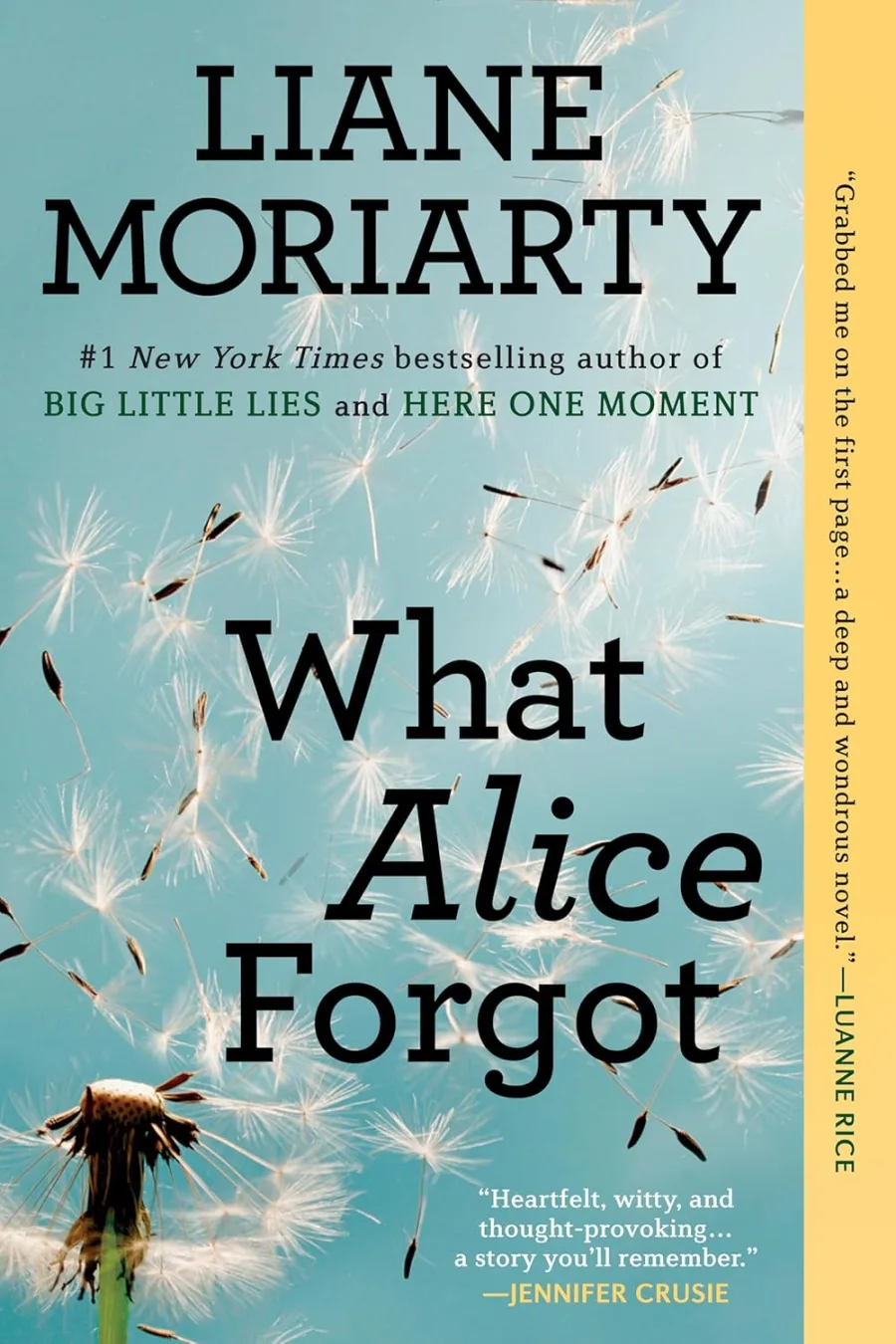
What Alice Forgot
Paperback
• 488 Pages
• USD 20.00
• English
• 9780425247440
No ratings yet
| Publisher | Berkley Books |
|---|---|
| ISBN13 | 9780425247440 |
| ASIN/SKU | 0425247449 |
| Book Format | Paperback |
| Language | English |
| Pages | 488 |
| List Price | USD 20.00 |
| Publishing Date | 24/04/2012 |
| Dimensions | 5.46 x 1.01 x 8.26 inches |
| Weight | 14.1 ounces |
| Book Code | BD00055924 |
Buy this Book
Amazon Stores
Ebook Stores
Other Stores
Discover What Alice Forgot by Liane Moriarty. This book is published by Berkley Books in Paperback format, ISBN 9780425247440, ASIN 0425247449, under Literature and Fiction, Mothers and Children Fiction, Women's Friendship Fiction.
Book Description
FROM THE #1 NEW YORK TIMES BESTSELLING AUTHOR OF BIG LITTLE LIES AND BIG LITTLE TRUTHS
A “cheerfully engaging”(Kirkus Reviews) novel for anyone who’s ever asked herself, “How did I get here?”
Alice Love is twenty-nine, crazy about her husband, and pregnant with her first child. So imagine Alice’s surprise when she comes to on the floor of a gym (a gym! She HATES the gym) and is whisked off to the hospital where she discovers the honeymoon is truly over—she’s getting divorced, she has three kids, and she’s actually 39 years old. Alice must reconstruct the events of a lost decade, and find out whether it’s possible to reconstruct her life at the same time. She has to figure out why her sister hardly talks to her, and how is it that she’s become one of those super skinny moms with really expensive clothes. Ultimately, Alice must discover whether forgetting is a blessing or a curse, and whether it’s possible to start over...
A “cheerfully engaging”(Kirkus Reviews) novel for anyone who’s ever asked herself, “How did I get here?”
Alice Love is twenty-nine, crazy about her husband, and pregnant with her first child. So imagine Alice’s surprise when she comes to on the floor of a gym (a gym! She HATES the gym) and is whisked off to the hospital where she discovers the honeymoon is truly over—she’s getting divorced, she has three kids, and she’s actually 39 years old. Alice must reconstruct the events of a lost decade, and find out whether it’s possible to reconstruct her life at the same time. She has to figure out why her sister hardly talks to her, and how is it that she’s become one of those super skinny moms with really expensive clothes. Ultimately, Alice must discover whether forgetting is a blessing or a curse, and whether it’s possible to start over...
Author Biography
Liane Moriarty is the #1 New York Times bestselling author of Nine Perfect Strangers, Three Wishes, Truly Madly Guilty, Big Little Lies, The Husband’s Secret, The Hypnotist’s Love Story, and What Alice Forgot. She lives in Sydney, Australia, with her husband and two children.
Editorial Reviews
Praise for What Alice Forgot
“Funny and knowing...[about] what we choose to remember, and fight to forget.”—O Magazine
“The gripping story of a woman who wakes up with a bump on her head and no knowledge of the past ten years...an acutely observed romantic comedy that is both thought-provoking and funny.”—Marie Claire (UK)
“The affecting tale of Alice’s chance for a ten-year do-over.”—The New York Times
“Grabbed me on the first page…a deep and wondrous novel.”—Luanne Rice, New York Times bestselling author
“I loved this book. It has, for me, everything that makes a good novel excellent.”—Jeanne Ray, New York Times bestselling author
“Heartfelt, witty, and thought-provoking...a story you’ll remember.”—Jennifer Crusie, New York Times bestselling author
“Highly addictive.”—She Magazine (UK; Book of the Month)
“I loved this original read.”—The Sun (UK)
“Funny and captivating.”—Closer (UK)
“Winning...well-paced, and thoroughly pleasurable.”—Publishers Weekly
“An often funny, sometimes heartrending, deeply personal portrait of a woman attempting to unravel her own mystery.”—Booklist
“Moriarity makes this more than just a one-note story, weaving in a plotline involving Alice's childless sister...intriguing...will keep readers guessing and curious to know more about Alice.”—Library Journal
“Funny and knowing...[about] what we choose to remember, and fight to forget.”—O Magazine
“The gripping story of a woman who wakes up with a bump on her head and no knowledge of the past ten years...an acutely observed romantic comedy that is both thought-provoking and funny.”—Marie Claire (UK)
“The affecting tale of Alice’s chance for a ten-year do-over.”—The New York Times
“Grabbed me on the first page…a deep and wondrous novel.”—Luanne Rice, New York Times bestselling author
“I loved this book. It has, for me, everything that makes a good novel excellent.”—Jeanne Ray, New York Times bestselling author
“Heartfelt, witty, and thought-provoking...a story you’ll remember.”—Jennifer Crusie, New York Times bestselling author
“Highly addictive.”—She Magazine (UK; Book of the Month)
“I loved this original read.”—The Sun (UK)
“Funny and captivating.”—Closer (UK)
“Winning...well-paced, and thoroughly pleasurable.”—Publishers Weekly
“An often funny, sometimes heartrending, deeply personal portrait of a woman attempting to unravel her own mystery.”—Booklist
“Moriarity makes this more than just a one-note story, weaving in a plotline involving Alice's childless sister...intriguing...will keep readers guessing and curious to know more about Alice.”—Library Journal
Book Summary
What Alice Forgot by Liane Moriarty is a touching, often funny, and quietly heartbreaking story about memory, marriage, identity, and how a life can slowly drift away from what you once imagined—without you even noticing. The novel centers on Alice Love, a 39 year old woman who, after hitting her head during a spin class, forgets the last ten years of her life. In her mind, she’s still 29: newly married, deliriously in love with her husband Nick, pregnant with their first child, and full of hope about the future. When she wakes up in the hospital, everyone keeps telling her she’s almost forty, she has three children, and her marriage is in serious trouble. She has no memory of any of it. That gap—ten years of love, conflict, growth, and mistakes suddenly erased—forces Alice to confront who she has become and whether she likes that person at all.
As Alice tries to make sense of her situation, she realizes that the world around her is nothing like what she remembers. The man she recalls as her adoring, funny husband now seems distant, angry, and almost like a stranger. She learns that they are separated and on the brink of divorce. The house she imagined them saving for and decorating together is now a stylish, highly organized home that feels like it belongs to someone else. Even her own body and tastes have changed: she’s slimmer, more polished, involved in school committees and busy social circles. People speak of her as driven, efficient, and sharp, a woman who handles everything and expects a lot from those around her. But inside, she still feels like the softer, more easygoing twenty something who adored Nick and didn’t care at all about competitive parenting or perfect schedules. The shock of these differences makes her question what happened in those missing years to turn her into this version of herself.
A big part of the story’s emotional weight comes from Alice meeting her three children—Madi, Tom, and little Olivia—without any memory of ever having been pregnant, giving birth, or raising them. She knows, intellectually, that they are her kids, but she doesn’t feel that deep, automatic bond right away, and that terrifies her. At the same time, she can see how much they are affected by the tension between her and Nick and the controlled, slightly brittle atmosphere that had built up in their home. As she slowly spends time with them, she begins to fall in love with them “again,” building a new emotional connection and seeing the kind of mother she seems to have been: organized, involved, but possibly driven to a level of perfection that created stress and distance. The amnesia gives her the strange chance to approach her children with fresh eyes, without the exhaustion and emotional baggage of the last decade, and that becomes a crucial piece of her journey.
The novel also explores Alice’s relationships with her sister Elisabeth and her honorary “grandmother” Frannie. Elisabeth is going through her own private heartbreak: years of infertility treatments, miscarriages, and the slow erosion of hope. Her story appears through diary entries and counseling writings, and they reveal how deeply her struggles have affected her sense of self and her marriage. In contrast to Alice, who unexpectedly finds herself with three children she doesn’t remember, Elisabeth is painfully aware of every month that passes without a child. This contrast between sisters—one with children she can’t remember, one who longs for children she cannot have—underscores the theme of how life can be both generous and cruel in ways that feel randomly unfair. Frannie, meanwhile, offers warmth, perspective, and gentle commentary, tying together the past and present of their family and reminding us that every generation faces its own version of confusion and regret.
As Alice moves through the days after her accident, she tries to understand what could have happened to her marriage. People talk about the “bad years,” about constant fights and legal proceedings, but she can’t remember any of it. Instead, she is stuck with the vivid memory of Nick as a man she loved fiercely, who made her laugh, who shared her dreams. She still feels that love and expects him to feel the same, but he shows up tense and guarded, clearly hurt by years of conflict. Their interactions are awkward and painful at first. Nick doesn’t fully trust this “new” Alice, who seems nothing like the woman he’s been fighting with, and Alice struggles to reconcile the way he looks at her now with the tenderness she remembers. The question hanging over the story is whether the couple is too damaged to find a way back, or whether losing her memory gives Alice an unexpected chance to reset their relationship.
Through Alice’s confusion, the novel gently examines the ways small, daily stresses can slowly erode a marriage. There was no single villainous act; instead, there were late nights at work, relentless commitments, financial pressures, parenting disagreements, resentment, and unmet expectations that built up over time. Alice learns about the decisions she made—prioritizing certain projects, social events, and school activities—that may have pushed Nick away or made him feel unimportant. She discovers that she took on a more controlling, critical role, and that she was not always as kind or loving as the younger version of herself would have imagined. It’s frightening for her to realize she’s capable of becoming someone she doesn’t entirely like. Yet, at the same time, she sees that many of those choices came from trying to cope, trying to be responsible, trying to do “the right thing” for her family. This makes her confront the uncomfortable truth that being a “good” adult can sometimes make you lose sight of the softer, simpler person you once were.
The amnesia serves as a clever device to ask a bigger question: if you could look at your present life through the eyes of your younger self, would you be proud of who you’ve become? Alice’s 29 year old mindset is shocked by the amount of busyness, tension, and competitiveness in her current world. She’s surprised by her friendships, which seem more strategic than sincere, and by the way school communities and social circles place pressure on parents to perform. She starts to strip back those layers, instinctively refusing some of the expectations that the “old” Alice had embraced. In doing so, she changes how people respond to her: some are confused, some are annoyed, and some are quietly relieved. The book suggests that life’s responsibilities and disappointments can gradually harden people, but it also hints that it’s possible to soften again, to remember what mattered most before you got buried in obligations.
Throughout the story, there is a subtle sense of suspense: will Alice’s memories return, and if they do, will that ruin the new, gentler perspective she’s gained? She worries that once she remembers the pain and anger of those missing years, she might go back to being the hardened, defensive woman she apparently became. She wonders whether the current second chance with Nick and the kids is only temporary, dependent on her forgetting the worst times. The novel doesn’t treat her memory loss as a magical escape; instead, it shows the emotional risk of truly knowing everything versus living with selective ignorance. Alice has to decide whether she wants the truth—even if it’s ugly—or whether she’d rather cling to the idealized version of her life that still exists inside her head.
As the plot moves toward its resolution, the different threads of the story—Elisabeth’s grief, Frannie’s reflections, the children’s needs, Nick’s hurt, and Alice’s missing years—come together. The outcome is not a neat fairy-tale fix, but it offers hope and tenderness. Alice doesn’t simply revert to her 29 year old self or stay stuck as the 39 year old version she doesn’t recognize. Instead, she begins to build a new identity, one that combines what she has learned, the mistakes she has made, and the love she still feels. The novel suggests that people are not just the sum of their worst moments, and that marriages, families, and individuals can sometimes find their way back from painful places if they are willing to see each other with fresh eyes.
In the end, What Alice Forgot is about more than just a woman who loses her memory. It’s about how time and routine can quietly change us, how relationships bend under pressure, and how easy it is to forget the simple joy and affection that once seemed so permanent. Through Alice’s strange second chance, Liane Moriarty invites readers to think about their own past selves, their current choices, and the possibility of rediscovering what truly matters, even after years of distraction, disappointment, and hurt.
As Alice tries to make sense of her situation, she realizes that the world around her is nothing like what she remembers. The man she recalls as her adoring, funny husband now seems distant, angry, and almost like a stranger. She learns that they are separated and on the brink of divorce. The house she imagined them saving for and decorating together is now a stylish, highly organized home that feels like it belongs to someone else. Even her own body and tastes have changed: she’s slimmer, more polished, involved in school committees and busy social circles. People speak of her as driven, efficient, and sharp, a woman who handles everything and expects a lot from those around her. But inside, she still feels like the softer, more easygoing twenty something who adored Nick and didn’t care at all about competitive parenting or perfect schedules. The shock of these differences makes her question what happened in those missing years to turn her into this version of herself.
A big part of the story’s emotional weight comes from Alice meeting her three children—Madi, Tom, and little Olivia—without any memory of ever having been pregnant, giving birth, or raising them. She knows, intellectually, that they are her kids, but she doesn’t feel that deep, automatic bond right away, and that terrifies her. At the same time, she can see how much they are affected by the tension between her and Nick and the controlled, slightly brittle atmosphere that had built up in their home. As she slowly spends time with them, she begins to fall in love with them “again,” building a new emotional connection and seeing the kind of mother she seems to have been: organized, involved, but possibly driven to a level of perfection that created stress and distance. The amnesia gives her the strange chance to approach her children with fresh eyes, without the exhaustion and emotional baggage of the last decade, and that becomes a crucial piece of her journey.
The novel also explores Alice’s relationships with her sister Elisabeth and her honorary “grandmother” Frannie. Elisabeth is going through her own private heartbreak: years of infertility treatments, miscarriages, and the slow erosion of hope. Her story appears through diary entries and counseling writings, and they reveal how deeply her struggles have affected her sense of self and her marriage. In contrast to Alice, who unexpectedly finds herself with three children she doesn’t remember, Elisabeth is painfully aware of every month that passes without a child. This contrast between sisters—one with children she can’t remember, one who longs for children she cannot have—underscores the theme of how life can be both generous and cruel in ways that feel randomly unfair. Frannie, meanwhile, offers warmth, perspective, and gentle commentary, tying together the past and present of their family and reminding us that every generation faces its own version of confusion and regret.
As Alice moves through the days after her accident, she tries to understand what could have happened to her marriage. People talk about the “bad years,” about constant fights and legal proceedings, but she can’t remember any of it. Instead, she is stuck with the vivid memory of Nick as a man she loved fiercely, who made her laugh, who shared her dreams. She still feels that love and expects him to feel the same, but he shows up tense and guarded, clearly hurt by years of conflict. Their interactions are awkward and painful at first. Nick doesn’t fully trust this “new” Alice, who seems nothing like the woman he’s been fighting with, and Alice struggles to reconcile the way he looks at her now with the tenderness she remembers. The question hanging over the story is whether the couple is too damaged to find a way back, or whether losing her memory gives Alice an unexpected chance to reset their relationship.
Through Alice’s confusion, the novel gently examines the ways small, daily stresses can slowly erode a marriage. There was no single villainous act; instead, there were late nights at work, relentless commitments, financial pressures, parenting disagreements, resentment, and unmet expectations that built up over time. Alice learns about the decisions she made—prioritizing certain projects, social events, and school activities—that may have pushed Nick away or made him feel unimportant. She discovers that she took on a more controlling, critical role, and that she was not always as kind or loving as the younger version of herself would have imagined. It’s frightening for her to realize she’s capable of becoming someone she doesn’t entirely like. Yet, at the same time, she sees that many of those choices came from trying to cope, trying to be responsible, trying to do “the right thing” for her family. This makes her confront the uncomfortable truth that being a “good” adult can sometimes make you lose sight of the softer, simpler person you once were.
The amnesia serves as a clever device to ask a bigger question: if you could look at your present life through the eyes of your younger self, would you be proud of who you’ve become? Alice’s 29 year old mindset is shocked by the amount of busyness, tension, and competitiveness in her current world. She’s surprised by her friendships, which seem more strategic than sincere, and by the way school communities and social circles place pressure on parents to perform. She starts to strip back those layers, instinctively refusing some of the expectations that the “old” Alice had embraced. In doing so, she changes how people respond to her: some are confused, some are annoyed, and some are quietly relieved. The book suggests that life’s responsibilities and disappointments can gradually harden people, but it also hints that it’s possible to soften again, to remember what mattered most before you got buried in obligations.
Throughout the story, there is a subtle sense of suspense: will Alice’s memories return, and if they do, will that ruin the new, gentler perspective she’s gained? She worries that once she remembers the pain and anger of those missing years, she might go back to being the hardened, defensive woman she apparently became. She wonders whether the current second chance with Nick and the kids is only temporary, dependent on her forgetting the worst times. The novel doesn’t treat her memory loss as a magical escape; instead, it shows the emotional risk of truly knowing everything versus living with selective ignorance. Alice has to decide whether she wants the truth—even if it’s ugly—or whether she’d rather cling to the idealized version of her life that still exists inside her head.
As the plot moves toward its resolution, the different threads of the story—Elisabeth’s grief, Frannie’s reflections, the children’s needs, Nick’s hurt, and Alice’s missing years—come together. The outcome is not a neat fairy-tale fix, but it offers hope and tenderness. Alice doesn’t simply revert to her 29 year old self or stay stuck as the 39 year old version she doesn’t recognize. Instead, she begins to build a new identity, one that combines what she has learned, the mistakes she has made, and the love she still feels. The novel suggests that people are not just the sum of their worst moments, and that marriages, families, and individuals can sometimes find their way back from painful places if they are willing to see each other with fresh eyes.
In the end, What Alice Forgot is about more than just a woman who loses her memory. It’s about how time and routine can quietly change us, how relationships bend under pressure, and how easy it is to forget the simple joy and affection that once seemed so permanent. Through Alice’s strange second chance, Liane Moriarty invites readers to think about their own past selves, their current choices, and the possibility of rediscovering what truly matters, even after years of distraction, disappointment, and hurt.
Sample Chapters
Sample Chapters will be added soon…
Reader Reviews
No reviews yet.
What Alice Forgot
Download Cover Image
Do you want to download the full cover image for What Alice Forgot?