
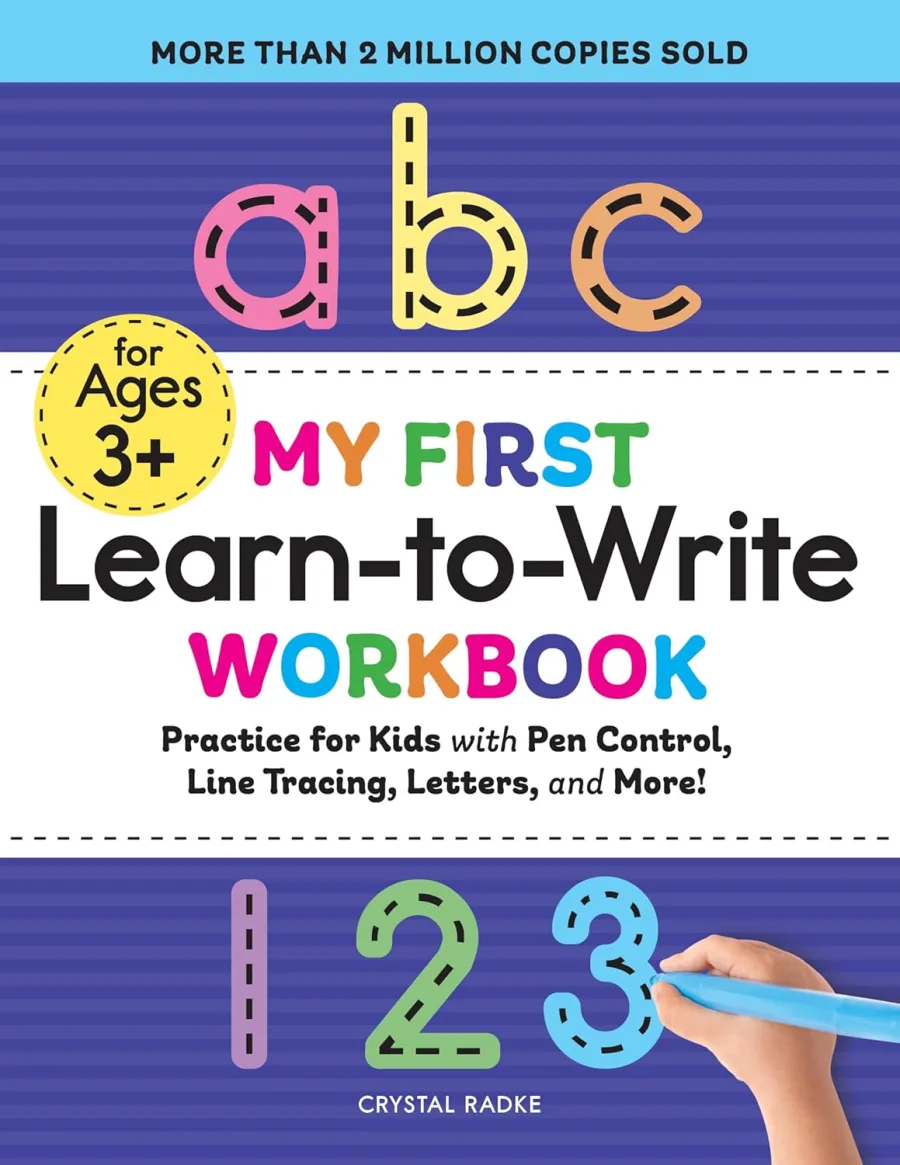
My First Learn-to-Write Workbook: Practice for Kids with Pen Control, Line Tracing, Letters
Paperback
• 84 Pages
• USD 8.99
• English
• 9781641526272
No ratings yet
| Publisher | Callisto Kids |
|---|---|
| ISBN13 | 9781641526272 |
| ASIN/SKU | 1641526270 |
| Book Format | Paperback |
| Language | English |
| Pages | 84 |
| List Price | USD 8.99 |
| Publishing Date | 27/08/2019 |
| Dimensions | 8.5 x 0.2 x 11 inches |
| Weight | 2.31 pounds |
| Book Code | BD00055925 |
Buy this Book
Amazon Stores
Ebook Stores
Other Stores
Discover My First Learn-to-Write Workbook: Practice for Kids with Pen Control, Line Tracing, Letters by Crystal Radke. This book is published by Callisto Kids in Paperback format, ISBN 9781641526272, ASIN 1641526270, under Children's Books, Language Arts Teaching Materials, Children's Handwriting Books.
Book Description
Help your little one build communication skills with the ultimate writing workbook for kids ages 3 to 5. More than 1 million copies sold!
Set kids up to succeed in school with a guide that offers letter, shape, and number practice for kindergarten―and beyond. My First Learn-to-Write Workbook introduces early writers to proper pen control, line tracing, and more with dozens of handwriting exercises that engage their minds and boost their reading and writing comprehension.
Get the best in summer learning workbooks for kids with:
Comprehensive skill-building―As they explore these preschool and kindergarten learning activities, kids will build a strong foundation of reading comprehension, the alphabet, penmanship, and fine motor skills.
75+ practice pages―Tons of engaging pencil-on-paper activities like connect-the-dots and fill-in-the-blanks offer enough repetition for real learning but enough variety to keep kids interested.
Colorful fun―This preschool summer workbook is full of helpful (and slightly silly) pictures and illustrations that will spark kids' imaginations and get them excited to keep practicing.
Get your child on the path to success the summer before kindergarten with activities that help them develop essential skills!
Set kids up to succeed in school with a guide that offers letter, shape, and number practice for kindergarten―and beyond. My First Learn-to-Write Workbook introduces early writers to proper pen control, line tracing, and more with dozens of handwriting exercises that engage their minds and boost their reading and writing comprehension.
Get the best in summer learning workbooks for kids with:
Comprehensive skill-building―As they explore these preschool and kindergarten learning activities, kids will build a strong foundation of reading comprehension, the alphabet, penmanship, and fine motor skills.
75+ practice pages―Tons of engaging pencil-on-paper activities like connect-the-dots and fill-in-the-blanks offer enough repetition for real learning but enough variety to keep kids interested.
Colorful fun―This preschool summer workbook is full of helpful (and slightly silly) pictures and illustrations that will spark kids' imaginations and get them excited to keep practicing.
Get your child on the path to success the summer before kindergarten with activities that help them develop essential skills!
Author Biography
CRYSTAL RADKE is a bestselling author, educational leader, and public speaker. After spending time as a kindergarten teacher, she began her consultant business where she mentors early childhood educators by providing inspirational keynotes and powerful professional development.
Editorial Reviews
"In an era where we are less focused on writing and more focused on typing, Crystal provides a fantastic resource for young children who are learning how to write. This book provides the exercises necessary to get a strong start in letter and number formation and introduces children to shapes, numbers, and letters in a fun and engaging way."―Melissa Middlebrook, Classical home educator
"I love this book. The format of the book―going from strokes to shapes to letters―is perfect for kids' development. Parents and teachers alike would benefit from this book to help their children with fine motor skills and handwriting!"―Kaci Hoffer of Mrs. Hoffer's Spot
"Preschoolers benefit from daily experiences that support the development of fine motor skills in their hands and fingers. Crystal guides you step-by-step through the sequence of pre-writing skills your child needs to be successful."―Vanessa Levin, Early Childhood Educator and Consultant, and Creator of pre-kpages.com
"I love this book. The format of the book―going from strokes to shapes to letters―is perfect for kids' development. Parents and teachers alike would benefit from this book to help their children with fine motor skills and handwriting!"―Kaci Hoffer of Mrs. Hoffer's Spot
"Preschoolers benefit from daily experiences that support the development of fine motor skills in their hands and fingers. Crystal guides you step-by-step through the sequence of pre-writing skills your child needs to be successful."―Vanessa Levin, Early Childhood Educator and Consultant, and Creator of pre-kpages.com
Book Summary
My First Learn-to-Write Workbook: Practice for Kids with Pen Control, Line Tracing, Letters, and More! by Crystal Radke is a friendly, activity-based workbook designed to help young children build the basic writing skills they need before they start formal handwriting. It is aimed mainly at preschoolers and kindergarten-age kids who are just beginning to hold a pencil correctly and understand how lines, shapes, and letters work. The tone of the book is encouraging and playful, so children feel like they are doing fun exercises rather than “schoolwork.” The focus is on gentle practice and repetition, helping kids gain confidence by mastering small steps: holding a pen, following lines, drawing shapes, and then eventually forming letters and simple words. The workbook is structured to move gradually from very simple tasks to more complex ones, so that children and parents can see clear progress over time.
The first part of the workbook concentrates on pen control and line tracing, which is the foundation for all later writing. Children are given pages with straight lines, curved lines, zigzags, waves, and patterns that they can trace. These tracing activities help them learn how to move their hand across the page with better control and how to follow a path from left to right, which is important for reading and writing later. Many of these lines are connected to simple pictures or playful themes to keep kids interested, such as tracing a road, a path, or decorative patterns. The goal here is not perfection but building muscle memory and confidence; children who struggle with fine motor skills can improve steadily by repeating these exercises. Parents or caregivers can easily sit with a child and encourage them as they trace, making it a shared learning moment.
After basic lines, the workbook moves into shapes and patterns, which are an important bridge between simple motion and forming actual letters. Kids practice tracing and sometimes copying circles, squares, triangles, spirals, and other easy shapes. These shapes closely resemble parts of letters—curved strokes, straight strokes, slanted lines—so this section quietly prepares them for the alphabet without jumping there too quickly. Many children enjoy this part because shapes are familiar and less intimidating than letters; they see it as drawing rather than writing. This also helps improve hand-eye coordination, visual tracking, and the ability to start and stop lines in the right places. Over time, children learn to control pressure, direction, and spacing, which are all important skills when they begin to write letters neatly.
Once pen control and shapes are introduced, the book starts guiding children into letter tracing, usually beginning with uppercase letters and then moving on to lowercase. Each letter typically appears with a large, clear model and dotted or dashed versions for the child to trace. Arrows or numbered steps show the correct stroke order, teaching kids how to form each letter from top to bottom and left to right instead of random scribbles. This helps prevent bad habits, like starting letters from the bottom or going in the wrong direction. The workbook often groups letters with similar shapes together, so kids can practice related movements (like straight-line letters or curved-line letters) in a sequence that feels natural. Alongside the letter forms, there are often simple images or words that begin with that letter to reinforce alphabet recognition and sound awareness.
As children grow more confident tracing letters, they are encouraged to try writing letters on their own within lightly guided spaces or lines. Instead of only tracing dotted outlines, they start writing inside provided boxes or on primary writing lines (with a top, middle, and bottom guideline). This helps them learn about letter size, placement, and consistency—skills that are crucial when they eventually write words and sentences. The workbook doesn’t expect perfection; it gives plenty of room for practice and mistakes. The idea is that repeated attempts allow children to slowly improve their letter shapes and spacing. Because the workbook is meant to be fun, many pages include little prompts or cheerful designs that make kids feel successful as they finish each section.
In addition to letters, the workbook often includes number tracing and basic early-writing activities, so children can get familiar with both letters and numbers together. Tracing numbers helps them recognize symbols they will use in counting and simple math, while also reinforcing the same fine motor skills used for letters. There may also be simple words or name-writing practice, encouraging kids to write something meaningful—like their own name—using the skills they’ve just learned. This connects the technical practice of tracing to real-life use, showing children that writing is not just an exercise but a way to communicate.
Crystal Radke designs the workbook to be parent and teacher-friendly as well. The pages are straightforward, uncluttered, and easy to photocopy or reuse if needed. Adults can easily see what each activity is meant to teach and can choose which sections to focus on depending on a child’s current level. For a child who still struggles to hold a pencil correctly, the early line-tracing and shape pages may be more appropriate; for a child who already recognizes the alphabet, the letter-tracing and simple word practice will be more useful. The book can be used at home as part of quiet playtime, or in a classroom as a supplement to early literacy and handwriting lessons.
Emotionally, the workbook aims to make early writing feel manageable and encouraging rather than frustrating. The tasks are bite-sized, and the progression is gentle enough that many children experience a sense of achievement after finishing a page. This is important for building a positive attitude toward learning. When kids see that they can trace lines, then shapes, then letters, they begin to believe that writing is something they can do, not something scary or too hard. That confidence is as important as the physical skill itself, because children who feel successful are more likely to keep practicing and improve more quickly.
Overall, My First Learn-to-Write Workbook is a practical, warm, and thoughtfully structured tool for helping young children take their first steps into handwriting. It combines playfulness with purposeful practice, guiding kids from simple lines to full letters in a way that feels natural and achievable. By focusing on pen control, tracing, and gradually introducing the alphabet and numbers, the workbook lays a solid foundation for later writing and school activities. It is not a storybook, but it tells a quiet story of progress: page by page, children see their own improvement and move from random scribbles to recognizable letters, learning not just how to write—but also how to enjoy the process of learning.
The first part of the workbook concentrates on pen control and line tracing, which is the foundation for all later writing. Children are given pages with straight lines, curved lines, zigzags, waves, and patterns that they can trace. These tracing activities help them learn how to move their hand across the page with better control and how to follow a path from left to right, which is important for reading and writing later. Many of these lines are connected to simple pictures or playful themes to keep kids interested, such as tracing a road, a path, or decorative patterns. The goal here is not perfection but building muscle memory and confidence; children who struggle with fine motor skills can improve steadily by repeating these exercises. Parents or caregivers can easily sit with a child and encourage them as they trace, making it a shared learning moment.
After basic lines, the workbook moves into shapes and patterns, which are an important bridge between simple motion and forming actual letters. Kids practice tracing and sometimes copying circles, squares, triangles, spirals, and other easy shapes. These shapes closely resemble parts of letters—curved strokes, straight strokes, slanted lines—so this section quietly prepares them for the alphabet without jumping there too quickly. Many children enjoy this part because shapes are familiar and less intimidating than letters; they see it as drawing rather than writing. This also helps improve hand-eye coordination, visual tracking, and the ability to start and stop lines in the right places. Over time, children learn to control pressure, direction, and spacing, which are all important skills when they begin to write letters neatly.
Once pen control and shapes are introduced, the book starts guiding children into letter tracing, usually beginning with uppercase letters and then moving on to lowercase. Each letter typically appears with a large, clear model and dotted or dashed versions for the child to trace. Arrows or numbered steps show the correct stroke order, teaching kids how to form each letter from top to bottom and left to right instead of random scribbles. This helps prevent bad habits, like starting letters from the bottom or going in the wrong direction. The workbook often groups letters with similar shapes together, so kids can practice related movements (like straight-line letters or curved-line letters) in a sequence that feels natural. Alongside the letter forms, there are often simple images or words that begin with that letter to reinforce alphabet recognition and sound awareness.
As children grow more confident tracing letters, they are encouraged to try writing letters on their own within lightly guided spaces or lines. Instead of only tracing dotted outlines, they start writing inside provided boxes or on primary writing lines (with a top, middle, and bottom guideline). This helps them learn about letter size, placement, and consistency—skills that are crucial when they eventually write words and sentences. The workbook doesn’t expect perfection; it gives plenty of room for practice and mistakes. The idea is that repeated attempts allow children to slowly improve their letter shapes and spacing. Because the workbook is meant to be fun, many pages include little prompts or cheerful designs that make kids feel successful as they finish each section.
In addition to letters, the workbook often includes number tracing and basic early-writing activities, so children can get familiar with both letters and numbers together. Tracing numbers helps them recognize symbols they will use in counting and simple math, while also reinforcing the same fine motor skills used for letters. There may also be simple words or name-writing practice, encouraging kids to write something meaningful—like their own name—using the skills they’ve just learned. This connects the technical practice of tracing to real-life use, showing children that writing is not just an exercise but a way to communicate.
Crystal Radke designs the workbook to be parent and teacher-friendly as well. The pages are straightforward, uncluttered, and easy to photocopy or reuse if needed. Adults can easily see what each activity is meant to teach and can choose which sections to focus on depending on a child’s current level. For a child who still struggles to hold a pencil correctly, the early line-tracing and shape pages may be more appropriate; for a child who already recognizes the alphabet, the letter-tracing and simple word practice will be more useful. The book can be used at home as part of quiet playtime, or in a classroom as a supplement to early literacy and handwriting lessons.
Emotionally, the workbook aims to make early writing feel manageable and encouraging rather than frustrating. The tasks are bite-sized, and the progression is gentle enough that many children experience a sense of achievement after finishing a page. This is important for building a positive attitude toward learning. When kids see that they can trace lines, then shapes, then letters, they begin to believe that writing is something they can do, not something scary or too hard. That confidence is as important as the physical skill itself, because children who feel successful are more likely to keep practicing and improve more quickly.
Overall, My First Learn-to-Write Workbook is a practical, warm, and thoughtfully structured tool for helping young children take their first steps into handwriting. It combines playfulness with purposeful practice, guiding kids from simple lines to full letters in a way that feels natural and achievable. By focusing on pen control, tracing, and gradually introducing the alphabet and numbers, the workbook lays a solid foundation for later writing and school activities. It is not a storybook, but it tells a quiet story of progress: page by page, children see their own improvement and move from random scribbles to recognizable letters, learning not just how to write—but also how to enjoy the process of learning.
Sample Chapters
Sample Chapters will be added soon…
Reader Reviews
No reviews yet.
My First Learn-to-Write Workbook: Practice for Kids with Pen Control, Line Tracing, Letters
Download Cover Image
Do you want to download the full cover image for My First Learn-to-Write Workbook: Practice for Kids with Pen Control, Line Tracing, Letters?