
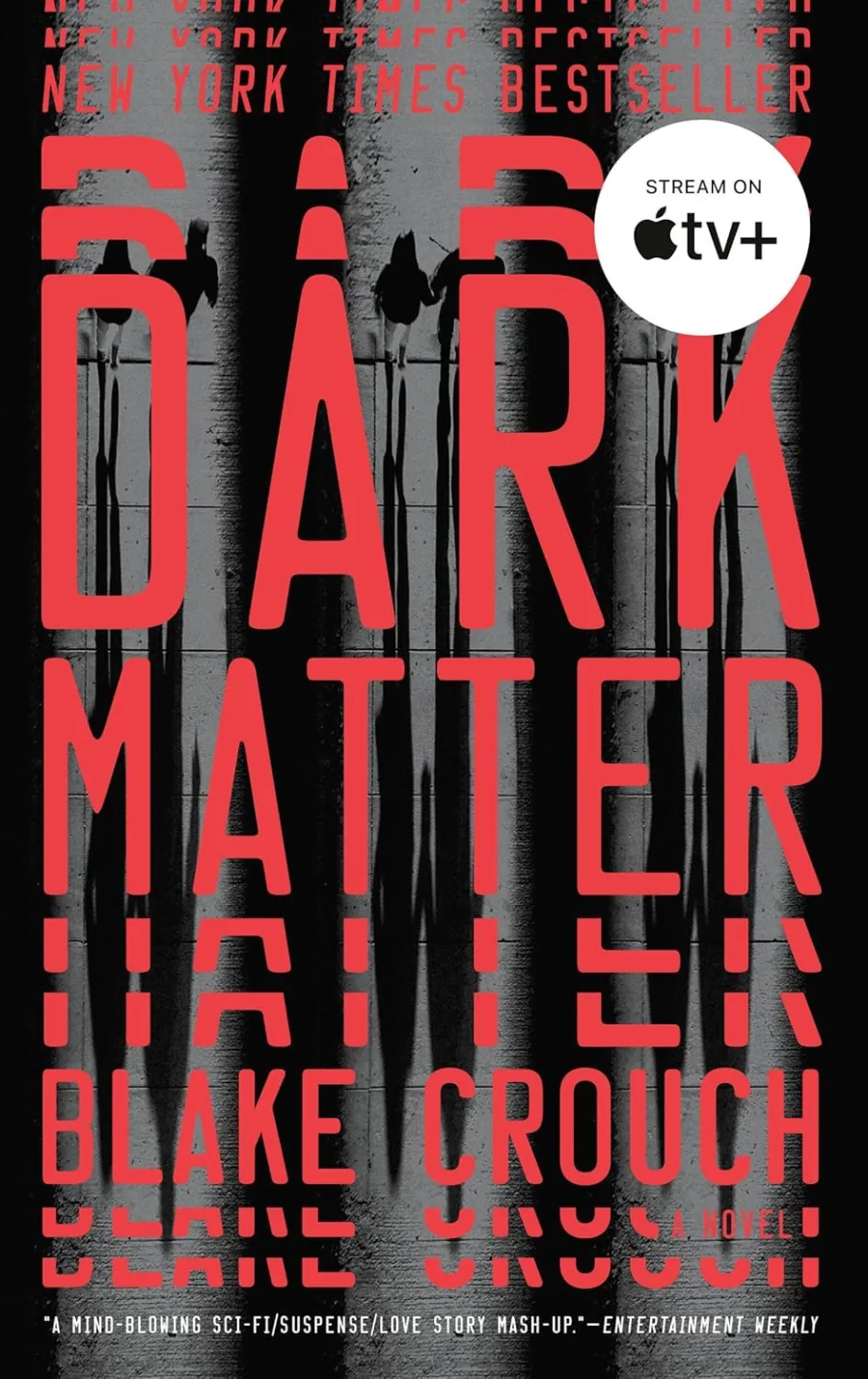
Dark Matter: A Novel
Paperback
• 368 Pages
• USD 20.00
• English
• 9781101904244
No ratings yet
| Publisher | Ballantine Books |
|---|---|
| ISBN13 | 9781101904244 |
| ASIN/SKU | 1101904240 |
| Book Format | Paperback |
| Language | English |
| Pages | 368 |
| List Price | USD 20.00 |
| Publishing Date | 02/05/2017 |
| Dimensions | 5.2 x 0.8 x 8 inches |
| Weight | 2.31 pounds |
| Book Code | BD00055930 |
Buy this Book
Amazon Stores
Ebook Stores
Other Stores
Discover Dark Matter: A Novel by Blake Crouch. This book is published by Ballantine Books in Paperback format, ISBN 9781101904244, ASIN 1101904240, under Science Fiction and Fantasy, Technothrillers, Science Fiction Short Stories.
Book Description
NEW YORK TIMES BESTSELLER • OVER ONE MILLION COPIES SOLD! • SEASON 2 STREAMING ON APPLE TV+ STARTING AUGUST 28
A “mind-blowing” (Entertainment Weekly) speculative thriller about an ordinary man who awakens in a world inexplicably different from the reality he thought he knew—from the author of Upgrade, Recursion, and the Wayward Pines trilogy
“Are you happy with your life?”
Those are the last words Jason Dessen hears before the kidnapper knocks him unconscious.
Before he awakens to find himself strapped to a gurney, surrounded by strangers in hazmat suits.
Before a man he’s never met smiles down at him and says, “Welcome back, my friend.”
In this world he’s woken up to, Jason’s life is not the one he knows. His wife is not his wife. His son was never born. And Jason is not an ordinary college professor but a celebrated genius who has achieved something remarkable. Something impossible.
Is it this life or the other that’s the dream? And even if the home he remembers is real, how will Jason make it back to the family he loves?
From the bestselling author Blake Crouch, Dark Matter is a mind-bending thriller about choices, paths not taken, and how far we’ll go to claim the lives we dream of.
A “mind-blowing” (Entertainment Weekly) speculative thriller about an ordinary man who awakens in a world inexplicably different from the reality he thought he knew—from the author of Upgrade, Recursion, and the Wayward Pines trilogy
“Are you happy with your life?”
Those are the last words Jason Dessen hears before the kidnapper knocks him unconscious.
Before he awakens to find himself strapped to a gurney, surrounded by strangers in hazmat suits.
Before a man he’s never met smiles down at him and says, “Welcome back, my friend.”
In this world he’s woken up to, Jason’s life is not the one he knows. His wife is not his wife. His son was never born. And Jason is not an ordinary college professor but a celebrated genius who has achieved something remarkable. Something impossible.
Is it this life or the other that’s the dream? And even if the home he remembers is real, how will Jason make it back to the family he loves?
From the bestselling author Blake Crouch, Dark Matter is a mind-bending thriller about choices, paths not taken, and how far we’ll go to claim the lives we dream of.
Author Biography
Blake Crouch is a bestselling novelist and screenwriter. His novels include Upgrade, Recursion, Dark Matter, and the Wayward Pines trilogy, which was adapted into a television series for FOX. Crouch also co-created the TNT show Good Behavior, based on his Letty Dobesh novellas. He lives in Colorado.
Editorial Reviews
“The most helter-skelter, race-to-the-finish-line thriller you’ll read all year, with a clever, mind-boggling final twist.”—The Guardian
“Relatable and unnerving . . . makes its characters—and readers—wonder what life would have been like had they made different decisions.”—USA Today
“A portal into other dimensions of reality . . . you’ll gulp it down in one afternoon, or more likely one night.”—The New York Times Book Review
“A mind-blowing sci-fi/suspense/love-story mash-up.”—Entertainment Weekly
“A fast, tasty read with a killer twist. It’s a whole bag of barbecue chips . . . just sitting there waiting for you to devour in one long rush.”—NPR
“A dazzling book . . . [with] a mind-bending premise, a head-spinning plot that’s dialogue-driven and adrenaline-fueled, and a gut-wrenching climax that gave me goose bumps.”—Minneapolis Star-Tribune
“Draws on questions and anxieties we all wrestle with in the dark hours . . . Crouch has invested [sci-fi motifs] with scientific plausibility, and more unusually, with emotional depth."—The Wall Street Journal
“[A] mind-blowing speculative-science thriller that throws in an old-fashioned love story for good measure.”—Fort Worth Star-Telegram
“A pacy, action-driven SF thriller . . . terse prose, strong characterisation and clever twists make for a quick, smart, engrossing read.”—Financial Times
“A high-tension thriller . . . always engaging and frequently moving. A strong piece of summertime get-away reading, perfect for those times when the mind wanders to contemplate an alternate reality of endless vacation.”—San Francisco Chronicle
“A mind-bending odyssey of parallel worlds and causality [that] unfolds with all the suspense and strength of a more straightforward thriller, building up to a deliciously surreal climax…memorable and well-rounded characters add a big, beating heart to the tale.”—New York Journal of Books
“Brilliant. A book to remember. I think Blake Crouch just invented something new.”—Lee Child, New York Times bestselling author of the Jack Reacher series
“Exceptional. An exciting, ingeniously plotted adventure about love, regret, and quantum superposition. It’s been a long time since a novel sucked me in and kept me turning pages the way this one did.”—Andy Weir, New York Times bestselling author of The Martian
“A masterful, truly original work of suspense. Crouch delivers laser-focused prose, a plot that melds science fiction and thriller to brilliant effect, and a touching, twisted love story that plays out in ways you'll never see coming. It all adds up to one hell of a ride.”—Harlan Coben, New York Times bestselling author of The Stranger
“Wow. I gulped down Dark Matter in one sitting and put it down awed and amazed by the ride. It's fast, smart, addictive—and the most creative, head-spinning novel I've read in ages. A truly remarkable thriller.”—Tess Gerritsen, New York Times bestselling author of the Rizzoli & Isles series
“A mind-bending thriller of the first order,
“Relatable and unnerving . . . makes its characters—and readers—wonder what life would have been like had they made different decisions.”—USA Today
“A portal into other dimensions of reality . . . you’ll gulp it down in one afternoon, or more likely one night.”—The New York Times Book Review
“A mind-blowing sci-fi/suspense/love-story mash-up.”—Entertainment Weekly
“A fast, tasty read with a killer twist. It’s a whole bag of barbecue chips . . . just sitting there waiting for you to devour in one long rush.”—NPR
“A dazzling book . . . [with] a mind-bending premise, a head-spinning plot that’s dialogue-driven and adrenaline-fueled, and a gut-wrenching climax that gave me goose bumps.”—Minneapolis Star-Tribune
“Draws on questions and anxieties we all wrestle with in the dark hours . . . Crouch has invested [sci-fi motifs] with scientific plausibility, and more unusually, with emotional depth."—The Wall Street Journal
“[A] mind-blowing speculative-science thriller that throws in an old-fashioned love story for good measure.”—Fort Worth Star-Telegram
“A pacy, action-driven SF thriller . . . terse prose, strong characterisation and clever twists make for a quick, smart, engrossing read.”—Financial Times
“A high-tension thriller . . . always engaging and frequently moving. A strong piece of summertime get-away reading, perfect for those times when the mind wanders to contemplate an alternate reality of endless vacation.”—San Francisco Chronicle
“A mind-bending odyssey of parallel worlds and causality [that] unfolds with all the suspense and strength of a more straightforward thriller, building up to a deliciously surreal climax…memorable and well-rounded characters add a big, beating heart to the tale.”—New York Journal of Books
“Brilliant. A book to remember. I think Blake Crouch just invented something new.”—Lee Child, New York Times bestselling author of the Jack Reacher series
“Exceptional. An exciting, ingeniously plotted adventure about love, regret, and quantum superposition. It’s been a long time since a novel sucked me in and kept me turning pages the way this one did.”—Andy Weir, New York Times bestselling author of The Martian
“A masterful, truly original work of suspense. Crouch delivers laser-focused prose, a plot that melds science fiction and thriller to brilliant effect, and a touching, twisted love story that plays out in ways you'll never see coming. It all adds up to one hell of a ride.”—Harlan Coben, New York Times bestselling author of The Stranger
“Wow. I gulped down Dark Matter in one sitting and put it down awed and amazed by the ride. It's fast, smart, addictive—and the most creative, head-spinning novel I've read in ages. A truly remarkable thriller.”—Tess Gerritsen, New York Times bestselling author of the Rizzoli & Isles series
“A mind-bending thriller of the first order,
Book Summary
Dark Matter: A Novel by Blake Crouch is a fast-paced, emotional science fiction thriller that asks a simple but unsettling question: what if you could see the life you might have lived if you’d made different choices—and what if that life tried to take yours away? The story follows Jason Dessen, a college physics professor in Chicago, who once had the talent and ambition to become a groundbreaking scientist. Years ago, he chose a different path: instead of pursuing a brilliant, high-risk career in theoretical physics, he settled into a quieter, more ordinary life—marrying his girlfriend Daniela, having a son, and trading big scientific dreams for stability, love, and family. He is mostly content, but there is a nagging sense of “what if” in the background, the feeling many people have that somewhere out there is a version of themselves who did something bigger.
One ordinary night, Jason goes out to buy ice cream and never makes it home. On his walk back, he is confronted by a masked man with a gun, forced into a car, driven to an abandoned building, and made to strip and hand over his clothes. The stranger seems to know him intimately, asking whether Jason is happy with his life, hinting that Jason wasted his potential. Jason is injected with something and loses consciousness. When he wakes up, everything is wrong. He is still Jason Dessen, but the world around him has changed: he is in a high-tech facility with people who treat him as a celebrated genius. His colleagues congratulate him on a breakthrough. He is praised for creating a revolutionary device—something called “the Box.” In this reality, he never married Daniela, never had his son Charlie, and instead became the brilliant scientist his younger self once imagined.
Slowly, Jason realizes that he has slipped from his own universe into an alternate one, where Jason Dessen made different choices. In this world, he stayed with his research, and the “Box” he designed is essentially a machine that opens the door to the multiverse—the countless possible realities branching out from every decision. The masked man who attacked him is another version of Jason, often called “Jason2” in readers’ minds: the version who rose to scientific fame but later regretted giving up the family life he never had. That other Jason discovered the ability to travel between universes and used it to steal the life he envied. The central twist is devastatingly simple: Jason has been replaced by himself—by a version who is more successful on paper but deeply unhappy.
From this point on, Dark Matter becomes both a mind-bending science thriller and an emotional quest. Jason is desperate to get back to his original world, to the wife and son he remembers with aching clarity. But the multiverse is not a clean set of labeled boxes he can step into and out of at will. Each trip using the Box throws him into a new reality, shaped by different choices and random events. He finds himself in versions of Chicago that are subtly or wildly altered: a city destroyed by a pandemic, a frozen wasteland, a world where his family’s situation is unrecognizable, a reality where he made darker choices. Each universe feels real, with its own history, culture, and dangers. Jason must navigate these endless possibilities, hoping that with enough care and intuition, he can find the one version of reality that matches the life he lost.
As Jason moves through these worlds, he becomes painfully aware of how fragile identity is. Each universe contains a Jason Dessen, more or less similar but shaped by circumstances. The Jason we follow is forced to ask what makes him truly “him”: his memories, his choices, his relationships. In many worlds, Daniela exists, but she is not always his wife. Sometimes she is successful as an artist; other times, her life has taken entirely different routes. Charlie, his son, may exist with different traits—or not at all. Jason’s journey is not just physical; it’s emotional and philosophical. Every reality he lands in reminds him how easily his entire life could have taken another path, and how much of what he cherishes is a delicate combination of luck and choice.
The science in the book, while simplified for readers, is rooted in the idea of quantum mechanics and infinite branching possibilities. Crouch uses the multiverse as a metaphor as much as a plot device. The Box doesn’t transport Jason in space; it moves him sideways into parallel versions of his own world, each one the result of different decisions. To navigate, Jason and those who use the Box must rely on intention, fear, and subconscious desire, which adds an eerie psychological element: where you end up can depend on what you truly want—or dread—deep down. That means Jason’s emotional state affects his journey, and finding his way home becomes not just a matter of coordinates, but of understanding himself.
One of the most intense parts of the story comes when Jason finally manages to get back to what seems like his original universe. He finds Daniela and Charlie, and the relief is overwhelming—but there is a horrific complication. Because of the nature of the multiverse, he is not the only Jason trying to return to that same “perfect” life. Other versions of Jason, spun off by different choices and realities, also discover that the world where Jason was happy with his family is better than what they have. Many of them are convinced they are the one who deserves that life. Suddenly, there are multiple Jasons converging on the same reality, each with the same memories up to a point, each claiming that Daniela and Charlie belong to him. This collision of selves turns the book from a private struggle into a chaotic, almost survival-horror scenario where Jason must prove—not just to his family, but to himself—that he is the original, or at least the one who will do anything to protect them.
Daniela’s role becomes crucial here. From her perspective, multiple versions of the same man appear, each insisting he is her husband. She must look beyond surface details and piece together which Jason feels like the man she built her life with: the small habits, the way he talks, the emotional history that cannot be fully copied. The family dynamic—trust, fear, and the possibility of choosing one reality over another—adds a deep emotional layer. Jason is forced to confront the dark side of the multiverse: if countless versions of him exist, what makes his claim to this life any more valid than theirs? There is no cosmic rule that says he is the “real one.” He has to rely on love, shared memory, and moral choice.
Throughout the book, Crouch keeps the tension high with chase scenes, desperate escapes, and close calls as Jason flees both enemies in other realities and other Jasons in his own. But beneath the suspense, the core of “Dark Matter” is surprisingly tender. Jason keeps returning, in his thoughts, to small, ordinary moments with his family—the warmth of dinner at home, the sound of his son’s laughter, his wife’s art, the comfortable mess of normal life. These memories are the anchor that keeps him sane amid the dizzying variety of possible worlds. The novel suggests that while grand achievements and success are tempting, it is the everyday intimacy of relationships that truly defines a meaningful life.
In the end, Dark Matter doesn’t try to resolve the multiverse with a neat scientific explanation. Instead, it resolves Jason’s personal journey. He must decide what he is willing to sacrifice to stay with Daniela and Charlie, and what kind of risk he can accept knowing that the multiverse is full of versions of him who will never have what he does. The conclusion is both thrilling and emotionally resonant, emphasizing choice, love, and the acceptance of the life you have. The book leaves readers thinking about their own “what ifs,” but also about the quiet miracle of the path actually taken—the version of reality where, despite lost dreams or imperfections, your connections and everyday joys are uniquely your own.
One ordinary night, Jason goes out to buy ice cream and never makes it home. On his walk back, he is confronted by a masked man with a gun, forced into a car, driven to an abandoned building, and made to strip and hand over his clothes. The stranger seems to know him intimately, asking whether Jason is happy with his life, hinting that Jason wasted his potential. Jason is injected with something and loses consciousness. When he wakes up, everything is wrong. He is still Jason Dessen, but the world around him has changed: he is in a high-tech facility with people who treat him as a celebrated genius. His colleagues congratulate him on a breakthrough. He is praised for creating a revolutionary device—something called “the Box.” In this reality, he never married Daniela, never had his son Charlie, and instead became the brilliant scientist his younger self once imagined.
Slowly, Jason realizes that he has slipped from his own universe into an alternate one, where Jason Dessen made different choices. In this world, he stayed with his research, and the “Box” he designed is essentially a machine that opens the door to the multiverse—the countless possible realities branching out from every decision. The masked man who attacked him is another version of Jason, often called “Jason2” in readers’ minds: the version who rose to scientific fame but later regretted giving up the family life he never had. That other Jason discovered the ability to travel between universes and used it to steal the life he envied. The central twist is devastatingly simple: Jason has been replaced by himself—by a version who is more successful on paper but deeply unhappy.
From this point on, Dark Matter becomes both a mind-bending science thriller and an emotional quest. Jason is desperate to get back to his original world, to the wife and son he remembers with aching clarity. But the multiverse is not a clean set of labeled boxes he can step into and out of at will. Each trip using the Box throws him into a new reality, shaped by different choices and random events. He finds himself in versions of Chicago that are subtly or wildly altered: a city destroyed by a pandemic, a frozen wasteland, a world where his family’s situation is unrecognizable, a reality where he made darker choices. Each universe feels real, with its own history, culture, and dangers. Jason must navigate these endless possibilities, hoping that with enough care and intuition, he can find the one version of reality that matches the life he lost.
As Jason moves through these worlds, he becomes painfully aware of how fragile identity is. Each universe contains a Jason Dessen, more or less similar but shaped by circumstances. The Jason we follow is forced to ask what makes him truly “him”: his memories, his choices, his relationships. In many worlds, Daniela exists, but she is not always his wife. Sometimes she is successful as an artist; other times, her life has taken entirely different routes. Charlie, his son, may exist with different traits—or not at all. Jason’s journey is not just physical; it’s emotional and philosophical. Every reality he lands in reminds him how easily his entire life could have taken another path, and how much of what he cherishes is a delicate combination of luck and choice.
The science in the book, while simplified for readers, is rooted in the idea of quantum mechanics and infinite branching possibilities. Crouch uses the multiverse as a metaphor as much as a plot device. The Box doesn’t transport Jason in space; it moves him sideways into parallel versions of his own world, each one the result of different decisions. To navigate, Jason and those who use the Box must rely on intention, fear, and subconscious desire, which adds an eerie psychological element: where you end up can depend on what you truly want—or dread—deep down. That means Jason’s emotional state affects his journey, and finding his way home becomes not just a matter of coordinates, but of understanding himself.
One of the most intense parts of the story comes when Jason finally manages to get back to what seems like his original universe. He finds Daniela and Charlie, and the relief is overwhelming—but there is a horrific complication. Because of the nature of the multiverse, he is not the only Jason trying to return to that same “perfect” life. Other versions of Jason, spun off by different choices and realities, also discover that the world where Jason was happy with his family is better than what they have. Many of them are convinced they are the one who deserves that life. Suddenly, there are multiple Jasons converging on the same reality, each with the same memories up to a point, each claiming that Daniela and Charlie belong to him. This collision of selves turns the book from a private struggle into a chaotic, almost survival-horror scenario where Jason must prove—not just to his family, but to himself—that he is the original, or at least the one who will do anything to protect them.
Daniela’s role becomes crucial here. From her perspective, multiple versions of the same man appear, each insisting he is her husband. She must look beyond surface details and piece together which Jason feels like the man she built her life with: the small habits, the way he talks, the emotional history that cannot be fully copied. The family dynamic—trust, fear, and the possibility of choosing one reality over another—adds a deep emotional layer. Jason is forced to confront the dark side of the multiverse: if countless versions of him exist, what makes his claim to this life any more valid than theirs? There is no cosmic rule that says he is the “real one.” He has to rely on love, shared memory, and moral choice.
Throughout the book, Crouch keeps the tension high with chase scenes, desperate escapes, and close calls as Jason flees both enemies in other realities and other Jasons in his own. But beneath the suspense, the core of “Dark Matter” is surprisingly tender. Jason keeps returning, in his thoughts, to small, ordinary moments with his family—the warmth of dinner at home, the sound of his son’s laughter, his wife’s art, the comfortable mess of normal life. These memories are the anchor that keeps him sane amid the dizzying variety of possible worlds. The novel suggests that while grand achievements and success are tempting, it is the everyday intimacy of relationships that truly defines a meaningful life.
In the end, Dark Matter doesn’t try to resolve the multiverse with a neat scientific explanation. Instead, it resolves Jason’s personal journey. He must decide what he is willing to sacrifice to stay with Daniela and Charlie, and what kind of risk he can accept knowing that the multiverse is full of versions of him who will never have what he does. The conclusion is both thrilling and emotionally resonant, emphasizing choice, love, and the acceptance of the life you have. The book leaves readers thinking about their own “what ifs,” but also about the quiet miracle of the path actually taken—the version of reality where, despite lost dreams or imperfections, your connections and everyday joys are uniquely your own.
Sample Chapters
Sample Chapters will be added soon…
Reader Reviews
No reviews yet.
Dark Matter: A Novel
Download Cover Image
Do you want to download the full cover image for Dark Matter: A Novel?