
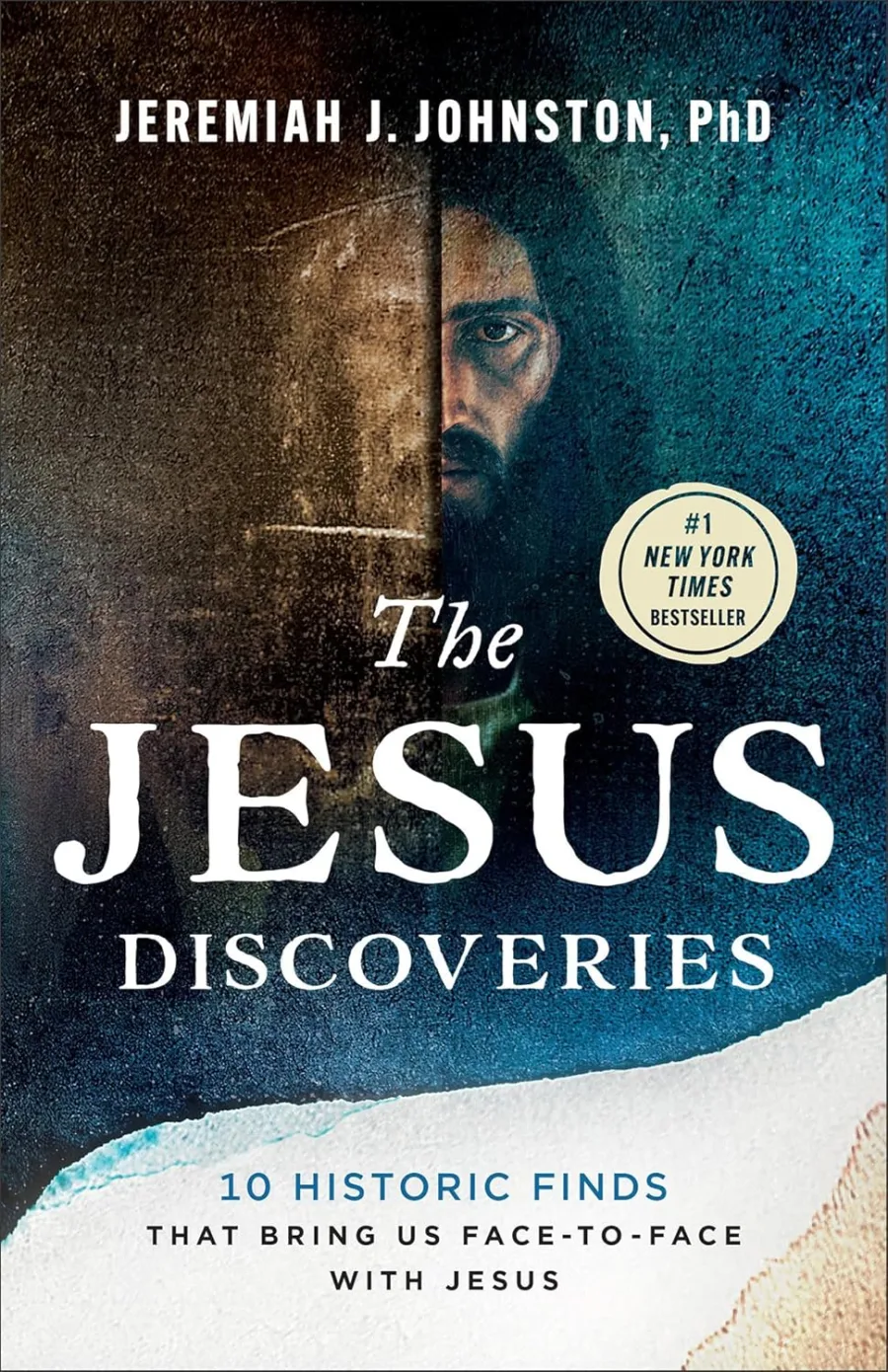
The Jesus Discoveries: 10 Historic Finds That Bring Us Face-to-Face with Jesus
Paperback
• 176 Pages
• USD 17.99
• English
• 9780764243660
No ratings yet
| Publisher | Bethany House Publishers |
|---|---|
| ISBN13 | 9780764243660 |
| ASIN/SKU | 0764243667 |
| Book Format | Paperback |
| Language | English |
| Pages | 176 |
| List Price | USD 17.99 |
| Publishing Date | 10/03/2026 |
| Dimensions | 5.5 x 0.4 x 8.5 inches |
| Weight | 7.2 ounces |
| Book Code | BD00055950 |
Buy this Book
Amazon Stores
Ebook Stores
Other Stores
Discover The Jesus Discoveries: 10 Historic Finds That Bring Us Face-to-Face with Jesus by Jeremiah J. Johnston. This book is published by Bethany House Publishers in Paperback format, ISBN 9780764243660, ASIN 0764243667, under Christian Books and Bibles, Christian Bible History and Culture, Christian Apologetics.
Book Description
Over 100,000 Copies Sold
#1 New York Times Bestseller
#1 Amazon Bestseller
USA Today Bestseller
Publishers Weekly Bestseller
10 Historic Finds That Support the Truth of Christianity
In an age of growing skepticism, many demand hard evidence before believing anything is true--especially when it comes to Jesus and the Bible. A kind of "artifacts or it didn't happen" attitude. Perhaps nowhere is this attitude more prevalent than when considering the claims of Christianity. The irony of this is that there are centuries of archaeological discoveries that support the narratives found in the Bible. Lost cities and civilizations, found. Lost art and technology, rediscovered. Lost documents, retrieved.
Okay, fine, the skeptic says. I'll give you cities and art. But what about Jesus? There's no actual evidence that he ever lived, right? Wrong.
In this eye-opening, faith-fortifying book from acclaimed New Testament scholar and minister Jeremiah Johnston, you'll encounter ten of the most compelling historic finds that corroborate the truth claims found in the Bible regarding who Jesus said he was, when and where He lived, His claims and aims, how His life ended, and how that wasn't the end of His story.
Far more than a tour of the past, The Jesus Discoveries connects His story with your story, perhaps in ways you've never before considered--revealing how Jesus's story changes your story.
● Explore compelling archeological discoveries that support the authenticity of the Bible, the resurrection of Jesus, and the reasonableness of Christianity
● Learn from an acclaimed biblical scholar and ministry leader
● Encounter evidence for Jesus, including the Shroud of Turin, the Magdalen Papyrus, the Dead Sea Scrolls, and more
#1 New York Times Bestseller
#1 Amazon Bestseller
USA Today Bestseller
Publishers Weekly Bestseller
10 Historic Finds That Support the Truth of Christianity
In an age of growing skepticism, many demand hard evidence before believing anything is true--especially when it comes to Jesus and the Bible. A kind of "artifacts or it didn't happen" attitude. Perhaps nowhere is this attitude more prevalent than when considering the claims of Christianity. The irony of this is that there are centuries of archaeological discoveries that support the narratives found in the Bible. Lost cities and civilizations, found. Lost art and technology, rediscovered. Lost documents, retrieved.
Okay, fine, the skeptic says. I'll give you cities and art. But what about Jesus? There's no actual evidence that he ever lived, right? Wrong.
In this eye-opening, faith-fortifying book from acclaimed New Testament scholar and minister Jeremiah Johnston, you'll encounter ten of the most compelling historic finds that corroborate the truth claims found in the Bible regarding who Jesus said he was, when and where He lived, His claims and aims, how His life ended, and how that wasn't the end of His story.
Far more than a tour of the past, The Jesus Discoveries connects His story with your story, perhaps in ways you've never before considered--revealing how Jesus's story changes your story.
● Explore compelling archeological discoveries that support the authenticity of the Bible, the resurrection of Jesus, and the reasonableness of Christianity
● Learn from an acclaimed biblical scholar and ministry leader
● Encounter evidence for Jesus, including the Shroud of Turin, the Magdalen Papyrus, the Dead Sea Scrolls, and more
Author Biography
Hi, I am Jeremiah, and I am honored to have you stop by my author central page. I live at the intersection of the scholarly and popular worlds; therefore, I have a passion for teaching and inspiring people like you to own your faith and to engage confidently with the world around you.
Dr. Jeremiah J. Johnston is a New Testament scholar, professor, apologist, and regular speaker on university campuses, churches, and conferences. His passion is equipping Christians to give intellectually informed accounts of what they believe. Dr. Johnston completed his doctoral residency in Oxford in partnership with Oxford Centre for Mission Studies and received his Ph.D. from Middlesex University (United Kingdom), with commendation. He has Masters Degrees from Acadia University (Canada) and Midwestern Baptist Theological Seminary (US). He has lectured throughout the United States, Canada, and the United Kingdom.
Dr. Johnston serves as the founder and president of Christian Thinkers Society, a resident institute at Houston Baptist University, where he also serves as associate professor of Early Christianity. Christian Thinkers Society produces live events, media productions, conferences, and publications to teach pastors and Christians to become thinkers, and thinkers to become Christians.
In addition to his popular publications, Dr. Johnston has distinguished himself with publications in scholarly, refereed journals and serials. These include entries in Oxford University Press and E. J. Brill reference works. He specializes in Christian origins, Jesus and the Gospels, and topics, especially apologetics, that closely relate to Jesus and the Gospels. These include: the resurrection of Jesus, New Testament manuscripts (their number, nature, and reliability), extra-canonical gospels, resurrection, and afterlife beliefs. He has presented academic papers at learned meetings and has examined ancient texts (papyri, codices, and the like) at renowned libraries, such as the Griffith Papyrology Room of Oxford University's Bodleian Library and the Beinecke Rare Book and Manuscript Library of Yale University. Dr. Johnston co-edits an academic series for Bloomsbury T&T Clark and is currently preparing a volume on Jesus in Cambridge University Press's distinguished "In Context" series.
For more information,
visit www.ChristianThinkers.com.
Connect with Jeremiah at:
Twitter: @_JeremiahJ
Instagram: @_JeremiahJ
Facebook: www.Facebook.com/ChristianThinkersSociety
Dr. Jeremiah J. Johnston is a New Testament scholar, professor, apologist, and regular speaker on university campuses, churches, and conferences. His passion is equipping Christians to give intellectually informed accounts of what they believe. Dr. Johnston completed his doctoral residency in Oxford in partnership with Oxford Centre for Mission Studies and received his Ph.D. from Middlesex University (United Kingdom), with commendation. He has Masters Degrees from Acadia University (Canada) and Midwestern Baptist Theological Seminary (US). He has lectured throughout the United States, Canada, and the United Kingdom.
Dr. Johnston serves as the founder and president of Christian Thinkers Society, a resident institute at Houston Baptist University, where he also serves as associate professor of Early Christianity. Christian Thinkers Society produces live events, media productions, conferences, and publications to teach pastors and Christians to become thinkers, and thinkers to become Christians.
In addition to his popular publications, Dr. Johnston has distinguished himself with publications in scholarly, refereed journals and serials. These include entries in Oxford University Press and E. J. Brill reference works. He specializes in Christian origins, Jesus and the Gospels, and topics, especially apologetics, that closely relate to Jesus and the Gospels. These include: the resurrection of Jesus, New Testament manuscripts (their number, nature, and reliability), extra-canonical gospels, resurrection, and afterlife beliefs. He has presented academic papers at learned meetings and has examined ancient texts (papyri, codices, and the like) at renowned libraries, such as the Griffith Papyrology Room of Oxford University's Bodleian Library and the Beinecke Rare Book and Manuscript Library of Yale University. Dr. Johnston co-edits an academic series for Bloomsbury T&T Clark and is currently preparing a volume on Jesus in Cambridge University Press's distinguished "In Context" series.
For more information,
visit www.ChristianThinkers.com.
Connect with Jeremiah at:
Twitter: @_JeremiahJ
Instagram: @_JeremiahJ
Facebook: www.Facebook.com/ChristianThinkersSociety
Editorial Reviews
Editorial Reviews will be added soon…
Book Summary
The Jesus Discoveries: 10 Historic Finds That Bring Us Face-to-Face with Jesus by Jeremiah J. Johnston is a Christian apologetics and historical investigation book that explores archaeological discoveries, ancient manuscripts, inscriptions, artifacts, and other historical evidence connected with the world of Jesus and the earliest Christian movement. Johnston's purpose is not to claim that archaeology can scientifically prove every Christian doctrine, but to show how discoveries from the ancient world can illuminate the historical setting of Jesus, the New Testament, and the first Christians. The book is particularly relevant for readers searching for The Jesus Discoveries summary, Jeremiah J. Johnston's evidence for Jesus, archaeological evidence for Christianity, historical evidence for Jesus Christ, New Testament archaeology, or archaeological discoveries related to the Bible. Through ten discoveries, Johnston seeks to bring readers closer to the historical environment in which Jesus lived, taught, died, and was proclaimed risen.
The central idea behind The Jesus Discoveries is that Christianity is deeply connected to real places, real people, real political circumstances, and real history. Christianity is not presented merely as a collection of timeless spiritual teachings detached from the ancient world. The Christian faith makes historical claims about Jesus of Nazareth: that He lived in first-century Judea, gathered disciples, taught publicly, was executed under Pontius Pilate, and that His followers soon afterward proclaimed that He had risen from the dead. Because these claims concern history, Johnston argues that archaeological and documentary evidence can help readers understand the world in which those events occurred. Archaeology does not answer every theological question, but it can provide important context and sometimes confirm details about the people, locations, customs, and institutions mentioned in ancient sources.
Johnston approaches the subject with the enthusiasm of an investigator. Instead of beginning with abstract theological arguments, he takes readers into the physical world surrounding the New Testament. Stones, inscriptions, ancient buildings, burial sites, manuscripts, coins, and other remains become windows into the past. These discoveries can make familiar Gospel stories feel less distant. A name that appears in an ancient inscription, for example, can remind readers that biblical characters belonged to a recognizable historical society rather than an imaginary world. A surviving structure or archaeological site can illuminate the social and political circumstances behind a passage of Scripture.
One of the book's recurring themes is the importance of Pontius Pilate, the Roman governor associated with Jesus's crucifixion. The Gospel accounts place Jesus's execution within the Roman administration of Judea, and the discovery of the so-called Pilate Stone provides tangible evidence for the historical existence and official position of Pontius Pilate. The inscription, discovered at Caesarea Maritima, identifies Pilate and connects him with his Roman administrative role. For Johnston, discoveries like this matter because they place a major figure in the Passion narrative within the documented historical landscape of first-century Judea. The stone does not prove the resurrection or every detail of the Gospels, but it reinforces the reality of the political world in which the crucifixion took place.
Another important dimension of Johnston's investigation concerns Jewish religious life and the Temple in Jerusalem. The Temple was central to Jewish identity, worship, and political life during the time of Jesus. Archaeological remains and inscriptions help modern readers understand how significant this institution was. Jesus's actions and teachings concerning the Temple therefore become more meaningful when viewed against this historical background. The Gospels describe Jesus teaching in and around the Temple, confronting religious leaders, and speaking about its future destruction. Archaeology provides a way to visualize the monumental environment that stood at the center of first-century Jewish life.
The book also examines discoveries that illuminate the practice of crucifixion. For many modern readers, crucifixion is familiar primarily as a theological symbol. Archaeology, however, demonstrates aspects of the physical practice used by the Romans. Discoveries associated with crucifixion help historians understand the brutality and public nature of Roman execution. This historical context gives greater weight to the Gospel accounts of Jesus's death. Johnston uses such evidence to reinforce the point that the crucifixion was not a symbolic story invented without reference to ancient practices. Jesus's death occurred within a known Roman system of punishment.
Another area of interest is burial and Jewish funerary practice. The Gospels contain references to tombs, burial customs, spices, and the treatment of the dead. Archaeological discoveries of first-century Jewish tombs and ossuaries provide context for these descriptions. Understanding how bodies were buried and how tombs were structured helps readers appreciate the Gospel narratives concerning Jesus's burial and the later claim that His tomb was empty. Archaeology cannot independently demonstrate that Jesus's body disappeared through resurrection, but it can help establish whether the burial practices described in the Gospels fit what is known about the period.
Johnston also explores the world of first-century Galilee, where Jesus spent much of His life and ministry. Discoveries from places associated with Galilean life reveal a society shaped by Jewish religious traditions, agriculture, fishing, trade, Roman political influence, and local communities. Understanding this environment helps readers interpret Jesus's teaching more accurately. References to fishing, farming, taxation, villages, synagogues, roads, and Roman authority are not abstract details. They belong to a recognizable world that archaeology continues to uncover.
The historical evidence surrounding Nazareth is particularly relevant because some critics have questioned whether Nazareth was a significant or even genuine settlement during Jesus's lifetime. Archaeological research has provided evidence for habitation in the area during the relevant period. This does not establish every detail of Jesus's childhood, but it challenges the idea that the Gospel writers simply invented a nonexistent hometown. Johnston uses such evidence to demonstrate how archaeology can address questions that arise from the biblical text.
The book also gives attention to ancient manuscripts and early Christian writings. Although manuscript discoveries are not archaeological artifacts in the narrow sense, they are crucial to understanding how early Christian beliefs and writings were transmitted. The survival of early Christian documents and fragments allows scholars to compare textual traditions and study how the New Testament was copied and circulated. Johnston's larger point is that Christianity emerged within a world where texts were written, copied, preserved, discussed, and transmitted across communities. The documentary evidence therefore becomes another part of the historical investigation.
A major question running through the book is whether the New Testament's portrayal of Jesus is historically credible. Johnston recognizes that the Gospels are theological documents, but he argues that this does not automatically make them historically useless. Ancient biographies and historical writings often combined historical reporting with interpretation. The question is therefore whether the Gospel writers were drawing upon genuine traditions and whether their descriptions correspond with what is known about first-century Judea. Archaeological evidence can sometimes strengthen confidence in the geographical, cultural, and political framework presented by the Gospel accounts.
The book's discussion ultimately leads toward the most important Christian claim: the resurrection of Jesus. Johnston distinguishes between evidence that establishes historical background and evidence used to argue for the resurrection itself. An archaeological discovery cannot uncover a “resurrection artifact” proving that Jesus rose from the dead. Instead, the case must involve multiple categories of historical evidence, including early Christian testimony, the disciples' proclamation, the empty-tomb tradition, and the rapid emergence of the Christian movement. Archaeology contributes by demonstrating that the resurrection claim emerged within a specific historical environment rather than as a detached spiritual myth.
This distinction is important because it demonstrates one of the book's broader methodological points: evidence has limits. A responsible historical investigation should not claim that an artifact proves more than it actually does. A stone inscription can establish the existence of a person or institution; a building can illuminate a historical setting; a manuscript can demonstrate the early circulation of a text. None of these objects, by themselves, proves a theological doctrine. Johnston's argument is cumulative. When different kinds of evidence converge, they can make the historical framework of Christianity increasingly credible.
Another major theme is the relationship between faith and evidence. Johnston challenges the idea that Christian faith necessarily requires turning off one's intellect. He presents investigation as something compatible with belief. Christians can ask difficult questions about manuscripts, archaeology, historical sources, cultural context, and alternative explanations. In fact, Johnston suggests that asking these questions can deepen faith because it transforms vague assumptions into a more informed understanding of the historical foundations of Christianity.
For readers, the greatest value of The Jesus Discoveries is perhaps its ability to make the ancient world feel tangible. Jesus lived in a landscape of stone roads, crowded marketplaces, synagogues, fishing villages, Roman administration, Jewish religious institutions, burial caves, and monumental buildings. Archaeological discoveries allow modern readers to imagine this world with greater clarity. Instead of thinking about Jesus only as a distant religious figure, readers are encouraged to see Him within the physical and historical circumstances of first-century Judea.
Ultimately, the main message of The Jesus Discoveries is that the historical world of Jesus is accessible through evidence, and archaeology can significantly enrich our understanding of the Gospel story. Johnston argues that discoveries connected with ancient Judea, Roman rule, Jewish religious life, burial customs, first-century settlements, manuscripts, and early Christianity provide a valuable backdrop against which the claims about Jesus can be evaluated.
For readers searching for The Jesus Discoveries book summary, archaeological evidence for Jesus, historical evidence for Christianity, Jeremiah J. Johnston's apologetics, Bible archaeology, evidence supporting the New Testament, or historical discoveries related to Jesus Christ, the book offers an accessible introduction to the subject. Its greatest contribution is not the claim that one archaeological discovery proves Christianity, but the cumulative picture created when many pieces of historical evidence are placed together.
In the end, The Jesus Discoveries invites readers to look at Christianity through the lens of both history and faith. The discoveries Johnston discusses do not eliminate every question or settle every scholarly debate, but they help reconstruct the world in which Jesus lived and the early Christian message emerged. The result is a compelling invitation to investigate rather than merely assume. For believers, the discoveries can make familiar biblical accounts more concrete and historically vivid. For skeptics and seekers, they provide reasons to take the historical claims of Christianity seriously. Johnston's ultimate message is that Jesus belongs not only to theology and worship but also to the landscape of history—a figure whose life and influence emerged within a real ancient world that archaeology continues to uncover.
The central idea behind The Jesus Discoveries is that Christianity is deeply connected to real places, real people, real political circumstances, and real history. Christianity is not presented merely as a collection of timeless spiritual teachings detached from the ancient world. The Christian faith makes historical claims about Jesus of Nazareth: that He lived in first-century Judea, gathered disciples, taught publicly, was executed under Pontius Pilate, and that His followers soon afterward proclaimed that He had risen from the dead. Because these claims concern history, Johnston argues that archaeological and documentary evidence can help readers understand the world in which those events occurred. Archaeology does not answer every theological question, but it can provide important context and sometimes confirm details about the people, locations, customs, and institutions mentioned in ancient sources.
Johnston approaches the subject with the enthusiasm of an investigator. Instead of beginning with abstract theological arguments, he takes readers into the physical world surrounding the New Testament. Stones, inscriptions, ancient buildings, burial sites, manuscripts, coins, and other remains become windows into the past. These discoveries can make familiar Gospel stories feel less distant. A name that appears in an ancient inscription, for example, can remind readers that biblical characters belonged to a recognizable historical society rather than an imaginary world. A surviving structure or archaeological site can illuminate the social and political circumstances behind a passage of Scripture.
One of the book's recurring themes is the importance of Pontius Pilate, the Roman governor associated with Jesus's crucifixion. The Gospel accounts place Jesus's execution within the Roman administration of Judea, and the discovery of the so-called Pilate Stone provides tangible evidence for the historical existence and official position of Pontius Pilate. The inscription, discovered at Caesarea Maritima, identifies Pilate and connects him with his Roman administrative role. For Johnston, discoveries like this matter because they place a major figure in the Passion narrative within the documented historical landscape of first-century Judea. The stone does not prove the resurrection or every detail of the Gospels, but it reinforces the reality of the political world in which the crucifixion took place.
Another important dimension of Johnston's investigation concerns Jewish religious life and the Temple in Jerusalem. The Temple was central to Jewish identity, worship, and political life during the time of Jesus. Archaeological remains and inscriptions help modern readers understand how significant this institution was. Jesus's actions and teachings concerning the Temple therefore become more meaningful when viewed against this historical background. The Gospels describe Jesus teaching in and around the Temple, confronting religious leaders, and speaking about its future destruction. Archaeology provides a way to visualize the monumental environment that stood at the center of first-century Jewish life.
The book also examines discoveries that illuminate the practice of crucifixion. For many modern readers, crucifixion is familiar primarily as a theological symbol. Archaeology, however, demonstrates aspects of the physical practice used by the Romans. Discoveries associated with crucifixion help historians understand the brutality and public nature of Roman execution. This historical context gives greater weight to the Gospel accounts of Jesus's death. Johnston uses such evidence to reinforce the point that the crucifixion was not a symbolic story invented without reference to ancient practices. Jesus's death occurred within a known Roman system of punishment.
Another area of interest is burial and Jewish funerary practice. The Gospels contain references to tombs, burial customs, spices, and the treatment of the dead. Archaeological discoveries of first-century Jewish tombs and ossuaries provide context for these descriptions. Understanding how bodies were buried and how tombs were structured helps readers appreciate the Gospel narratives concerning Jesus's burial and the later claim that His tomb was empty. Archaeology cannot independently demonstrate that Jesus's body disappeared through resurrection, but it can help establish whether the burial practices described in the Gospels fit what is known about the period.
Johnston also explores the world of first-century Galilee, where Jesus spent much of His life and ministry. Discoveries from places associated with Galilean life reveal a society shaped by Jewish religious traditions, agriculture, fishing, trade, Roman political influence, and local communities. Understanding this environment helps readers interpret Jesus's teaching more accurately. References to fishing, farming, taxation, villages, synagogues, roads, and Roman authority are not abstract details. They belong to a recognizable world that archaeology continues to uncover.
The historical evidence surrounding Nazareth is particularly relevant because some critics have questioned whether Nazareth was a significant or even genuine settlement during Jesus's lifetime. Archaeological research has provided evidence for habitation in the area during the relevant period. This does not establish every detail of Jesus's childhood, but it challenges the idea that the Gospel writers simply invented a nonexistent hometown. Johnston uses such evidence to demonstrate how archaeology can address questions that arise from the biblical text.
The book also gives attention to ancient manuscripts and early Christian writings. Although manuscript discoveries are not archaeological artifacts in the narrow sense, they are crucial to understanding how early Christian beliefs and writings were transmitted. The survival of early Christian documents and fragments allows scholars to compare textual traditions and study how the New Testament was copied and circulated. Johnston's larger point is that Christianity emerged within a world where texts were written, copied, preserved, discussed, and transmitted across communities. The documentary evidence therefore becomes another part of the historical investigation.
A major question running through the book is whether the New Testament's portrayal of Jesus is historically credible. Johnston recognizes that the Gospels are theological documents, but he argues that this does not automatically make them historically useless. Ancient biographies and historical writings often combined historical reporting with interpretation. The question is therefore whether the Gospel writers were drawing upon genuine traditions and whether their descriptions correspond with what is known about first-century Judea. Archaeological evidence can sometimes strengthen confidence in the geographical, cultural, and political framework presented by the Gospel accounts.
The book's discussion ultimately leads toward the most important Christian claim: the resurrection of Jesus. Johnston distinguishes between evidence that establishes historical background and evidence used to argue for the resurrection itself. An archaeological discovery cannot uncover a “resurrection artifact” proving that Jesus rose from the dead. Instead, the case must involve multiple categories of historical evidence, including early Christian testimony, the disciples' proclamation, the empty-tomb tradition, and the rapid emergence of the Christian movement. Archaeology contributes by demonstrating that the resurrection claim emerged within a specific historical environment rather than as a detached spiritual myth.
This distinction is important because it demonstrates one of the book's broader methodological points: evidence has limits. A responsible historical investigation should not claim that an artifact proves more than it actually does. A stone inscription can establish the existence of a person or institution; a building can illuminate a historical setting; a manuscript can demonstrate the early circulation of a text. None of these objects, by themselves, proves a theological doctrine. Johnston's argument is cumulative. When different kinds of evidence converge, they can make the historical framework of Christianity increasingly credible.
Another major theme is the relationship between faith and evidence. Johnston challenges the idea that Christian faith necessarily requires turning off one's intellect. He presents investigation as something compatible with belief. Christians can ask difficult questions about manuscripts, archaeology, historical sources, cultural context, and alternative explanations. In fact, Johnston suggests that asking these questions can deepen faith because it transforms vague assumptions into a more informed understanding of the historical foundations of Christianity.
For readers, the greatest value of The Jesus Discoveries is perhaps its ability to make the ancient world feel tangible. Jesus lived in a landscape of stone roads, crowded marketplaces, synagogues, fishing villages, Roman administration, Jewish religious institutions, burial caves, and monumental buildings. Archaeological discoveries allow modern readers to imagine this world with greater clarity. Instead of thinking about Jesus only as a distant religious figure, readers are encouraged to see Him within the physical and historical circumstances of first-century Judea.
Ultimately, the main message of The Jesus Discoveries is that the historical world of Jesus is accessible through evidence, and archaeology can significantly enrich our understanding of the Gospel story. Johnston argues that discoveries connected with ancient Judea, Roman rule, Jewish religious life, burial customs, first-century settlements, manuscripts, and early Christianity provide a valuable backdrop against which the claims about Jesus can be evaluated.
For readers searching for The Jesus Discoveries book summary, archaeological evidence for Jesus, historical evidence for Christianity, Jeremiah J. Johnston's apologetics, Bible archaeology, evidence supporting the New Testament, or historical discoveries related to Jesus Christ, the book offers an accessible introduction to the subject. Its greatest contribution is not the claim that one archaeological discovery proves Christianity, but the cumulative picture created when many pieces of historical evidence are placed together.
In the end, The Jesus Discoveries invites readers to look at Christianity through the lens of both history and faith. The discoveries Johnston discusses do not eliminate every question or settle every scholarly debate, but they help reconstruct the world in which Jesus lived and the early Christian message emerged. The result is a compelling invitation to investigate rather than merely assume. For believers, the discoveries can make familiar biblical accounts more concrete and historically vivid. For skeptics and seekers, they provide reasons to take the historical claims of Christianity seriously. Johnston's ultimate message is that Jesus belongs not only to theology and worship but also to the landscape of history—a figure whose life and influence emerged within a real ancient world that archaeology continues to uncover.
Sample Chapters
Sample Chapters will be added soon…
Reader Reviews
No reviews yet.
The Jesus Discoveries: 10 Historic Finds That Bring Us Face-to-Face with Jesus
Download Cover Image
Do you want to download the full cover image for The Jesus Discoveries: 10 Historic Finds That Bring Us Face-to-Face with Jesus?